Rose Cultivation in India: Complete Guide to Profitable Rose Farming (2026)
Rose Farming in India: Complete Guide to Profitable Commercial Cultivation
Rose farming in India is emerging as a highly profitable agricultural activity, with farmers earning ₹10–15 lakh per acre when managed systematically. Whether you're a beginner starting small or a commercial farmer planning to scale, this guide covers everything from choosing the right varieties to managing key operational details.
What is Rose Cultivation?
Rose cultivation is the commercial farming of rose flowers for cut flower markets, value-added products, and export. Known as the "Queen of Flowers," roses (Family: Rosaceae) are grown across India, with Maharashtra, Tamil Nadu, and Karnataka leading production.
Commercial rose farming includes:
- Cut flowers for bouquets, decorations, and gifting
- Export-quality Dutch roses for international markets
The best part? You can start rose farming in both open fields and controlled polyhouse environments, making it accessible for farmers with different budgets and technical expertise.
Types of Roses in India: Choosing the Right Variety
The success of your rose cultivation depends heavily on selecting varieties that match your climate, market demand, and farming approach.
Commercial Rose Varieties
1. Hybrid Tea Roses — These premium varieties produce one large flower per stem, perfect for high-end bouquets and gifts. They're ideal for polyhouse cultivation where you can control temperature and humidity.
2. Dutch Roses (Export Quality) — Dutch roses have become a major part of commercial floriculture in India due to their consistent quality, vase life, and strong demand in export markets. Popular dutch rose varieties are:
- Top Secret (Red) — High demand for Valentine's Day and weddings
- Avalanche (White) — Export favorite for European markets
- Hot Shot (Pink) — Popular in domestic premium segment
- Gold Strike (Yellow) — Excellent for year-round production
- Jumelia (Bicolor) — Niche market with premium pricing
- Revival (Pink) — Strong disease resistance
3. Floribunda Roses — These produce clusters of smaller flowers on each stem, offering higher yield per plant. They're more forgiving for beginners and adapt well to open-field cultivation.
4. Spray Roses (Cut Flower Bouquets) — These multi-headed roses produce 3-5 smaller blooms per stem, making them perfect for mixed bouquets and floral arrangements. Spray roses are gaining popularity in Indian markets due to their versatility and higher stem count per plant.
Where Roses Are Grown In India
Roses are commercially grown in Maharashtra (Pune–Nashik belt), Karnataka (Bengaluru, Hosur), Tamil Nadu (Ooty, Kodaikanal), and parts of North India, with polyhouse cultivation preferred in plains and open-field or semi-protected systems in cooler regions.
Want to know if Roses can be grown in your region, contact Agriplast Team Now For A Free Advisory Call.
_1772187517_69a16f7d78c49.webp)
Choosing the right variety depends on market demand, climate adaptability, and vase life requirements
Climate and Soil Requirements for Rose Cultivation
Getting these basics right can make or break your rose farming venture. Here's what works in Indian conditions.
Climate Parameters
| Parameter | Optimal Range | Acceptable Range | Critical Range (Protect) |
|---|---|---|---|
| Day Temperature | 25-30°C | 20-35°C | <10°C or >35°C |
| Night Temperature | 15-18°C | 12-22°C | <10°C |
| Relative Humidity | 70-75% | 60-80% | <40% or >85% |
| Sunlight (Hours/Day) | 5-6 hours | 4-7 hours | <3 hours |
| Light Intensity | 40,000-60,000 lux | 30,000-70,000 lux | <20,000 lux |
| Rainfall | Moderate | — | Heavy continuous rain |
| Wind Speed | Gentle breeze | <15 km/hr | >30 km/hr |
Soil Requirements
- pH Level: Maintain soil pH between 5.5-6.5. This slightly acidic range ensures optimal nutrient absorption. Test your soil before planting and amend with organic matter if needed.
- Soil Type: Well-drained loamy soil works best. Avoid heavy clay that holds water—roses hate waterlogged conditions. If you have clayey soil, Agriplast recommends mixing 8,000 kg rice husk per acre to improve drainage and porosity.
- Electrical Conductivity (EC): Keep soil EC between 0.2-0.8 mS/cm. Higher salinity reduces nutrient uptake and stunts growth. Regular soil testing helps you catch problems early.
- Organic Matter: Healthy rose plants need rich organic soil. Apply per acre: 10,000 kg Farm Yard Manure (FYM), 2,500 kg Vermicompost, 1,500 kg Neem Cake, 8,000 kg Rice Husk (for porosity)
Production Technology of Rose: From Cutting to Planting
Understanding propagation is crucial for commercial success. Here are the proven methods used by successful rose farmers.
Propagation Methods
I-Budding (Most Common): This technique involves inserting a single bud from a desired variety into rootstock. It's the preferred method for commercial Dutch rose cultivation because:
- Cost-effective (₹7-8 per piece)
- Faster establishment (85-90% success rate)
- Uniform quality (Better disease resistance from strong rootstock)
Grafting: In grafting, a stem section is joined to rootstock. While more expensive (₹15-20 per plant), grafting offers:
- Stronger initial growth
- Better survival in challenging conditions
- Suitable for traditional rose varieties
Cuttings: Best for home gardeners and small-scale farmers. Take 20-25 cm cuttings from healthy mother plants, dip in rooting hormone (IBA 500 ppm), and plant in nursery beds. Success rate is 60-70% with proper care.
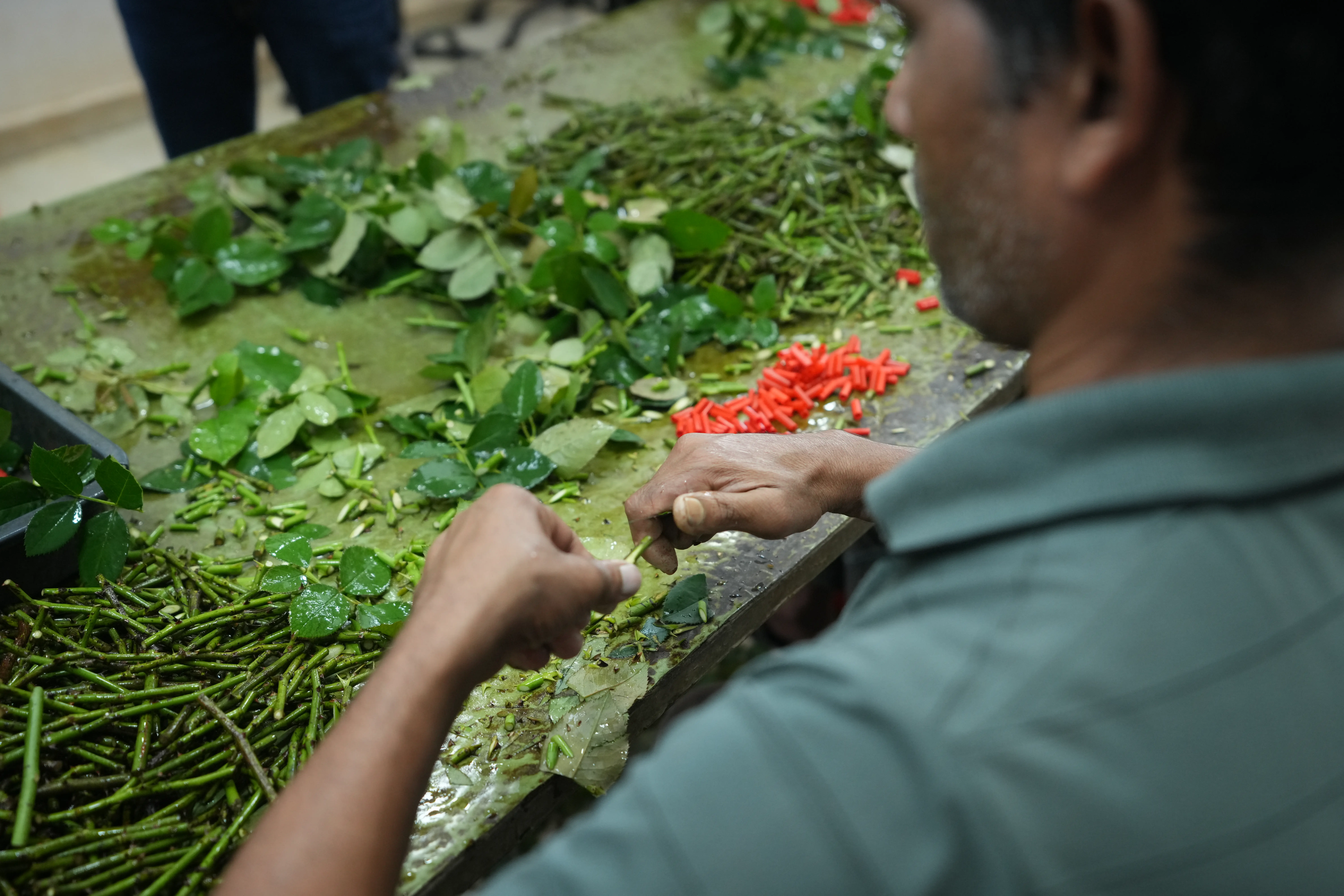
Professional grafting technique combines disease-resistant rootstock with premium varieties — success rate exceeds 85% with proper timing and technique
Nursery Management
For commercial planting, buy 5-6 week old budded plants from reliable sources. Agriplast recommends using root trainer trays (104 cavity) with dimensions 28.5x4 cm for uniform root development.
Plant Selection Checklist:
- Healthy green stems with no yellowing
- Well-developed root ball visible through pot
- 2-3 active growing points
- No signs of pest or disease damage
- Proper varietal labeling
Land Preparation: The Foundation of Success
Step 1: Deep Plowing — Cultivate soil to 40-45 cm depth. In heavy soils, go deeper to 60 cm. This breaks hardpan and allows deep root penetration.
Step 2: Apply Basal Doses (Per Acre)
| Material | Quantity per Acre | NPK Contribution | Primary Benefit |
|---|---|---|---|
| Farm Yard Manure (FYM) | 10,000 kg | Balanced nutrients | Improves soil structure, microbial activity |
| Vermicompost | 2,500 kg | Rich in humus | Slow-release nutrients, improves soil health |
| Neem Cake | 1,500 kg | Nitrogen boost | Pest control, organic matter |
| Rice Husk | 8,000 kg | Improves porosity | Better drainage, aeration |
| Single Super Phosphate (SSP) | 300 kg | 16% P₂O₅ | Root development, flowering |
| Magnesium Sulphate | 100 kg | 10% Mg, 13% S | Chlorophyll formation, enzyme activation |
| Biozyme Granules | 60 kg | Growth hormones | Plant vigor, stress tolerance |
| Micronutrient Mix | 40 kg | Zn, Fe, Mn, B, Cu | Prevents deficiencies |
| Trichoderma | 10 kg | Biological control | Protects against fungal diseases |
Step 3: Soil Solarization (Summer Only) — This critical step eliminates 90% of soil-borne diseases:
- Level the land after plowing
- Lay drip irrigation lines
- Cover with 30-micron transparent plastic sheet
- Run drip irrigation every 3-4 days for 3-4 weeks
- Heat kills fungal spores, nematodes, and weed seeds
Step 4: Prepare Raised Beds — For polyhouse cultivation, follow these exact dimensions:
- Bed height: 45 cm
- Top width: 90 cm
- Bottom width: 100 cm
- Pathway between beds: 65 cm
These measurements ensure proper drainage, air circulation, and comfortable harvesting height.
_1772187604_69a16fd4216a9.webp)
Raised beds with 1.2m width and 45cm plant spacing ensure optimal root development and worker access
Rose Plantation: Step-by-Step Guide
This is where your investment takes physical form. Follow these steps for 95%+ plant survival.
Best Planting Season
For Plains (Most of India): September-October is ideal, right after monsoon ends. Avoid planting during:
- Hot summer (March-May) — heat stress kills young plants
- Heavy monsoon (June-August) — excess water causes root rot
For Hill Stations: October-November or February-March work best. The earlier season gives plants more establishment time before summer.
Spacing and Plant Density
Your planting density directly impacts yield and disease management.
Open Field Cultivation:
- Plant-to-plant: 1 meter
- Row-to-row: 2 meters
- Density: 5,000 plants per acre
Polyhouse Cultivation (Agriplast Method):
- Plant-to-plant: 15-18 cm
- Row-to-row: 40 cm
- Two rows per bed
- Density: 30,000 plants per acre (7.5 plants/sq meter)
This intensive planting works in controlled environments because you can precisely manage nutrients, water, and pest control.
Planting Procedure
Step 1: Soil Treatment — Before planting, spray H2O2 (nano silver hydrogen peroxide 500ppm) at 30-35 ml per liter per sq meter. This prevents fungal and bacterial diseases. Wait 24 hours before planting.
Step 2: Transplanting — Plant in early morning or late evening
- Handle root balls gently—don't disturb roots
- Plant at same depth as nursery pot
- Firm soil around base (no air pockets)
- Water immediately after planting
- Maintain 80-90% humidity for first 2-3 weeks using mist systems in polyhouses
Polyhouse vs Open Field: When to Choose What
Choose Polyhouse If:
- You want export-quality Dutch roses
- You have access to drip irrigation and electricity
- You can invest ₹20-25 lakh per acre (with government subsidy)
Benefits of Polyhouse with Agriplast's UV-stabilized greenhouse films:
- Temperature control: Maintain 18-25°C year-round with proper ventilation
- Light transmission: 85-90% PAR light reaches plants while blocking harmful UV
- Weather protection: Shield flowers from hail, heavy rain, and strong winds
- Extended flowering: Get blooms even in off-season when prices are 2-3x higher
- Higher yield: 230 flowers per sq meter annually vs 150 in open field
Watch: How Mr. Raju Grows Premium Roses in His Agriplast Polyhouse
Hear directly from Mr. Raju as he shares how Agriplast's polyhouse setup transformed his rose farming — from variety selection and climate control to achieving consistent export-quality blooms year-round.
Choose Open Field If:
- You're starting with limited budget (₹2-3 lakh per acre)
- You have suitable climate (moderate temperatures, low wind)
- Your target is local flower markets
- You want to test rose farming before scaling up
Irrigation and Fertilization: The Growth Engine
Proper water and nutrient management separates successful rose farmers from struggling ones.
Drip Irrigation System
Roses need consistent moisture without waterlogging. Install drip system with:
- Two lines per bed: 20 cm apart
- Emitter spacing: 30 cm
- Flow rate: 1 liter per hour (lph)
Run drip daily in summer, alternate days in winter. Total water requirement: 1,500-2,000 liters per day per acre.
Fertigation Schedule
Use this proven NPK ratio throughout the growing season:
_1772187648_69a1700047b95.webp)
Follow this proven fertigation schedule for optimal Dutch rose growth — adjust NPK ratios based on growth stage and season
Mulching Benefits
Apply Agriplast's 25-micron mulching film on beds to:
- Reduce water requirement by 30-40%
- Suppress weed growth (saves 60% labor cost)
- Maintain consistent soil temperature
- Prevent soil splash on flowers during irrigation
- Improve fertilizer efficiency
Black mulch works best for rose cultivation as it blocks all light to weeds while allowing water and air penetration. Learn more about mulching in agriculture guide and plastic mulching in agriculture for comprehensive insights.
Intercultural Operations: Maintaining Plant Health
These routine practices determine your final flower quality and yield.
Bending Technique
Bending is critical for multi-stem production and higher yields:
First Bending: When plants are 30-40 days old
- Bend main stem at 45-degree angle
- Tie to support wire
- This forces lateral bud growth
Second Bending: After 50-60 days
- Bend secondary stems
- Maintains plant structure
- Ensures even light distribution
Proper bending can increase your total stem production by 40-50%.
Pruning
Light Pruning: Remove weak, diseased, or crossing branches
- Do this continuously as needed
- Maintains airflow and prevents diseases
Hard Pruning: Cut plants back to 30-40 cm height
- Done in October-November (plains)
- Forces strong new growth
- Apply Bordeaux paste on cut ends to prevent infection
Disbudding
For premium single-stem roses, remove side buds when they're pea-sized. This directs all energy to the terminal bud, creating larger, more perfect flowers.
Weed Management
Weeds compete for nutrients and harbor pests. Control them using:
- Mulching (Most effective method, 99% weed suppression)
- Manual weeding in pathways between beds
- Agriplast shade nets for pathway areas (durable, last 4-5 seasons) and weed mat for agriculture solutions
Avoid chemical herbicides in polyhouses as they can damage rose plants through volatilization.
_1772187735_69a170578b2af.webp)
Agriplast agronomist teaching rose bending technique in polyhouse which increases lateral shoot production by 30-40%, resulting in higher flower yield per plant
Pest & Disease Management Guide
| Pest/Disease | Key Symptoms | Favorable Conditions | Prevention | Control Measures |
|---|---|---|---|---|
| Spider Mites | Leaf stippling, webbing underneath | Hot, dry weather (>30°C) | Maintain 70% humidity, monitor regularly | Bio-pesticides, approved miticides when threshold reached |
| Thrips | Bud/petal scarring, brown tips | Warm, poor ventilation | Yellow sticky traps, good hygiene | Rotate approved controls |
| Whiteflies | Yellowing, sticky honeydew, sooty mold | Warm, humid conditions | Good ventilation, sanitation | Remove infested parts, selective sprays |
| Aphids | Clusters on shoots/buds | Cool weather (15-25°C) | Regular scouting | Physical removal, biologicals |
| Caterpillars | Leaf holes, visible larvae | Monsoon, overgrown plants | Weekly inspection | Manual removal, Bt spray if severe |
| Powdery Mildew | White powder on leaves | High humidity + poor airflow | Proper spacing, ventilation | Preventive fungicide program |
| Downy Mildew | Yellow spots, gray growth below | Cool (15-20°C) + high humidity | Control moisture, drip irrigation | Remove infected leaves, fungicides |
| Botrytis | Gray mold on flowers/stems | Dense canopy, >85% humidity | Air circulation, avoid wet foliage | Sanitation, preventive sprays |
Integrated Pest Management (IPM) Protocol
5-Point Strategy:
- Install 20-25 yellow sticky traps per acre
- Maintain proper spacing and ventilation
- Remove and destroy infected plant parts immediately
- Apply controls only at threshold levels
- Rotate products to prevent resistance
Harvesting Rose Flowers: Timing is Everything
Proper harvesting determines flower quality, vase life, and ultimately, your profit.
When to Start Harvesting
According to Agriplast's cultivation data, expect your first commercial harvest 100-120 days after planting. In polyhouse conditions, you'll get:
- Average yield: 230 flowers per sq meter per year
- Peak production: Months 6-18
- Expected harvests: 15-20 times per year
How to Harvest
First Cutting: Cut stem 8-10 inches (20-25 cm) from the base. This establishes the plant structure for future harvests.
Subsequent Cuttings: Harvest leaving 3-5 leaves on the remaining stem. These leaves feed the next flush of growth. Never cut below this point or you'll weaken the plant.
Best Time: Harvest early morning (5-7 AM) when flowers are:
- Turgid (full of water)
- Cool (better vase life)
- At "pencil stage" (sepals just opening, petals still tight)
Correct Bud Stage: Too tight — Won't open properly. Too open — Short vase life. Just right — Sepals reflexed, color visible but petals not separated.
Grading Standards
Professional grading increases your selling price by 30-50%:
Grade A (Premium):
- Stem length 60-70 cm
- Stem thickness >8 mm
- Bud size >5 cm
- No defects
Grade B (Standard):
- Stem length 50-60 cm
- Stem thickness 6-8 mm
- Bud size 4-5 cm
- Minor defects acceptable
Grade C (Local Market):
- Stem length 40-50 cm
- Any thickness
- Any bud size
- Visible defects
Post-Harvest Handling: Preserving Quality
What you do in the first hour after harvest determines shelf life.
Pre-Cooling
Immediately place cut stems in buckets with clean water mixed with floral preservative. Move to cold room at 3-4°C within 30 minutes. This stops respiration and extends vase life from 5-7 days to 10-14 days.
Grading and Bunching
Grade flowers by length and quality. Make bunches of:
- 10 stems for export quality (Grade A)
- 12 stems for premium domestic (Grade A/B)
- 20 stems for local markets (Grade C)
Secure with rubber bands, not thread which can cut stems.
Packing
Use corrugated boxes with:
- Proper ventilation holes
- Water source (wet foam or tubes)
- Tissue paper between layers
- Maximum 200-250 stems per box
Pack boxes within 4-6 hours of harvest for maximum freshness.
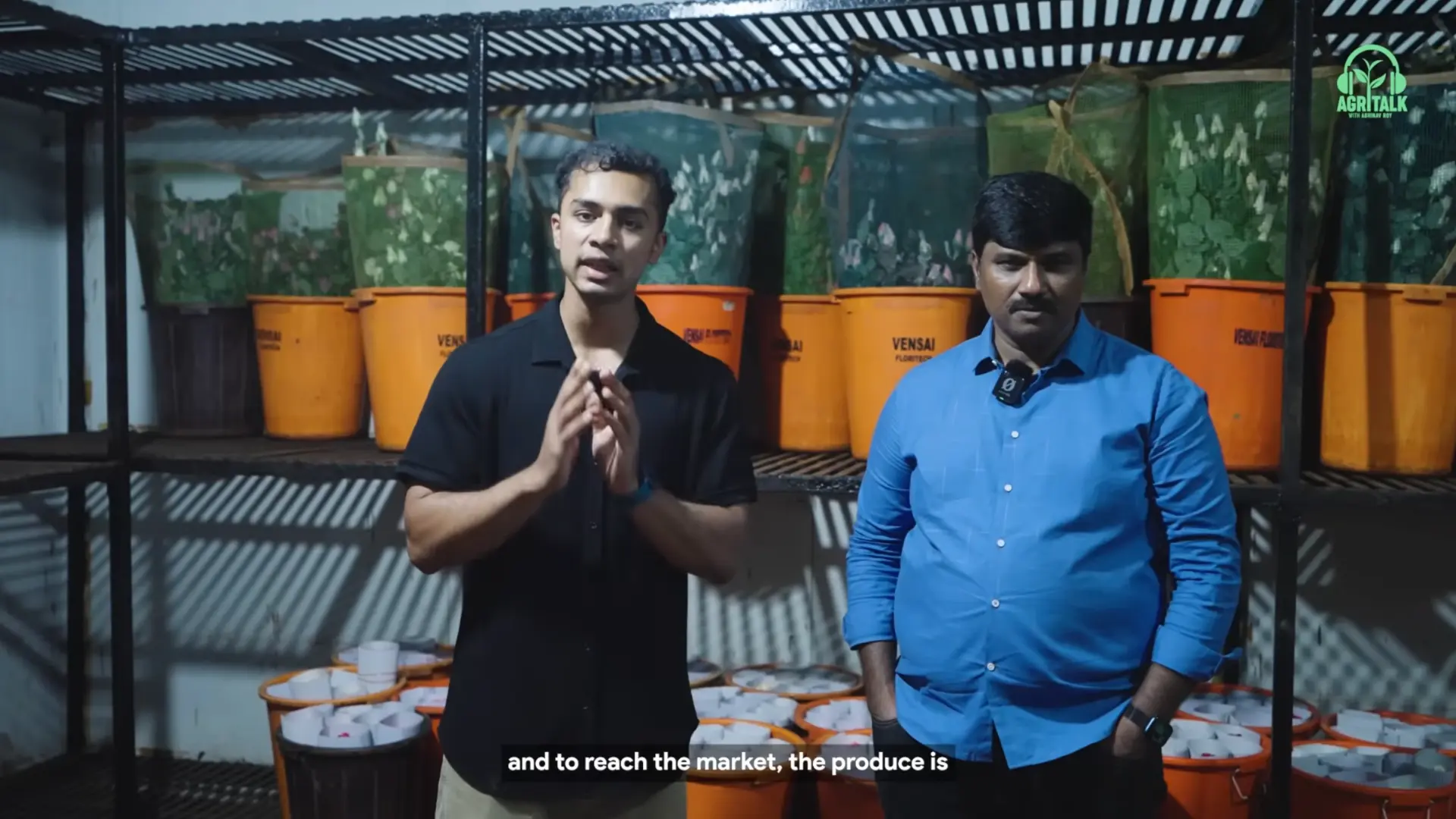
Cold storage is mandatory for rose farming to ensure proper shelf life and quality of the produce
Rose Farming Profit Per Acre: The Complete Economics
Farming economics vary widely based on region, scale, and management practices. To understand how rose farming economics typically work under protected cultivation, refer to this detailed breakdown here: Dutch Rose Economics.
Peak Season Pricing
Your profits multiply during peak demand periods:
- Valentine's Week (Feb 7-14): ₹12-20 per stem
- Wedding Season (Nov-Feb): ₹8-12 per stem
- Festival Season: ₹7-10 per stem
- Regular days: ₹4-6 per stem
Smart farmers plan production to peak during these high-price periods, potentially doubling their annual income.
Marketing Your Rose Production
Growing beautiful roses is only half the battle—selling them at good prices completes your success.
Local Flower Markets
Every major city has wholesale flower markets. Build relationships with commission agents who can sell your entire production. Typical commission: 10-15% of selling price.
Top flower markets: Mumbai (Dadar, Ghatkopar), Delhi (Ghazipur), Bangalore (KR Market), Pune (Shaniwar Peth), Chennai (Koyambedu)
Direct Supply to Businesses
Cut out middlemen by supplying directly to:
- 5-star hotels (100-500 stems daily, premium prices)
- Event management companies (bulk orders for weddings/corporate)
- Florist shops (regular daily, relationship-based)
- Temples (high volume, moderate prices, very regular demand)
Build 3-5 direct relationships for 60-70% of your production, sell rest in wholesale markets.
IFAB (International Flower Auction Bengaluru)
Bangalore has its own flower auction centre where growers can sell flowers at fixed rates.
Export Opportunities
If you grow premium Dutch roses in polyhouse, explore export markets through:
- APEDA (Agricultural and Processed Food Products Export Development Authority)
- Export houses in Bangalore and Pune
- Direct connections with importers in UAE, Europe
Exports require strict quality standards but pay 3-4x domestic prices (₹15-20 per stem).
Frequently Asked Questions
Conclusion
Rose cultivation in India offers one of the highest returns in horticulture if you do it right.
Ready to start your rose farming journey? Explore Agriplast's complete protected cultivation solutions from greenhouse films to mulching solutions designed specifically for Indian farmers. Discover how you can grow 28 polyhouse crops you can grow in India, and check our comprehensive guide on starting your polyhouse farming journey. Contact Agriplast Team at +91-8141446666 or visit www.agriplast.co.in for technical guidance and quality products.
Blog written and Posted by
Abhinav Roy
Abhinav Roy is an agribusiness professional, agricultural communicator, and host of AgriTalk by Abhinav Roy. He works closely with farmers, agripreneurs, across India to simplify complex agricultural technologies into practical, field-ready insights. With hands-on exposure to protected cultivation, crop protection systems, and farm economics, Abhinav focuses on bridging the gap between science, sustainability, and scalable farming solutions.You can write your view/comments here
Need Expert Assistance?
Get personalized recommendations for your greenhouse, polyhouse, or irrigation needs.
-
Bengaluru (Corporate Office)
- 918141446666
- support@agriplast.co.in
WeWork Roshni Tech Hub - 1st floor, PFS Club House, Marathahalli Main Rd, R.J.Gardens, Lakshminarayana Pura, EPIP Zone, Chinnapanna Halli, Bengaluru, Karnataka 560037