How to Grow Capsicum in Polyhouse: Profitable Farming Guide 2026
Over the last decade, polyhouse farming in India has expanded rapidly. What began as a niche practice has now become a mainstream response to unpredictable weather patterns, rising climate stress, and the limitations of open-field cultivation. This transition has been further accelerated by state and central government subsidies and a growing market demand for high-value crops such as coloured capsicum.
As a result, India's protected cultivation footprint has grown nearly tenfold — from about 25,000 hectares to over 2.5 lakh hectares — driven largely by government initiatives under the MIDH (Mission for Integrated Development of Horticulture) schemes.
Among the crops adopted under these systems, capsicum has consistently delivered strong results for farmers, particularly in polyhouse conditions where quality, yield stability, and marketability can be tightly controlled.
In this blog, we break down capsicum farming in polyhouse systems in India — covering costs, cultivation practices, yield expectations, and the on-ground realities farmers must understand before investing.

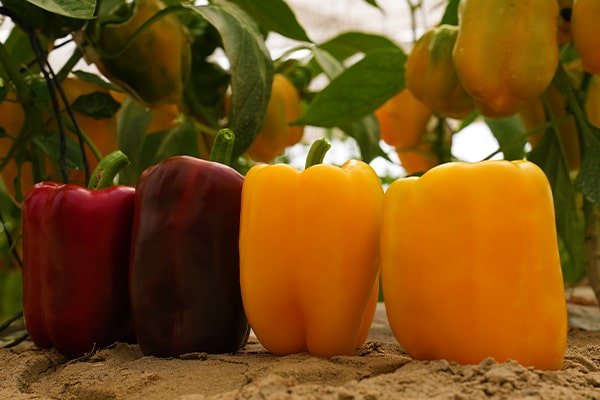
Coloured capsicum (red, yellow) grown under controlled polyhouse conditions for premium market quality.
Introduction
Capsicum farming in a polyhouse is a high-value commercial crop with a crop cycle of 8 to 9 months, significantly longer than open-field cultivation. With proper understanding of the crop, the right technology, and efficient fertigation management, a well-managed acre can yield 45–50 tons in favourable conditions such as Bangalore, and 20–30 tons in hotter regions of North India, with gross revenues touching ₹20–30 lakhs per annum. The controlled environment ensures thicker fruit walls, a longer shelf life of 15–20 days, and enables the production of coloured varieties (red and yellow) that command premium market prices averaging ₹70–80 per kg.
Polyhouse Vs Open Field for Capsicum
Can Capsicum be grown only in Polyhouse/Greenhouse structures?
No.
Capsicum can be grown both in open fields and under polyhouse/greenhouse structures, but the risk profile, quality, and market potential differ significantly.
Open-field capsicum is limited mainly to green varieties, requires low capital investment, and follows a short crop cycle of 4–5 months. Market prices are typically lower, averaging ₹20–30/kg. Crops are exposed to weather fluctuations, higher pest and disease pressure, often leading to more chemical spraying. Fruit quality can vary, with thinner walls and inconsistent size.
Polyhouse cultivation offers control over fruit maturity, which directly improves quality and value. Fruits mature in ~30 days (vs ~20 days in open fields), resulting in thicker walls and better firmness. Shelf life improves to 15–20 days (vs ~7 days). Controlled conditions enable stable yields over 8–9 months and allow reliable production of red and yellow capsicum. Uniform quality leads to better acceptance by supermarkets, exporters, and institutional buyers.
Your decision to grow capsicum in open field or polyhouse should be based on your budget and market demand.

Left: polyhouse-grown coloured capsicum; Right: open field green capsicum grown using Agriplast mulch
What Is The Best Time To Grow Capsicum In India?
Capsicum growing season in India is dictated by the Geography.
- North India (Aug–May): Planting typically occurs in August. Harvesting continues until May or June when extreme heat (40°C+) halts production. Yields are generally lower (25–30 tons) due to the shorter window.
- South India (Year-Round): Regions like Bangalore and Hosur offer a stable climate allowing for 12-month production cycles with planting typically happening in August or in February.
Capsicum has a crop cycle/crop duration of 8-10 months under protected cultivation in India. A Typical Capsicum crop cycle will look like:
| Crop Stage | Duration | Important Points To Keep In Mind |
|---|---|---|
| Nursery Stage | 25–30 days | - Seed sowing in pro-trays using cocopeat - Germination: 7–10 days - Seedlings ready for transplanting at 4–5 true leaf stage - Healthy seedling is critical for uniform growth and yield |
| Transplanting & Establishment | 0–30 days after transplant | - Transplanting into prepared beds has to be done carefully - Avoid stress during this phase to prevent early flower drop |
| Vegetative Growth | 30–60 days | - Establish the two-leader (V) system early for balanced canopy and light distribution. - Avoid excess nitrogen; over-vegetative growth reduces flowering and fruit set. - Remove side shoots and suckers weekly to channel energy toward fruiting - Maintain good airflow and uniform spacing to prevent humidity-related diseases. - Keep irrigation and Fertigation consistent to avoid uneven plant growth. |
| Flowering & Fruit Set | 60–90 days | - Maintain stable temperature and 60–70% humidity to prevent flower drop. - Avoid plant stress from aggressive pruning or nutrient imbalance. - Ensure adequate calcium and micronutrients for fruit set. - Monitor pests closely, as early damage reduces total yield. |
| Fruit Development & First Harvest | 90–120 days | - Maintain consistent irrigation to support fruit filling. - Avoid moisture fluctuations that cause misshapen fruits. - Handle fruits carefully during first harvest to avoid plant damage. - Fruit maturity duration directly impacts wall thickness and quality. |
| Continuous Harvest Phase | 120–240 days | - Continue maintenance pruning to remove old and shaded leaves. - Monitor pest and disease pressure continuously. - Keep fertigation balanced to maintain fruit size and quality. |
| Late Crop / Decline Phase | 240–270 days | - Expect gradual reduction in fruit size and setting. - Increase monitoring for pests and diseases. - Assess cost vs return to decide on crop continuation or termination. - Plan crop removal and sanitation to reduce carry-over issues. |
| Total Crop Cycle | 8–9 months |
Cost & Economics Of Coloured Capsicum In India
Polyhouse Farming is capital intensive and the decision to invest should be backed by proper research and market study. While these numbers are based on data from hundreds of our Agriplast Farmers across India, one must understand that actual numbers and results are highly variable to location, farmer skill and involvement and proper execution.
Download detailed Coloured Capsicum Economics here. Sourced From: Agriplast Protected Cultivation
Step by Step Process To Grow Coloured Capsicum In Polyhouses
Step 1 – Understanding The Growing Conditions
Capsicum is highly sensitive to environmental stress. Maintaining the right climate, soil, and water quality is essential for consistent yield and fruit quality.
Ideal Growing Conditions
- Temperature: 18–35°C
- Relative Humidity: 50–70%
- Light Intensity: 55,000–65,000 lux
Maintaining temperature and humidity within the ideal range is also influenced by the quality and light-diffusion properties of the greenhouse film, which affect heat build-up, light penetration, and crop stress inside the polyhouse.
Soil Requirements
- Soil must be porous and well-drained for healthy root development.
- Soil pH: 5.5–6.5
- Soil EC: 0.1–0.8 mS/cm
Soil & Water Testing (Mandatory)
Test soil and irrigation water before planting for:
- pH, EC, TDS
- Salinity: Na, Cl, HCO₃, RSC
- Primary nutrients: N, P, K
- Secondary nutrients: Ca, Mg
- Micronutrients: B, Fe, Zn, Mn, Cu
Water Quality Standards for Capsicum
| Parameter | Ideal Range |
|---|---|
| pH | 5.5 – 6.5 |
| EC (mS/cm) | 0.2 – 0.8 |
| SAR | < 2 |
| RSC | < 1.25 |
| Na / Cl (ppm) | < 80 |
| Ca (ppm) | 40 – 120 |
| Mg (ppm) | 6 – 25 |
| B (ppm) | < 0.5 |
| Fe / Zn (ppm) | < 5 |
| Cu (ppm) | < 0.02 |
| HCO₃ (ppm) | < 90 |
Step 2 – Preparing Nursery
A healthy nursery is the foundation of a successful capsicum crop. Weak or infected seedlings reduce yield potential right from the start.
Materials Required
- Seedling trays
- Cocopeat
- Vermiculite
- Perlite
Growing Media & Conditions
- Media ratio: Cocopeat : Vermiculite = 60 : 40
- Water pH: 6.0 – 6.5
- Water EC: ≤ 0.5 mS/cm
- Temperature: 18–35°C
Nursery Protection (Preventive)
- Fungicide (pre-treatment): Bavistin @ 0.5–1.0 g/L
- Insecticide: Abamectin 1.9% @ 0.2–0.3 ml/L
Seedling Readiness
- Seedlings are ready for transplanting at 25–30 days, with well-developed roots and healthy growth.

Step-by-step process of capsicum nursery preparation using cocopeat-filled pro-trays.
Step 3 – Field Preparation
Proper field preparation is critical for root development, nutrient uptake, and long crop duration in capsicum.
- Cultivate the soil to a depth of at least 40–45 cm to loosen the root zone and improve drainage.
- In medium to heavy soils, deep cultivation using a vibrating plough at 60–70 cm depth is recommended once every two years to break hard pans and improve root penetration.
- Ensure the soil is well-drained and friable; water stagnation at any stage severely affects capsicum roots.
- Incorporate well-decomposed organic matter during preparation to improve soil structure and microbial activity.

Field preparation for capsicum farming — soil cultivated to 40–45 cm depth inside the polyhouse.
Step 4 – Bed Preparation
Proper bed preparation ensures good drainage, healthy root growth, and uniform fertigation throughout the crop cycle.
- In a standard 8-meter grid, prepare 5 beds.
- Prepare raised beds to avoid water stagnation and improve root aeration.
- Bed width: 80–100 cm
- Bed height: 30–40 cm
- Bed spacing (centre to centre): ~1.5 m to allow airflow and easy movement during harvesting.
- Incorporate well-decomposed FYM or compost evenly into the beds before planting.
- Install drip irrigation lines before mulching to ensure accurate water and nutrient delivery.
- Beds should be level, firm, and uniform to avoid uneven irrigation and nutrient distribution.

Raised beds (80–100 cm wide, 30 cm high) with mulch film and drip irrigation for capsicum.
Step 5 – Plantation
Correct plantation practices ensure uniform plant establishment and strong early growth, which directly affect final yield.
- Plant population: ~12,000 plants per acre (≈ 3 plants per sqm)
- Spacing:
- Plant to plant: 40 cm
- Row to row: 35–40 cm
- Seedling age: 25–30 days old, 10–12 cm height, or 6 true leaves
- Transplant only healthy, well-rooted seedlings to avoid early mortality.
Irrigation Schedule During Transplanting
- Day 1: Irrigation before plantation
- Day 2: Irrigation immediately after plantation
- Day 3: No irrigation (allows roots to settle)
- Day 4: Irrigation with light fertigation

Early-stage capsicum plants after transplanting in a polyhouse with mulch and drip lines.
Step 6: Plant Maintenance (Training, Pruning & Flower Regulation)
Plant maintenance becomes critical 25–30 days after transplanting, when multiple branches begin to develop on each capsicum plant.
- At this stage, 3–4 branches emerge per plant. Maintain only 2 strong main branches (two-leader system) and remove the remaining branches.
- At each internode, retain one healthy flower.
- On sub-branches, also retain only one flower and remove excess buds.
- Continue this pruning and flower regulation throughout the entire crop life to maintain balance between vegetative growth and fruiting.

Agriplast agronomist Naveen Singh demonstrating the two-leader training and pruning method in polyhouse capsicum.
Step 7: Harvesting
Capsicum harvesting typically begins 80–90 days after transplanting, depending on variety and growing conditions.
- Fruits are harvested at commercial maturity, where approximately 70% of the fruit is mature and 30% is still immature. This stage ensures better firmness, shelf life, and transportability.
- Harvesting is done on an alternate-day basis to maintain continuous fruit setting and uniform size.
- In a well-managed one-acre polyhouse, daily harvest during peak production can range between 250–300 kg per harvest day.
Post-Harvest Handling
- Immediately after harvest, capsicum should be stored in cold storage at 8–10°C to maintain freshness and extend shelf life.
Step 8: Sorting, Grading & Packing
Proper sorting and grading after harvest are essential to maintain quality, shelf life, and market price.
- After harvesting, capsicum fruits are first pre-cooled in cold storage to remove field heat.
- Post pre-cooling, fruits are cleaned, sorted, and graded based on appearance and quality.
- High-quality capsicum fruits are identified by:
- 3–4 well-formed lobes
- Clean, smooth surface with uniform colour
- No physical damage or disease marks
- After grading, fruits are packed using appropriate boxes and packing materials to prevent damage during transport.
- Packed boxes are then moved to the market or supply chain for sale.

Capsicum harvest showing fruit quality assessed by number of lobes, uniform colour, and clean surface.
Marketing Strategy: Where and How To Sell Capsicum?
Growing capsicum is only one part of the process; deciding where to sell coloured capsicum in India has a direct impact on overall profitability.
1) Mandis
Wholesale mandis are best suited for handling large and continuous volumes of capsicum. While there is no traceability or branding, mandis provide a guaranteed market and fast liquidity, which is critical during peak harvest periods. Farmers must closely track price trends, arrivals, and demand–supply dynamics to maximise returns.
2) Own Marketing / Distribution Channels
Farmers who grow capsicum using Good Agricultural Practices (GAP) and maintain residue-free produce can build their own marketing and distribution channels. This includes selling through social media, local networks, or direct retail supply. These channels offer better price realisation but are practical only for limited volumes and require active involvement in logistics and sales.
3) Quick Commerce
Quick commerce platforms are increasingly sourcing residue-free, organic, hydroponic, and exotic vegetables, including coloured capsicum. Many platforms have dedicated premium sections, offering higher prices than mandis. However, strict quality standards and limited daily offtake make this channel suitable as a supplementary outlet, not a primary sales route.
4) Export
Export of coloured capsicum is viable only when adequate volumes are available, usually through farmer groups or aggregators. This channel requires GAP certification, residue testing, traceability, and a strong cold chain, but can provide access to stable premium markets when done at scale.
5) HORECA
The HORECA segment — hotels, restaurants, and catering services — demands capsicum with uniform size, colour, and quality. Supply is often contract-based, offering consistency, though payment cycles may be longer compared to wholesale mandis.
Things To Keep In Mind Before you Start Capsicum Farming
☑ Plan Your Market in Advance
Do not rely entirely on retail apps or B2C channels. Large daily harvest volumes cannot be absorbed by these platforms. Follow the 80/20 rule — sell 80% through wholesale mandis for volume and liquidity, and 20% through premium channels for better price realisation.
☑ Test Water Quality Without Exception
Always test irrigation water for EC and pH. High salts lead to nutrient lockout, reduced uptake, and wastage of expensive fertilisers.
☑ Harvest Correctly
Never pluck capsicum fruits by hand from the stem. Always cut at the abscission layer to prevent stem damage and die-back.
☑ Be Proactive on Pests & Diseases
In real polyhouse conditions, thrips outbreaks can escalate rapidly if climate and hygiene are not tightly managed. Poor climate control and hygiene inside a polyhouse can favour pest buildup. Maintain strict hygiene, monitor early, and follow Integrated Pest Management (IPM) from the beginning to avoid excessive pesticide use and unsafe produce. Pest pressure inside polyhouses can be reduced significantly using physical barriers like insect nets, especially against thrips.
☑ Stay Actively Involved
Capsicum demands daily attention and precision. Crops perform best when the farmer is actively involved in monitoring, decision-making, and execution throughout the crop cycle.
Polyhouse capsicum farming is not just agriculture; it is precision management. By controlling the climate, pruning technically, and managing nutrition scientifically, farmers can turn a standard vegetable into a high-revenue asset.
Frequently Asked Questions (FAQ)
Blog written and Posted by
Abhinav Roy
Abhinav Roy is an agribusiness professional, agricultural communicator, and host of AgriTalk by Abhinav Roy. He works closely with farmers, agripreneurs, across India to simplify complex agricultural technologies into practical, field-ready insights. With hands-on exposure to protected cultivation, crop protection systems, and farm economics, Abhinav focuses on bridging the gap between science, sustainability, and scalable farming solutions.You can write your view/comments here
Need Expert Assistance?
Get personalized recommendations for your greenhouse, polyhouse, or irrigation needs.
-
Bengaluru (Corporate Office)
- 918141446666
- support@agriplast.co.in
WeWork Roshni Tech Hub - 1st floor, PFS Club House, Marathahalli Main Rd, R.J.Gardens, Lakshminarayana Pura, EPIP Zone, Chinnapanna Halli, Bengaluru, Karnataka 560037