Shade Net Colour Guide: Which Colour Is Best for Your Crop?
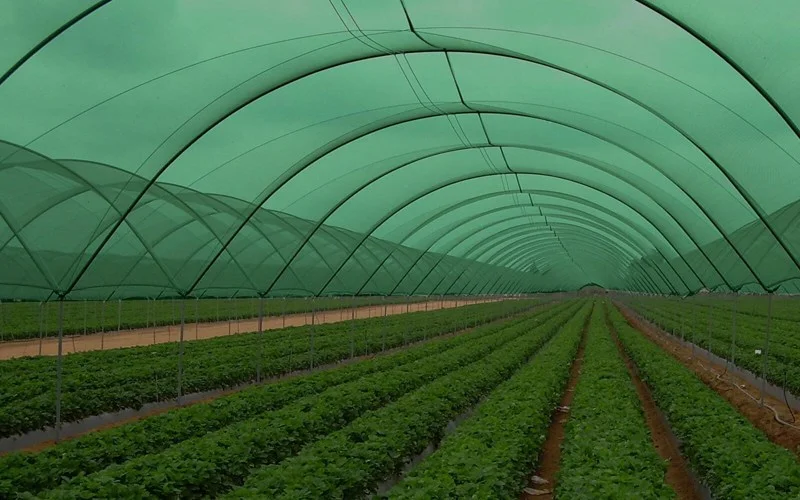
Choosing the right shade net for your farm isn't just about blocking sunlight. The colour of your shade net directly affects how your crops grow, flower, and yield. Most farmers pick green out of habit or black because it's cheap but research shows this single decision can mean a 15-40% difference in harvest.
Scientists from Israel's Volcani Center, US universities, and Indian agricultural institutes have studied how different shade net colours filter sunlight. The findings are clear: colour matters, and understanding the science helps you make smarter choices for your specific crops.
📖 New to shade nets? Start with our complete Shade Net Guide: Everything You Need to Know Before Buying — it covers types, GSM, shade percentages, and how to pick the right one for your farm.

Why Shade Net Colour Affects Plant Growth
Plants don't use all sunlight equally. They respond to specific light wavelengths—blue light makes plants compact and bushy, red light drives flowering and fruiting, and green light penetrates deep into leaf canopy. When you install a coloured shade net, you're filtering these wavelengths differently.
Research published in Frontiers in Plant Science found that light quality—not just quantity—significantly impacts photosynthesis, especially under high-intensity conditions common in Indian summers.
This is why two farms with identical shade percentage can get very different results if one uses black shade net and the other uses white shade net or aluminet.
Shade Net Colour Guide: How to Pick the Right Colour for Your Farm
1) Black Shade Net: Simple and Economical
Black shade netting absorbs light equally across all wavelengths. It reduces intensity without changing the colour balance reaching your crops.
Best for: Budget applications, non-crop shading, situations where you want pure shade reduction without growth manipulation.
Limitation: Absorbs heat, so temperatures under black nets can be higher than other colours.

2) White Shade Net: Maximum Cooling
White shade net reflects solar radiation instead of absorbing it—including heat-causing infrared. This creates noticeably cooler conditions underneath.
Key benefits:
- 2-3°C cooler than black nets
- Diffused light reaches lower leaves and inner canopy
- More uniform flower colour development
Best for: Summer nurseries, heat-sensitive crops, floriculture (gerbera, roses, carnation), and regions with extreme temperatures.

3) Green Shade Net: The Safe Default
Green shade net filters some green wavelengths while allowing balanced red and blue light through. This mimics natural forest canopy shade.
Why it's popular: Predictable results across diverse crops. No dramatic growth changes—just reliable protection.
Best for: General-purpose shading when you're not targeting specific growth manipulation. Works well for most vegetables, nurseries, and mixed farming.

4) Aluminet Shade Net: Year-Round Climate Control
Aluminet shade net features metallic coating that reflects 50-80% of incoming radiation.
Unique advantages:
- 5-8°C cooler than ambient in summer
- Retains warmth during cold nights (thermal barrier)
- Light scattering similar to white nets
Best for: High-value crops where temperature control affects market price, year-round protected cultivation, export-quality produce.

5) Red, Yellow & Blue Shade Nets: Targeted Growth Control
These chromatic or photoselective nets are designed to manipulate specific plant responses. Research by Dr. Yosepha Shahak at Israel's Volcani Center pioneered this science.
Red Shade Net
Transmits more red and far-red light, enhancing vegetative growth. Studies on bell pepper showed 15-40% yield increase compared to black nets. Also reduced whitefly penetration by ~50%.
Yellow Shade Net
Strongest vegetative growth stimulation. Research published in MDPI Agriculture confirms yellow nets reduced cucumber mosaic virus incidence by 10x—the altered light spectrum deters aphid vectors.
Blue Shade Net
Produces compact, dwarf growth with shorter internodes. Useful for ornamentals where height control matters, or crops where bushier structure improves quality.

| Your Goal | Recommended Shade Net | Why | Product |
|---|---|---|---|
| Maximum summer cooling | White or Aluminet | Reflects heat | Aluminet |
| Year-round temperature control | Aluminet | Cools in summer, retains warmth in winter | Aluminet |
| Higher vegetative yield | Red or Yellow | Enhanced red light stimulates growth. ( Can also lead to temperature rise, consult expert ) | Tape x Tape |
| Compact plant structure | Blue | Suppresses stem elongation | Mono x Mono |
| Reduce virus transmission | Yellow | Deters aphid vectors | Tape x Tape |
| Budget shading | Black | Lowest cost, neutral effect | Shade Net Solutions |
Getting the Most From Your Shade Net
Colour benefits only work if your shade netting performs as designed:
Keep nets clean. Dust changes light transmission. Clean every 3-6 months.
Choose UV-stabilized nets. Colour fading from UV degradation reduces effectiveness. Agriplast tape-type and mono-type shade nets include UV stabilization for longer life.
Match to your specific crop. A tomato grower and a rose grower have different needs—even in the same climate.
Conclusion
Shade net colour is a crop management decision, not just an aesthetic choice. Black shade net offers economical, neutral shading. White shade net and aluminet solve heat problems. Green shade net delivers reliable, balanced results. Chromatic nets (red, yellow, blue) let you manipulate growth for specific outcomes.
The research is clear: choosing the right colour for your crop and climate can improve yields by 15-40%. That's a significant return on a relatively small decision.
Need help choosing the right shade net for your farm? Get in touch with Agriplast — we'll recommend the right colour, percentage, and type based on your specific crops and conditions.
FAQs
Aluminet can reduce temperatures by up to 5–8°C under optimal installation and climatic conditions, making it critical during April–June when greenhouse temperatures can otherwise cross 45°C.
Yes. Black absorbs sunlight including infrared (heat), then radiates it downward. For crops, this means higher canopy temperatures compared to white or aluminet nets at the same shade percentage.
It depends on the type. Agriplast monofilament shade nets (125 GSM) come with a 5-year UV warranty, while 100 GSM variants have a 3-year warranty. Aluminet carries a 4-year UV warranty. Clean your nets every 3-6 months to maintain light transmission.
Yes — green is the safest all-rounder. It filters light similar to natural tree canopy, giving you balanced red and blue wavelengths without dramatic growth changes. Agriplast recommends green tape-type shade nets specifically for nurseries, and green monofilament (125 GSM, 5-year UV warranty) for nethouses and polyhouses.
Blog written and Posted by
Abhinav Roy
Abhinav Roy is an agribusiness professional, agricultural communicator, and host of AgriTalk by Abhinav Roy. He works closely with farmers, agripreneurs, across India to simplify complex agricultural technologies into practical, field-ready insights. With hands-on exposure to protected cultivation, crop protection systems, and farm economics, Abhinav focuses on bridging the gap between science, sustainability, and scalable farming solutions.You can write your view/comments here
Need Expert Assistance?
Get personalized recommendations for your greenhouse, polyhouse, or irrigation needs.
-
Bengaluru (Corporate Office)
- 918141446666
- support@agriplast.co.in
WeWork Roshni Tech Hub - 1st floor, PFS Club House, Marathahalli Main Rd, R.J.Gardens, Lakshminarayana Pura, EPIP Zone, Chinnapanna Halli, Bengaluru, Karnataka 560037