Anti-Hail Net for Apple Orchards: Complete Protection Guide India
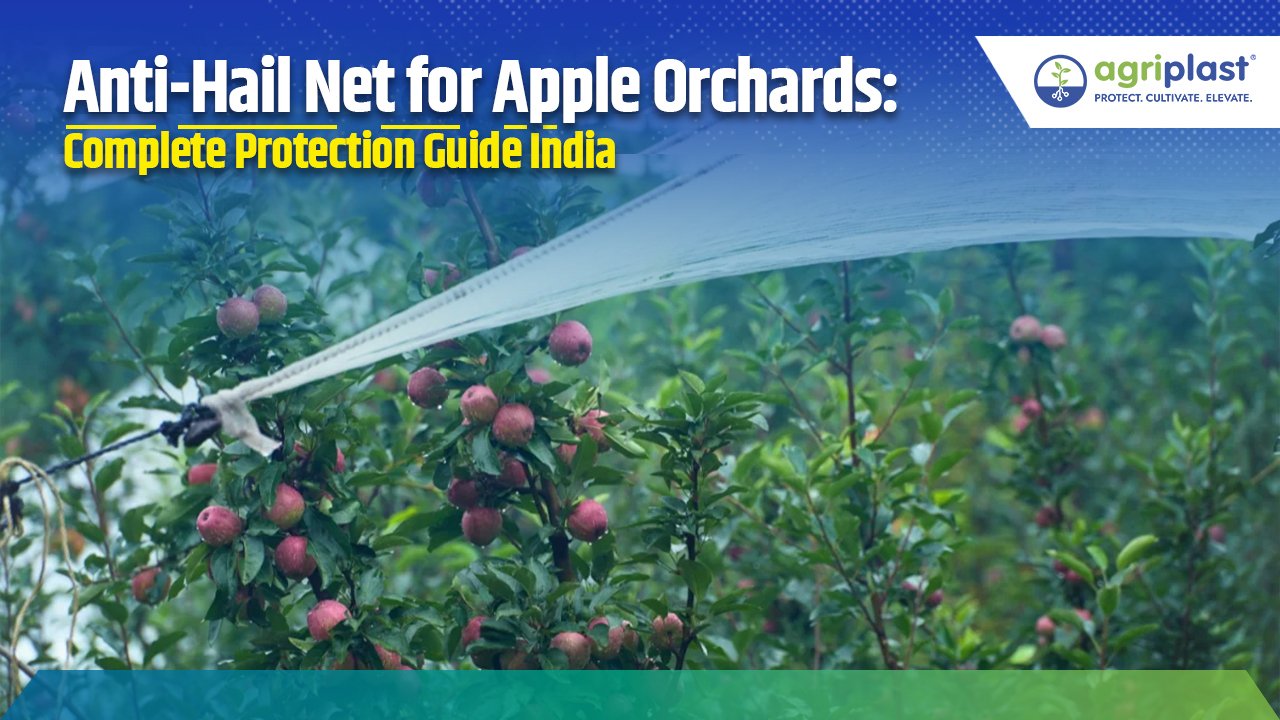
Apple is a once-a-year crop. There is no second chance. If a hailstorm hits your orchard during the growing season, you don't just lose this year's fruit — the damage to wood and fruiting spurs can reduce your yield for the next two to three years. That is why an anti-hail net for apple orchards has become essential for serious growers across Himachal Pradesh, Jammu & Kashmir, and Uttarakhand.
India's apple belt covers over 2 lakh hectares and generates ₹5,000–6,000 crore in revenue annually. Yet most of this harvest remains exposed to increasingly unpredictable hailstorms.
In this guide, we cover everything an Indian apple grower needs to know about anti-hail nets — why apples are more vulnerable to hail damage than other crops, how nets affect fruit colour, ripening, and sunburn, the month-by-month installation and removal calendar, and common mistakes that cost farmers money every season.
For a complete overview of how anti-hail nets work, the difference between Raschel and Leno nets, and all available installation methods, read our comprehensive anti-hail net guide for crops.
What's Inside This Guide:
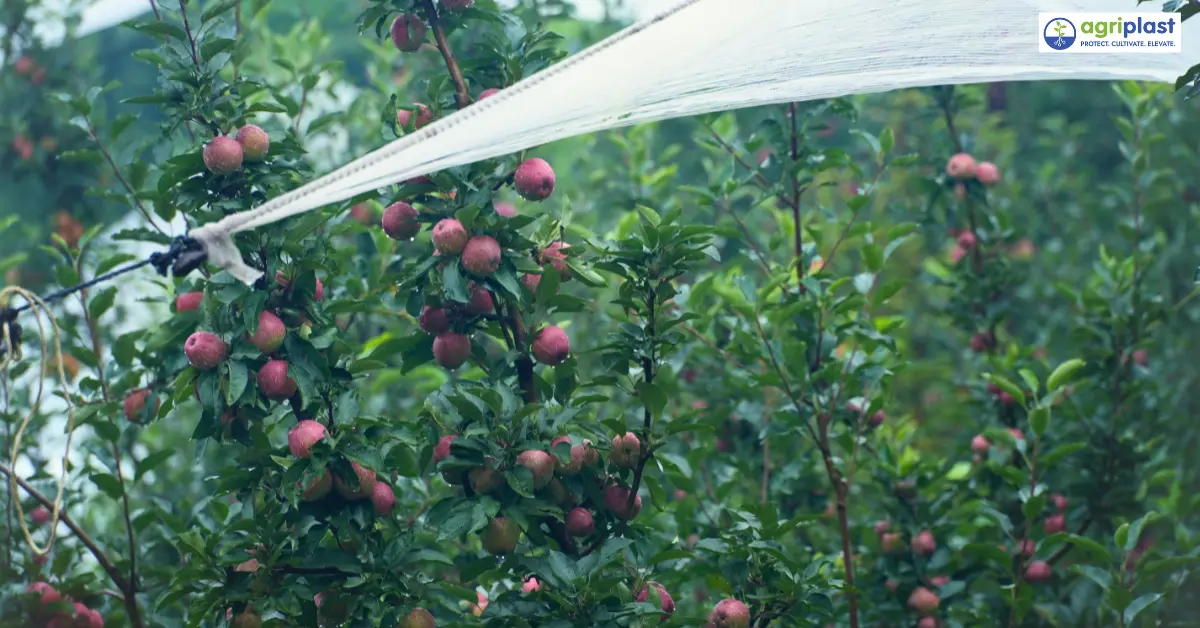
Anti-hail nets protecting an apple orchard in Himachal Pradesh — the most cost-effective crop insurance for India's apple belt.
The Apple-Specific Hail Problem: Why Apples Are More Vulnerable Than Other Crops
Not all crops suffer equally from hail. Apples are uniquely exposed, and the damage goes far beyond a few bruised fruits.
1) Long exposure window
Apple trees in Himachal Pradesh flower in March–April, and the fruit is harvested in September–October. That creates an exposure window of nearly six months which is much longer than most seasonal vegetable crops.
During this entire period, orchards remain vulnerable to sudden hailstorms. With changing climate patterns, even traditionally "safe" months are no longer reliable.
2) Hail Leads To Infection
When a hailstone hits an apple, it can crack or weaken the skin. That small injury becomes an entry point for bacterial and fungal infections.
Within days, a minor dent can turn into rot, making the fruit unmarketable. This chain reaction — impact, crack, infection, rot — is especially severe in fleshy fruits like apples.
3) Extended Damage
Many growers underestimate this. Severe hailstorms don't just destroy the current fruit. They also damage fruiting spurs and young wood, which produce next year's crop.
As a result, one hail event can reduce yields for two to three seasons, affecting both productivity and income.
4) Cosmetic damage can erase profits
Even if the skin isn't cracked, a small dent can downgrade fruit from Grade A to processing grade.
That single impact can reduce the selling price by 60–80% or more, depending on the market — even though the cost of growing the fruit stays the same.
The 2023 season showed the real risk
In 2023, Himachal Pradesh saw a combination of low winter snowfall, untimely rain during flowering, and hailstorms on young fruit. Production fell by more than 50%.
Farmer organisations estimated total losses at ₹2,500–3,000 crore across the state — a clear reminder of how a few extreme weather events can wipe out an entire year's income.
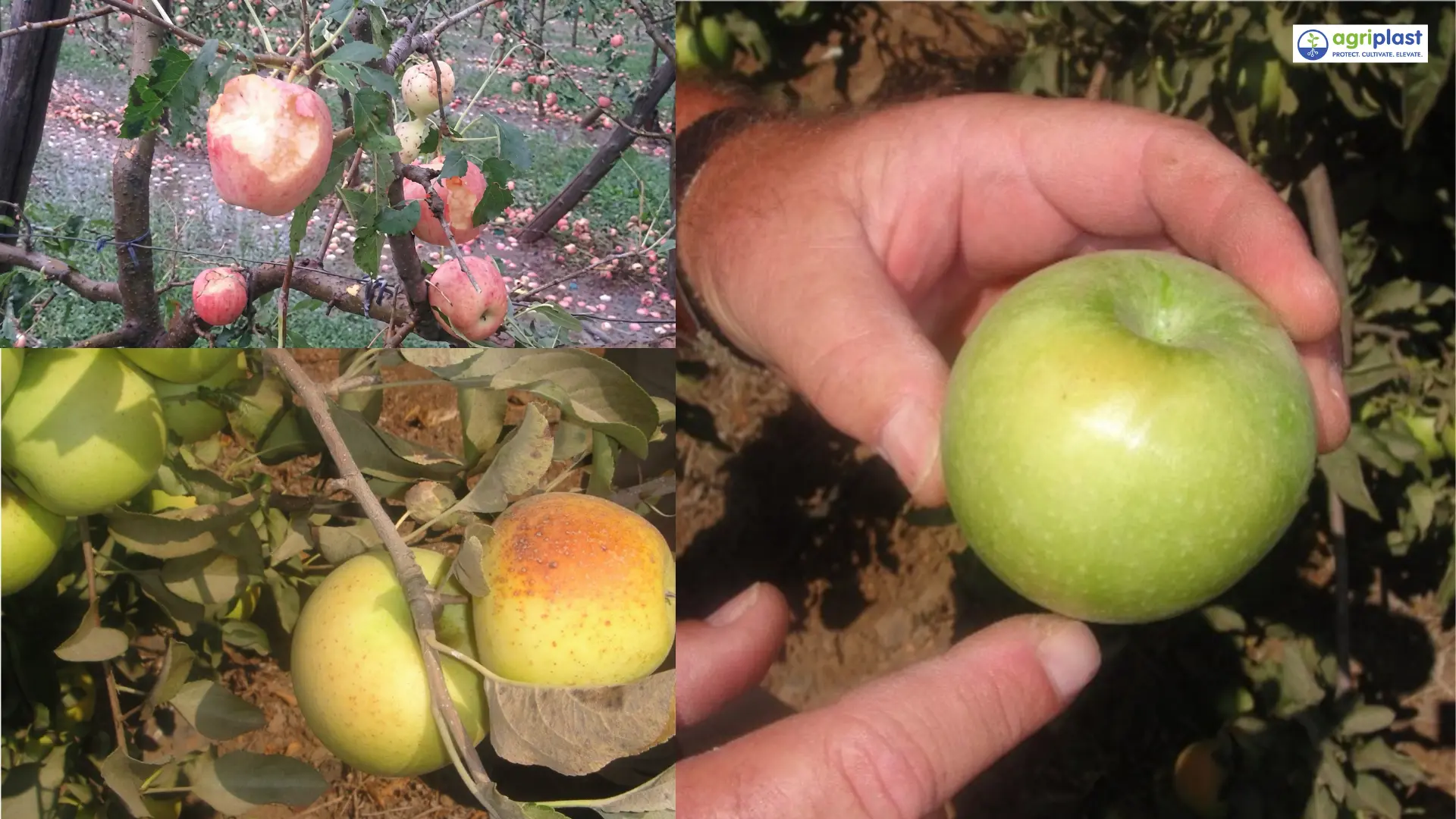
Left: Apple fruit showing sunburn damage and skin cracking in an unprotected orchard — these cosmetic defects alone drop the fruit from Grade A (₹80–100/kg) to processing grade (₹15–20/kg). Right: Healthy, unblemished apple grown under anti-hail net — clean skin, no sunburn, market-ready.
How Anti-Hail Nets Affect Apple Quality, Colour, and Ripening
This is the question most apple farmers ask: will the net affect fruit colour?
The answer depends mainly on shade percentage.
Shade Percentage and Apple Colour Development
Every anti-hail net blocks some sunlight. The shade percentage directly affects colour development.
- Leno woven nets (9–15% shade) allow more light and suit colour-critical varieties like Red Delicious, Royal Gala, and Fuji.
- Raschel knitted nets (18–23% shade) block more light and work well for general orchards or varieties where deep red colour is less critical.
- Nets above 30% shade should generally be avoided. High shade produces larger but paler fruit, reducing market grade.
Moderate shading has only a small impact on photosynthesis. Light shade can also help maintain sugar-acid balance and reduce heat stress.
Sunburn Reduction — Direct Price Impact
Research from Washington State University shows netting can reduce sunburn damage from about 25% to 5–10% of fruit.
Netting also lowers fruit surface temperature. Without nets, apple skin can reach 20°F (11°C) above air temperature. Under netting, this drops to about 7°F (4°C). At 35°C air temperature, that is the difference between fruit skin reaching 46°C (sunburn risk) and staying closer to 39°C.
Fruit Firmness and Internal Quality
Studies reviewed in Scientia Horticulturae show netting maintains or slightly improves fruit firmness. A more stable microclimate helps fruit develop without damaging heat spikes.
The Pollination Question
Install anti-hail nets after petal fall.
Apple flowers rely on bees. Nets installed during flowering can restrict bee movement and reduce fruit set. Waiting until petals drop is the safest practice.
Practical farmer takeaway
- Export-grade, colour-critical varieties (Red Delicious, Fuji, Gala) → Leno woven nets
- General orchards where colour is less critical → Raschel knitted nets
For a detailed comparison of Raschel and Leno net specifications, check our anti-hail net guide.
💡 Farmer Success Story: From ₹8 Lakh to ₹25 Lakh with Anti-Hail Nets
Yudhishthir, an apple farmer from District Mandi, Himachal Pradesh, has been using Ginegar anti-hail nets on his 20 bigha orchard since 2014. Before installing nets, his annual revenue was around ₹8 lakh. After netting — it jumped to ₹15–25 lakh.
He also noticed a clear difference between quality nets and cheaper alternatives: "Desi nets are too dense — they block sunlight, cause colour problems in apples, and diseases like mites start appearing. Ginegar nets allow proper sunlight and airflow."
His nets from 2014 are still in use — and he says they look as good as new.
Seasonal Timeline: When to Install and Remove Nets in Apple Orchards
Timing is as important as the net itself. Install too early and you block pollinators. Install too late and you miss the most vulnerable stage.
Here is a practical calendar for apple orchards in Himachal Pradesh and the broader Indian apple belt:
| Month | Apple Growth Stage | Net Action |
|---|---|---|
| March–April | Flowering and petal fall | ❌ Do not install — bees must access flowers |
| May (after last petals drop) | Fruit set begins | ✅ Install nets immediately — critical protection window |
| June–August | Fruit growth and development | ✅ Keep nets on — peak hail-risk period |
| Early September | Pre-harvest colour stage | Optional early removal (1–2 weeks) if hail risk is low |
| September–October | Harvest | ✅ Remove nets, label by row, roll onto spools |
| November–February | Tree dormancy | Store nets indoors, elevated and rodent-safe |
Why this timing matters
The May–June stage is when fruitlets are most vulnerable. Hail hitting young fruit causes deeper, permanent damage. Mature fruit closer to harvest can sometimes tolerate minor impact.
A practical complication in Himachal
In some parts of the Shimla belt, hailstorms now occur as early as April, overlapping with flowering. Farmers in high-risk zones sometimes install nets slightly earlier, accepting a small pollination trade-off to avoid severe hail damage. This decision depends on your local hail history.
Removal tip
Keep the gap between net removal and harvest as short as possible.
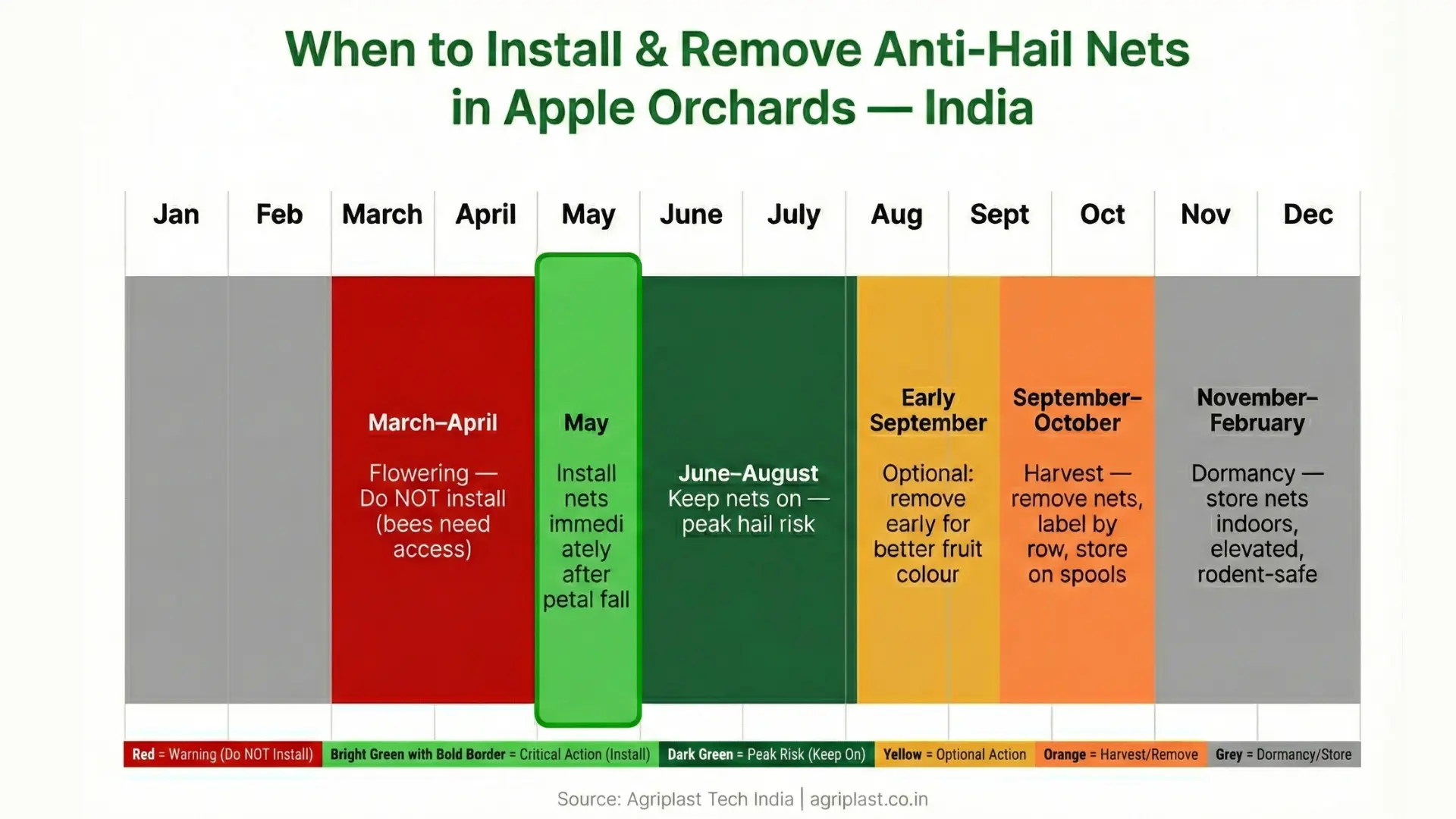
Seasonal installation calendar: Install after petal fall in May, keep nets on through August, and remove just before harvest in September–October.
Common Mistakes Apple Growers Make with Anti-Hail Nets
Based on field experience across HP's apple regions, these are the most common and costly mistakes:
1. Installing before petal fall
This blocks bees during pollination, leading to poor fruit set and lower yields — even without hail. Always wait until the last petals drop.
2. Choosing nets with too much shade
Nets above 30% shade produce larger but paler fruit. For colour-graded varieties like Red Delicious, this means lower mandi prices. Stay within 15–23% shade for apples.
3. Buying cheap, unbranded nets
Low-quality nets are often too dense. They block light, reduce airflow, and create humid conditions where mites and scab thrive. Colour suffers, and the net may fail in 1–2 seasons.
Yudhishthir, a farmer from Mandi, saw this firsthand. His Ginegar nets from 2014 still perform well, while cheaper nets damaged his fruit. A quality UV-stabilised net lasts 5–8 years. A cheap one costs twice — in replacement and lost fruit quality.
4. Leaving gaps at the edges
Hail rarely falls straight down. Wind-driven stones enter from the sides. After draping, zip-tie the edges under the canopy to seal all openings.
5. Not labelling nets by row
After one season, nets stretch to fit specific rows. Swapping them next year causes bunching and gaps. Label each net before storage.
6. Storing nets on the ground
Floor storage invites rodent damage. Mice chew through HDPE quickly. Store nets on spools, elevated on pallets or shelves.
7. Waiting for subsidy before installing
This is often the costliest mistake. One unprotected season can exceed the full price of the net. Treat subsidy as a bonus, not a prerequisite.
Frequently Asked Questions
Protecting your apple orchard with an anti-hail net is the single most effective investment an Indian apple grower can make. Whether you are in Shimla, Kullu, Kinnaur, or the Kashmir Valley, the combination of increasing hailstorm frequency, rising input costs, and the fragile economics of Grade A apple pricing makes crop protection non-negotiable.
Explore Agriplast's anti-hail net range — manufactured by Ginegar-Polysack, Israel, with a 5-year UV warranty, and trusted across 500+ projects in 15+ countries.
Blog written and Posted by
Abhinav Roy
Abhinav Roy is an agribusiness professional, agricultural communicator, and host of AgriTalk by Abhinav Roy. He works closely with farmers, agripreneurs, across India to simplify complex agricultural technologies into practical, field-ready insights. With hands-on exposure to protected cultivation, crop protection systems, and farm economics, Abhinav focuses on bridging the gap between science, sustainability, and scalable farming solutions.You can write your view/comments here
Need Expert Assistance?
Get personalized recommendations for your greenhouse, polyhouse, or irrigation needs.
-
Bengaluru (Corporate Office)
- 918141446666
- support@agriplast.co.in
WeWork Roshni Tech Hub - 1st floor, PFS Club House, Marathahalli Main Rd, R.J.Gardens, Lakshminarayana Pura, EPIP Zone, Chinnapanna Halli, Bengaluru, Karnataka 560037