Anti-Hail Net: Protection & Installation Guide 2026
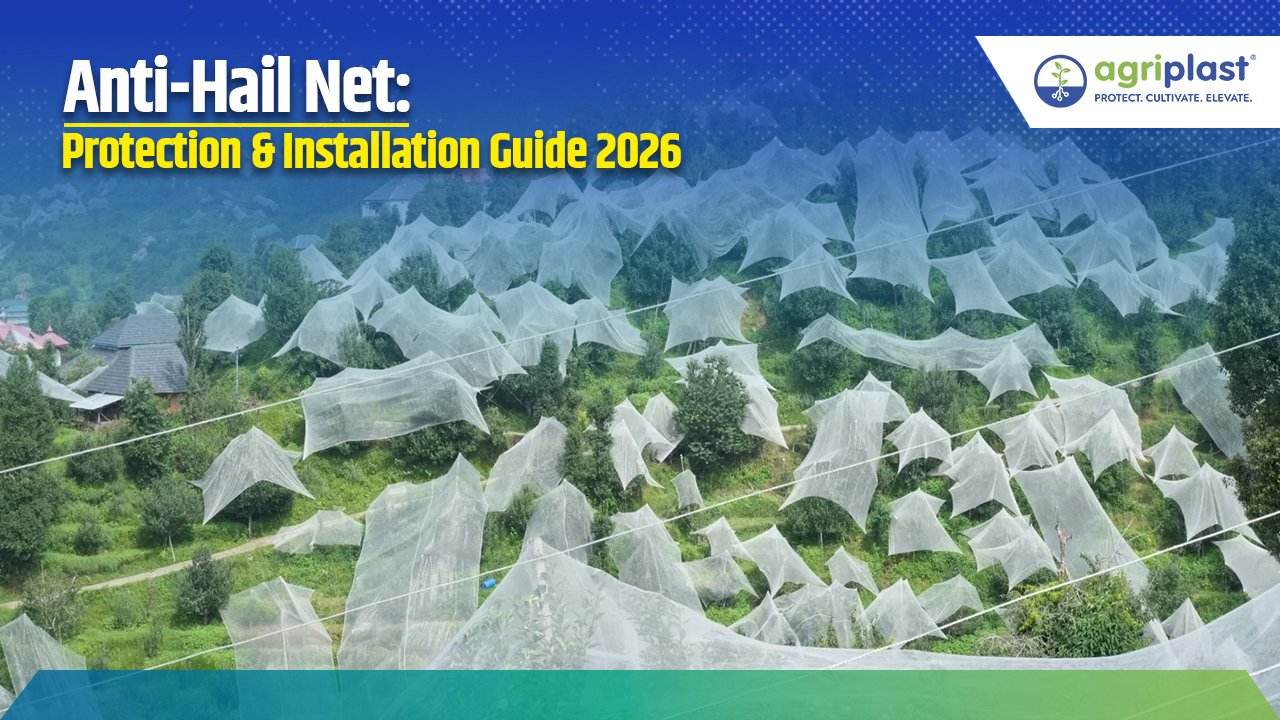
Indian agriculture is facing a new reality. Between January and November 2025, extreme weather events hit crops on 331 out of 334 days — that is 99% of the year. Hailstorms, once limited to a few weeks in winter, now strike across all seasons. According to CSE and Down To Earth's annual climate analysis, approximately 17.4 million hectares of farmland suffered crop damage from extreme weather in 2025 — a staggering 9X increase from just 1.96 million hectares in 2022.
For farmers growing high-value horticultural crops like grapes, pomegranate, apples, and mangoes, a single hailstorm can destroy an entire season's income in under 15 minutes. An anti-hail net is the most effective and proven solution to prevent this — a UV-stabilized HDPE mesh that physically shields your crops from hailstone impact while also improving the growing environment underneath.
This guide will help you choose the right anti-hail net, understand installation options, calculate subsidy benefits, and decide the best system for your farm.
In this guide, we will cover:
- Why hail protection is now essential
- What is an anti-hail net
- Raschel vs Leno nets
- Installation methods
- Government subsidies
- How to choose the right system
- FAQs
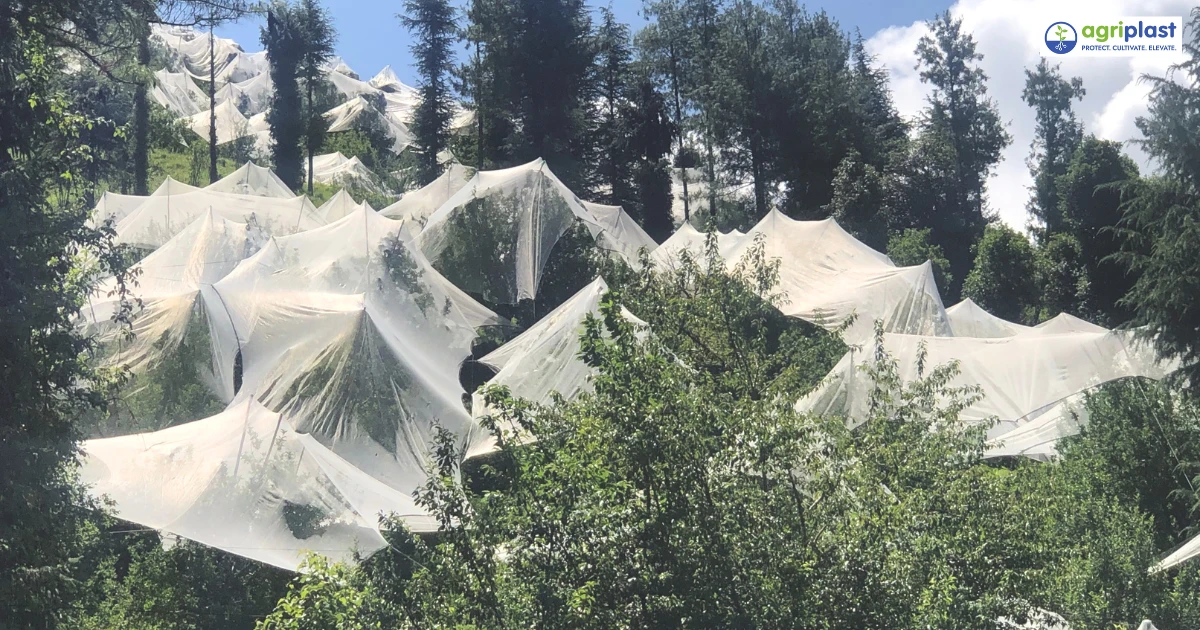
Anti-hail netting over a commercial orchard — the most effective way to protect high-value crops from hailstorm damage
Why Hail Protection for Crops Is No Longer Optional
The numbers tell a devastating story. A survey of 6,615 marginal farming households in 2024 found that 50% of farmers and 45-65% of other crop growers consistently lost more than half their standing crops to extreme weather over the past five years. This is not a fringe risk anymore — it is the central threat to farm income across India's horticultural belts.
Look at what happened in Maharashtra's grape belt. In March 2023, unseasonal rains and hailstorms destroyed nearly 50,000 acres of vineyards across Maharashtra's grape-growing divisions — Nashik, Pune, Sangli and Solapur. Export-quality grapes that were selling at Rs 35-40 per kg dropped to Rs 10-15 per kg. Farmers estimate that nearly 25% of the season's grape exports were affected in a single weather event.
In Himachal Pradesh, the 2023 apple season was devastated by a combination of no winter snowfall, rain during flowering, hailstorms on young fruit, and monsoon floods that blocked roads and left apples rotting in orchards. Production fell by more than 50% compared to the previous year. Farmer organisations estimated losses at Rs 2,500-3,000 crore across the state.
If you grow apples, read our complete guide on how anti-hail nets protect apple orchards in India.
The economics are brutal. A farmer who spends lakhs per acre on cultivation — pesticides, fertilisers, labour, diesel — can lose the entire investment plus expected profit in one hailstorm. Installing a hail protection net for crops is not an additional expense. It is insurance for the money already spent.
_1771250089_699321a98e557.webp)
Hail-damaged apples in an orchard — a single hailstorm can destroy an entire season's harvest in minutes
What Is an Anti-Hail Net and How Does It Work?
An anti-hail net is a protective mesh fabric made from high-density polyethylene (HDPE) that is UV-stabilized for outdoor durability. The net works on a straightforward principle — the knitted or woven mesh creates a physical barrier above your crop canopy that absorbs and distributes the kinetic energy of falling hailstones. Instead of smashing directly into your fruit, the hailstones hit the net, lose their momentum, and either slide off the edges or sit harmlessly on top until they melt.
But modern anti-hail netting does much more than just stop hailstones. Research conducted at Washington State University (WSU) on netting systems found some striking microclimate benefits:
- Fruit surface temperature drops significantly. Without netting, fruit surfaces can be 20°F (11°C) warmer than the surrounding air. Under netting, this drops to just 7°F (4°C) warmer — meaning at 35°C air temperature, your fruit stays at around 37°C instead of hitting 46°C.
- Sunburn damage falls from 25% to 5-10% — a major quality improvement, especially for apples and grapes where skin appearance affects market price.
- Wind speed reduces by approximately 40%, protecting flowers during pollination and preventing physical abrasion on developing fruit.
- Photosynthesis actually improves because plants maintain steady activity under netting instead of shutting down during the intense midday heat.
Think of it this way — the net does not just protect against the occasional hailstorm. It creates a gentler, more stable growing environment every single day it is up. Research from French vineyard studies in the Rhône Valley confirmed that well-designed hail netting reduces hail damage by up to 90% with no substantial reduction in crop yield.
Types of Anti-Hail Nets — Raschel vs Leno
Not all anti-hail nets are the same. There are two main types manufactured by Agriplast Ginegar which differ in how they are manufactured, how much light they block, how strong they are, and what they cost.
Here is a side-by-side comparison:
| Feature | Raschel Knitted | Leno Woven |
|---|---|---|
| How It's Made | Warp knitting machine (HDPE monofilament/tape) | Leno weave construction (HDPE monofilament) |
| Shade Factor | 18–23% | Lower than Raschel (more transparent) |
| Tear Strength | Moderate — unique construction allows sharp stems to pass through without tearing | High — locked Leno weave prevents yarn slippage |
| Weight (GSM) | 70 GSM | Contact Agriplast for specifications |
| UV Warranty | 5 years | 5 years |
| Key Benefits | Hail + bird + wind protection, high ventilation, easy install/uninstall, reusable | Hail + bird + wind protection, superior strength, high ventilation |
| Cost | More economical | Premium (higher cost than Raschel) |
| Best For | Multi-purpose use — hail protection + partial shade + bird exclusion | Premium orchards needing maximum sunlight (grapes, apples, cherries) |
| Lifespan | 5+ years with proper care | 5+ years with proper care |
When to choose which:
Raschel knitted nets are the go-to choice for most Indian farmers. They are versatile, economical, and provide 18–23% shade — enough to offer partial sun protection without blocking the light your crops need. If you need a net that handles hail, provides partial shade, and keeps birds away — all at a reasonable price — Raschel is your answer. Agriplast's Raschel anti-hail net is imported from Ginegar-Polysack, Israel, with a 5-year UV warranty and a unique construction that lets sharp plant stems pass through without tearing the mesh. Available in 8m, 9m, and 10m widths.
Leno woven nets are the premium choice for orchards where every percentage point of sunlight matters. Leno nets use a locked weave construction that makes them stronger and more transparent than Raschel — critical for fruit colouring in grapes (especially export varieties), Red Delicious apples, and cherries. The trade-off is cost — expect to pay more compared to Raschel. Agriplast's Ginegar Leno anti-hail net also carries a 5-year UV warranty and is recommended for areas with frequent, forceful hailstorms.
Not sure which type suits your farm? Get in touch with Agriplast's agronomy team for a personalised recommendation based on your crop, location, and budget.
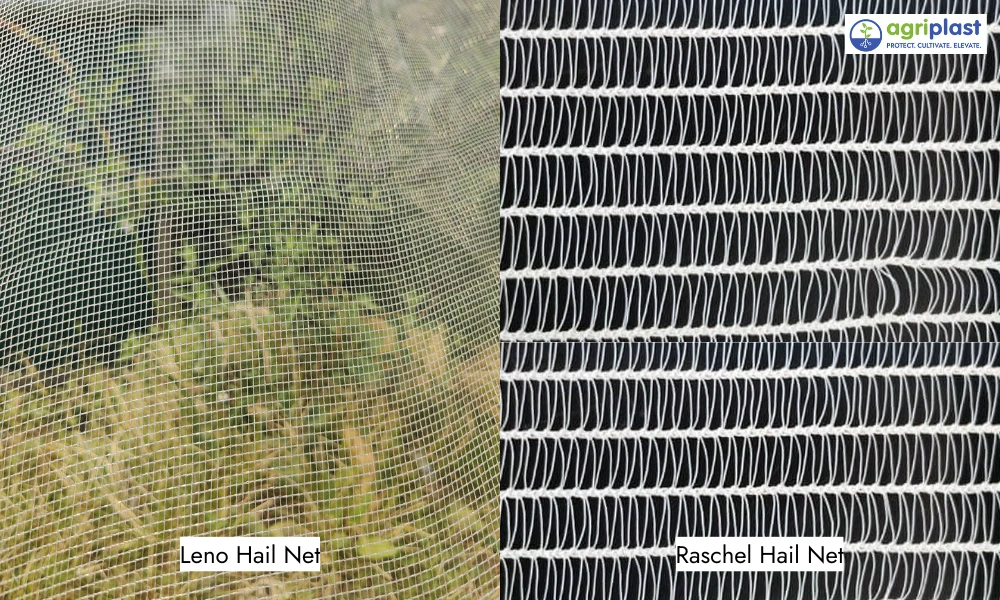
Side-by-side: Leno Woven net (left) vs Raschel Knitted net (right) — note the difference in mesh density
Anti-Hail Net Installation Methods
There are many ways anti-hail nets are installed which depends on factors like kind and scale of crop and farming. Below are a few, starting from the simplest to the most efficient systems:
1. Wooden / Iron Support Structure
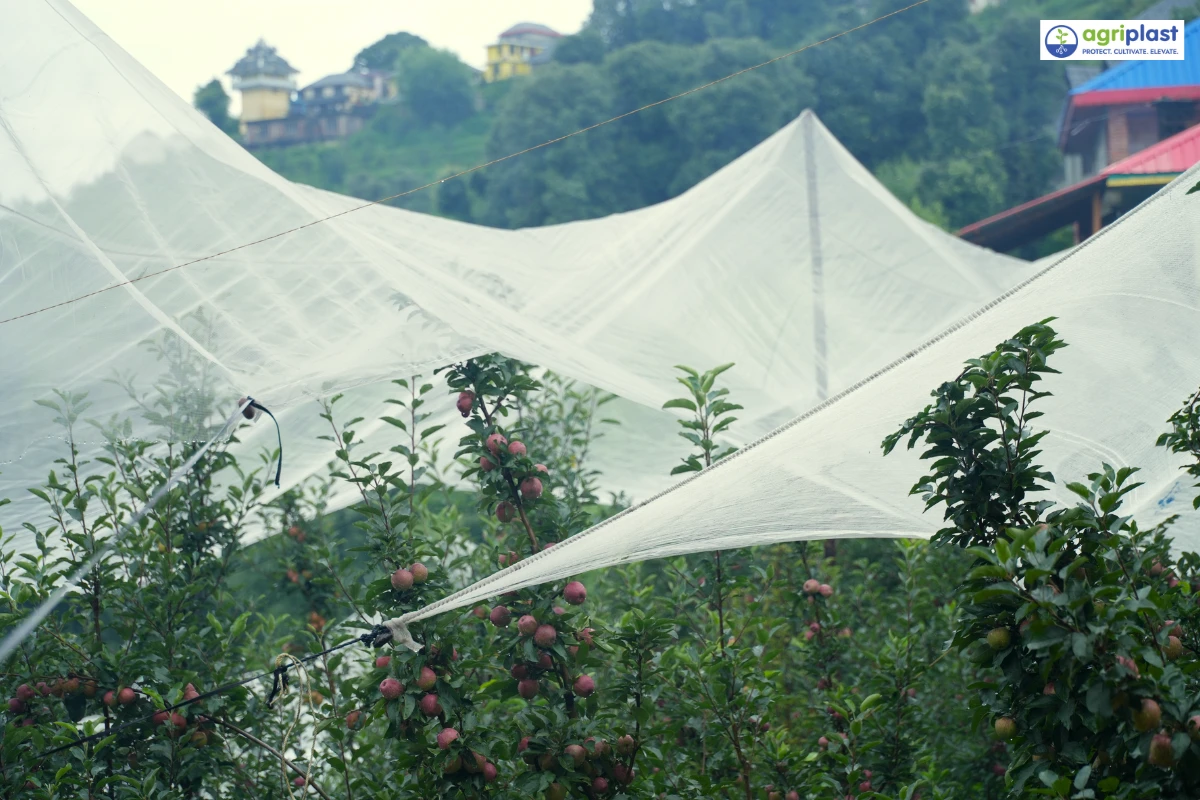
Agriplast anti-hail net on wooden pole supports over an apple orchard in Himachal Pradesh — the most common installation method used by Indian farmers
Simple, seasonal protection using wooden poles over individual trees.
This is the most widely used method in hilly apple regions like Himachal Pradesh, J&K, and Uttarakhand.
Key features:
- Net stretched across wooden poles
- No permanent structure required
- Flexible setup and removal
Best suited for:
- Steep hillside orchards
- Small to medium farms
- Farmers with limited budgets
Practical notes:
- Install after flowering
- Remove before harvest
- Seasonal, reusable setup
2. Trellis Support System
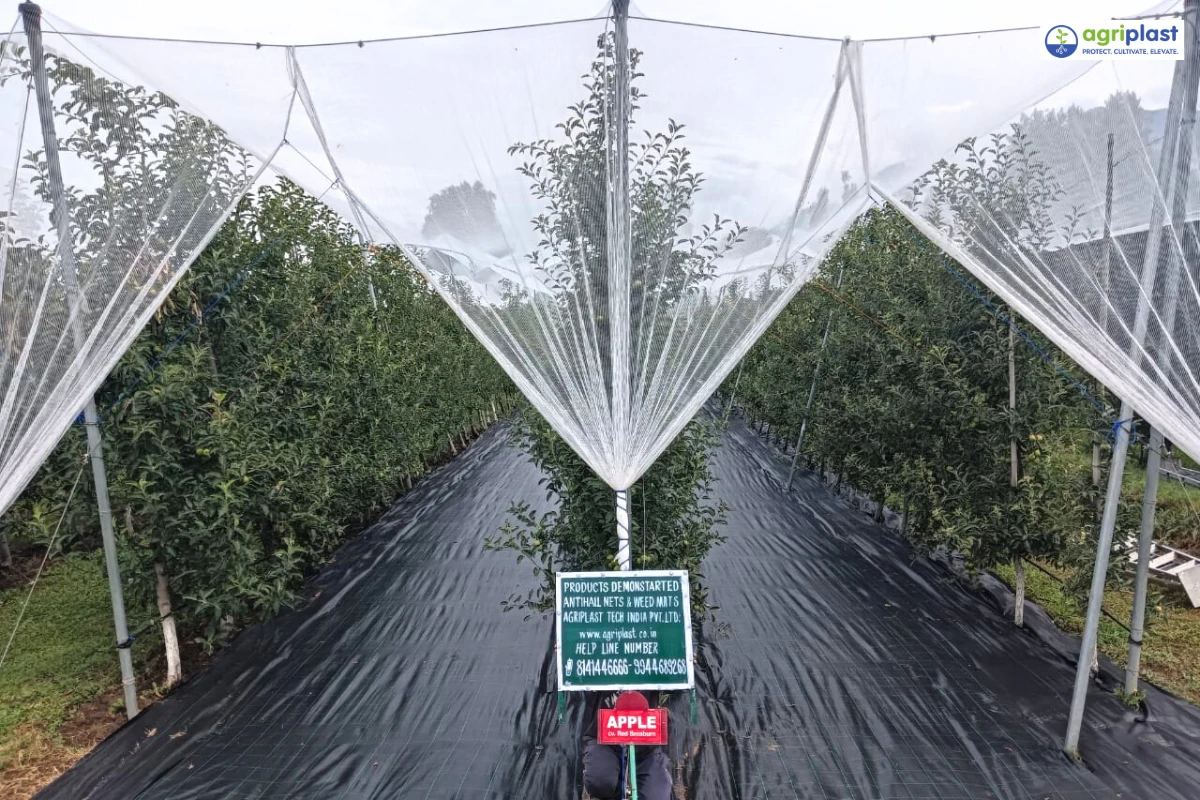
Agriplast anti-hail net on iron pole supports over high-density apple trees with weed mat ground cover — a complete crop protection system at an Agriplast demonstration site
A more durable, structured system designed for modern high-density orchards.
Key features:
- Net installed on iron or metal poles
- Aligned along trellis rows
- Gathered at the top in a V-pattern
Best suited for:
- High-density apple orchards
- Progressive valley-floor farms
- Commercial-scale operations
Practical notes:
- More durable than wooden poles
- Multi-season use
- Commonly installed under MIDH/NHB subsidy projects
3. Full Canopy / Net House Structure
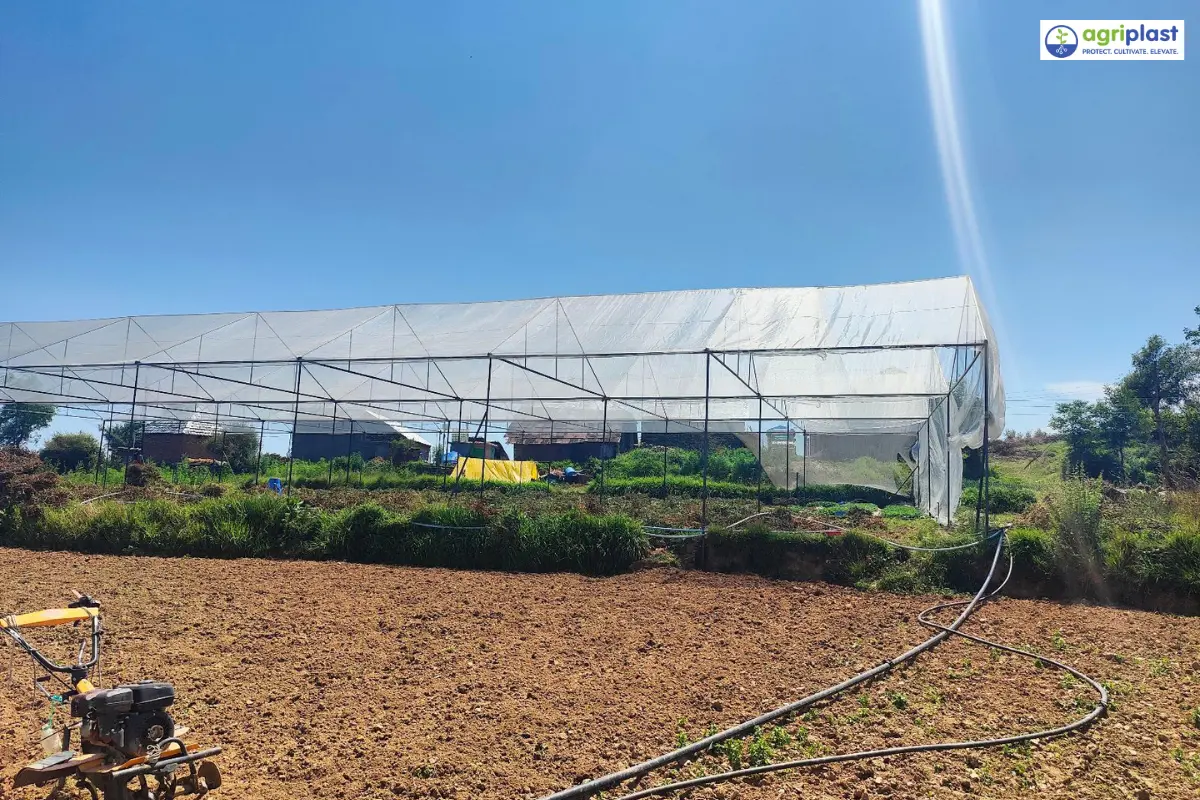
Full canopy structure with permanent steel framework and anti-hail netting — ideal for commercial farms on flat land offering year-round protection from hail birds and excessive sun
A permanent steel framework providing full, year-round protection.
Key features:
- Steel support structure
- Flat-roof netting on top
- Side curtains for added protection
Best suited for:
- Flat commercial farms
- Grapes, pomegranate, and vegetable crops
- Farms needing multi-threat protection
Practical notes:
- Highest initial investment
- Permanent, long-term solution
- Eligible under NHB/MIDH subsidy schemes
There is no single installation method that fits every farm. The right system depends on your terrain, crop type, and budget.
Government Subsidies for Anti-Hail Nets in India
The Indian government subsidises anti-hail net installations under MIDH (Mission for Integrated Development of Horticulture). Under the anti-bird/anti-hail net component, the cost norm is Rs 50 per square metre with 50% subsidy — meaning the government pays half.
The central government covers 60% of the subsidy amount and the state covers 40%; in North-Eastern and Himalayan states, the central share rises to 90%.
Several states offer additional top-ups on top of the central subsidy — check with your district horticulture office for the latest rates in your state, as these change frequently.
Pro tip: Start at your district horticulture office. They'll guide you on which scheme fits your farm and help prepare the Detailed Project Report (DPR) — the single most important document in your application.
How to Choose the Right Anti-Hail Net for Your Farm
With different net types, installation methods, and subsidy options available, here's a simple checklist to narrow down the right choice.
1. What crop are you growing?
Colour-sensitive fruits like apples and grapes need maximum light transmission — Leno woven nets are more transparent than Raschel and better suited for these crops. Crops that tolerate some shade, like pomegranate or mango, work well with Raschel nets (18-23% shade) at a lower cost.
2. How severe is hail in your region?
If your area gets frequent, heavy hailstorms, invest in Leno woven nets — their locked weave structure is stronger and holds up better under impact. For moderate, occasional hail, Raschel knitted nets provide reliable protection at an economical price point.
3. What's your terrain and budget?
Steep hillside orchards in HP, J&K, or Uttarakhand typically use wooden pole support structures — affordable and practical for sloped terrain. Farms on flatter land with higher budgets can go for iron pole trellis systems or permanent canopy structures, which last longer and are often eligible for MIDH subsidy.
4. Do you need multi-purpose protection?
Both Raschel and Leno anti-hail nets also protect against bird damage and reduce sunburn on fruit. If your farm faces multiple threats, a single anti-hail net installation can replace the need for separate bird nets and shade solutions — making it more cost-effective than layering individual nets.
5. What's the real cost per year?
Both Agriplast Raschel and Leno nets come with a 5-year UV-stabilised warranty. Factor the per-year cost, not just the upfront price. A net that costs more but lasts longer on your specific terrain and UV exposure is the better investment.
Not sure which type fits your farm? Contact Agriplast's technical team — with 500+ projects across 15+ countries, they can recommend the right net type, mesh size, and installation method for your crop, region, and budget.
Frequently Asked Questions
Hailstorm damage to crops in India has increased dramatically — from 1.96 million hectares in 2022 to 17.4 million hectares in 2025. For farmers growing high-value horticultural crops, the question is no longer whether to invest in an anti-hail net, but which type to choose and how to install it correctly.
The right hail protection netting system does three things: it prevents catastrophic crop losses from hailstorms, it creates a better microclimate for your crops every day, and it pays for itself within 1-2 seasons when you factor in prevented losses and government subsidies covering 50-85% of the cost.
Whether you grow grapes in Nashik, apples in Shimla, pomegranate in Solapur, or mangoes in Ratnagiri — there is a proven netting solution that fits your crop, your terrain, and your budget.
The real question today is not whether to install an anti-hail net — but which system suits your farm best.
Start by checking your subsidy eligibility at your district horticulture office, then speak to Agriplast's technical team for a crop-specific recommendation.
Blog written and Posted by
Abhinav Roy
Abhinav Roy is an agribusiness professional, agricultural communicator, and host of AgriTalk by Abhinav Roy. He works closely with farmers, agripreneurs, across India to simplify complex agricultural technologies into practical, field-ready insights. With hands-on exposure to protected cultivation, crop protection systems, and farm economics, Abhinav focuses on bridging the gap between science, sustainability, and scalable farming solutions.You can write your view/comments here
Need Expert Assistance?
Get personalized recommendations for your greenhouse, polyhouse, or irrigation needs.
-
Bengaluru (Corporate Office)
- 918141446666
- support@agriplast.co.in
WeWork Roshni Tech Hub - 1st floor, PFS Club House, Marathahalli Main Rd, R.J.Gardens, Lakshminarayana Pura, EPIP Zone, Chinnapanna Halli, Bengaluru, Karnataka 560037