Cucumber Farming in Polyhouse: Cost, Yield & Profit Guide
Cucumber farming in polyhouse is one of the fastest ways for Indian farmers to reach ₹20+ lakh annual revenue from a single acre. The crop grows fast — first harvest in 35-40 days — and you can take 2 cycles per year on soil beds or 3 cycles on soilless troughs from the same structure. That means while open-field farmers get one shot per season, you get two to three.
But the numbers only work if you get the setup right. The wrong film, wrong variety, or wrong fertigation schedule can turn a profitable crop into an expensive learning experience. This guide covers everything you need to make an informed decision: real investment figures, actual yield data from Indian farms, the best parthenocarpic varieties, step-by-step growing instructions, and subsidy options that can reduce your effective setup cost significantly.
Every number in this guide comes from either published research, government data, or firsthand farmer reports.
What This Guide Covers
- Growing conditions — climate, water quality, pH, humidity, and ventilation requirements
- Step-by-step growing guide — from site testing to harvest, 2 pre-steps + 8 execution steps
- Investment and ROI — capital cost, operating cost, and profit projections per acre
- Government subsidies — MIDH/NHM coverage, cost norms, and application process
- Common mistakes — 9 execution errors that cost farmers the most
Why Indian Farmers Are Choosing Cucumber for Polyhouse Farming
Three reasons cucumber has become the go-to crop for polyhouse growers across India:
- Fast cash cycle. Cucumber starts producing fruit within 35–40 days of transplanting — significantly faster than capsicum (60–75 days) or tomato (55–70 days). In a polyhouse, you can run 2 crop cycles per year on soil beds, or up to 3 on soilless systems — January to April, May to August, and September to December. That translates into multiple revenue windows from the same structure, improving cash flow and reducing risk.
- Year-round demand. India is among the world's top cucumber producers, with over 1.3 million tonnes produced annually (National Horticulture Board production data). Demand from urban markets, hotels, restaurants, and the health-focused consumer segment keeps prices relatively stable between ₹20–40/kg through most of the year. Markets like Delhi-NCR, Mumbai, Bangalore, and Hyderabad consistently absorb large volumes without sharp seasonal crashes.
- High compatibility with protected cultivation. Parthenocarpic cucumber varieties (seedless, no pollination required) are specifically bred for greenhouse conditions (ICAR-IARI protected cultivation guidelines). They produce straight, uniform fruits with higher water content and better shelf life compared to open-field varieties — resulting in fewer rejections at the mandi and better price realization per kg.
Farmers growing polyhouse crops across India are increasingly adding cucumber as either a primary or rotation crop — and the economics clearly support this shift.
Growing Conditions For Cucumber: Climate, Soil and Water
Cucumber is a warm-season crop, but inside a polyhouse, you're controlling the environment. Here's what to maintain:
Temperature: Optimal range is 22-28°C during the day and 16-20°C at night (FAO technical guidelines for cucumber). Below 15°C, growth slows. Above 35°C, flowers drop and fruit develops bitterness. If you're in a hot zone (Gujarat, Rajasthan, parts of Maharashtra), a fan-pad cooling system or shade net integration becomes necessary during April-June.
Light: Cucumber needs 12-14 hours of light per day. It's not highly light-sensitive — unlike rose or gerbera — so standard 200-micron polyhouse film transmits enough light in most Indian zones. During peak summer in North India, a retractable shade screen (35-50%) inside the polyhouse prevents leaf burn.
Soil / Growing Media
- Soil beds: Sandy loam with pH 5.5-6.8 (Indian Institute of Horticultural Research soil guidelines). Add 15-20 tons of well-decomposed FYM per acre before planting. Good drainage is non-negotiable — cucumber roots rot in waterlogged conditions.
- Soilless (coco peat trough): This system uses coco peat in long troughs — 20 cm high, 40 cm wide (20×40×20 cm). One 5-kg coco peat brick fills about 1 meter of trough length. The advantage is total control over nutrition and zero soil-borne disease.
Water and Fertigation
Cucumber drinks heavily.
- Daily water requirement: 8,000-15,000 litres per acre depending on season and growth stage
- EC (Electrical Conductivity): Maintain 1.4-2.5 mS/cm in the drip feed
- pH: Around 6.0
- Drip setup: Use a double drip line with 1-litre drippers at 30 cm spacing for uniform wetting
On monitoring: "We check EC and pH daily. If we feed EC 2.0 and the drain reads 1.4, the plant consumed 0.6. That tells us the crop is feeding well. If the drain reads 1.8, something is off — the plant isn't absorbing, and we need to investigate." — Agriplast Agronomist
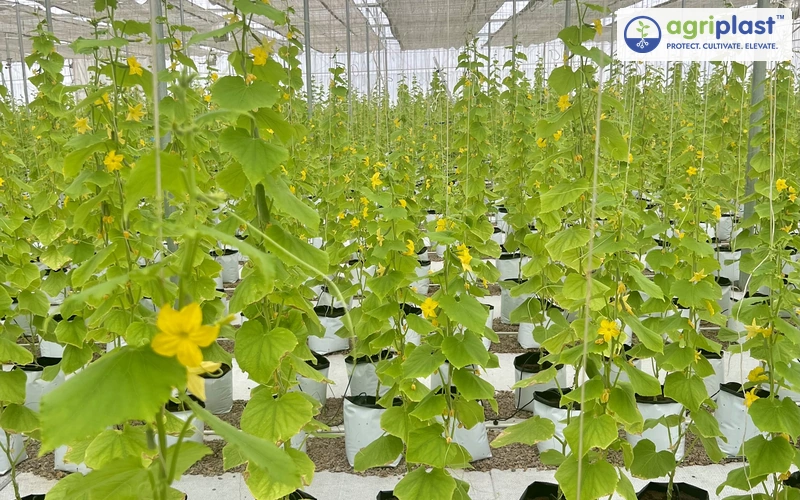
Soilless cucumber cultivation — grow bags with cocopeat substrate and vertical training for maximum yield.
Step-by-Step Growing Guide: From Planning to Harvest
Most cucumber polyhouse guides jump straight to "prepare beds and plant." That's like building a house before checking if the land is yours. The farmers who fail at polyhouse cucumber — and many do — usually skip the thinking that comes before the doing.
This section follows the sequence that successful farmers actually follow. Two planning steps first, then eight execution steps.
Pre-Step 1: Site Feasibility & Resource Audit
A greenhouse is a tool, not a magic wand. It doesn't fix weak fundamentals — it exposes them. Before you invest, take a hard look at your resources.
- Water. Cucumber is a heavy drinker. Each plant needs about 1 litre per day. That translates to roughly 7,000–8,000 litres per acre in winter, and up to 15,000 litres in peak summer. This isn't occasional demand. It's daily. For 90+ days. Without interruption. Also, test your water before you begin. Check EC and pH. Poor quality water will silently reduce yield even if everything else is right.
- Electricity. You don't need heavy infrastructure, but you do need consistency. Irrigation, fertigation, and air circulation all depend on it. Power cuts at the wrong time will hurt the crop.
- Soil. Sandy loam with good drainage works best. Cucumber roots don't tolerate standing water. In fact, waterlogging will damage the crop faster than most pests.
- Greenhouse Structure. A polyhouse only works if it can create the right environment. Minimum benchmarks: ridge height of at least 6.8 metres, wide side ventilation (around 4 metres), and proper top ventilation (about 1.2 metres). If airflow is restricted, temperature and humidity will go out of control — especially in summer.
Pre-Step 2: Market Research & Supplier Planning
Cucumber is perishable. You have 3-5 days at room temperature to sell it. If you plant first and hunt for a buyer later, you'll sell 25-40 tons of produce at distress rates of ₹8-12/kg instead of ₹20-30/kg. The market plan must exist before the first seed goes into the tray.
First, identify your buyers. Visit the nearest APMC mandi and talk to 3-4 commission agents to get an understanding of rates and seasonal patterns. Don't chase off-season production. Focus on healthy, in-season crops. The money comes from volume and consistency, not from trying to sell when the plant is struggling.
Map your selling channels. Local mandi (₹15-25/kg), wholesale market (₹20-30/kg), modern retail like Reliance Fresh or BigBasket (₹30-40/kg), and direct hotel/restaurant supply (₹25-35/kg with contracts). The channel you choose decides your variety, grading standards, and packaging investment.
Source your inputs before you need them. Identify suppliers for: parthenocarpic seeds (lead time: 2-4 weeks from distributor), water-soluble fertilisers (NPK + micronutrients for fertigation), coco peat (if going soilless), and crop protection products. Running out of a critical input mid-season is expensive — the crop doesn't wait.
Labour planning. Cucumber requires at least 4-5 labourers per acre for planting, training, clipping, daily harvesting, and packing. Skilled workers who understand plant training are harder to find than general farm labour. Start recruiting early.
Step 1: Choose Your Growing System — Soil or Soilless
Cucumber can be grown in a polyhouse both in soil and soilless systems. This is the single biggest decision after building the structure, because it determines your yield ceiling, operating cost, and skill requirement for the entire operation.
| Factor | Soil Beds | Soilless Trough |
|---|---|---|
| Setup cost (beds/troughs per acre) | ₹50,000 – 1,00,000 | ₹2,00,000 – 3,00,000 |
| Crop cycles per year | 2 (soil needs rest + 45-day solarisation between cycles) | 3 (no rest period needed — sterile media) |
| Yield per cycle | ~40 tons (4-6 kg/plant) | 40-50 tons |
| Annual yield per acre | ~80 tons | 120+ tons (50t Jan-Apr, 40t May-Aug, 30-40t Sep-Dec) |
| Soil/media requirement | Sandy loam, mandatory solarisation + EC flushing before each cycle | Coco peat in troughs, roots spread 8-9m along trough |
| Monitoring intensity | Moderate — soil buffers small mistakes | High — daily EC and pH checks, no exceptions |
| Disease risk | Higher (soil-borne pathogens accumulate) | Lower (sterile media, no carryover) |
| Best for | First-time polyhouse farmers learning the crop | Experienced growers ready for precision farming |
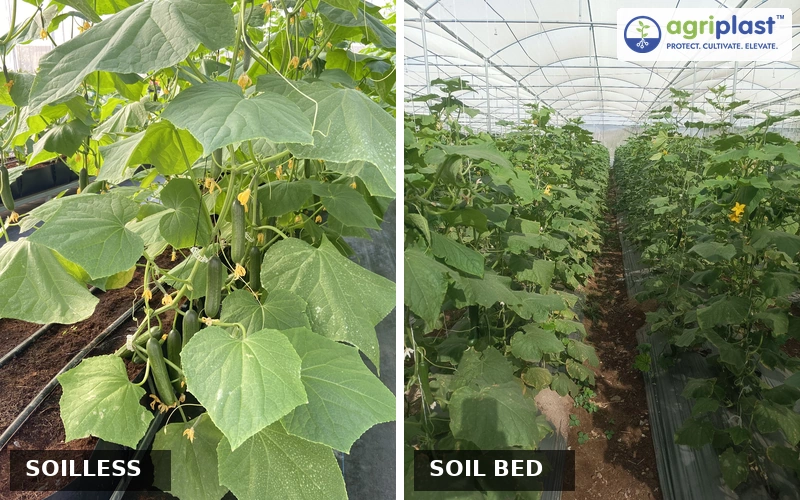
Soilless troughs (left) vs soil beds (right) — two approaches to polyhouse cucumber farming.
Step 2: Prepare Beds or Troughs
| Parameter | Soil Beds | Soilless Troughs |
|---|---|---|
| Bed/trough dimensions | 80 cm wide, 1 foot (30 cm) high, 80 cm walking paths | Trough 20×40×20 cm — 20 cm high, 40 cm wide |
| Growing media | Sandy loam + 15-20 tons well-decomposed FYM per acre | Coco peat — 5 kg per running metre (soak and flush before planting to remove excess salts) |
| Moisture check | "Laddu test" — squeeze a handful of soil into a ball. Holds shape but crumbles when poked = right. Drips = too wet. Won't hold = too dry. | EC/pH of drain runoff (covered in Step 6) |
| Drip setup | Single drip line per row | Double drip line, 1-litre drippers at 30 cm spacing |
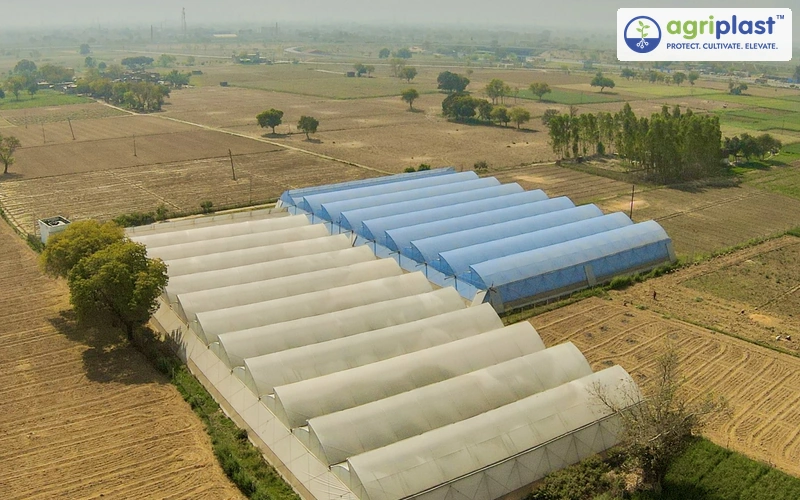
Aerial view of a commercial polyhouse cluster — the structure that makes year-round cucumber farming possible.
Step 3: Select the Right Variety for Your Season
Variety selection is not a one-time decision. Different varieties perform better in different seasons, and planting the wrong variety at the wrong time causes flower abortion — the plant flowers but drops fruit before it can develop.
Inside a polyhouse, you must grow parthenocarpic varieties — seedless cucumber types that don't need pollination from insects. The polyhouse film and insect netting block bee entry, so non-parthenocarpic varieties will produce deformed or no fruit.
Agriplast Agronomist's advice: follow a seasonal rotation and experiment with varieties to see which one suits your location the best.
| Season | Months | Recommended Variety | Seed Company | Why This One |
|---|---|---|---|---|
| Winter (Rabi) | January – March | Multistar | Nunhems (BASF) | Early maturity, handles cool nights well |
| Summer | April – June | King Star | — | Heat-tolerant, holds fruit in high temperatures |
| Monsoon (Kharif) | July – September | Captain Star | — | Handles humidity, less fungal susceptibility |
| Late winter | October – December | PA-64 | Seminis | Good yield in declining day length |
| Alternative | Any | Fadiya | Enza Zaden | Consistent performer across seasons |
Another key decision while choosing a variety is between single-fruiting and multi-fruiting types — this determines how many fruits develop at each node.
In practice, single-fruiting varieties (one fruit per node) tend to be more stable and consistent in production. They place less stress on the plant and maintain better fruit uniformity across the crop cycle.
Multi-fruiting varieties can offer higher output per node, but require tighter control over nutrition and climate to perform well.
Seed cost: ₹2-3 per seed. At approximately 10,800 plants per acre (2.7 plants per sq metre in a pair-row zigzag layout with 40 cm spacing), your total seed cost is ₹22,000-32,000 per cycle.
Step 4: Nursery and Transplanting
Sow seeds in pro trays (plug trays) filled with coco peat and vermicompost. One seed per cell. Seeds typically germinate in 3–4 days at 25–28°C. Below 20°C, germination is slower and uneven. Seedlings are ready for transplanting at 2–3 true leaves — usually 15–20 days after sowing.
For transplanting, use a pair-row zigzag pattern — two rows per bed, with plants staggered so each plant gets maximum light. Maintain spacing of 40 cm between plants. This layout gives approximately 2.7 plants per square metre, or around 10,800 plants per acre.
Transplant in the evening or on a cloudy day to reduce shock. Water immediately after planting.
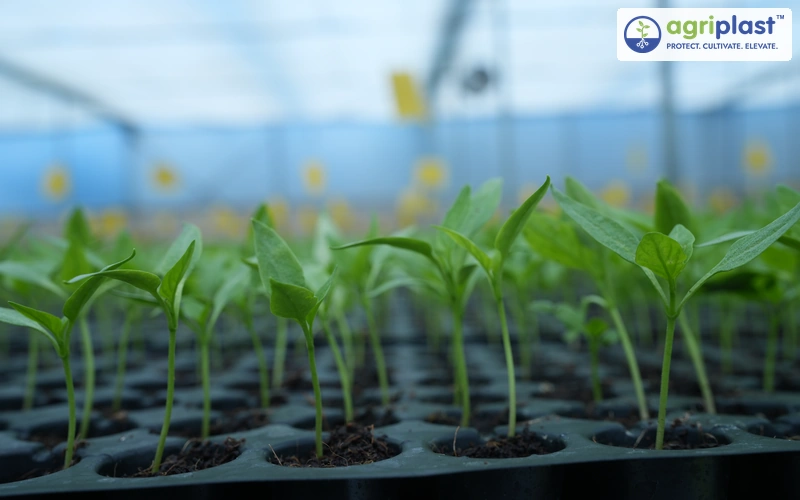
Healthy seedlings in pro trays — ready for transplanting at 15-20 days after sowing.
Step 5: Training, Clipping, and Pruning
Cucumber grows fast. Once established, a plant can add several centimetres per day. Without proper management, the crop turns into a dense canopy with poor airflow and uneven fruit. Training and clipping are not occasional tasks. They are daily operations.
Training: Install GI wire or nylon string from the overhead structure and guide the plant upward using clips or twine from the first week after transplanting. Early direction keeps the plant structured and easy to manage.
Clipping: Start around day 15. Remove all side shoots and flowers from the lower nodes (typically up to the 2nd–3rd node). This pushes energy into the main stem and builds a stronger plant. After this stage, continue managing side shoots to maintain balance between vegetative growth and fruiting.
Leaf pruning for ventilation: As the plant grows, the lower canopy becomes dense and restricts airflow. Remove older and yellowing leaves from the bottom gradually. Good airflow is critical — wet, stagnant foliage creates the perfect environment for fungal diseases like powdery mildew and downy mildew. Proper spacing, pruning, and ventilation together keep the crop healthy.
Why this matters: Unmanaged plants waste energy on excess foliage. Proper training and pruning improve fruit uniformity, increase the share of Grade A produce, and make harvesting faster and more efficient.
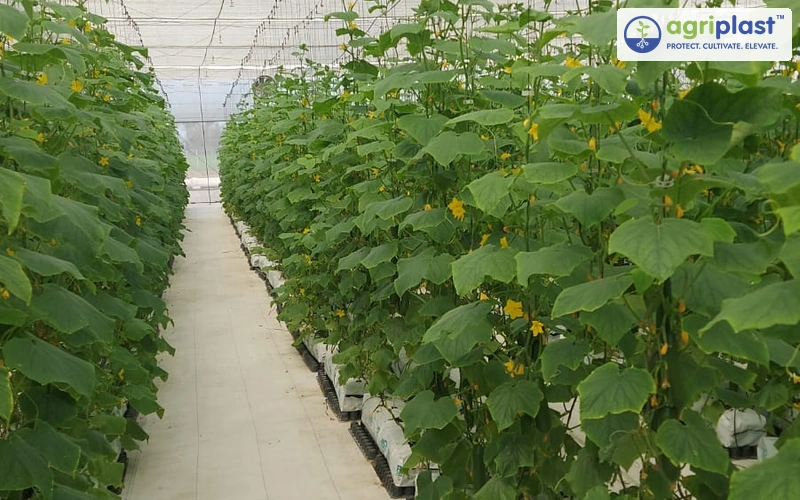
Vertical string training in a soilless setup — daily clipping and pruning keeps the canopy productive.
Step 6: Irrigation and Fertigation
In a polyhouse, irrigation and fertigation function as one system. Water and nutrients move together through drip lines and must be managed together.
Irrigation basics: Drip is essential. Flood irrigation leads to root rot, uneven growth, and water loss. A practical baseline is ~1 litre per plant per day — about 7,000–8,000 litres per acre in winter, increasing to 12,000–15,000 litres in summer.
For soilless systems, use double drip lines with 1-litre drippers at 30 cm spacing for uniform distribution.
Fertigation — the Two-Half Rule
Split the crop cycle into two phases. Early stage (establishment to flowering) prioritises phosphorus for root and structural development. Later stage (fruiting to harvest) shifts to potassium for fruit quality and shelf life. Nitrogen remains steady throughout.
| Growth Phase | Primary Focus | EC (mS/cm) | Water Requirement |
|---|---|---|---|
| Establishment (0–15 days) | Phosphorus (roots) | 1.2–1.4 | 7,000–8,000 L/acre/day |
| Vegetative + early flowering (15–40 days) | Phosphorus + nitrogen | 1.4–1.8 | 8,000–10,000 L/acre/day |
| Fruiting + harvest (40–90+ days) | Potassium (fruit quality) | 1.8–2.5 | 10,000–15,000 L/acre/day |
EC and pH Monitoring (Soilless)
Monitor EC daily to track nutrient uptake. If feed EC is 2.0 and drain is 1.4, uptake is efficient. If drain is close to feed, uptake is low — check roots, pH, or temperature.
Maintain pH around 6.0 for soilless systems. For soil beds, a wider range of 5.5–6.8 is acceptable.
Leaching irrigation: Run plain water every 7–10 days to flush excess salts and prevent root damage.
Step 7: Pest and Disease Management
Inside a polyhouse with proper 40-mesh insect netting, pest pressure drops significantly compared to open field. But it does not disappear. The risks shift — from insects to diseases driven by humidity and poor airflow.
The biggest threat is fungal, not insect. In polyhouse cucumber, the main risks are powdery mildew, downy mildew, and stem rot. These develop when foliage stays wet and air movement is restricted. If ventilation and humidity are managed well, most problems are avoided.
| Threat | What to Watch For | Prevention |
|---|---|---|
| Powdery mildew | White powdery patches on upper leaf surface | Maintain airflow, regular leaf pruning, avoid prolonged leaf wetness |
| Downy mildew | Yellow patches on upper leaf, grey mould underneath | Keep humidity below ~80%, ensure proper ventilation during the day |
| Stem rot (early stage) | Soft, brown stem base in first 10–15 days | Avoid excess moisture near stem, control irrigation carefully |
| Red spider mite | Fine webs under leaves, yellowing | Maintain balanced humidity, avoid plant stress |
| Whitefly | Sticky honeydew, sooty mould | Use 40-mesh insect netting, monitor regularly |
Prevention vs Cure
In a polyhouse, prevention is the system — not a separate step. Proper anti-insect netting and ventilation through quality polyhouse film with low condensation drip reduce most risks before they appear. Once disease sets in, control becomes difficult and losses escalate quickly.
Step 8: Harvesting and Post-Harvest
First harvest timing: 35–40 days after transplanting in soilless systems, and around 45 days in soil beds. After the first harvest, picking continues daily for 3–4 months per cycle.
Harvest standards: Target fruit weight: ~120 grams. Length: 15–20 cm (variety-dependent). Appearance: dark green, straight, uniform, no yellowing. In summer, harvest early morning (6–8 AM). Afternoon harvesting reduces shelf life.
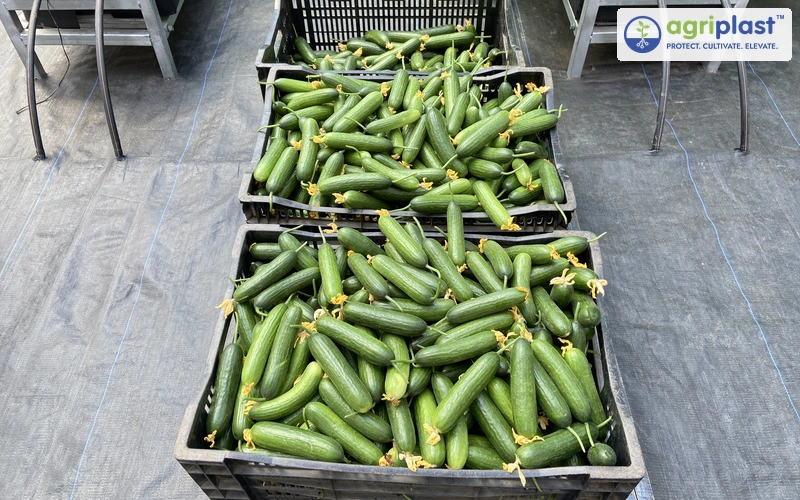
Harvest-ready cucumbers — uniform grade, no blemishes, premium market quality.
Post-Harvest Handling
Grade by size and quality. Use ventilated plastic crates — avoid gunny bags. Shelf life: 3–5 days at ambient temperature, 10–14 days at 10–12°C cold storage.
Selling Channels and Rates
- Local mandi: ₹15–25/kg
- Wholesale: ₹20–30/kg
- Modern retail: ₹30–40/kg
- Hotels/restaurants: ₹25–35/kg (contract-based)
Maintain an average of ~₹20/kg across the year. Below this, soilless economics become difficult.
Season Planning — Soil vs Soilless
- Soil beds: Typically 2 cycles per year. Allow a rest period and ~45 days of solarisation between cycles. Avoid a third cycle — disease pressure increases and yield drops.
- Soilless systems: Up to 3 cycles per year — Jan–Apr: ~50 tons, May–Aug: ~40 tons, Sep–Dec: ~30–40 tons. No rest period required, as the growing media remains controlled.
How Much Does Polyhouse Cucumber Farming Cost Per Acre?
This is the first question every farmer asks, and it deserves a straight answer.
Capital Investment (One-Time Setup)
| Item | Cost Per Acre (₹) | Notes |
|---|---|---|
| Polyhouse structure (GI pipe, cladding, film, insect net, mulch, installation) | 40,00,000 – 45,00,000 | Includes UV-stabilized greenhouse film, 40-mesh insect netting, and mulch film. Fan-pad structures cost more than naturally ventilated. |
| Civil work, irrigation, fertigation unit, labour room, and miscellaneous | 5,00,000 – 15,00,000 | Varies by site — includes land levelling, plumbing, electrical, storage, and worker facilities |
| Raised bed / soilless trough setup | 50,000 – 3,00,000 | ₹50K-1L for soil beds; ₹2-3L for soilless trough system |
| Total Capital | 46,00,000 – 63,00,000 | Government subsidy covers 50% of cost norm — see Subsidy section |
Operating Cost Per Crop Cycle (3-4 Months)
| Item | Cost Per Cycle (₹) | Notes |
|---|---|---|
| Seeds (parthenocarpic hybrid) | 70,000 – 85,000 | ~10,000 plants per acre at ₹7+ per seed |
| Fertilisers and nutrients | 30,000 – 45,000 | Water-soluble NPK + micronutrients via fertigation |
| Plant protection (pesticides, IPM inputs) | 15,000 – 25,000 | Lower inside polyhouse due to physical barriers |
| Labour (planting, training, clipping, harvesting) | 50,000 – 80,000 | 4-5 workers per acre for the full cycle; biggest variable across states |
| Electricity and water | 15,000 – 20,000 | Pumping, fan-pad operation (if applicable) |
| Total Per Cycle (Soil Beds) | ₹2,50,000 – 3,00,000 | Drops to ₹2-2.25L where labour is cheaper |
| Total Per Cycle (Soilless) | ₹3,00,000 – 4,00,000 | Higher media + nutrient cost |
| System | Cost Per Cycle | Cycles/Year | Annual Operating Cost |
|---|---|---|---|
| Soil beds | ₹2.5 – 3.0 lakh | 2 | ₹5.0 – 6.0 lakh |
| Soilless troughs | ₹3.0 – 4.0 lakh | 3 | ₹9.0 – 12.0 lakh |
Important: These are working figures from greenhouse operations in UP and Delhi-NCR. Costs vary ±15% across states — labour is the biggest variable.
Expected Yield and Production Numbers
Here's where polyhouse cucumber farming separates itself from open field. The yield difference is not marginal — it's a multiple.
| Parameter | Soil Beds (Polyhouse) | Soilless Trough (Polyhouse) |
|---|---|---|
| Yield per plant | 4-6 kg | Higher (trough root volume advantage) |
| Plants per acre | ~10,000 (pair-row zigzag, 40 cm spacing) | ~10,000 |
| Yield per acre per cycle | ~40 tons (target 40-45 tons) | 40-50 tons |
| Crop cycles per year | 2 (soil needs rest + 45-day solarisation) | 3 (Jan-Apr, May-Aug, Sep-Dec) |
| Annual yield per acre | ~80 tons | 120+ tons |
| Days to first harvest | ~45 days | 35-40 days |
| Harvest duration per cycle | 3-4 months, daily picking | 3-4 months, daily picking |
The basic production math: 4 kg per plant × 10,000 plants = 40 tons per crop cycle. In good conditions, this goes up to 6 kg per plant. Soilless troughs push yield further because roots spread 8-9 metres along the trough — far more root volume than pots or grow bags.
Why soil beds max out at 2 cycles: The soil needs a rest period plus 45 days of solarisation between crops to kill soil-borne pathogens. Attempting 3 cycles on soil beds leads to disease buildup and falling yields. Soilless troughs use sterile coco peat — no rest period needed, so you get that third cycle.
Profit and ROI: What Farmers Actually Earn
Numbers from real operations, not projections.
Soil-Based Operation
| Parameter | Per Crop Cycle | Annual (2 Cycles) |
|---|---|---|
| Gross revenue | ₹8 – 9 lakh | ₹16 – 18 lakh |
| Operating cost | ₹2.5 – 3 lakh | ₹5 – 6 lakh |
| Net operating profit | ₹5 – 6.5 lakh | ₹10 – 13 lakh |
Soilless Operation
| Parameter | Annual (3 Cycles) |
|---|---|
| Gross revenue | ₹24 – 30 lakh |
| Average selling rate | ₹20 – 25/kg |
| Operating cost | ₹9 – 12 lakh |
| Net operating profit | ₹12 – 21 lakh |
🎥 Watch: Soilless Cucumber Farming Economics — 120 Tons Per Year From One Acre
Hear directly from Piyush Pandey, an Agriplast agronomist with 18+ years of field experience, as he walks through a live soilless cucumber greenhouse in Ghaziabad (Delhi NCR). He explains how the trough system (17×40 cm cocopeat troughs) works, why roots respond faster in soilless vs grow bags, daily EC/pH monitoring, the 3-cycle production plan (50t + 40t + 30-40t = 120 tons/year), and how this translates to ₹24-30 lakh gross revenue per acre.
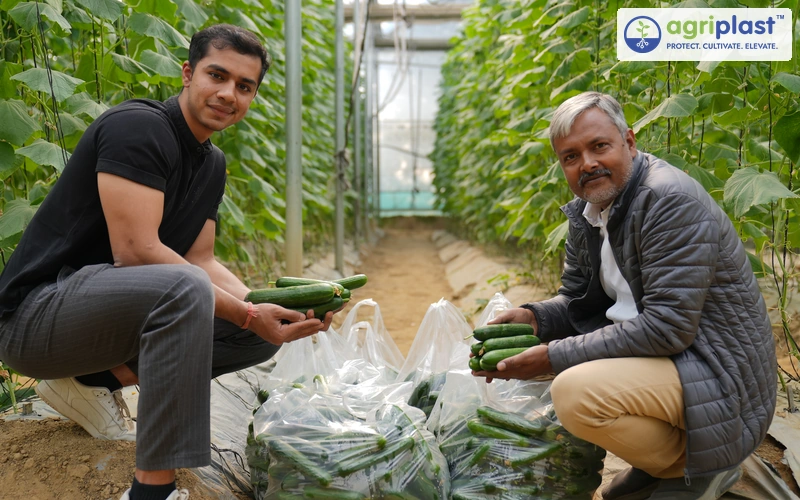
Real returns from real operations — Agriplast team with a cucumber farmer reviewing harvest output.
Capital Recovery Timeline
| Scenario | Without Subsidy | With ~₹20L NV Subsidy |
|---|---|---|
| Effective capital | ₹46 – 63 lakh | ₹26 – 43 lakh |
| Soil-based recovery (₹10-13L/year profit) | 3.5 – 6.3 years | 2 – 4.3 years |
| Soilless recovery (₹12-21L/year profit) | 2.2 – 5.3 years | 1.2 – 3.6 years |
📌 Note: Subsidy is calculated on government cost norms (₹1,000/sq.m. for naturally ventilated, ₹1,600/sq.m. for fan-pad), not on actual expenditure. Fan-pad structures receive higher subsidy (~₹32L for 1 acre). Actual subsidy depends on structure type and state-level top-ups.
Government Subsidies for Polyhouse Farming in India
The Indian government covers 50% of the approved cost norm for polyhouse setup under MIDH and NHM schemes, with a maximum cap of ₹1 crore per project. The subsidy is calculated on government-set cost norms (₹1,600/sq.m. for fan-pad, ₹1,000/sq.m. for naturally ventilated) — not on your actual expenditure. For a one-acre naturally ventilated polyhouse, that works out to roughly ₹20 lakh in subsidy.
This is a credit-linked, back-ended subsidy — you take a bank loan, build the structure, get it inspected, and the subsidy is credited to your loan account. No upfront cheque. Minimum area: 4,000 sq.m. in general areas, 1,000 sq.m. in NE and hilly regions. Some states (Haryana, Telangana, Karnataka) offer additional top-ups of 15-45%.
One non-negotiable rule: Apply before you build. Most schemes require pre-approval and a Detailed Project Report (DPR). Building first and applying later gets rejected. Plan finances to cover 100% upfront, keep every receipt, and expect 6-12 months for disbursement.
Common Mistakes to Avoid in Polyhouse Cucumber Farming
Polyhouse cucumber is profitable, but execution-sensitive. Most losses happen in the first 1–2 crop cycles due to avoidable mistakes.
- Poor soil health management (soil beds). Ignoring soil health leads to disease buildup and declining yields. Practices like solarisation, proper drainage, and organic matter management are essential between cycles.
- Overwatering after transplanting. The first 10–15 days are critical. Excess moisture at the stem base causes fungal rot and plant loss. Water lightly, keep the base dry, and monitor daily. Losses above 5–10% indicate over-irrigation or poor drainage.
- Wrong variety selection. Each season needs a specific variety. Mismatch leads to flower drop and poor fruit set. Always align variety with season and climate.
- Chasing off-season production. Forcing crops in unfavourable conditions increases disease, reduces yield, and raises costs. Consistent in-season production is more reliable than one off-season attempt.
- Poor EC and pH management (soilless). Soilless systems have no buffer. Small errors show up fast. Without daily EC and pH monitoring, nutrient imbalance and root stress are common.
- Weak canopy management — pruning, training, and ventilation. Dense, untrained plants block airflow, trap moisture, and invite fungal disease. Training, clipping, and leaf removal are daily tasks, not occasional ones. Proper ventilation height and buffer zones between plants are equally important.
- Poor water quality. High EC or incorrect pH in irrigation water reduces nutrient uptake and affects yield. Always test water before starting.
- Delayed harvesting. Skipping harvests leads to oversized fruit, lower prices, and reduced plant productivity. Harvest frequently.
- Underestimating labour requirement. Cucumber needs daily attention — training, clipping, harvesting. Lack of skilled labour directly impacts yield and quality.
Frequently Asked Questions
Start With the Right Setup
Cucumber farming in polyhouse works because the controlled environment removes the three biggest risks in farming — weather, pests, and inconsistent quality. The investment is real, but the subsidy significantly reduces your effective capital outlay, and the returns — ₹16-30 lakh gross per acre per year — justify the commitment.
The pattern is consistent across successful farmers: invest in quality materials, follow the science, and the numbers follow.
If you're planning a polyhouse cucumber operation and want guidance on the right film, netting, and mulch for your zone and climate — connect with Agriplast's technical team. The agronomist consultation is free, and they support you through the crop cycle, not just the purchase.
Call: 8141-46-6666 | WhatsApp: 8861-461-730
Blog written and Posted by
Abhinav Roy
Abhinav Roy is an agribusiness professional, agricultural communicator, and host of AgriTalk by Abhinav Roy. He works closely with farmers, agripreneurs, across India to simplify complex agricultural technologies into practical, field-ready insights. With hands-on exposure to protected cultivation, crop protection systems, and farm economics, Abhinav focuses on bridging the gap between science, sustainability, and scalable farming solutions.You can write your view/comments here
Need Expert Assistance?
Get personalized recommendations for your greenhouse, polyhouse, or irrigation needs.
-
Bengaluru (Corporate Office)
- 918141446666
- support@agriplast.co.in
WeWork Roshni Tech Hub - 1st floor, PFS Club House, Marathahalli Main Rd, R.J.Gardens, Lakshminarayana Pura, EPIP Zone, Chinnapanna Halli, Bengaluru, Karnataka 560037