Insect Net for Polyhouse and Open Field Farming: How It Improves Crop Yield
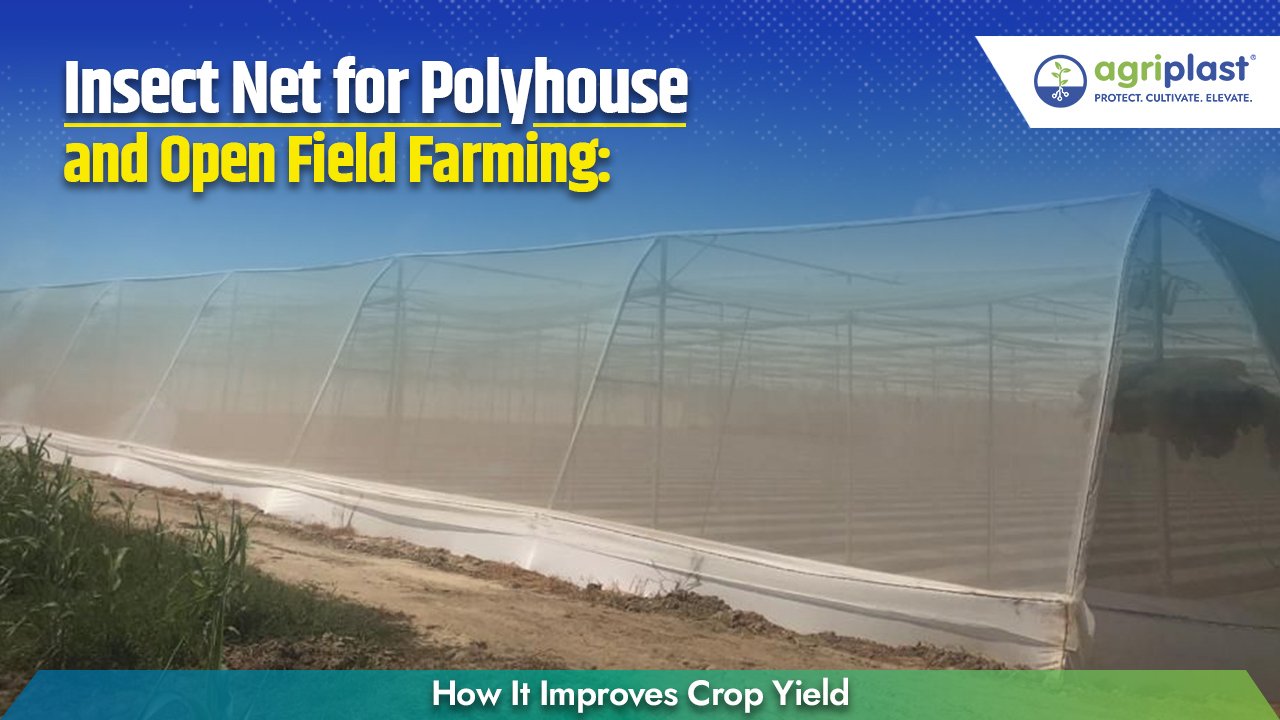
Every year, pests and diseases consume 20–25% of India's total food production — documented by ICAR-CIPHET, cited in the Indian Pesticides Market report (Research & Markets, 2024). For high-value crops like capsicum, rose, cucumber, and gerbera, losses run far higher.
India's pesticide market reached ₹274 billion in 2025 and is projected to reach ₹464 Billion by 2034, growing at a compound annual growth rate of 5.49% from 2026-2034 (IMARC Group, 2025). Yet resistance keeps growing, residue violations keep triggering export rejections, and the spray calendar keeps getting longer.
More spraying is not the solution. It never was.
An insect net is a physical barrier placed between the pest and your crop. The pest never enters. No spray is triggered. No resistance builds. No residue ends up on your produce.
This guide explains how insect nets work in polyhouse and open field farming, the benefits they deliver, and how to choose the right net for your crop.
What This Guide Covers
- Why insect nets matter in Indian farming
- Benefits of insect nets in farming
- Insect nets in polyhouse farming
- Insect nets in open field farming
- Polyhouse vs open field: side-by-side
- Which insect net is right for your crop
- Farmer Result: Agriplast insect net on the ground
- Frequently asked questions
_1776431629_69e2320dd87ca.webp)
Top: Agriplast insect net on polyhouse sidewalls — blocks insects at the boundary. Bottom: Open field insect net tunnel enclosing crop rows — the net forms the protective structure itself.
Why Insect Nets Matter in Indian Farming
Indian agriculture spends billions on pesticides every year. Yet pest damage keeps climbing. That's not a coincidence — it's what happens when the only tool is a spray.
The Problem With Relying Only on Pesticides
Pesticide consumption in India stands at 0.5 kg per hectare — compared to 17 kg per hectare in some countries, according to a Parliamentary Standing Committee report (December 2023). Even at this relatively low level, three critical problems exist:
- Resistance is growing. Insects adapt to chemicals over time. Pests that were easily controlled a few seasons ago now require stronger doses or more frequent applications to get the same result.
- Residues are causing export rejections. India's produce is regularly rejected in EU and US markets for exceeding Maximum Residue Limits (MRLs). High pesticide use is directly linked to these rejections — a recurring cost to Indian farmers selling to premium buyers.
- Spraying treats damage, not entry. Pesticides act after insects have already entered the crop environment. By the time you spray, the pest is already feeding, laying eggs, or transmitting a virus.
What Insect Nets Do Differently
An insect net is a physical barrier. It stops insects from reaching the crop in the first place — before they feed, before they breed, before they spread disease.
According to FAO's Integrated Pest Management programme, physical exclusion barriers are among the most effective non-chemical tools in IPM precisely because they work without ever creating resistance.
No resistance builds up. No residues accumulate on your produce. No repeat purchase every season. The net keeps working until it needs replacing — typically 5–7 years later.
Benefits of Insect Nets in Farming
Here are the measurable outcomes farmers see when insect nets are installed correctly — backed by research and field data.
40–80% Reduction in Pesticide Use
Farmers using correctly installed insect nets report a 40–80% reduction in pesticide purchase costs. This range is supported by a peer-reviewed study published in the journal PMC (NCBI, 2019), which found that insect-proof nets in cultivation environments significantly reduced pest and disease incidence — with some tested setups achieving zero chemical pesticide input across the full growth period.
Reduction levels vary by crop type, mesh size, installation quality, and pest pressure in your region.
Virus Prevention — Not Just Pest Control
This is the most undervalued benefit. Thrips and whiteflies don't just damage crops — they transmit viruses. Once a virus spreads inside an enclosed polyhouse, entire batches are lost.
- Capsicum: Tomato Yellow Leaf Curl Virus (TYLCV), transmitted by whiteflies
- Rose and gerbera: Tomato Spotted Wilt Virus (TSWV) and Impatiens Necrotic Spot Virus (INSV), transmitted by thrips
- Cucumber: Cucumber Mosaic Virus (CMV), transmitted by aphids
- Banana: Banana Bunchy Top Virus (BBTV), transmitted by aphids
Research published in Scientific Reports (Nature, 2024) found that insect nets incorporating optical properties — specifically red-coloured fibres — significantly suppressed thrips invasion rates and reduced virus-related crop damage. The study confirmed that visual deterrence in the net material itself reduces pest entry beyond what mesh size alone can achieve.
The Agriplast Ginegar OptiNet is built on this principle: UV-sensitive optical additives in the HDPE yarn disorient thrips and whiteflies before they reach the net surface, reducing pest entry by up to 5x compared to a standard 50-mesh net.
Better Produce Quality and Export Access
Crops protected from pest damage have fewer blemishes, lower residue loads, and longer shelf life — directly improving prices in both domestic mandis and export markets.
EU buyers enforce strict Maximum Residue Limits (MRLs) under EC Regulation 396/2005. A correctly installed insect net reduces the number of spray rounds needed, which reduces residue accumulation on the produce — the most direct path to export qualification.
Lower Labour Costs per Cycle
Fewer spray rounds means fewer labour hours. For a 2.5-acre polyhouse farm running capsicum, this can reduce operational labour meaningfully across each crop cycle — a saving that compounds over the 5–7 year life of the net.
5–7 Year Return from a One-Time Investment
Unlike pesticides — a recurring cost every season — a quality insect net is a one-time capital investment. Agriplast's 135 GSM insect net carries a 5-year UV warranty. Many installations last 6–7 years with correct maintenance.
Insect Nets in Polyhouse Farming
A polyhouse manages rain, temperature, and humidity through its greenhouse film. But it can't stop insects from entering through ventilation gaps.
Thrips, whiteflies, and aphids enter through sidewall openings, gable vents, door frames, and roof vents. Once inside, they breed quickly in the warm, humid microclimate.
The role of the Agriplast Insect Net in a polyhouse is boundary exclusion. It goes on sidewalls, vent panels, door surrounds, and gable ends — at every entry point.
Why 50-Mesh Is the Standard for Polyhouse Use
The dominant pest in Indian polyhouses is thrips — just 1.0–1.5 mm in body length. A standard 40-mesh net has openings of approximately 0.42 × 0.54 mm. Thrips can fly straight through.
- 50-mesh blocks thrips effectively — this is the minimum specification for polyhouses with rose, gerbera, capsicum, or cucumber.
- 40-mesh is not sufficient in thrips-heavy polyhouses. This is not a grey area.
The Agriplast Ginegar OptiNet takes this further. It is a 50-mesh net with patented optical additives built into the HDPE yarn — additives that disorient thrips and whiteflies before they even reach the net surface.
This reduces pest entry by up to 5x compared to a standard 50-mesh net without optical properties, as confirmed in Agriplast's field data. For export-oriented floriculture farms, this directly reduces spray frequency and residue load.
GSM Guide for Polyhouse Sidewall Installation
- 105–120 GSM — standard for naturally ventilated polyhouses. Allows sufficient airflow while blocking insects.
- 135 GSM — for coastal zones, Himachal Pradesh, hilly terrain, and high-wind locations where mechanical stress is higher.
All Agriplast insect nets carry a declared 5-year UV life — non-negotiable for fixed polyhouse installations that can't be replaced every season.
To understand how insect nets reduce pesticide dependency and why this matters for food safety certification,
Read: Insect Nets in Agriculture: How They Reduce Pesticides and Improve Food Safety.
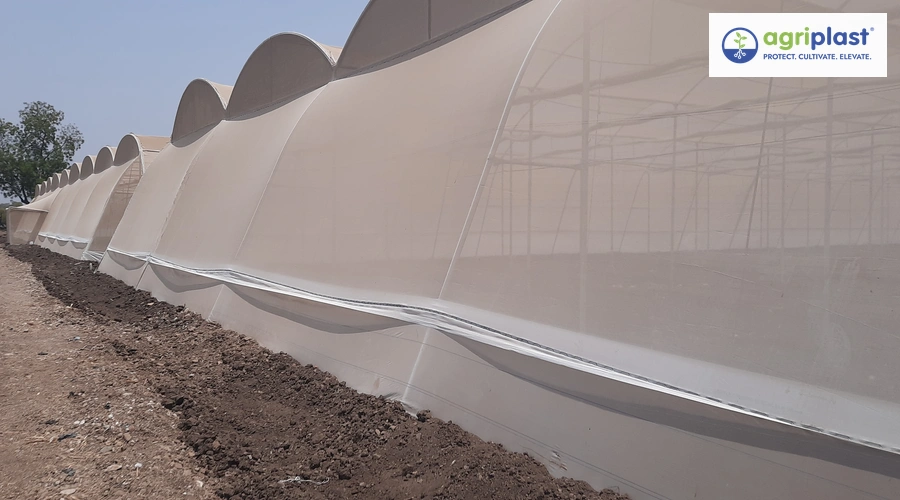
Agriplast insect net covering the full sidewall of a polyhouse — the scalloped roll-up panels allow controlled ventilation while the net blocks thrips, whiteflies, and aphids at every entry point.
Insect Nets in Open Field Farming
In open field farming, there is no polyhouse frame to attach a net to. The insect net itself becomes the structure. It is stretched over low hoops or support frames directly over the crop rows — covering plants from above and from all sides.
Why the Role Is Completely Different
In a polyhouse, the net controls access. In open field, the net controls the entire crop environment. Pest exposure in open field is 360 degrees. Fruit flies, leaf miners, aphids, whiteflies, grape moth, and pomegranate borer come from every direction.
Airflow also matters far more in open field tunnels. Poor ventilation inside a closed tunnel creates excess humidity — leading to fungal diseases like downy mildew and botrytis that can be worse than the pests themselves.
Why 40-Mesh Is the Standard for Open Field Use
- 40-mesh — the recommended standard. Slightly larger openings than 50-mesh = better airflow = healthier crop environment. Effectively blocks aphids, fruit flies, whiteflies, and leaf miners.
- 50-mesh in open field — only when growing high-value export vegetables in documented heavy thrips zones (parts of Telangana, Maharashtra, Karnataka). Weigh it against the airflow cost.
Open Field Structure Types and Net Widths
| Structure | Application | Net Width Needed | Crop Examples |
|---|---|---|---|
| Low-tunnel hoop system | Vegetable rows, nursery beds | 2.5–3.5m | Capsicum, tomato, brinjal seedlings |
| Walk-in tunnel | Taller crops, ease of field access | 4.0–5.2m | Cucumber, bitter gourd, pomegranate |
| Net house (fixed frame) | Permanent semi-protected structure | Custom stitched widths | Papaya, banana, floriculture |
| Overhead row cover | Orchards, vineyards, berry farms | Depends on row spacing | Grapes, blueberries, strawberries |
Agriplast insect nets are available in widths from 2.5m to 5.2m in standard rolls (50m or 100m), and can be stitched to custom widths for larger walk-in structures.
GSM Guide for Open Field Use
- 120–135 GSM — right for all open field applications. Direct wind and rain load requires heavier GSM than polyhouse sidewall use.
- 135 GSM mandatory for coastal areas (Konkan coast, Gujarat Saurashtra), wide-span walk-in structures, and high-wind corridors.
Non-stabilised nets fail fast under Indian summer radiation in high-UV zones — Rajasthan, Gujarat, Maharashtra. Always check for a declared, warranted UV life before buying.
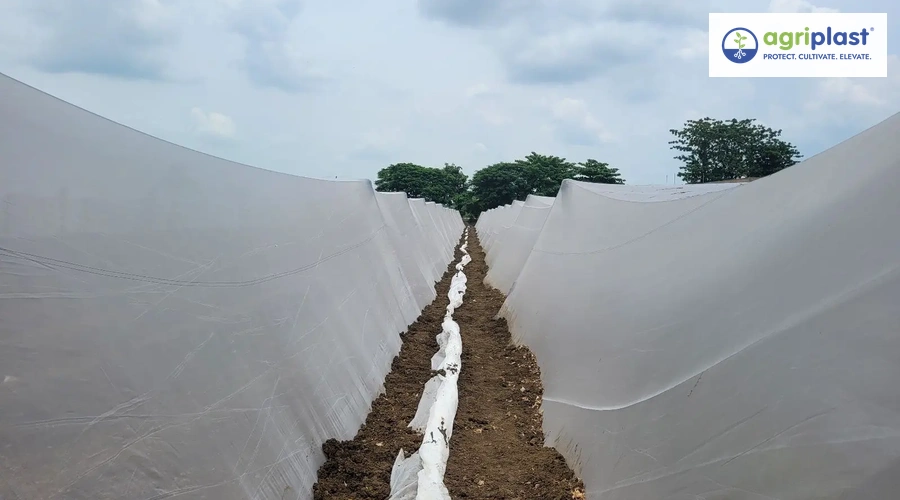
Agriplast open field insect net tunnels stretched over crop rows — the net forms the complete protective structure in the field, replacing recurring spray cycles with season-long physical pest exclusion.
Polyhouse vs Open Field: How Insect Nets Work in Each Setup
Here's a side-by-side breakdown of how insect net function, specification, and importance differ between the two farming systems.
| Factor | Insect Net in Polyhouse | Insect Net in Open Field |
|---|---|---|
| Role of the net | Blocks insects at entry points (vents, sidewalls, doors) | Forms the complete protective structure over crops |
| What it protects against | Thrips, whiteflies, aphids — virus vectors in enclosed space | Aphids, fruit flies, leaf miners, pomegranate borer, grape moth |
| Recommended mesh | 50-mesh (thrips pass through 40-mesh openings) | 40-mesh (better airflow; adequate for larger pests) |
| Recommended GSM | 105–120 GSM (standard); 135 GSM (high-wind) | 120–135 GSM (direct wind and rain load) |
| Installation method | Fixed to polyhouse frame — every opening covered | Stretched over hoops, frames, or fixed net house |
| Airflow importance | Moderate — polyhouse structure buffers wind | High — poor airflow = humidity + fungal disease |
| Key advantage delivered | Residue-free export-grade produce; virus prevention | Season-long pest protection without recurring spray cost |
| Best crops | Rose, gerbera, capsicum, cucumber | Tomato, chilli, pomegranate, grapes, banana, nursery |
| Maintenance needed | Quarterly — check seams, soil line, all vents | After rain and wind events — check anchor points |
Which Insect Net Is Right for Your Crop
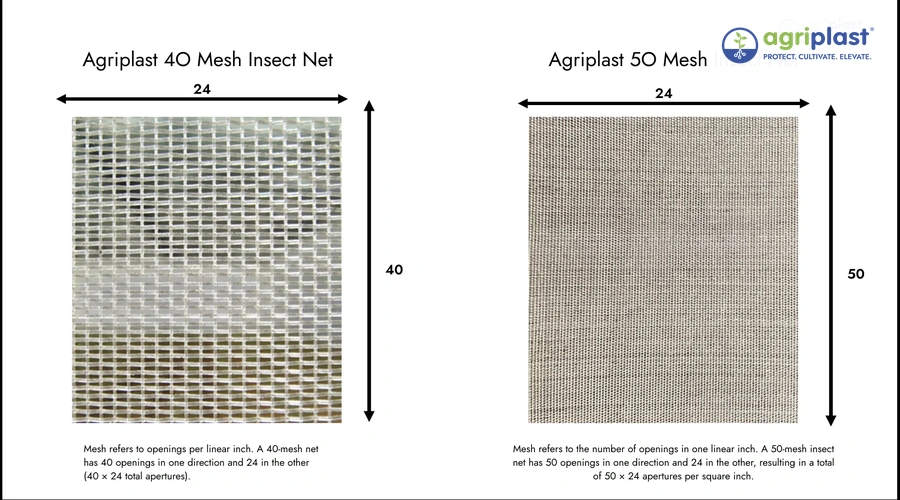
Agriplast 40-mesh (left) vs 50-mesh (right) insect net — the finer 50-mesh has 50×24 apertures per square inch, blocking thrips (1.0–1.5mm) that pass freely through 40-mesh. Choose based on your dominant pest.
Rose and Gerbera — Polyhouse
Use: Agriplast 50-mesh insect net (Ginegar OptiNet strongly recommended).
Thrips carry INSV and TSWV — both destroy flower quality and make entire batches unsellable. The 50-mesh sidewall net with sticky traps is the baseline. The Ginegar OptiNet adds optical deterrence that standard 50-mesh nets don't provide.
Capsicum and Cucumber — Polyhouse
Use: Agriplast 50-mesh insect net.
Thrips and whiteflies spread TYLCV (capsicum) and CMV (cucumber) rapidly inside closed polyhouses. One infected plant can spread to the full batch within days.
For a detailed crop guide, read the Cucumber Farming in Polyhouse: Complete Guide
Tomato, Brinjal, Chilli — Open Field
Use: Agriplast 40-mesh in a low-tunnel hoop system.
Aphid and whitefly pressure is real, but so is the need for ventilation. Protect the seedling and early vegetative stages most — that's when pest damage creates the most lasting crop impact.
Pomegranate and Grapes — Open Field
Use: Agriplast 40-mesh walk-in tunnel or net house.
Pomegranate's primary threat is fruit borer. Grapes face Mediterranean fruit fly and grape moth — both cause direct fruit damage that eliminates market value. Season-long protection is more cost-effective than repeated spray cycles during fruit development.
Banana — Open Field
Use: Agriplast 40-mesh net house or overhead row cover at the bunch stage.
Aphids and thrips transmit BBTV — one of India's most damaging banana diseases. Physical exclusion during bunch development cuts spray frequency significantly.
Nursery and Seedling Production — Open Field
Use: Agriplast 40–50 mesh low-tunnel hoop system.
Seedlings are the highest-value, most vulnerable stage. Protecting them from the start is far cheaper than replacing damaged transplants. Use 50-mesh if thrips pressure is documented in your region.
Farmer Result: What Agriplast Insect Netting Delivered on the Ground
Byregowda from Kanmangala, Chikkaballapur district, Karnataka has farmed for 18 years across 20 acres. He started with open field capsicum — the results were poor.
- Yield: 1–2 kg per plant
- Constant pest pressure from thrips and mites
- Poor fruit quality, low market value
He switched to a net house using Agriplast insect netting, mulching, and shade net — on the same land, the same crop. The yield went to 8–9 kg per plant. He then planted cucumber in the same net house as a second crop.
Total input cost for 2.5 acres (Agriplast insect net, mulch film, drip, seedlings, labour): ₹15 lakh. Revenue from capsicum alone: ₹30–35 lakh.
Actual yields and revenues may vary based on crop variety, location, weather, soil, farm practices, and market prices. The figures are indicative, not guaranteed. Consult a local agronomist or polyhouse expert before investing.
Insect Net Cost and ROI
Agricultural insect netting in India is priced between ₹40–50 per square meter for BIS-standard HDPE monofilament nets. For a standard 2.5-acre polyhouse with perimeter insect netting covering approximately 1,000–1,200 sq m of sidewall and vent area, the material cost for the net alone comes to roughly ₹40,000–50,000 — a one-time investment at installation.
Agriplast insect nets carry a 5-year UV warranty on 135 GSM and a 3-year BIS-approved warranty on 105 GSM, with field life typically reaching 5–7 years. For current pricing specific to your structure, contact the Agriplast technical team.
Disclaimer: Figures are indicative. Actual ROI and costs vary by farm area, crop, location, weather, and market conditions. Consult a local agronomist before investing in protected cultivation infrastructure.
🎥 Watch: Net House vs Open Field — 8 kg vs 2 kg Yield Difference
Byregowda from Kanmangala, Chikkaballapur, Karnataka shares how switching from open field to a net house with Agriplast insect netting transformed his capsicum yield — from 1–2 kg per plant to 8–9 kg — and generated ₹30–35 lakh from just 2.5 acres.
Conclusion
You started this guide because you already know what a bad season looks like. The spray rounds that keep increasing. The costs that keep climbing. The crop that still gets hit.
The answer isn't a better spray. It's stopping the pest before it ever reaches your crop.
An insect net does exactly that — in a polyhouse and in an open field. Not by treating damage after the fact, but by making the damage impossible in the first place.
The One Question That Matters Before You Buy
What is the dominant pest on my crop — and what mesh size actually stops it?
- Thrips → Agriplast 50-mesh, polyhouse or open field
- Aphids, fruit flies, leaf miners → Agriplast 40-mesh in open field
If you're unsure, don't guess. The wrong net costs you a full season. The right one pays for itself in the first crop cycle and keeps paying for five to seven years after that.
For detailed installation guidance, read the Agriplast guide to pest-free greenhouses.
Get the Right Agriplast Insect Net for Your Farm — Free Expert Advice
Our agronomists have helped thousands of farmers across India choose the right insect net for their crop, structure, and pest pressure.
Tell us your crop and structure — we'll tell you exactly what you need.
View Agriplast Insect Nets & Talk to an Expert →📞 Call us: +91 81414 46666 | Pan-India delivery | BIS-certified | 5-year UV warranty
Frequently Asked Questions
Blog written and Posted by
Rani Singh
Rani Singh is a Content Executive at Agriplast Tech India, covering high-value farming, protected cultivation, and farmer success stories. She focuses on turning field experiences into practical, actionable content for Indian farmers and agri-entrepreneurs.You can write your view/comments here
Need Expert Assistance?
Get personalized recommendations for your greenhouse, polyhouse, or irrigation needs.
-
Bengaluru (Corporate Office)
- 918141446666
- support@agriplast.co.in
WeWork Roshni Tech Hub - 1st floor, PFS Club House, Marathahalli Main Rd, R.J.Gardens, Lakshminarayana Pura, EPIP Zone, Chinnapanna Halli, Bengaluru, Karnataka 560037