Polyhouse Farming Success Story: How an Infosys Engineer Built a Profitable Farm
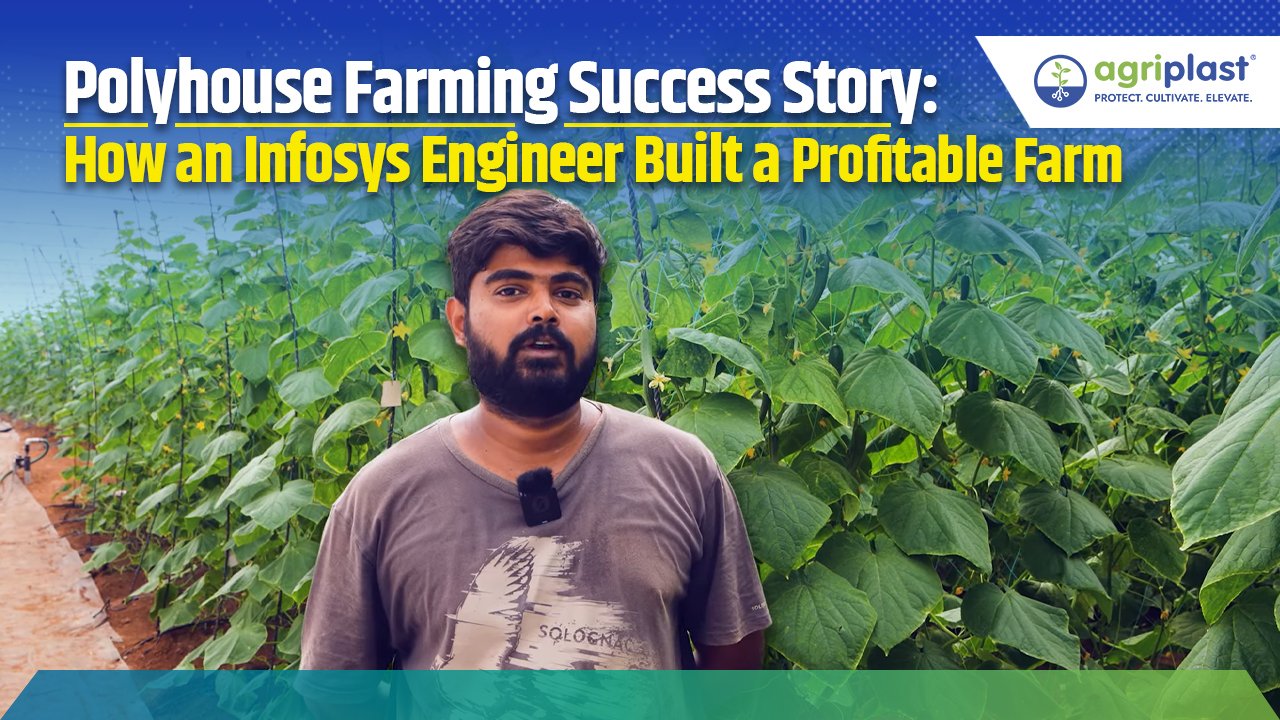
Arul Shankar had everything most people dream of — a stable software engineering career at Infosys, four years of experience in Ireland, and a salary in euros.
But he chose to walk away. Not because something was missing — but because he saw something bigger in farming.
This polyhouse farming success story is not about emotion or escaping corporate life. It’s about strategy.
Arul returned to his village in Erode, Tamil Nadu, and built a controlled polyhouse farm — where crops are not left to monsoon uncertainty, but managed through data, planning, and precision.
Every decision is calculated. Every cycle is optimized. And unlike traditional farming, the returns are predictable. Two years later, his farm operates without a single major failure or service issue.
This isn’t just another farming journey.
It’s a real example of how profitable polyhouse farming in India can work — when done scientifically.
And for every farmer and agripreneur asking the same question — is polyhouse farming worth the investment? — this farmer story has answers.
Let’s explore Arul Shankar’s polyhouse farming journey.
Why Polyhouse Farming Is a Better Business Model
When Arul returned to India, one decision was already clear — he would not farm the way most farmers around him did.
This wasn’t emotion. It was a business calculation.
Open-field farming across regions like Erode, Nashik, Ludhiana, or Guntur depends heavily on weather cycles and mandi prices.
In a good year, farmers get 2–3 productive seasons.
In a bad year, monsoon failure, extreme heat, or pest attacks can wipe out months of investment.
Costs remain fixed. Income doesn’t. Polyhouse farming changes this equation completely.
Here is what drew Arul to it — and what draws farmers from across India to protected cultivation today:
- Year-round production — You grow on your schedule, not the weather's. Market demand, not the monsoon, sets your crop calendar.
- Controlled environment — Temperature, humidity, and pest pressure are managed inside the structure. External shocks that destroy open-field crops are significantly reduced.
-
Higher, consistent yields — Agriplast's data from hundreds of farmers across India shows polyhouse capsicum yields of 45–50 tonnes per acre under favourable conditions, generating ₹20–30 lakh annually. The fruits have thicker walls and a 15–20 day shelf life, meeting premium buyer and export standards (Agriplast Capsicum Farming Guide).
- Significant water savings — Research from IIT Kharagpur found drip-irrigated capsicum in a polyhouse requires 35% less water than open-field cultivation. In water-stressed farming zones across India, that is a material advantage.
- Automation and systems — Drip irrigation, fertigation, and climate monitoring are systems you build and refine. Over time, they reduce dependency on daily manual labour and improve consistency.
This shift is happening across the country. Polyhouse farming in Tamil Nadu alone has expanded significantly over the last decade, and the national numbers confirm it.
Disclaimer: Results and returns may vary based on location, crop selection, climate, and farm management practices; consult a local agronomist before making any capital investment.
Since 2014–15, India's MIDH scheme has brought an additional 15.66 lakh hectares under horticulture crops and facilitated protected cultivation across 2.51 lakh hectares with a government investment of ₹2,963.91 crore (MIDH Guidelines 2025, NHB).
Key Takeways: Polyhouse farming is not just traditional farming with a plastic cover. It is a completely different business model — one that offers control over production, quality, and income.
But this is where most beginners fail. They invest in the structure - but ignore the most critical decision — crop selection. Even a perfectly designed polyhouse can fail if the crop is wrong.
To make the right start, explore our detailed guide on 28 Polyhouse Crops You Can Grow in India and choose strategically.
Polyhouse vs Traditional Farming: The Honest Numbers
Here is the side-by-side comparison most farmers and agripreneurs are really looking for — with verified figures, not general claims.
| Factor | Traditional Open-Field | Polyhouse Farming |
|---|---|---|
| Crop cycles per year (capsicum) | 1–2 (weather dependent) | 1–1.5 (8–9 month crop cycle) |
| Crop cycles per year (cucumber) | 2 max | 2–3 on soil beds; up to 3 on soilless |
| Capsicum yield per acre (South India) | Lower volumes, lower market price | 45–50 tonnes, gross revenue ₹20–30 lakh/annum |
| Water use (drip capsicum) | Baseline | 35% less water than open-field |
| Weather and pest risk | High — open exposure | Significantly lower with insect netting and quality film |
| Setup investment (NVPH, 1 acre) | Low | NHB cost norm: ₹1,000 per sq.m |
| Central government subsidy | Minimal | 50% of NHB cost norm; credit-linked, back-ended |
| Income predictability | Low | High — plan harvests and revenue months in advance |
Disclaimer: Results and returns may vary based on location, crop selection, climate, and farm management practices; consult a local agronomist before making any capital investment.
On crop cycles: The "3–4 cycles per year" figure is crop-specific. Capsicum runs 8–9 months per cycle — you get 1 to 1.5 cycles annually, not 3 or 4. Cucumber, with a 60–70 day cycle, gives 2–3 rounds per year on soil beds. Plan your finances around the crop you actually intend to grow, not a generalised figure.
For a detailed capsicum farming guide, explore our Capsicum in Polyhouse: Profitable Farming Guide 2026.
On subsidy: The NHB central subsidy is 50% of the government cost norm (₹1,000 per sq.m for NVPH). Actual construction costs in 2026 often run higher than the norm. Your effective saving on actual spend is closer to 35–40%, because the subsidy is calculated on the norm. It is also back-ended and credit-linked: you build first with a bank loan, then the subsidy is credited to your loan account after government inspection (MIDH Guidelines 2025, NHB).
On-Ground Execution: How Agriplast Supported Setup and Automation
Once construction began, the Agriplast team visited Arul’s farm in Erode for a detailed site inspection.
This wasn’t just material delivery — it was hands-on technical execution.
During the visit, the Agriplast team evaluated the farm layout, growing conditions, and system requirements. More importantly, they guided Arul on automating fertigation — integrating irrigation and nutrient delivery into a single, efficient drip system.
"The people from the Agriplast company arrived and they also inspected the area and what we are going to do. They also actually gave me a good advice on how the fertigation can be automated and also the devices that they use in their own plants for automation of fertigation."
— Arul Shankar, Erode district, Tamil Nadu
Instead of generic recommendations, the team demonstrated real systems used in their operational farms, giving practical clarity rather than theory. They also conducted multiple follow-up visits during the setup phase, ensuring that installation and system calibration were done correctly.
This level of continuous field support reduced early-stage errors — one of the biggest reasons polyhouse projects fail.
For Arul, this wasn’t just assistance. It was execution support that helped convert a plan into a working, revenue-ready system from day one.
Fertigation automation is not optional for a first-time operator with no farm staff. It is what makes the operation manageable. Here is what it delivers in practice:
- Nutrients reach plant roots at the right time, at the right concentration — no guesswork
- Water savings of 35% compared to open-field irrigation for the same crop (IIT Kharagpur, IJERR 2024)
- Labour requirement drops significantly — one person can manage what would need multiple workers manually
- Consistent crop nutrition means uniform growth and fewer quality rejections at harvest
For a deeper look at how drip fertigation works in a polyhouse context, see Agriplast's guides on capsicum fertigation management and mulch film with drip irrigation — the two are typically deployed together for maximum water efficiency and root-zone control.
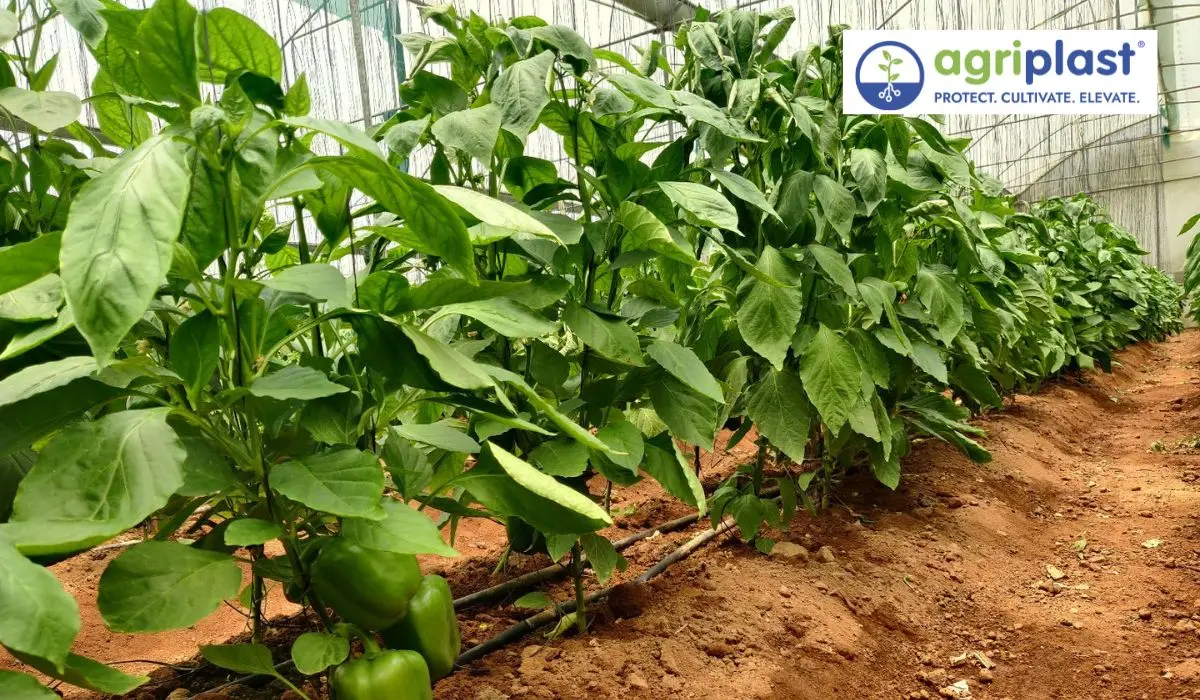
A drip irrigation and fertigation system inside Arul's polyhouse in Erode — nutrients and water delivered together through drip lines, reducing labour and saving up to 35% water versus open-field irrigation.
Why Greenhouse Film Quality Matters in Polyhouse Farming
Eighteen months into farming, Arul's feedback on the Agriplast materials is direct:
"I've been continuously doing it in this particular field for the last one year and it's been great. I had no problems with the service or anything like that and the materials that they used were of certain quality that I don't have any issues coming up every now and then."
— Arul Shankar, Erode district, Tamil Nadu
That phrase — “materials of certain quality” — is something most first-time polyhouse farmers underestimate.
Greenhouse film quality in India varies significantly based on manufacturer, UV grade, and micron specification. The structure is only as reliable as the material covering it, especially in South India’s high-UV, high-heat conditions.
A low-quality film gradually degrades — losing UV stabilisation, developing micro-tears, and transmitting excess heat instead of filtering it. As a result, the internal climate becomes unstable, affecting crop health and yield. Early film failure also leads to replacement costs at the worst possible time — when the farm should be generating returns, not adding overheads.
Agriplast’s Ginegar greenhouse films use 5-layer co-extrusion technology with UV stabilisation, anti-drip, anti-dust, and infrared control. These features are designed to maintain performance under Indian climatic conditions.
For example, the Ginegar Driplock Diffused film offers 87% light transmission and 62% light diffusion, reducing hot spots inside the polyhouse and improving yield uniformity for crops like capsicum and cucumber (Agriplast Greenhouse Films).
When evaluating greenhouse film for your polyhouse, check these specifically:
- UV stabilisation grade — Must match your region's radiation levels. Do not choose by price per metre alone.
- Micron thickness — 200 microns is the standard for Indian polyhouse conditions. Do not go below the minimum recommended for your structure type.
- Light diffusion — Diffused films spread light evenly across the canopy, reducing hot spots that cause uneven growth.
- Anti-drip layer — Prevents condensation from dripping onto crops, which reduces fungal disease pressure.
For a full technical breakdown of greenhouse film types, see the Agriplast Greenhouse Film Complete Guide.
For the specific choice between clear and diffused film — which directly affects light distribution and yield consistency inside your polyhouse — the Clear vs Diffused Film comparison covers it in detail.
Why Daily Presence Is Non-Negotiable
Arul closes his video with a line that is easy to underestimate:
"It's been going good and there is no issues or whatsoever in the field and I'll be here on a daily basis from morning to evening."
That is not just commitment. It is a farming requirement. A polyhouse does not manage itself. Specific things happen daily that require a decision-maker to be present:
- Temperature monitoring — An unventilated polyhouse in peak summer can reach 45–50°C inside within hours. Vents must be opened, shade adjusted, and cooling checked every day.
- Pest and disease watch — A small tear in insect netting is all it takes for thrips or whitefly to establish. Caught on day one it is a management task. Caught on day five it is a crisis.
- Drip system checks — A blocked emitter means one section of the bed gets no water or nutrients. Uneven growth across beds affects marketable yield quality for the entire harvest.
- Fertigation timing — Plants have nutritional windows within their growth cycle. Missing a scheduled fertigation round is not neutral — it pushes back fruit set for that cycle.
This is why polyhouse farming rewards the same discipline that makes professionals successful in other fields. And why it does not work as an absentee investment.
Also worth reading: How Girish from Tumkur, Karnataka earns ₹25 lakh per acre from chrysanthemum — different crop, same discipline, same commitment to doing it right from the start.
Could You Do What Arul Did? The Honest Assessment
Arul is part of a growing group across India — engineers, MBAs, returning NRIs, progressive farmers — who are building polyhouse farming as a business in India, treating it as a first-choice career, not a fallback. Polyhouse farming fits this group because it rewards planning, systems thinking, and consistent execution. It does not reward guesswork or cutting corners at setup.
Here is the honest picture:
- Setup cost is real — The NHB government cost norm for a naturally ventilated polyhouse is ₹1,000 per sq.m. Actual construction in 2026 often runs higher (NHB). Budget for the real figure, not the norm.
- Subsidy helps, but understand how it works — 50% of the NHB cost norm. Back-ended, credit-linked. Your effective saving on actual spend is closer to 35–40%. Read the full process before planning (MIDH Guidelines 2025).
- Crop selection determines your business model — Capsicum gives 1–1.5 cycles per year with high per-kg value. Cucumber gives 2–3 cycles with faster cash flow. Each requires a different management approach. Read the crop guides before deciding.
- ICAR-supported research confirms the economics work — Polyhouse capsicum cultivation shows a Benefit-Cost Ratio of 1.80, an IRR of 53.7%, and payback under two years — with proper management (Journal of Horticultural Sciences, IIHR).
- Daily presence on the farm is not optional — Temperature, pests, drip blockages, and fertigation timing all require daily decisions. This is not a side project.
- Get the foundation right before you build — Water quality tested, greenhouse film verified, fertigation system designed, reliable technical support confirmed. These pre-construction decisions determine nearly everything that follows.
If those conditions match your situation and commitment level, polyhouse farming is one of the most defensible agricultural businesses you can build anywhere in India. The weather stops making your income decisions for you.
Agriplast works with polyhouse farmers across India — Tamil Nadu, Karnataka, Maharashtra, Rajasthan, Haryana, Uttar Pradesh, and beyond. With 1,000+ dealers pan-India and presence in 15+ countries, Agriplast's greenhouse films, insect nets, and fertigation accessories are available wherever you farm (Agriplast Tech India).
Watch Arul Tell His Story Himself
Arul covers the complete journey in this Agriplast field visit — why he left Infosys, how he set up his polyhouse in Erode, what the Agriplast team did on site, and what 1.5 years of continuous farming has actually looked like on the ground.
🎥 Watch: From Infosys to Farming — Arul Shankar's Polyhouse Success Story in Erode, Tamil Nadu
Arul Shankar — ex-Infosys engineer, Erode district — explains why he left a corporate career in Ireland, how the Agriplast team inspected his site and advised on fertigation automation, and what 1.5 years of zero-failure polyhouse farming has taught him about running agriculture as a business.
Frequently Asked Questions
Thinking of Making the Same Move?
Arul walked away from a stable corporate career abroad and built a farm that runs without failures, without shortcuts, on his own terms. He did it by treating farming the way he treated work — with preparation, the right tools, and showing up every day.
If you are evaluating polyhouse farming — whether you are a returning professional, an existing farmer looking to upgrade, or an agripreneur running the numbers — start where Arul started. Test your water. Verify your materials.
Planning a polyhouse investment? Get it right from the start.
Talk to the Agriplast team and get a customised plan for your land, crop selection, and ROI strategy—before you commit your capital.
Agriplast Tech India Private Limited (APTIPL) manufactures greenhouse films, mulching films, shade nets, insect nets, and other protected cultivation products for farmers across India and 15+ countries. APTIPL is a separate entity from Agriplast Protected Cultivation (APPC).
Blog written and Posted by
Rani Singh
Rani Singh is a Content Executive at Agriplast Tech India, covering high-value farming, protected cultivation, and farmer success stories. She focuses on turning field experiences into practical, actionable content for Indian farmers and agri-entrepreneurs.You can write your view/comments here
Need Expert Assistance?
Get personalized recommendations for your greenhouse, polyhouse, or irrigation needs.
-
Bengaluru (Corporate Office)
- 918141446666
- support@agriplast.co.in
WeWork Roshni Tech Hub - 1st floor, PFS Club House, Marathahalli Main Rd, R.J.Gardens, Lakshminarayana Pura, EPIP Zone, Chinnapanna Halli, Bengaluru, Karnataka 560037