Pomegranate Farming in India: Varieties, Bahar & Profit Guide (2026)
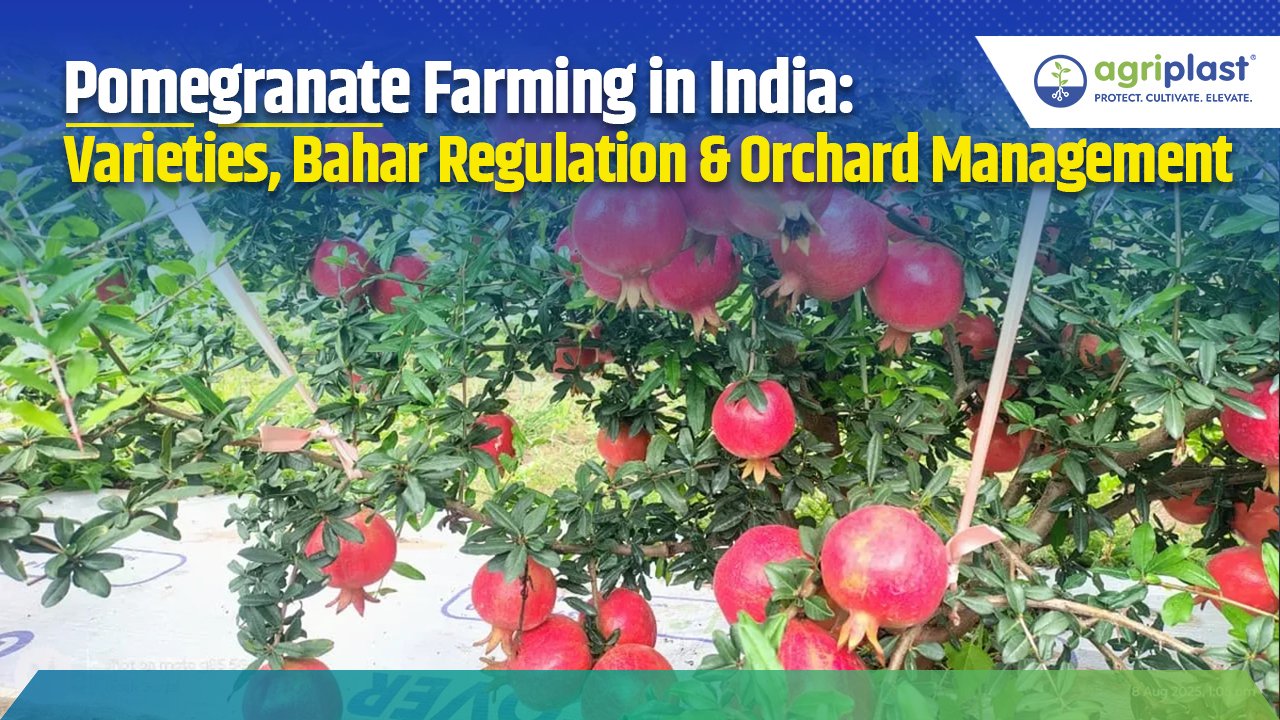
Pomegranate farming in India is one of the few orchard crops that rewards long-term discipline. A single planting, when managed correctly, can produce for 7–8 years with consistent demand across domestic and export markets — unlike seasonal crops like mango or grape.
Exports have grown from 18,210 MT in 2010–11 to 72,000 MT worth USD 69.15 million in 2023–24 — reflecting both rising demand and expanding market access.
Yet, in practice, most orchards operate far below their potential. This gap is rarely due to soil, weather, or variety. In most cases, it comes down to a few critical decisions made during the first 18 months of orchard establishment — decisions that are often misunderstood because the underlying mechanisms are not clearly explained.
This guide focuses on those mechanisms. From variety selection and bahar regulation to orchard floor management, investment planning, and government subsidies, the goal is to help you understand not just what to do, but why it works.
What This Guide Covers
- Why Pomegranate Is a Strong Orchard Investment
- Which States and Soils Suit Pomegranate
- Best Varieties for Indian Farmers
- Bahar Regulation — The Most Misunderstood Practice
- Step-by-Step Cultivation Guide
- Orchard Floor Management — Agriplast Products
- Investment and Revenue Breakdown
- Government Subsidies Available
- 5 Mistakes That Kill Profit
- Frequently Asked Questions
Why Pomegranate Is a Strong Orchard Investment
It earns across all 12 months
Most fruit crops have a window — mango, grape, banana each compete for shelf space in their season. Pomegranate doesn't have that problem. Demand runs year-round in domestic markets and all three major export windows (UAE, Netherlands, Bangladesh).
One planting. Seven to eight years of yield.
Unlike vegetables that reset every 90 days, one pomegranate planting produces fruit for 7–8 years. Yield per tree increases each year — the investment is front-loaded, the returns compound.
It tolerates water stress
Pomegranate is a xerophyte (a plant adapted to dry, low-rainfall conditions). It survives in semi-arid zones where most high-value crops fail — making it particularly valuable in Marathwada, Rayalaseema, and northern Karnataka, where water is the binding constraint.
| Parameter | Pomegranate | Mango | Grape |
|---|---|---|---|
| Productive life | 7–8 years | 15–20 years | 10–12 years |
| Water requirement | Low (drought-tolerant) | Medium | High |
| Average yield/acre (well-managed) | 4,000–6,000 kg | 1,500–2,500 kg | 3,000–5,000 kg |
| Year-round demand | ✅ Yes | ❌ Seasonal | ❌ Seasonal |
| Export potential | High (Bhagwa variety) | Very High | High |
Which States and Soils Suit Pomegranate
Climate requirements at a glance
Pomegranate fruits best at 15–35°C with hot, dry summers during fruit development and cold, dry winters for dormancy. It can grow up to 500 metres above sea level and tolerates temperatures as low as 0°C in dormancy.
Rainfall: 500–800mm annually is adequate. Below that, drip irrigation is mandatory — not optional.
Soil that works
- Type: Sandy loam to deep loam
- pH: 6.5–8.5 (pH is a measure of soil acidity/alkalinity on a scale of 0–14; 7 is neutral)
- Critical requirement: Excellent drainage. Even brief waterlogging damages roots and invites fungal disease
- EC target (root zone): 0–2.5 (EC = Electrical Conductivity, a measure of how salty the soil is — high EC locks up nutrients)
Where to grow — state-by-state
According to NHB 2020–21 data, Maharashtra leads with approximately 1.62 lakh hectares and 17.48 lakh MT of production — around 58% of India's total pomegranate area.
| State | Suitability | Key Districts | Recommended Bahar |
|---|---|---|---|
| Maharashtra | ★★★★★ | Nashik, Solapur, Pune, Satara, Sangli | Mrig + Ambe |
| Karnataka | ★★★★ | Bijapur, Chitradurga, Bellary | Mrig |
| Andhra Pradesh | ★★★★ | Kurnool, Anantapur, Kadapa | Mrig |
| Gujarat | ★★★ | Bhavnagar, Kutch | Hasta |
| Rajasthan | ★★★ | Barmer, Jalore, Jodhpur | Ambe |
For district-level agroclimate and variety data, refer to the ICAR-NRCP & MANAGE High-Tech Pomegranate Production Practices guide - India's national reference for pomegranate research.
Best Pomegranate Varieties for Indian Farmers
The variety you plant determines whether you sell at the local mandi or to an export packhouse — for the next 7–8 years. Get this decision right before anything else.
Bhagwa is the dominant commercial choice, occupying over 80% of India's pomegranate area. Its saffron-red rind, very soft seeds, and 250–500g fruit size make it the first choice in EU and Gulf import markets.
Ganesh is the legacy variety, still grown in Gujarat for domestic markets.
Phule Arakta, developed at MPKV Rahuri, has deep red rind with strong Maharashtra domestic demand.
| Variety | Fruit Weight | Seed Type | Avg. Yield/Acre | Best States | Export Fit |
|---|---|---|---|---|---|
| Bhagwa | 250–500g | Very soft | 8,000–12,000 kg | MH, KA, AP | ★★★★★ |
| Ganesh | 200–400g | Soft | 8,000–12,000 kg | GJ, MH | ★★★ |
| Phule Arakta | 200–300g | Soft | 6,000–8,000 kg | MH | ★★★ |
| Mridula | 150–250g | Very soft | 6,000–8,000 kg | MH, KA | ★★★ |
| Ruby | 300–500g | Soft | 6,000–8,000 kg | AP, KA | ★★★★ |
_1775142897_69ce87f1775e4.webp)
Dense fruit cluster from a well-managed Bhagwa tree. Thinning to 150 flowers per tree and maintaining 300g+ fruit size produces this kind of consistent, Grade A output.
Bahar Regulation in Pomegranate: How It Actually Works
Bahar is the deliberate induction of a specific flowering season by controlling irrigation. You withhold water to force the tree into stress and dormancy, then restart irrigation to trigger flowering. It is the single most important management practice in pomegranate farming.
Done correctly, it produces a heavy crop of uniform, high-grade fruit. Done incorrectly, it produces mostly male flowers that fall without setting any fruit.
The science in plain language
When you withhold water, vegetative growth stops, old leaves yellow and drop (defoliation), and carbohydrates (the plant's stored energy, built from photosynthesis) accumulate in dormant buds. When you restart irrigation after defoliation is complete, high carbohydrate reserves trigger female flowers → fruit sets. Low reserves trigger male flowers → fruit drops. Male and female flowers look identical for the first few days — then male flowers drop without setting.
| Bahar | Defoliate | Harvest | Best For | Key Risk |
|---|---|---|---|---|
| Mrig Bahar | May–June | Dec–Jan | Europe and Gulf export; peak market prices | Fruit splitting if rain hits at harvest |
| Hasta Bahar | Sep–Oct | Mar–Apr | Gujarat and dryland zones | Lowest quality in wet years |
| Ambe Bahar | Jan–Feb | Jul–Sep | Karnataka with assured irrigation | Heat stress during fruit development |
The 150-flower rule
Thin to exactly 150 flowers per tree — no more. The calculation: 150 flowers × 300g average fruit × ~400 trees per acre = 18 tonnes gross potential.
After removing Grade B, a precision-managed orchard targets 10–12 tonnes Grade A per acre. Allowing 250+ flowers produces smaller, lower-grade fruit, exhausts the tree's carbohydrate reserves, and weakens the following bahar. More flowers is not more money — it is less money and a weaker tree.
Step-by-Step Pomegranate Cultivation Guide
Each decision compounds across the 7–8 year orchard life. The steps below integrate guidance from the ICAR-NRCP & MANAGE High-Tech Pomegranate Production Practices guide (2022).
Step 1 — Prepare the land correctly from the start
Deep plough 2–3 times. Level the surface and shape for drainage. Conduct a soil test — correct pH before planting, not after. Bed specification: 3.5 feet wide, 1.5 feet high raised beds, compacted firmly before laying any ground cover. Lay two drip laterals per bed row before any planting begins.
Step 2 — Select and acclimatise saplings
Use only certified tissue culture saplings. Inspect the nursery mother block before purchase. Bacterial blight (Xanthomonas citri pv. punicae) spreads via humidity, wind, and infected material — avoid nurseries with visible symptoms. After procurement, keep saplings in shade for 7–8 days for acclimatisation before planting.
Step 3 — Plant at the right spacing
Standard commercial spacing: 4.5m × 3m (~740 plants per acre). Pit size: 1m × 1m × 1m. Fill with topsoil + 10 kg farmyard manure + 500g single superphosphate + 1 kg neem cake. Planting season: February–March (subtropical zones); July–August (tropical zones).
Step 4 — Install ground cover at planting
Lay Weed Mat and mulch film at the time of planting — not weeks later when weeds appear. See the Orchard Floor Management section below for full product specifications and application guidance.
Step 5 — Train the tree frame in the first 6 months
Keep 3–4 main stems from the base. Remove water shoots (suckers — vigorous vertical shoots that drain energy from the main structure) every 15 days from Day 21 onwards. Pull cleanly by hand — cutting with secateurs leaves a stub that re-sprouts 2–3 new shoots. When the main shoot reaches 9 inches, top it where two lateral branches diverge. Repeat 4 times in the first 6 months.
Step 6 — Irrigate and fertigate by growth stage
Drip irrigation is mandatory. Research in Maharashtra's Nashik region confirmed that optimised drip irrigation produced 50–64% more fruit weight compared to flood irrigation.
Nutrient priority sequence (per ICAR-NRCP MANAGE 2022):
- Potash (K) — primary. Producing 1 tonne of pomegranate requires approximately 3.7 kg of potash. Potash governs fruit size, rind colour, sugar content, and disease resistance.
- Calcium — second. Required for cell wall formation in every new leaf, flower, and shoot. Deficiency makes new growth structurally weak and disease-prone.
- Magnesium — third. The only nutrient that builds chlorophyll (the green pigment that drives photosynthesis). Without adequate magnesium, leaf colour fades and photosynthesis rate falls.
- Boron — fourth. Increases fruit sugar content and strengthens cell walls. Also important for disease resistance.
Step 7 — Induce bahar correctly
Wait until the tree is 15–18 months old before inducing the first bahar. Stop all irrigation completely — Mrig Bahar stress phase: 30–45 days; Hasta Bahar: 45–60 days. Do not restart mid-stress due to heat or labour pressure.
Defoliation is complete when: 80–90% of old leaves have yellowed and dropped. If more than 20% of shoots still show green leaves, stress is incomplete — do not restart irrigation yet. Once complete, prune lightly, then restart irrigation with a potash-dominant dose. New leaf flush appears within 7–14 days; female flowers within 45–90 days.
Total timeline from planting to first harvest: approximately 20 months.
Step 8 — Manage diseases before they start
Bacterial blight (Xanthomonas citri pv. punicae) is the most serious disease threat. A severe infection can cause 50–100% output loss. Wilt (mur) is the second major threat — soil-borne with no effective chemical cure once established.
Step 9 — Thin flowers, then bag each fruit
At fruit-set stage, thin to 150 flowers per tree. Once fruit reaches walnut size, bag each fruit individually using Fruit Shield Cover — 8-inch tube, 17 GSM white non-woven, 12-month UV-stabilised. Bagging protects Bhagwa from sunburn scarring, borer entry, and skin blemishes that cause export grade failure.
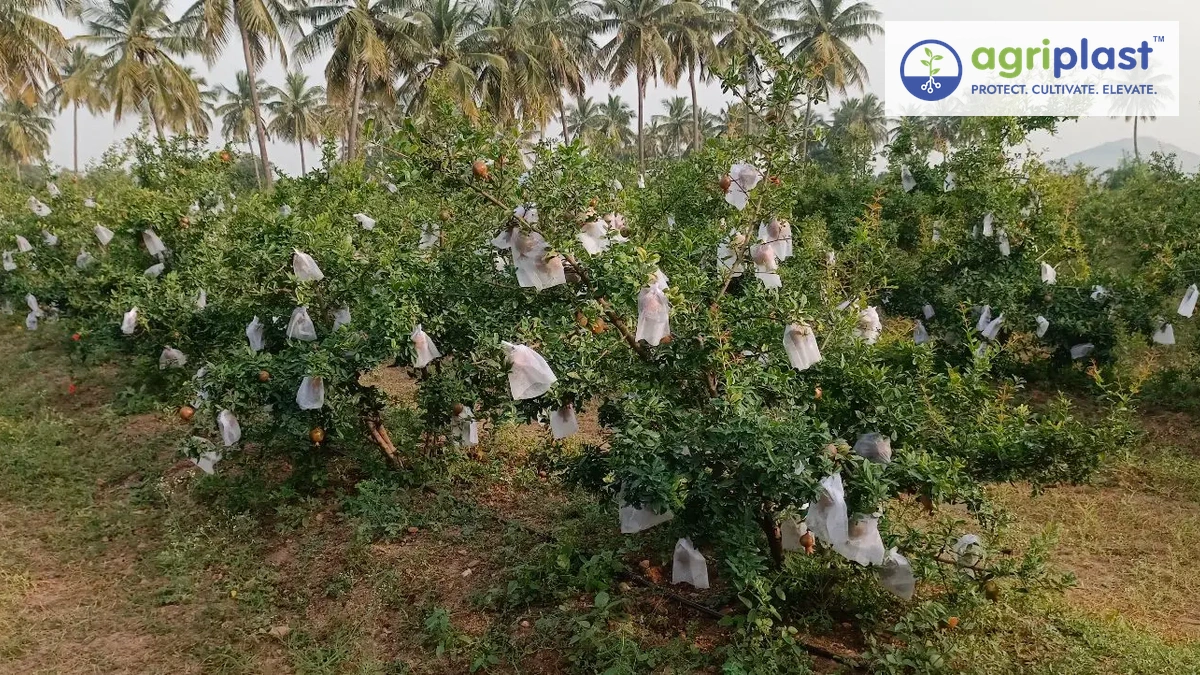
Each pomegranate fruit individually bagged with Agriplast Fruit Shield Cover — protecting Bhagwa from sunburn, borer entry, and blemishes that reduce export grade and price.
Step 10 — Harvest at the right maturity signals
Fruit is ready 120–130 days after fruit set. Look for: calyx (the crown-like structure at the fruit tip) fully closed; rind colour shifted to yellowish-red; fruit flanks slightly flattened. Harvest with clippers, cutting cleanly at the stem — never pull. Storage: up to 2 months at 5°C; up to 10 weeks at 10°C and 95% relative humidity.
Export grading: Super (>400g), King (350–400g), Queen (300–350g), Prince (250–300g). Export grade 12A requires 300g+, clean skin, no blemishes, no stem tearing.
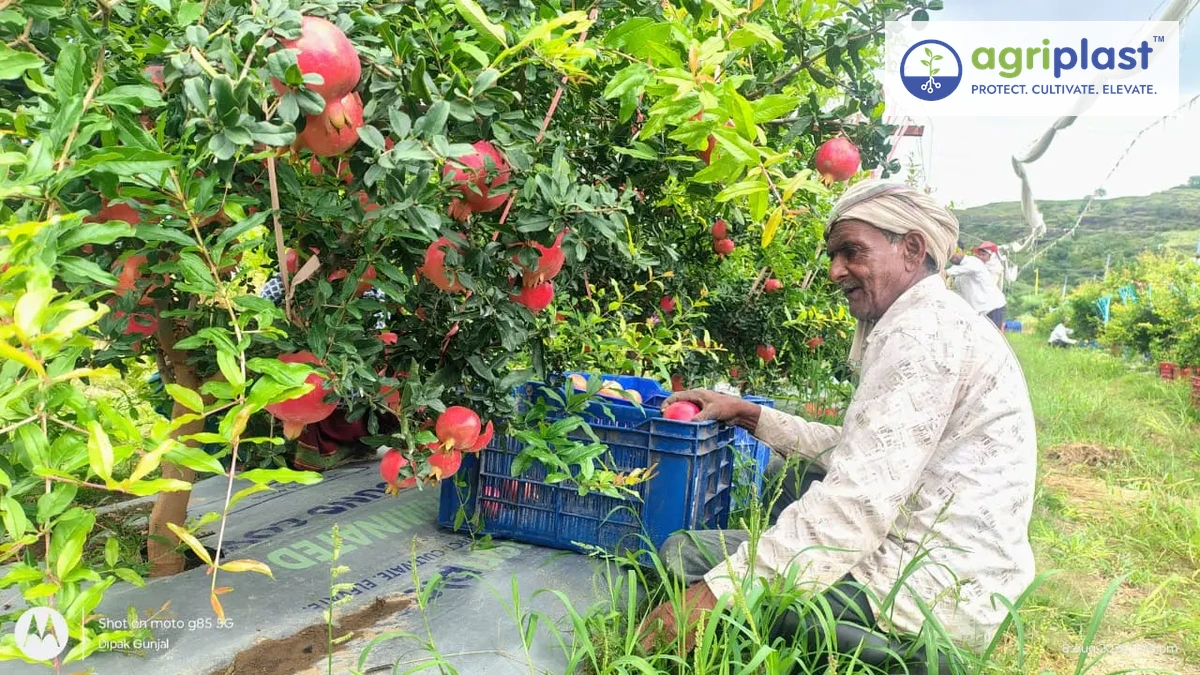
Harvest time in a well-managed orchard — Agriplast ground cover visible beneath the trees, keeping the orchard floor weed-free through the full growing season.
Orchard Floor Management — Agriplast Products for Pomegranate
Without ground cover, weeding labour runs ₹40,000–60,000 per acre every year — compounding to ₹3–5 lakh per acre in avoidable cost across the orchard life. Weed competition in the first 3 years also directly reduces the tree's carbohydrate storage capacity, making bahar regulation harder to execute.
1. Weed Mat — Permanent Ground Cover
Agriplast Weed Mat is woven polypropylene (tightly woven plastic that blocks sunlight but remains permeable to water). It suppresses 95–100% of weed growth while allowing drip irrigation and rainfall to pass through freely.
For pomegranate, use the Black-White (silver side up) option — the silver surface reflects diffused light upward into the lower canopy, improving colour development at the calyx end of the fruit, which is a key export grading marker.
For a full breakdown of GSM options, installation, and ROI across crops, see the complete weed mat guide for orchards.
| Product | GSM | UV Life | Best Use |
|---|---|---|---|
| Weed Mat 90 GSM | 90 | 3 years | Nurseries, short-duration crops |
| Weed Mat 100 GSM | 100 | 3–4 years | Open fields and orchards — standard choice |
| Weed Mat 130 GSM | 130 | 3–5 years | Heavy-duty, walkable orchard floor |
🎥 How Ganesh Awad Saved 75–80% on Weeding Labour in Pomegranate Farming
🎥 Watch: Healthier Pomegranates with Better Mulching — Ganesh Awad, Nashik
Ganesh Dashrath Awad from Dodi village, Sinner Taluka, Nashik shares how using 101 bundles of Agriplast Weed Mat on his 11-acre pomegranate orchard reduced irrigation from every 3–4 days to once weekly, cut weeding labour by 75–80%, and improved white root development — all within the first 6 months of planting.
2. Mulching Film — Raised Bed Surface
Pair weed mat on the orchard floor with Agriplast Mulching Film on the raised bed surface. For pomegranate raised beds, use the 100-micron Orchard Mulch — designed for multi-year orchard use with superior moisture retention.
Silver-Black suits hot Maharashtra conditions; White-Black is ideal for moderate Karnataka and AP climates.
| Method | Annual Cost | Water Saving | Duration | Weed Suppression |
|---|---|---|---|---|
| Manual weeding | ₹40,000–60,000 | None | Ongoing | Temporary |
| Chemical herbicides | ₹8,000–12,000 | None | Per application | 60–75% |
| Standard mulch (25 micron) | ₹6,000–8,000 | 30–40% | 3–4 months | 90–95% |
| Agriplast Weed Mat 100 GSM | ~₹2,000–3,000/yr amortised | Up to 60% | 3–5 years continuous | 95–100% |
3. Fruit Shield Cover — Individual Fruit Bagging
Agriplast Fruit Shield Cover: 8-inch tube, 17 GSM white non-woven polypropylene, 12-month UV-stabilised. Protects Bhagwa from sunburn scarring, borer entry, and skin blemishes that fail export grading. Apply once fruit reaches walnut size (~60 days after fruit set).
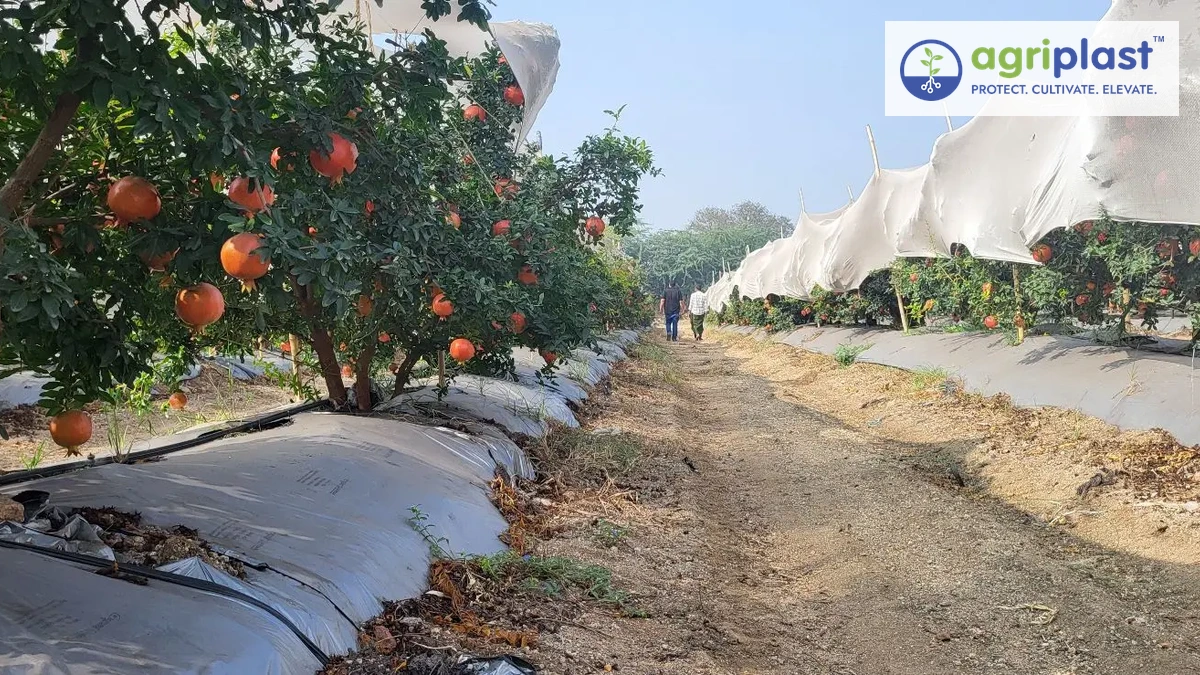
Mulch film on raised beds with anti-hail net overhead — a fully protected pomegranate orchard setup. Silver-black ground cover controls weed pressure, retains soil moisture, and reflects diffused light into the lower canopy.
Investment and Revenue Breakdown
Capital investment — Year 1
| Item | Estimated Cost (₹/acre) |
|---|---|
| Land development, levelling, fencing | 30,000–50,000 |
| Tissue culture saplings (740 plants @ ₹60–80) | 44,000–59,000 |
| Drip irrigation + fertigation unit | 40,000–60,000 |
| Pit preparation + FYM + neem cake | 20,000–30,000 |
| Agriplast Weed Mat 100 GSM (~9 bundles/acre) | 18,000–22,000 |
| Agriplast Ginegar Orchard Mulch (raised beds) | 10,000–15,000 |
| Agriplast Fruit Shield Cover — partial Year 1 | 8,000–12,000 |
| Establishment labour | 15,000–20,000 |
| Ginegar Anti-Hail Net (optional — hail-prone zones only) | 60,000–1,20,000 |
| Total capital investment | ₹1.85–2.7 lakh/acre (excl. anti-hail net) |
Annual operating cost — Year 2 onwards
| Item | Cost (₹/year/acre) |
|---|---|
| Fertigation — potash-dominant + micronutrients | 30,000–45,000 |
| Plant protection | 15,000–25,000 |
| Labour — thinning, bagging, harvest | 20,000–30,000 |
| Irrigation electricity/diesel | 8,000–12,000 |
| Miscellaneous | 5,000–8,000 |
| Total annual operating cost | ₹78,000–1.2 lakh/acre |
Revenue — from Agriplast farmer data
| Year | Target Yield/Tree | Yield/Acre | Floor Price | Projected Revenue |
|---|---|---|---|---|
| Year 1 | 10–12 kg | ~4,000–5,000 kg | ₹100/kg | ~₹1 lakh/acre |
| Year 2 | 20–22 kg | ~8,000–9,000 kg | ₹100/kg | ~₹7–8 lakh/acre |
| Year 3 | 25–30 kg | ~10,000–12,000 kg | ₹100–120/kg | ~₹12–13 lakh/acre |
Source: Agriplast farmer- Ganesh Dashrath Awad, Sinner Taluka, Nashik. Based on ~400 trees/acre. Floor price of ₹100/kg used; actual market prices vary by season and grade.
Government Subsidies Available for Pomegranate Farming
💰 Government Subsidy Available for Pomegranate Farmers
MIDH (Mission for Integrated Development of Horticulture) provides 40% subsidy (50% for SC/ST/women) on new plantation costs, and 50–90% subsidy on drip irrigation systems depending on state. Register with APEDA at agriexchange.apeda.gov.in for export market access, buyer directories, and APEDA-approved packhouse support in Solapur and Nashik.
| Scheme | What It Covers | Subsidy Rate | How to Apply |
|---|---|---|---|
| MIDH — New Plantation | Sapling cost + establishment inputs | 40% (general); 50% (SC/ST/women) | District Horticulture Office |
| MIDH — Drip Irrigation | Drip system + fertigation equipment | 50–90% (varies by state) | State Horticulture Dept / RKVY portal |
| NHM — State Component | Post-harvest handling, cold storage | Varies by state | State Horticulture Department |
| NABARD Area Development | Orchard block project financing | Credit-linked subsidy | NABARD District Office |
Contact your District Horticulture Officer for current 2025–26 season allocations — rates and eligibility change between seasons.
5 Management Mistakes That Kill Pomegranate Profit
1. Buying cuttings instead of tissue culture
The disease risk is real — and delayed. Bacterial wilt surfaces 5–10 months after planting, when the investment is fully committed. Always visit the nursery mother block before buying.
2. Skipping or rushing the defoliation phase
Incomplete defoliation = incomplete carbohydrate accumulation = predominantly male flowers = near-zero fruit set. The stress phase is not negotiable. Wait until 80–90% of leaves have dropped before restarting irrigation.
3. Allowing more than 150 flowers per tree
More flowers does not mean more income. It means smaller fruit, lower export grade, and tree exhaustion that weakens the following bahar. 150 flowers at 300g each beats 300 flowers at 150g — in revenue and in tree health.
4. Overusing copper and bactericide without diagnosis
Excessive antibiotic use has caused antibiotic-resistant blight strains in field populations. Excess copper drives magnesium and boron deficiency — silently reducing fruit quality. Diagnose before spraying.
5. Delaying weed mat installation
Weed competition in the first 3 years directly reduces carbohydrate storage capacity — the foundation of every future bahar. Install Agriplast Weed Mat at planting, not when weeds become visible.
Talk to the Agriplast Team Before You Plant
Getting ground cover, mulch, and fruit bagging right from Day 1 is the highest-return controllable decision in pomegranate orchard establishment — the cost is fixed, the saving runs for 7–8 years. Our agronomy team advises on product selection, layout, and installation tailored to your orchard size, soil type, and bahar season.
📞 Call: +91 81414 46666 | Mon–Sat | 9 AM – 6 PM IST
💬 WhatsApp: Chat with us →
✉️ Email: support@agriplast.co.in
Frequently Asked Questions
Blog written and Posted by
Rani Singh
Rani Singh is a Content Executive at Agriplast Tech India, covering high-value farming, protected cultivation, and farmer success stories. She focuses on turning field experiences into practical, actionable content for Indian farmers and agri-entrepreneurs.You can write your view/comments here
Need Expert Assistance?
Get personalized recommendations for your greenhouse, polyhouse, or irrigation needs.
-
Bengaluru (Corporate Office)
- 918141446666
- support@agriplast.co.in
WeWork Roshni Tech Hub - 1st floor, PFS Club House, Marathahalli Main Rd, R.J.Gardens, Lakshminarayana Pura, EPIP Zone, Chinnapanna Halli, Bengaluru, Karnataka 560037