Mango Farming in India 2026: Best Varieties, Planting Systems, and Profit Guide
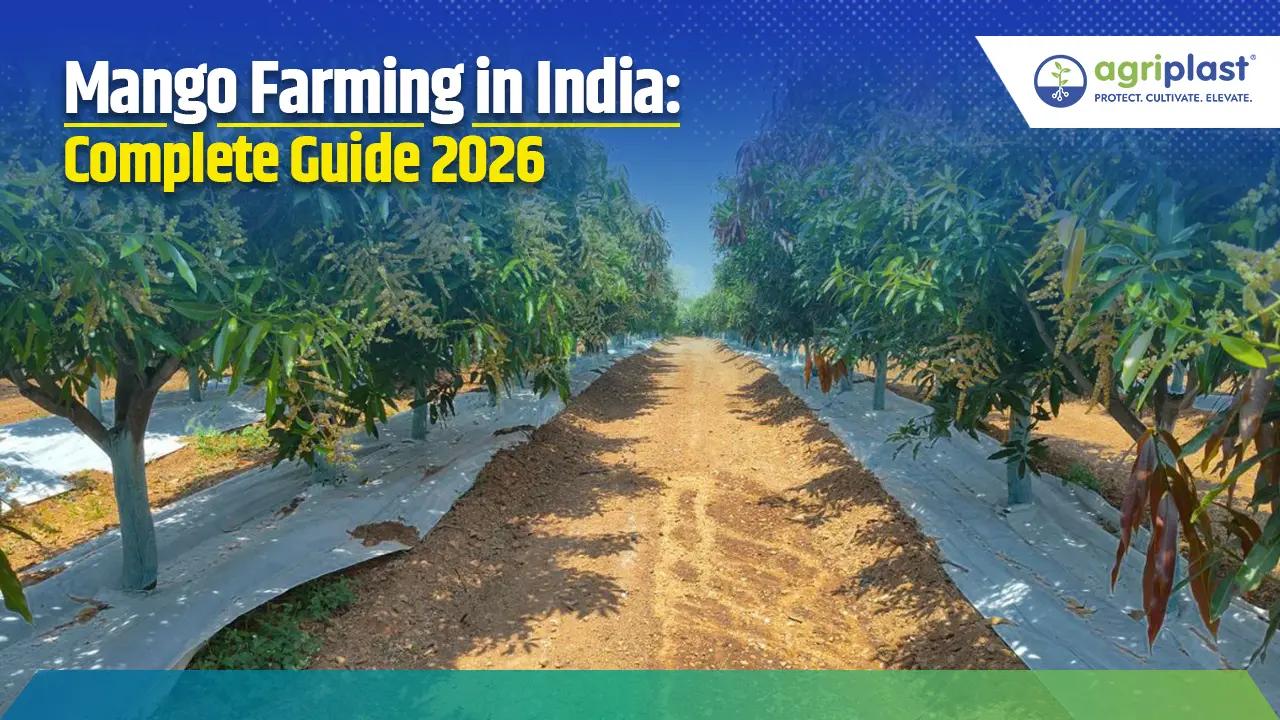
Every summer, India produces more mangoes than any other country — and still can't meet its own demand. The NHB Annual Report 2023–24 puts output at 25 million tonnes across 2.3 million hectares — roughly 45% of global production.
Exports stay below 0.3%. The domestic market absorbs almost everything.
That tells you everything about mango as a farming business: strong cultural demand, a fixed season, and no import competition. Consumers pay a premium for quality — Dasheri in Lucknow, Alphonso in Mumbai, Banganapalli in Hyderabad.
A mango orchard is a 20–60 year commitment, and the system you plant decides where you land.
- Traditional wide-spacing (10×10 m) lasts 40–60 years.
- High-density (5×5 m, 6×3 m) peaks in 15–25 years.
- Ultra-high-density (3×2 m) lasts 10–15 years.
But your Year 1 decisions — spacing, rootstock, soil preparation, irrigation, and floor management — lock in your orchard's economic life. This guide helps you make those choices with eyes open.
What This Guide Covers
- Why Indian Mango Commands a Global Premium
- Best Varieties by Zone — Decision Matrix
- Orchard Layout — Traditional, HDP, and UHDP Compared
- Rootstock Selection — The Decision Most Farmers Skip
- Step-by-Step Orchard Establishment
- Orchard Protection — Hail, Weeds, and Frost
- Pest and Disease Control Without Residues
- Irrigation, Flowering, and Post-Harvest
- Mango Farming Economics — Cost, Yield, and Profit
- Frequently Asked Questions
Why Indian Mango Commands a Global Premium
India's edge isn't just volume — it's flavour. A complex profile of terpene and ester compounds gives varieties like Alphonso, Kesar, Dasheri, and Banganapalli an aromatic depth that no other producing country matches. This is a confirmed biochemical advantage, not marketing.
Competing exporters — Thailand, Mexico, Brazil, the Philippines, Peru — prioritise shelf life over taste. Tommy Atkins dominates global trade because of its durability, not its flavour. Despite India exporting only 55,000–70,000 metric tonnes annually (per APEDA), varieties like Alphonso and Kesar command premium prices across Japan, Gulf, and UK markets.
The constraint on Indian exports is not demand. Per NHB 2023–24, it is the gap in grading, traceability, and post-harvest handling at the farm level. Farmers who close that gap access markets their neighbours cannot.
Best Mango Varieties for Indian Farmers — Zone-Wise Matrix
Picking the wrong variety for your region is the first — and most expensive — mistake in mango farming. Match your variety to your state's soil, rainfall, and target market first. Everything else becomes easier once you get this right.
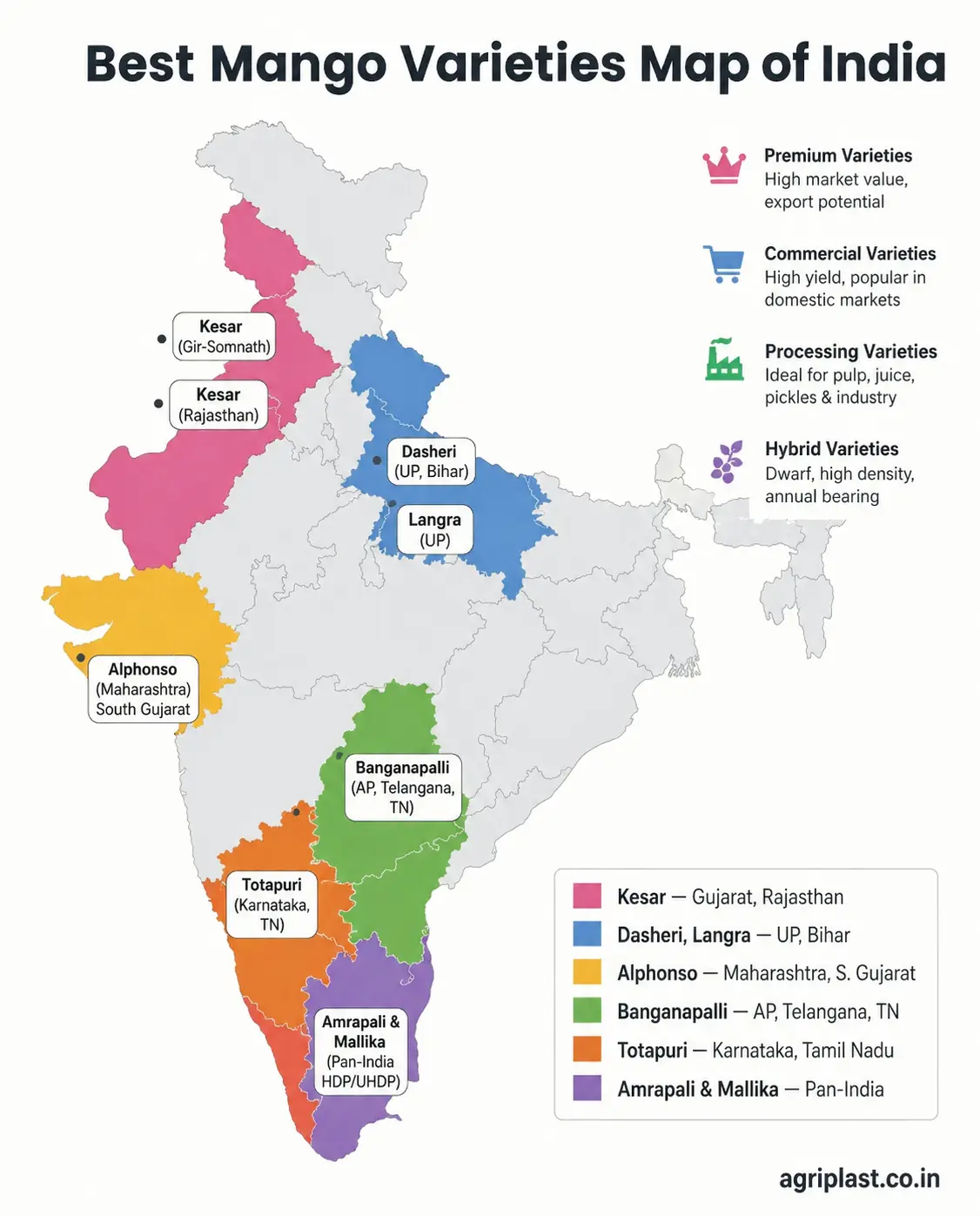
Each state's dominant commercial variety is shaped by soil type, rainfall pattern, and winter temperature. This map is the starting point for every orchard investment decision.
Alphonso — Maharashtra, South Gujarat
Alphonso farming in Ratnagiri and Devgad is India’s most premium mango enterprise. Laterite soil, sea breeze, and coastal humidity create its unmatched flavour. The GI tag restricts “Hapus” to specific talukas. Harvest runs late March–early May (3–4 weeks). Highly prone to Anthracnose and unsuitable for North India’s dry climate.
Kesar — Gujarat (Gir-Somnath), Rajasthan
Kesar is centred in the Gir region of Saurashtra. Black cotton soil and semi-arid climate give its saffron pulp colour. GI-tagged and export-friendly, it fruits May–June. More disease-tolerant than Alphonso, with strong demand in Gulf and European markets.
Dasheri — Uttar Pradesh, Bihar
Dasheri dominates North India, especially Malihabad (Lucknow). Known for fibreless pulp and good shelf life, it fruits June–July. Major challenge: biennial bearing, requiring Paclobutrazol for yield stability. Not suited to high-humidity coastal zones.
Langra — Uttar Pradesh
Langra is a popular local-market variety with fibreless, kidney-shaped fruit. Its short shelf life (4–5 days) limits long-distance trade. Best suited for local mandis and direct selling.
Banganapalli / Safeda — Andhra Pradesh, Telangana, Tamil Nadu
Banganapalli has the largest acreage in Andhra Pradesh. It is high-yielding, large-sized, and ideal for pulp processing. GI-tagged (Kurnool, Prakasam), fruits April–May, and tolerates extreme heat. Preferred near processing units.
Totapuri — Karnataka, Tamil Nadu
Totapuri is a processing-focused variety (pickles, pulp). It is highly disease-resistant and high-yielding. Not suitable for premium fresh markets, but ideal for farms near processing hubs like Chikkaballapur and Tumkur.
Amrapali & Mallika — Pan-India (HDP/UHDP)
Developed by ICAR-CISH, these hybrids transformed mango economics.
- Amrapali (Dasheri × Neelum) → Fruits July–August
- Mallika (Neelum × Dasheri) → Fruits June–July
Both are dwarf, regular-bearing (no biennial issue) and ideal for high-density planting. Though prices are moderate, high tree density + annual yield = stable income.
| Variety | Best States | Harvest | Yield Potential | Market Type | Biennial Risk |
|---|---|---|---|---|---|
| Alphonso | Maharashtra, S. Gujarat | Mar–May | 8–12 T/ha | Premium + export | Moderate |
| Kesar | Gujarat (Gir), Rajasthan | May–Jun | 10–14 T/ha | Premium + export | Low |
| Dasheri | UP, Bihar | Jun–Jul | 10–15 T/ha | Fresh domestic | High |
| Langra | UP | Jun–Jul | 8–12 T/ha | Local fresh | Moderate |
| Banganapalli | AP, Telangana, TN | Apr–May | 12–18 T/ha | Fresh + processing | Low |
| Totapuri | Karnataka, TN | May–Jun | 15–20 T/ha | Processing + export | Very Low |
| Amrapali | Pan-India | Jul–Aug | 12–16 T/ha | Fresh domestic | Very Low (annual) |
| Mallika | Pan-India | Jun–Jul | 14–18 T/ha | Fresh domestic | Very Low (annual) |
Yield potential sourced from NHB Area-Production-Productivity data and ICAR-CISH variety performance trials. Actual yields vary by age, management, soil, and climate.
Orchard Layout — Traditional, HDP, and UHDP Compared
Spacing locks in your yield potential, capital requirement, and income timeline for the next 30 years. Choose it carefully — you cannot change it later without replanting.
Traditional (9m × 9m ≈ 50 Plants/Acre)
Maximum canopy room per tree. Trees can produce for 50–100 years. The key problem: 6–8 years before meaningful yield, and income in early years barely covers costs. Best for low-capital farmers with multigenerational land ownership and premium varieties like Alphonso or Kesar.
High-Density Planting (5m × 5m ≈ 160 Plants/Acre)
Three times the tree count per acre. First fruiting in Year 3–4; commercial yield by Year 6–7. Drip irrigation is non-negotiable. Seasonal pruning is required to manage canopy overlap. Suited to Amrapali, Mallika, Totapuri, or Banganapalli with active management.
Ultra-High Density / UHDP (3m × 2m ≈ 670–1,100 Plants/Acre)
Fruiting begins in Year 2–3. At 10 kg/tree by Year 5, a 1,100-tree orchard delivers approximately 10 tonnes per acre — equivalent to ₹3–3.5 lakh at standard wholesale rates. Requires drip fertigation, twice-yearly canopy pruning, and trees kept at 1.5–2m through planned hedging. Without this discipline, UHDP fails by Year 5. Suited almost exclusively to Amrapali and Mallika.
| Planting System | Plants/Acre | First Fruiting | Peak Yield Potential | Capital Intensity |
|---|---|---|---|---|
| Traditional (9×9m) | ~50 | Year 6–8 | 3–5 T/acre | Low |
| High-Density (5×5m) | ~160 | Year 3–4 | 6–10 T/acre | Medium |
| UHDP (3×2m) | 670–1,100 | Year 2–3 | 10–18 T/acre | High |
Rootstock Selection — The Decision Most Farmers Skip
The rootstock your scion grafts onto is as important as the variety itself. Most nurseries use whatever local seedling is available — one of the most common causes of underperforming orchards in India, and almost entirely avoidable.
| Rootstock | Region | Soil | Key Advantage | Avoid If |
|---|---|---|---|---|
| Kurukkan | Kerala, TN, Karnataka | Laterite, red loam, acidic | Best for heavy-rainfall acidic South Indian soils | Alkaline soils above pH 7.5 |
| Olour | Karnataka, Goa, Konkan MH | Laterite, coastal clay loam | Tolerates coastal salinity and humidity | Dry sandy inland soils |
| Vellaikolamban | Tamil Nadu, AP | Sandy red loam | Drought-tolerant; suits low-rainfall AP and TN | Waterlogged soils |
| Moovandan | Kerala | Laterite, clay loam | Strong anchorage in high-rainfall zones | Alkaline alluvial |
| Desi (local seedling) | UP, Bihar, North India | Alluvial, loamy | Hardy, widely available, sub-tropical adapted | Heavy clay or waterlogged soils |
Step-by-Step Orchard Establishment
The first three years determine the orchard's productivity across the following four decades. Each step below builds directly on the last.
Step 1 — Land Preparation and Soil Testing
Begin 3–4 months before planting. Deep plough twice, level the field, and orient rows North–South for maximum canopy sunlight exposure. Soil testing is non-negotiable — mango needs pH 5.5–7.5 with good aeration to at least 1.5m depth.
Run a drainage test before planting: fill a 60cm pit with water. If water remains after 2–3 hours, install raised beds or sub-surface drainage. State-specific soil adjustments:
| State / Region | Dominant Soil | pH Range | Key Adjustment |
|---|---|---|---|
| Maharashtra (Konkan) | Laterite (red loam) | 5.5–6.5 | None — ideal for Alphonso |
| UP / Bihar | Deep alluvial / silt loam | 7.0–8.2 | Gypsum if pH >8.0; add FYM for drainage |
| Gujarat (Saurashtra) | Black cotton (vertisol) | 7.5–8.5 | Improve drainage; gypsum at 300–500 kg/acre |
| AP / Telangana | Sandy red loam | 6.0–7.5 | Micronutrient correction (Zn, B) before planting |
| Karnataka | Red laterite / clay loam | 5.5–7.0 | Lime if pH <5.5 in acidic laterite belts |
| Rajasthan | Sandy loam | 7.5–8.5 | Heavy FYM + drip essential; avoid flood irrigation |
ICAR-CISH research confirms zinc deficiency affects over 60% of North Indian mango orchards, and boron deficiency is widespread in peninsular red soils. Both reduce fruit set and skin finish on export-grade fruit. Test for micronutrients before planting.
Step 2 — Pit Digging and Filling
Use a sub-soil plough along each row before digging to break the hard pan — the compacted layer below typical plough depth that blocks water and root penetration. Breaking it once, before planting, lets roots reach deeper moisture across the orchard's entire life.
Pit sizes: 1m × 1m × 1m for traditional and HDP; 60cm × 60cm × 60cm for UHDP. Leave pits open to sunlight for 15–20 days to destroy soil-borne pathogens. Fill with:
- Topsoil: 50%
- Well-decomposed FYM or compost: 30 kg
- Single super phosphate: 500g
- Neem cake: 1 kg
Fill to 15cm above ground level, water once, and allow to settle for 15 days.
Step 3 — Planting Grafted Saplings
Plant at monsoon onset — June to August across most of India. In Gujarat and South India, February–March planting with assured drip irrigation is also practiced. Remove the polybag carefully without disturbing the root ball. Place the sapling with the graft union 10–15cm above ground level. Back-fill firmly and stake against wind for the first 2 seasons.
_1777535230_69f308fe5da82.webp)
Weed mat applied from Day 1 eliminates the first season's costliest weeding rounds and retains root-zone moisture through the critical first monsoon. See Agriplast weed mat widths and specifications →
Step 4 — Young Plant Care (Years 1 to 3)
Water every 3–5 days in dry months using drip at 20–30 litres per tree per day. Stop all irrigation from October through January — this dry-cool stress is what triggers flowering induction. Intercrop onion, groundnut, or cowpea between rows to suppress weeds and generate income during the non-bearing years.
| Tree Age | FYM (kg/tree) | Urea (g/tree) | SSP (g/tree) | MOP (g/tree) |
|---|---|---|---|---|
| Year 1 | 10 | 200 | 300 | 200 |
| Year 3 | 25 | 400 | 600 | 400 |
| Year 5 | 35 | 600 | 900 | 600 |
| Year 7 | 45 | 800 | 1,200 | 800 |
| Year 10+ | 50 | 1,000 | 1,500 | 1,000 |
Apply fertiliser in two splits: 50% at monsoon onset (June) and 50% post-monsoon in October. For UP, Bihar, and Punjab orchards where temperatures drop below 5°C, wrap first-year saplings in shade net material on bamboo frames from December to February — it raises the microclimate by 2–4°C, enough to prevent frost kill.
Step 5 — Pruning and Canopy Training
From Season 1, remove all shoots below 60–70cm from the ground. Allow 3–4 well-spaced primary branches to form the scaffold. Remove shoots growing vertically inward — they block light and harbour pests.
For HDP and UHDP systems, keep trees within their designated height and spread from Year 1. Pruning once post-harvest and once pre-flowering is what separates productive high-density orchards from overgrown failures.
Orchard Protection — Hail, Weeds, and Frost
A mango orchard is a 20-year-minimum investment. One hailstorm or frost event can erase years of growth. Farmers who protect early spend less over the long run and reach profitable yields faster.
Hail Protection with Anti-Hail Net
Hail strikes during flowering (November–February) and early fruit set (March–April) — the two most economically critical stages of the season. A 15-minute hailstorm during peak flowering can destroy 60–80% of the crop. High-risk zones include Maharashtra's Konkan belt, Vidarbha, UP's Malihabad, and HP's Kangra district.
Anti-hail netting installed as overhead canopy cover intercepts hailstones before they reach flowering branches. Installation cost is typically recovered within one protected season on a high-value Alphonso or Kesar orchard.
See the complete guide on anti-hail nets for Indian orchards for installation layouts and risk-zone maps.
Weed Mat for the Orchard Floor
From Year 3, the inter-row floor becomes a persistent weed problem. Manual weeding 3–4 times per year costs ₹2,500–4,000 per acre per round — ₹10,000–16,000 annually, every year, indefinitely.
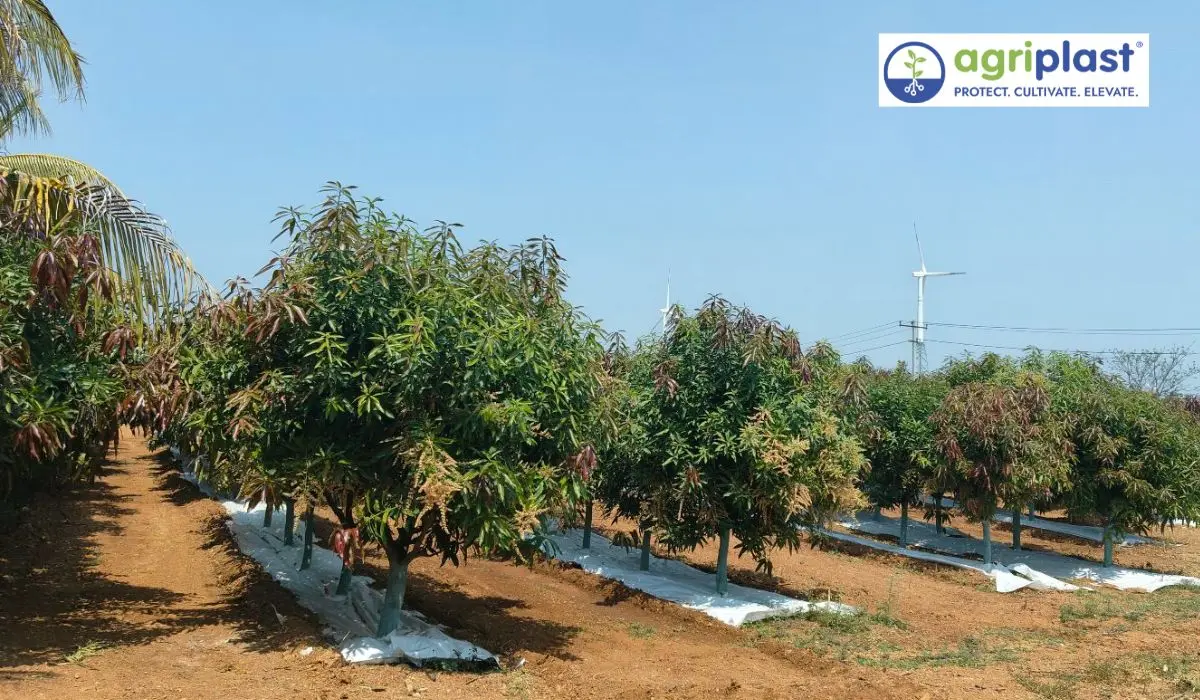
A single weed mat installation lasts 4–5 seasons and keeps the orchard floor clean for spray operations, pruning, and harvest. Cost per year is significantly lower than ongoing manual weeding.
Weed mat is water-permeable, so drip irrigation and rainfall pass through while weeds are blocked from below. It also keeps the orchard floor firm and clean for pruning, spraying, and harvest operations across all seasons.
For detailed application methods, see our complete weed mat guide for orchards.
Mulching Film at the Tree Basin
Silver-black mulching film applied 1–1.5m around each tree conserves soil moisture and blocks weed germination at the root zone. Silver side up reflects light, reducing aphid and thrips pressure. Apply after the first post-monsoon irrigation in October; replace every 2–3 seasons.
For detailed techniques and benefits, see our complete guide on mulching in agriculture.
Shade Net for Frost Protection
First-year saplings in UP, Bihar, and Punjab can die if temperatures drop below 4°C for 3+ consecutive nights. A shade net draped over bamboo frames raises the microclimate by 2–4°C. Remove covers during daylight hours.
See the complete shade net guide for density recommendations by state.
Pest and Disease Control Without Residues
Most mango crop losses trace back to three causes: fruit fly, mango hopper, and powdery mildew. A residue-free approach is not just viable — it is essential for export market access, where pesticide residue limits are strictly enforced.
Fruit Fly — Physical and Biological Control
Mango fruit fly (Bactrocera dorsalis) lays eggs under fruit skin (April–June). Larvae cause total loss of affected fruit. Use a three-layer approach:
- Methyl eugenol pheromone traps: 1 trap per acre from February. Replace the lure every 30–45 days. Breaks the population cycle with zero chemical use.
- Molasses bait: 50ml molasses + 50ml water at trunk bait stations every 10–15 days from April.
- Physical fruit bagging: Paper bags or non-woven crop cover bags from marble-size stage. Gold standard for Alphonso and Kesar export orchards.
Remove and destroy all fallen infested fruits every 2 days — fallen fruit is the primary breeding reservoir.
Mango Hopper — Cultural and Physical Management
Mango hopper (Idioscopus clypealis) attacks panicles (January–March), causing flower drop and sooty mould. Prevention is more effective than treatment:
- Prune the canopy after harvest to open air circulation — hoppers breed in dense, humid interiors.
- Kaolin clay spray (3–5%) on panicles creates a physical deterrent film with no toxicity.
- Neem oil (3000 ppm at 3–5ml/litre) at panicle emergence disrupts feeding through antifeedant activity.
- Sticky yellow traps at panicle height capture adults in January–February.
Powdery Mildew, Anthracnose, and Other Pests
| Pest / Disease | Critical Window | Primary Organic Control | Supporting Method |
|---|---|---|---|
| Powdery mildew | Dec–Jan | Wettable sulphur 80% WP at 3g/litre | Open canopy pruning; no overhead irrigation |
| Anthracnose | Flowering + pre-harvest | Bordeaux mixture at flowering; hot water (52°C, 5 min) post-harvest | Remove infected wood; orchard floor hygiene |
| Stem borer | Year-round | Neem oil + clay plug in bore holes | Lime whitewash on trunk base to 60cm |
| Mealy bug | Feb–Mar | Sticky adhesive band on trunk by Feb 15 | Neem oil canopy spray if crawlers reach shoots |
Irrigation, Flowering, and Post-Harvest Handling
Water Requirements by Tree Age
| Tree Age | Daily Requirement | Method | Critical Period |
|---|---|---|---|
| Year 1 | 20–30 L/day | Drip or manual basin | May–October |
| Year 2–3 | 30–50 L/day | Drip | March–September |
| Year 4–7 | 50–80 L/day | Drip | March–September |
| Year 8+ (mature) | 80–120 L/day | Drip or flood | March–June |
Flowering Pattern Across India
| Region | Panicle Emergence | Full Bloom | Fruit Set Complete |
|---|---|---|---|
| South India (AP, TN, Karnataka) | November–December | December–January | February |
| Maharashtra | December–January | January–February | February–March |
| Gujarat | December–January | January–February | March |
| North India (UP, Bihar) | February–March | March | March–April |
Natural fruit set is only 0.1–0.25% of flowers — rest drop at various stages, which is normal. To reduce avoidable drop: apply potassium nitrate at 1% foliar spray at full bloom, and stop all nitrogen from October onwards (excess nitrogen promotes vegetative growth at the expense of flowering). For biennial bearers like Dasheri, apply Paclobutrazol at 10g/tree in September–October of the ON year.
Post-Harvest Handling
Per ICAR-CIPHET, India loses 20–30% of mango produce post-harvest due to heat, latex, and disease. The essentials:
- Immediately: Move fruits to shade within 2 hours. Use padded bags or shallow crates. Never pile in the sun.
- Washing: Clean water for domestic markets. Hot water treatment at 52°C for 5 minutes for export — kills anthracnose spores and meets US, Japan, and Korea standards.
- Grading: A-grade (uniform size, no blemish), B-grade (domestic premium), C-grade (pulp/juice processing).
- Export packaging: 3 kg or 5 kg corrugated boxes, individual fruit wrapping, no straw or husk, labelled with variety/grade/weight/date. Pre-cool at 12–14°C before transport.
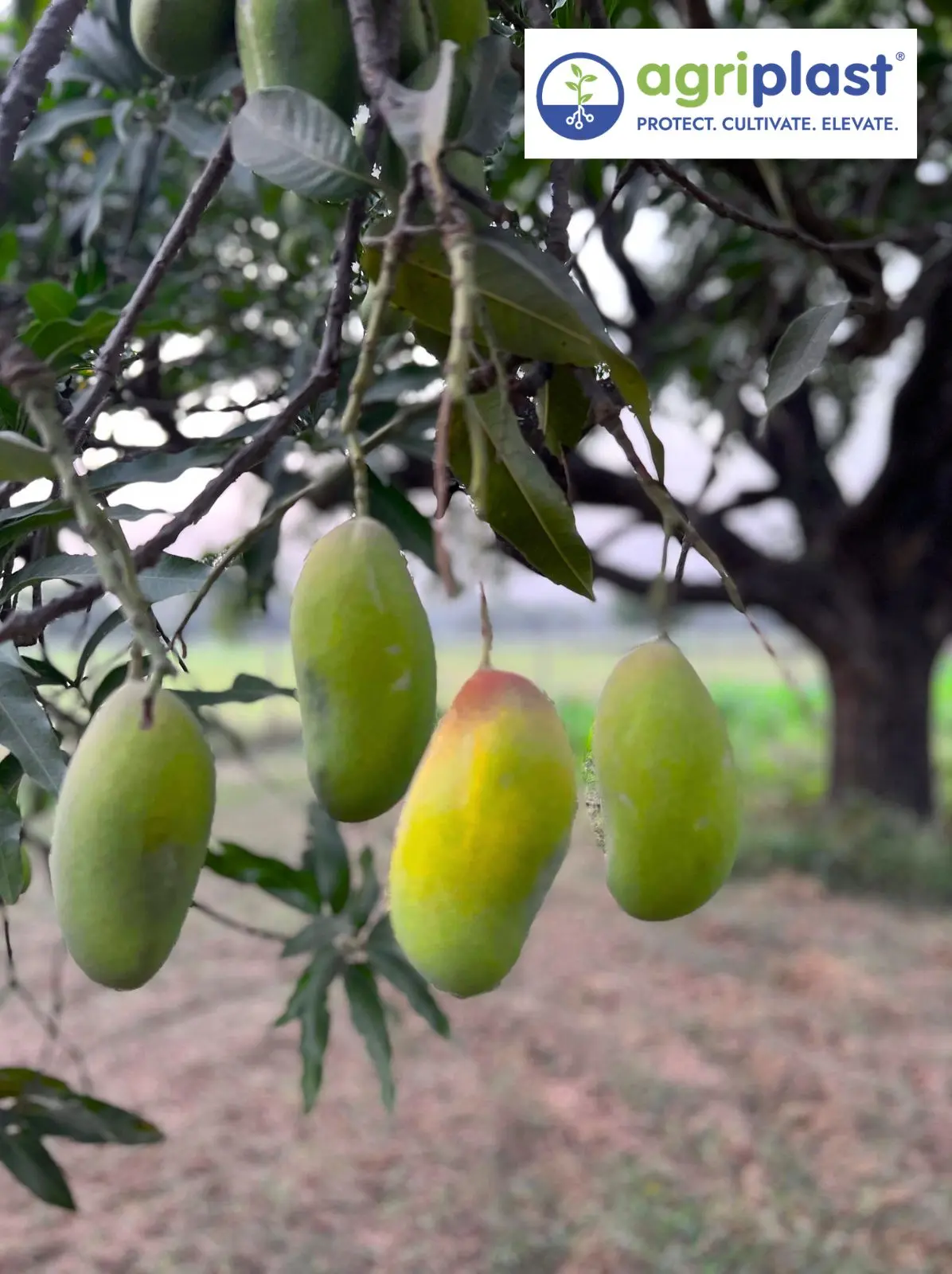
Fruit size at this stage is directly influenced by irrigation consistency, nitrogen management, and the number of fruits retained per cluster. Consistent drip from flowering to harvest is non-negotiable for export-grade produce.
Mango Farming Economics — Cost, Yield, and Profit per Acre
Mango farming profit depends on three things: planting system, variety, and management intensity. Capital is front-loaded; income is back-loaded. Figures below are benchmarked against MIDH operational guidelines, NHB 2022–23 data, and ICAR-CISH yield performance trials.
Year 1 Capital Investment per Acre
| Item | Traditional (~50 trees) | HDP (~160 trees) | UHDP (670–1,100 trees) |
|---|---|---|---|
| Land prep + levelling + pit digging | ₹12,000–16,000 | ₹18,000–22,000 | ₹24,000–30,000 |
| Grafted saplings | ₹5,000–8,000 | ₹16,000–24,000 | ₹67,000–1,50,000 |
| Drip irrigation system | ₹18,000–25,000 | ₹25,000–35,000 | ₹35,000–45,000 |
| Weed mat (inter-row) | ₹10,000–15,000 | ₹15,000–20,000 | ₹20,000–28,000 |
| Mulching film (tree basins) | ₹4,000–6,000 | ₹8,000–12,000 | ₹15,000–20,000 |
| Fertilisers + FYM | ₹5,000–7,000 | ₹8,000–10,000 | ₹12,000–15,000 |
| Labour (Year 1) | ₹12,000–16,000 | ₹16,000–20,000 | ₹22,000–28,000 |
| Total Year 1 | ₹66,000–93,000 | ₹1,06,000–1,43,000 | ₹1,95,000–3,16,000 |
Yield Curve and Revenue by Variety — Mature Orchard (Year 10+)
| Variety | System | Yield/Acre | Farm Gate Price | Gross Revenue | Net Profit* |
|---|---|---|---|---|---|
| Alphonso (Ratnagiri) | Traditional | 2.5–4 T | ₹80–150/kg | ₹2–6 lakh | ₹1.5–5 lakh |
| Kesar (Gir) | Traditional/HDP | 4–8 T | ₹60–120/kg | ₹2.4–9.6 lakh | ₹1.8–8.5 lakh |
| Dasheri (Malihabad) | HDP | 6–10 T | ₹25–45/kg | ₹1.5–4.5 lakh | ₹75,000–3.7 lakh |
| Banganapalli | HDP | 8–12 T | ₹15–30/kg | ₹1.2–3.6 lakh | ₹60,000–2.8 lakh |
| Amrapali | UHDP | 12–18 T | ₹20–35/kg | ₹2.4–6.3 lakh | ₹1.7–5.5 lakh |
*Net profit = gross revenue minus annual operating costs (₹44,000–71,000/acre). Capital recovery not included. Farm gate prices from APEDA market intelligence and NHB data 2022–24. Prices fluctuate annually.
Planning your orchard inputs? Weed mat, mulching film, shade net, and anti-hail net requirements vary by state, variety, and planting system. Talk to Agriplast's team →
Evaluating mango against other perennial crops? The pomegranate farming guide covers a comparable orchard investment with different risk and return dynamics.
Frequently Asked Questions
Blog written and Posted by
Rani Singh
Rani Singh is a Content Executive at Agriplast Tech India, covering high-value farming, protected cultivation, and farmer success stories. She focuses on turning field experiences into practical, actionable content for Indian farmers and agri-entrepreneurs.You can write your view/comments here
Need Expert Assistance?
Get personalized recommendations for your greenhouse, polyhouse, or irrigation needs.
-
Bengaluru (Corporate Office)
- 918141446666
- support@agriplast.co.in
WeWork Roshni Tech Hub - 1st floor, PFS Club House, Marathahalli Main Rd, R.J.Gardens, Lakshminarayana Pura, EPIP Zone, Chinnapanna Halli, Bengaluru, Karnataka 560037