How Sachin Dake Earns ₹10 L/Acre with Mulching for Strawberry Farming in Ooty

What if the biggest barrier between you and a profitable farming business was something you never actually needed? Most people who visit strawberry farms in Ooty return with the same belief — without a polyhouse, earning ₹10–12 lakh per acre is nearly impossible.
They see rows of white polytunnels covering the hills, hear about ₹40–50 lakh investments, and assume this is a game only for those with deep pockets.
But Sachin Dake saw it differently.
For seven years, he worked as a flower farmer in Ooty, understanding the land, the climate, and the risks that come with farming in open conditions. When he shifted to strawberries, he didn’t invest in a polyhouse. Instead, he focused on optimizing open-field cultivation across his 2-acre farm.
Today, he earns ₹10–12 lakh net profit per acre — matching the returns of many polyhouse growers, but without the heavy capital investment.
This wasn’t luck. It was a result of consistent learning, field-level experimentation, and smart input choices — where mulching film played a critical role in controlling weeds, retaining moisture, and improving crop quality
Why Ooty Doesn't Need a Polyhouse
Strawberry is a cold-climate crop. For proper flowering and fruiting, it needs stable temperatures between 14–28°C — a condition most Indian regions can offer only for four to five months a year. Ooty, at 2,240 metres in the Nilgiris, has it twelve months straight.
That single geographic fact changes everything. A polyhouse lease in Ooty costs ₹4 lakh per acre per year. Open-field leased land costs ₹1 lakh. That ₹3 lakh difference doesn't go to infrastructure — it stays as profit.
Sachin harvests from March through October — a seven-to-eight month window most Indian farmers can't match. According to National Horticulture Board data, Nilgiris ranks among India's most productive strawberry micro-climates for open-field cultivation.
Why Mulching for Strawberry Farming Is Essential
Strawberry fruit hangs low — just above the soil surface. When drip irrigation wets the ground beneath, the berry makes contact with damp earth. That's exactly where Botrytis cinerea, the grey mould that destroys strawberry crops, enters. Soil splash carries the spores directly onto the fruit.
Without a barrier, one infected plant becomes ten. One bad week becomes a ruined bed. And on an eight-month crop, you cannot afford to restart.
"When we irrigate, the soil gets wet. If the fruit touches that wet soil, fungal damage starts. Mulching stops that from happening. And the weeds — they simply don't come up."
— Sachin Dake, Ooty, Nilgiris, Tamil Nadu
The mulch film creates a barrier between wet soil and fruit, breaking the infection cycle before it begins. At the same time, it blocks sunlight from reaching the soil, preventing weed growth throughout the season.
That has a direct impact on labour. Sachin employs around eight workers per acre, each earning ₹350–400 per day. Without mulch, a significant portion of their time would go into weeding. With proper mulching, that effort shifts entirely to harvesting — the part of the work that actually generates income.
To go deeper into how mulching works, explore plastic mulching in agriculture.
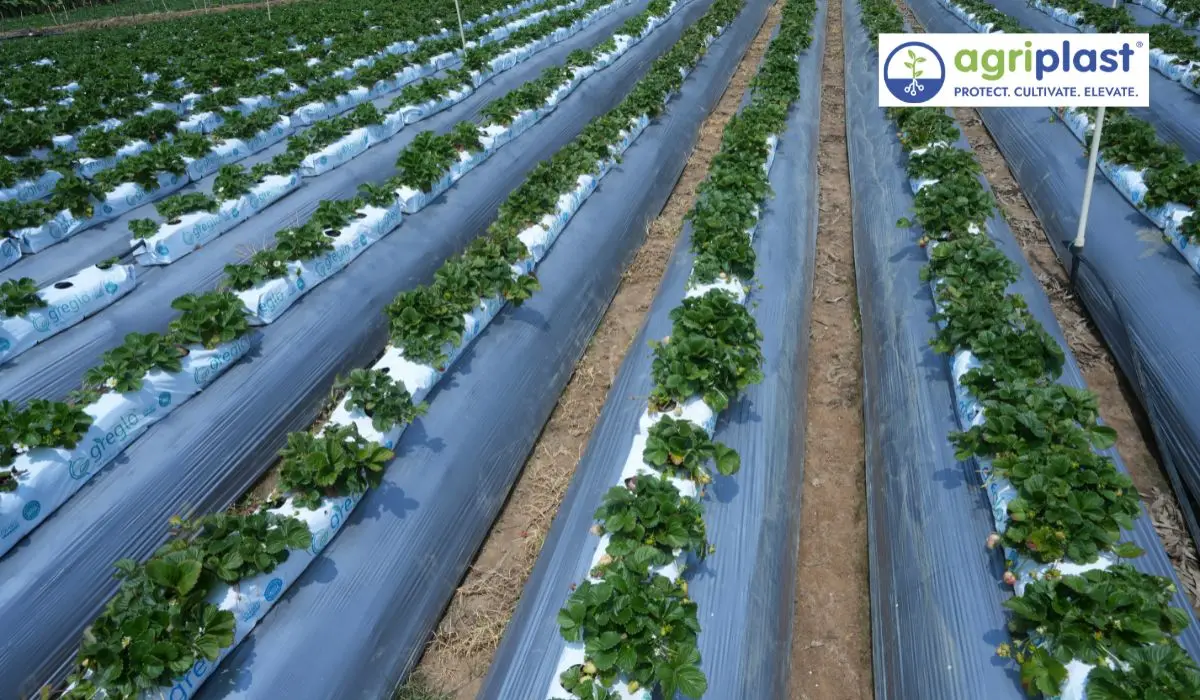
Silver-black mulch film over inline drip laterals — pre-punched holes mark each plant position. The black underside blocks light completely; the silver top reflects UV back toward the crop.
Why Silver-Black, Not Plain Black
Most farmers start with black mulch. It controls weeds, retains moisture, and for many crops that's enough. Sachin chose silver-black from the beginning — and after two seasons with Agriplast mulching film, he's specific about what it does for strawberry.
The silver upper surface reflects ultraviolet light back toward the plant canopy. Strawberry fruit colour — the deep red that separates Grade A from Grade B — depends on anthocyanin production in the skin. Anthocyanin is triggered by UV. Silver-black doubles the UV exposure the fruit receives: once from above, once reflected from below.
"We are using silver-black mulching. One benefit we get is that the strawberry colour comes out better. We have been using Agriplast mulching for two years — performance is very good. It holds for eight to nine months."
— Sachin Dake, Ooty, Nilgiris, Tamil Nadu
At the packing table, Grade A berries — fully red, firm, uniform — fetch ₹250–300/kg from aggregators. Grade B goes to the local market the same day. At a ₹50–100/kg gap between grades, silver-black mulch's colour benefit becomes a direct margin gain.
See how to choose the right mulch film for full selection guidance.
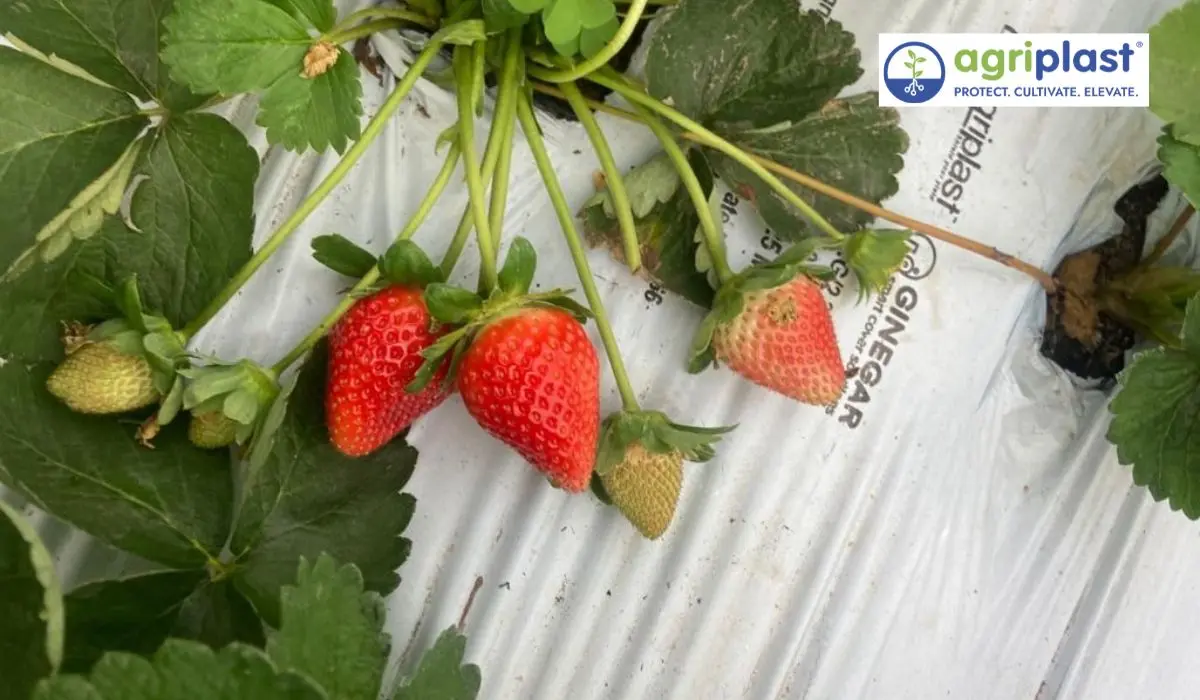
Grade A strawberries on Agriplast silver-black mulch — no soil contact, no fungal risk. UV reflection drives the deep red colour that commands ₹250–300/kg.
The Real Numbers: Investment vs. Profit
Most strawberry farming content shows revenue and calls it profit. Here is the honest breakdown — from bed preparation to first sale.
| Cost Item | Per Acre |
|---|---|
| Seedlings — 25,000 plants at ₹12 each | ₹3,00,000 |
| Drip irrigation system | ₹1,50,000 |
| Mulching film and laying | ₹25,000–35,000 |
| Bed preparation and soil work | ₹30,000–40,000 |
| Fertiliser and chemicals (first 3 months) | ₹60,000–80,000 |
| Labour — setup phase | ₹50,000–70,000 |
| Total to first fruit | ₹7,00,000–8,00,000 |
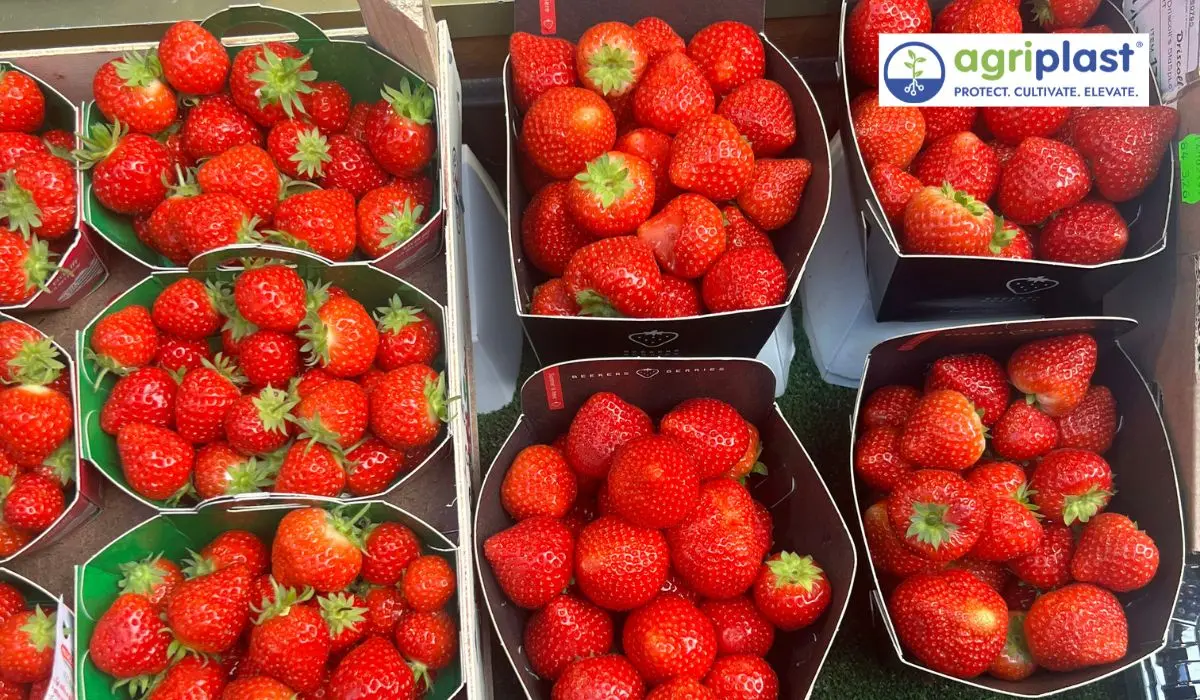
Grading and packing at Sachin's farm — Grade A at ₹250–300/kg to aggregators, Grade B to the local market same day.
Against that investment: 20,000 productive plants at 0.5–1 kg each, sold at ₹200–250/kg, gives gross revenue of ₹18–20 lakh per acre. After costs, net profit runs ₹10–12 lakh. The open-field land lease saving of ₹3 lakh over polyhouse adds directly to that figure.
Strawberry farming also qualifies for MIDH planting material subsidy — roughly ₹1.11 lakh per hectare — reducing first-year seedling costs. Check current MIDH eligibility before you plan.
🎥 Watch: Sachin Dake's Strawberry Farm in Ooty — Full Walkthrough
Bed layout, drip setup, mulch laying, and the complete economics — in Sachin's words.
Sachin's Advice for Aspiring Farmers
Sachin still farms three acres of floriculture alongside his strawberry. He hasn't abandoned flowers. But ask which crop changed his business — he'll always say strawberry. Then he'll tell you where to start.
"Not every farmer can afford a polyhouse. But in the right climate, open-field strawberry is also profitable. You don't need the structure."
— Sachin Dake, Ooty, Nilgiris, Tamil Nadu
Mulch goes down before the plant — not after. Get the foundation right on day one, and the rest — pest monitoring, leaf cleanup, grading — builds on it.
For Sachin, mulching isn't optional — it's the foundation everything else builds on.
Thinking of starting strawberry farming? Explore our complete guide to strawberry farming in India to understand the right practices, costs, and profit potential before you begin.
Frequently Asked Questions
Blog written and Posted by
Rani Singh
Rani Singh is a Content Executive at Agriplast Tech India, covering high-value farming, protected cultivation, and farmer success stories. She focuses on turning field experiences into practical, actionable content for Indian farmers and agri-entrepreneurs.You can write your view/comments here
Need Expert Assistance?
Get personalized recommendations for your greenhouse, polyhouse, or irrigation needs.
-
Bengaluru (Corporate Office)
- 918141446666
- support@agriplast.co.in
WeWork Roshni Tech Hub - 1st floor, PFS Club House, Marathahalli Main Rd, R.J.Gardens, Lakshminarayana Pura, EPIP Zone, Chinnapanna Halli, Bengaluru, Karnataka 560037