Mango Farming in India 2026: Best Varieties, Planting Systems, and Profit per Acre
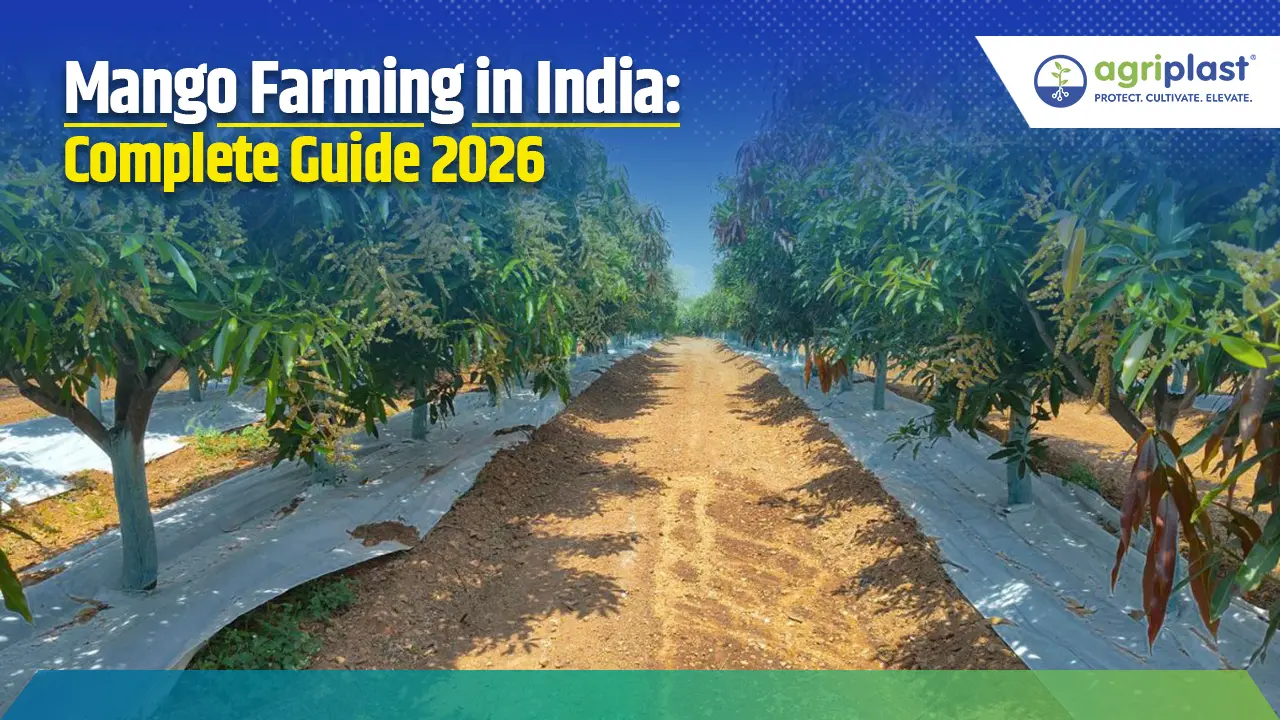
Every summer, India produces more mangoes than any other country on earth — and still cannot meet its own demand. According to the National Horticulture Board Annual Report 2023–24, the country produces around 25 million metric tonnes of mangoes across 2.3 million hectares—nearly 45% of global output. Yet exports remain below 0.3%, as the domestic market absorbs almost everything.
That statistic tells you something important about mango as a farming business. With strong cultural demand, a fixed season, and minimal import competition, consumers consistently pay a premium for quality—from Dasheri in Lucknow to Alphonso in Mumbai and Banganapalli in Hyderabad.
A mature mango orchard in India produces for 40 to 50 years from the same land. The decisions made in Year 1 — spacing, rootstock, soil preparation, irrigation design, and orchard floor management — determine whether those decades are productive or not.
This guide helps you get those decisions right—from varieties and planting systems to long-term profitability.
What Will This Guide Cover
- Why Indian Mango Has No Equal in the Global Market
- Best Mango Varieties for Indian Farmers — Zone-Wise Matrix
- Orchard Layout — Traditional, High-Density, and UHDP Planting
- Step-by-Step Orchard Establishment — Land Prep to Year 3
- Orchard Protection — Managing Hail, Weeds, Mulching, and Frost
- Mango Pest and Disease Management
- Orchard Care Through the Year — Irrigation, Flowering, and Harvest
- Mango Farming Economics — Cost, Yield, and Profit per Acre
- Government Subsidies for Mango Farming in India
- Frequently Asked Questions
Why Indian Mango Has No Equal in the Global Market
Among all mango-producing countries, India stands in a category of its own—not just in volume, but in flavour and aroma.
The defining edge of Indian mangoes lies in their complex terpene and ester compounds, which create a fragrance intensity unmatched globally. Varieties like Alphonso, Kesar, Dasheri, and Banganapalli are not just sweet—they are aromatic experiences.
This is not marketing—it’s a biochemical advantage confirmed by flavour research. And it directly translates into premium pricing in global markets.
Other major mango-producing countries—Thailand, Mexico, Brazil, the Philippines, and Peru—prioritise shelf life and transport durability over flavour. Varieties like Tommy Atkins dominate global trade due to uniform size and long storage, but lack the rich aroma of Indian mangoes. Even sweeter types like Carabao fall short in fragrance complexity.
This flavour advantage gives Indian mangoes consistent premium pricing. Despite exporting only 55,000–70,000 metric tonnes annually (per APEDA), varieties like Alphonso, Kesar, Dasheri, and Langra command high value across Japan, Gulf, and UK markets. Buyers pay for uniqueness—this is structural pricing power.
According to the National Horticulture Board, India exports less than 0.3% of its total production (NHB Annual Report 2023–24). The constraint is not demand, but gaps in grading, traceability, and post-harvest standardisation at the farm level.
Best Mango Varieties for Indian Farmers — Zone-Wise Matrix
Picking the wrong variety for your region is the first — and most expensive — mistake in mango farming. Mango cultivation in India spans many agro-climatic zones, and each zone favours specific varieties. Match your variety to your state's temperature range, soil type, and target market. Get this right and everything else becomes easier to manage.
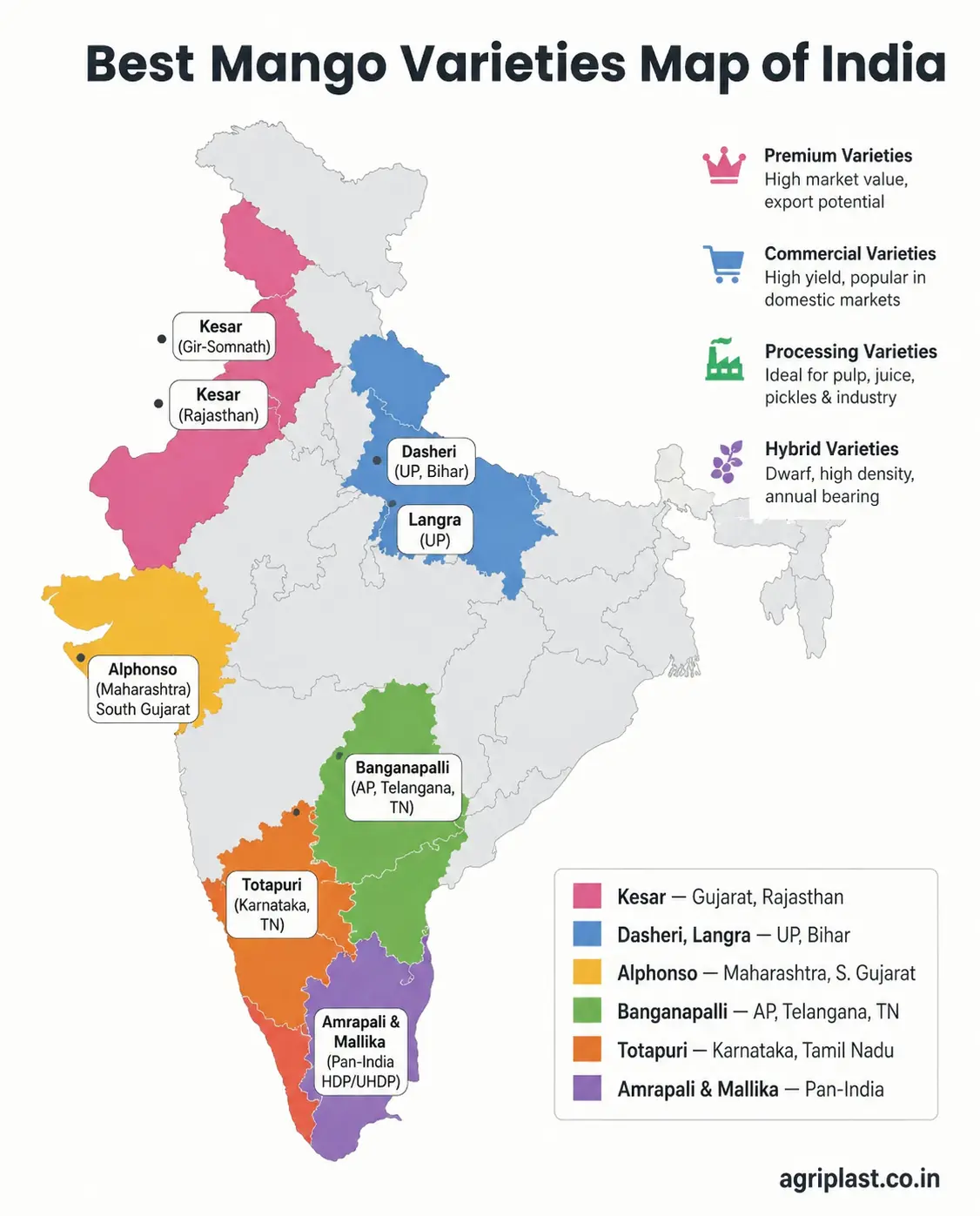
Zone-wise mango variety distribution across India. Each state's dominant commercial variety is shaped by its soil type, rainfall pattern, and winter temperature. Selecting the right variety for your zone is the first and most consequential decision in mango orchard planning.
Alphonso — Maharashtra, South Gujarat
Alphonso mango farming in Ratnagiri and Devgad is India's most commercially prestigious horticultural enterprise. The laterite coastal soil, sea breeze, and specific humidity produce a flavour no other growing zone replicates. The GI tag restricts the "Hapus" label to specific talukas in Ratnagiri and Devgad. It fruits late March to early May with a narrow 3–4 week harvest window. It is highly susceptible to anthracnose and not suited to North India's dry summers.
Kesar — Gujarat (Gir-Somnath), Rajasthan
Kesar mango farming is centred in Gir, Saurashtra. Black cotton soil and semi-arid conditions produce its signature saffron-coloured pulp. Kesar holds a GI tag for Gir-origin produce and is the second most export-friendly variety after Alphonso. It fruits May to June. It is less disease-prone than Alphonso and is seeing growing demand in Middle East and European export markets.
Dasheri — Uttar Pradesh, Bihar
Dasheri is North India's dominant commercial variety. It is centred in Malihabad, Lucknow — the world's largest single mango-producing area. It has a long shelf life and fibreless pulp. It fruits June to July. The main challenge is severe biennial bearing — without Paclobutrazol management, alternate-year production halves effective income. It performs well in UP and Bihar but does not suit high-humidity coastal areas.
Langra — Uttar Pradesh
Langra is a popular fresh-market variety in North India. Its shelf life is only 4–5 days at ambient temperature, which limits commercial value to within 100 km of the orchard. It is fibreless with a kidney shape. It suits local fresh markets and direct farm-to-consumer channels rather than long-distance trade.
Banganapalli / Safeda — Andhra Pradesh, Telangana, Tamil Nadu
Banganapalli covers the largest mango acreage in Andhra Pradesh. It is large, high-yielding, and well-suited to processing into pulp and juice. It holds a GI tag for Kurnool and Prakasam districts. It fruits April to May and tolerates AP's intense summer heat well. It is the primary choice for farmers near mango processing units.
Totapuri — Karnataka, Tamil Nadu
Totapuri is the primary raw-use and processing mango. It is firm, sour, and parrot-beaked — used in chutneys, pickles, and export pulp. It is extremely disease-resistant with very high yield potential. It is not suited to fresh premium markets but ideal for farmers near processing facilities in Chikkaballapur and Tumkur.
Amrapali + Mallika — Pan-India (HDP/UHDP)
Amrapali (Dasheri × Neelum) and Mallika (Neelum × Dasheri) are ICAR-developed hybrids that changed mango farming economics. Both are dwarf in stature and bear fruit every year — eliminating biennial bearing. They are the recommended varieties for any farmer considering high-density or ultra-high-density planting systems.
Amrapali fruits July to August; Mallika fruits June to July. Market price is moderate, but higher tree density and annual bearing compensate with consistent income.
| Variety | Best States | Harvest Season | Yield Potential (Mature) | Market Type | Biennial Bearing Risk |
|---|---|---|---|---|---|
| Alphonso | Maharashtra, S. Gujarat | Mar–May | 8–12 T/ha | Premium fresh + export | Moderate |
| Kesar | Gujarat (Gir), Rajasthan | May–Jun | 10–14 T/ha | Premium fresh + export | Low |
| Dasheri | UP, Bihar | Jun–Jul | 10–15 T/ha | Fresh domestic | High |
| Langra | UP | Jun–Jul | 8–12 T/ha | Local fresh | Moderate |
| Banganapalli | AP, Telangana, TN | Apr–May | 12–18 T/ha | Fresh + processing | Low |
| Totapuri | Karnataka, TN | May–Jun | 15–20 T/ha | Processing + export | Very Low |
| Amrapali | Pan-India | Jul–Aug | 12–16 T/ha | Fresh domestic | Very Low (annual) |
| Mallika | Pan-India | Jun–Jul | 14–18 T/ha | Fresh domestic | Very Low (annual) |
Yield potential figures sourced from NHB Area-Production-Productivity data and ICAR-CISH variety performance trials. Actual yields vary by age, management, soil, and climate.
Orchard Layout — Traditional, High-Density, and UHDP Planting
Spacing is the single most consequential orchard decision after variety selection. Before you establish a mango plantation, the system you choose — traditional, high-density, or ultra-high-density — locks in your yield potential, capital requirement, and income timeline for the next 30 years.
Traditional Spacing (9m × 9m ≈ 50 Plants/Acre)
Traditional spacing gives each tree maximum canopy room. Trees can produce for 50–100 years with good management. This is the default for most legacy orchards in India. The key problem: you wait 6–8 years for meaningful yield, and your peak return per acre is capped at what 50 trees can produce. Returns in the early years barely cover operating costs. This system suits farmers with low capital, multigenerational land ownership, and premium varieties like Alphonso or Kesar where individual tree quality matters more than density.
High Density Mango Planting (5m × 5m ≈ 160 Plants/Acre)
High density mango planting at 5m × 5m puts 160 trees per acre — three times the traditional count. Fruiting begins in Year 3–4 and yield per acre rises significantly by Year 6–7. Drip irrigation is non-negotiable for this system. Root competition between trees is real, and seasonal pruning is required to prevent canopy overlap. This is a managed system, not a plant-and-wait system. It suits progressive farmers with irrigation infrastructure, targeting Amrapali, Mallika, Totapuri, or Banganapalli.
Ultra-High Density Planting / UHDP (3m × 2m ≈ 670–1,100 Plants/Acre)
UHDP is precision farming — up to 1,100 plants per acre at the tightest spacing, with fruiting beginning in Year 2–3. At 10 kg/tree by Year 5, a 1,100-tree orchard produces approximately 10 tonnes per acre — equivalent to ₹3–3.5 lakh in wholesale revenue at standard market rates. UHDP requires drip fertigation, systematic canopy pruning at least twice a year, and trees maintained at 1.5–2m height through planned hedging.
Without this discipline, UHDP becomes an overgrown failure by Year 5. It is suited almost exclusively to Amrapali and Mallika. For absent farmers or those with limited management time, wider spacing is strongly recommended.
Grafted Sapling Selection
Never plant mango from seed. Seed-grown trees take 8–10 years to fruit and produce inconsistent quality. Grafted saplings — veneer-grafted or epicotyl-grafted — carry the exact genetic traits of the parent variety and fruit in 3–4 years. Source saplings from state horticulture department nurseries, NHB-certified private nurseries, or ICAR-CISH (Central Institute for Subtropical Horticulture) in Lucknow.
Always request a nursery certificate confirming scion variety. Mismatched or failed-graft saplings planted in a commercial orchard can mean discovering the wrong variety 8 years later — a loss that cannot be recovered.
Rootstock Selection — The Decision Most Farmers Skip
The rootstock — the root system your scion grafts onto — is as important as the variety itself. Different rootstocks tolerate different soil types, pH levels, waterlogging, drought, and nematode pressure. Most nurseries use whatever local seedling is available. This is one of the most common causes of underperforming orchards in India — and almost entirely avoidable.
ICAR-CISH research and state horticulture departments recommend specific rootstocks by region. The table below summarises their guidance:
| Rootstock | Recommended Region | Soil Suitability | Key Advantage | Avoid If |
|---|---|---|---|---|
| Kurukkan | Kerala, TN, Karnataka | Laterite, red loam, acidic soils | Best for heavy-rainfall acidic South Indian soils | Alkaline soils above pH 7.5 |
| Olour | Karnataka, Goa, Konkan Maharashtra | Laterite, coastal clay loam | Tolerates coastal salinity and humidity | Dry, sandy inland soils |
| Vellaikolamban | Tamil Nadu, AP | Sandy red loam | Drought-tolerant; suits low-rainfall AP and TN | Waterlogged soils |
| Moovandan | Kerala | Laterite, clay loam | Strong anchorage; good in high-rainfall zones | Alkaline alluvial |
| Desi (local seedling) | UP, Bihar, North India | Alluvial, loamy | Hardy, widely available, adapted to sub-tropical conditions | Heavy clay or waterlogged soils |
| Planting System | Plants/Acre | First Fruiting | Peak Yield Potential | Capital Intensity |
|---|---|---|---|---|
| Traditional (9×9m) | ~50 | Year 6–8 | 3–5 T/acre | Low |
| High-Density (5×5m) | ~160 | Year 3–4 | 6–10 T/acre | Medium |
| UHDP (3×2m) | 670–1,100 | Year 2–3 | 10–18 T/acre | High |
Step-by-Step Orchard Establishment — Land Prep to Year 3
Step 1 — Land Preparation and Soil Testing
Begin land preparation 3–4 months before planting. Deep plough twice to loosen compacted layers and break soil clods. Level the field to prevent waterlogging around tree roots. If possible, carry out laser land levelling — a one-time cost of ₹8,000–10,000 per acre that pays back many times over through better irrigation efficiency and reduced waterlogging over the orchard's lifetime.
Also mark your row orientation at this stage. Orient rows North to South. This ensures maximum sunlight reaches all sides of the tree canopy through the day — leading to more even ripening, lower fungal disease pressure, and reduced fungicide use over the orchard's life. Use a compass on your phone and mark the North-South line with chalk or lime before pit digging begins.
Soil testing is not optional. According to NHB mango production guidelines, mango thrives in well-drained loamy to sandy loam soils with pH 5.5–7.5 and good aeration down to at least 1.5m. Waterlogged or compacted soils damage root systems.
Before planting, also carry out a drainage test: dig a 60cm pit and fill it with water. If water drains completely within one hour, drainage is adequate. If water remains after 2–3 hours, install raised beds or sub-surface drainage before establishing the orchard.
| State / Region | Dominant Soil | pH Range | Key Adjustment Needed |
|---|---|---|---|
| Maharashtra (Konkan) | Laterite (red loam) | 5.5–6.5 | None — ideal for Alphonso |
| UP / Bihar (Gangetic) | Deep alluvial / silt loam | 7.0–8.2 | Gypsum if pH >8.0; add FYM for drainage |
| Gujarat (Saurashtra) | Black cotton (vertisol) | 7.5–8.5 | Improve drainage; gypsum at 300–500 kg/acre |
| AP / Telangana | Sandy red loam | 6.0–7.5 | Micronutrient correction (Zn, B) before planting |
| Karnataka | Red laterite / clay loam | 5.5–7.0 | Lime if pH <5.5 in acidic laterite belts |
| Rajasthan | Sandy loam | 7.5–8.5 | Heavy FYM + drip essential; avoid flood irrigation |
Studies by ICAR-CISH (Central Institute for Subtropical Horticulture), Lucknow confirm that zinc deficiency affects over 60% of North Indian mango orchards, and boron deficiency is widespread in peninsular red soils. Both limit fruit set and reduce skin finish on export-grade mangoes. Test for micronutrients before planting — not after the problem appears.
After levelling, broadcast sunn hemp (sannai) or dhaincha on the prepared field. This green manuring crop enriches soil carbon, adds nitrogen through root fixation, and helps you visually identify nutrient-deficient patches before planting — wherever growth is sparse, the soil needs attention.
Step 2 — Pit Digging and Filling
Dig pits at your chosen spacing. Before digging, use a sub-soil plough (hard pan breaker or key-line plough) along each planting row. This breaks the compacted layer — the hard pan — that forms below the typical plough depth and blocks water and root penetration. Breaking the hard pan once, before planting, allows roots to reach deeper moisture and nutrient reserves for the entire life of the tree.
Pit sizes: 1m × 1m × 1m for traditional and HDP systems; 60cm × 60cm × 60cm for UHDP. Leave pits open to sunlight for 15–20 days to destroy soil-borne pathogens before filling.
Pit filling mix (per pit, traditional/HDP):
- Topsoil: 50%
- Well-decomposed FYM or compost: 30 kg
- Single super phosphate: 500g
- Neem cake: 1 kg
- Neem cake: 500g (natural termite deterrent and soil conditioner)
Fill to 15cm above ground level to account for settling. Water once and allow to settle for 15 days. Place a marking stake at each filled pit — when the sapling arrives, you'll know exactly where to plant without disturbing the nutrient layer below.
Step 3 — Planting Grafted Saplings
Plant at the onset of the monsoon — June to August for most of India. In Gujarat and South India, February–March planting with assured drip irrigation is also commercially practiced. Remove the polybag carefully without disturbing the root ball. Place the sapling so the graft union sits 10–15cm above ground level. Back-fill firmly.
Create a water basin around the tree. Stake young saplings against wind for the first 2 seasons. Avoid planting on rainy days — wet soil compacts differently around roots and can restrict early root development.
_1777535230_69f308fe5da82.webp)
A newly planted grafted mango sapling on a black weed mat row. Weed mat applied from Day 1 of establishment eliminates the first season's most costly weeding rounds and retains root-zone moisture during the critical first monsoon.
Step 4 — Young Plant Care — Years 1 to 3
Understanding how to grow mango correctly starts here. Mango tree care in the first three years determines your orchard's productive life across the next four decades. Water every 3–5 days in dry months for the first 2 years. Use drip at 20–30 litres per tree per day during establishment. Stop watering completely from October through January — this dry-cool stress triggers flowering induction for the following season.
Weeds in the first year compete aggressively with young mango roots for nitrogen and phosphorus. Hand weeding 4–5 times in Year 1 is common but costs ₹2,000–3,000/acre per round. Intercrop with low-height vegetables — onion, groundnut, cowpea — between rows. This suppresses weeds naturally while generating income during the non-bearing years.
| Tree Age | FYM (kg/tree) | Urea (g/tree) | SSP (g/tree) | MOP (g/tree) |
|---|---|---|---|---|
| Year 1 | 10 | 200 | 300 | 200 |
| Year 3 | 25 | 400 | 600 | 400 |
| Year 5 | 35 | 600 | 900 | 600 |
| Year 7 | 45 | 800 | 1,200 | 800 |
| Year 10+ | 50 | 1,000 | 1,500 | 1,000 |
Apply fertiliser in two splits: 50% at onset of monsoon (June) and 50% post-monsoon in October. For North India orchards in UP, Bihar, and Punjab where winter temperatures drop below 5°C, wrap first-year saplings in shade net material on bamboo frames from December to February. The cover breaks wind chill and raises the microclimate temperature around the sapling by 2–4°C — enough to prevent frost kill.
Step 5 — Mango Tree Pruning and Canopy Training
Mango tree pruning begins from the first season. Remove all shoots below 60–70cm from the ground to establish a clean stem. Allow 3–4 well-spaced primary branches to form the scaffold. Remove shoots that grow vertically inward — they block light from the canopy interior and harbour pests and disease.
For HDP and UHDP systems, formative pruning begins from Year 1. Keep trees within their designated height and lateral spread. Systematic mango orchard management through pruning — at least once post-harvest and once pre-flowering — is what separates productive high-density orchards from overgrown failures.
Orchard Protection — Managing Hail, Weeds, Mulching, and Frost
A mango orchard is a 20-year investment. A single hailstorm, a frost event, or two seasons of uncontrolled weeding can erase years of growth. Farmers who protect early spend less in the long run and reach profitable yields faster.
Hail Protection with Anti-Hail Net
Hail is the most destructive single weather event for mango orchards. It strikes during flowering (November to February) and early fruit set (March to April) — the two most economically critical stages of the mango season. A 15-minute hailstorm during peak flowering can destroy 60–80% of the season's crop. Maharashtra's Konkan belt, Vidarbha, UP's Malihabad region, and HP's Kangra district all face recurring hailstorm risk.
The standard approach is to install anti-hail netting as an overhead canopy cover over high-value orchard blocks during the vulnerable window — from panicle emergence through fruit set. The net intercepts hailstones before they reach flowering branches. Nets are anchored to posts and removed once fruit set is complete.
The cost per installation is recovered within one protected season on a high-value Alphonso or Kesar orchard. It also protects flowering branches themselves — a hailstorm that snaps panicles doesn't just destroy this year's crop, it reduces next year's bearing capacity as well.
See our full guide on anti-hail nets for Indian orchards for installation layouts and risk-zone state maps.
Weed Mat for Orchard Floor Management
From Year 3 onwards, the inter-row orchard floor becomes a persistent weed management problem. Manual weeding 3–4 times per year is the traditional approach, costing ₹2,500–4,000 per acre per round. At four rounds per year, that is ₹10,000–16,000 in annual weeding costs — every year, indefinitely.
Weed mat laid between rows is the practical alternative. It is a water-permeable fabric that allows rainfall and drip irrigation to pass through while blocking weeds from below. Unlike mulching film at the tree basin, weed mat covers the full inter-row pathway — and it does not need to be lifted for routine orchard operations. A single installation typically lasts 4–5 seasons, which brings the amortised annual cost well below ongoing manual weeding.
Explore our complete guide on weed mat in agriculture for coverage calculations and installation tips.
One practical note: weed mat also keeps the orchard floor clean and firm, which makes spray operations, pruning, and harvest easier across all seasons. Agriplast's weed mat is rated for Indian field conditions — see widths and specifications on their product page.
Shade Net for Frost and Heat Protection
For North India orchards in UP, Bihar, and Punjab established in monsoon season, the first winter is a critical risk window. First-year saplings can die if temperatures fall below 4°C for more than 3 consecutive nights. A shade net draped over bamboo frames around individual plants breaks wind chill and raises the immediate microclimate temperature by 2–4°C. Remove covers during the day to allow photosynthesis.
See our complete shade net guide for the right density for your state and crop stage.
Intercropping During Early Orchard Years
In Years 1–4, trees occupy less than 20–25% of the orchard floor. The inter-row space is a wasted asset unless you plant it. Short-duration vegetables — onion, garlic, groundnut, cowpea, or wheat — between rows generate income while the orchard matures, suppress weeds through canopy coverage, and add organic matter through root biomass.
Stop intercropping once tree canopies begin overlapping at Year 4–5, or earlier in HDP systems with tighter spacing.
Mango Pest and Disease Management
Most mango crop losses in India trace back to three causes: fruit fly, mango hopper, and powdery mildew. A sustainable, residue-free approach to each of these — using physical exclusion, biological controls, and cultural practices — is both viable and increasingly essential for export market access, where pesticide residue limits are strictly enforced.
Fruit Fly — Physical and Biological Control
Mango fruit fly (Bactrocera dorsalis) is the most damaging pest in Indian orchards. Females lay eggs under the fruit skin (April–June); larvae feed inside, causing fruit drop and total loss. A consistent, residue-free strategy from February can effectively control it.
Three-layer sustainable management protocol:
- Methyl eugenol pheromone traps: Deploy 1 trap per acre from February. Replace the lure every 30–45 days. This biological attractant draws and captures male flies before mating — breaking the population cycle without any chemical application.
- Protein bait with molasses: A mixture of 50ml molasses + 50ml water applied to trunk bait stations every 10–15 days from April attracts and traps flies using a natural food-based lure.
- Physical fruit exclusion: Paper bags, non-woven fabric covers, or crop cover bags over individual fruits from marble-size stage completely prevent fly access. This is the gold standard for Alphonso and Kesar export orchards.
For orchards with severe infestation history, insect net enclosures over individual tree sections during the April–June window provide whole-tree physical exclusion. Remove and destroy all fallen infested fruits every 2 days — fallen fruits are the primary breeding reservoir for the next generation.
Mango Hopper — Cultural and Physical Management
Mango hopper (Idioscopus clypealis) attacks flower panicles (Jan–March), causing flower drop and honeydew secretion, which leads to sooty mould. Effective control depends on prevention + early intervention, not heavy chemicals.
Pruning the canopy after harvest to open air circulation is the single most effective preventive step — hoppers breed in dense, humid canopy interiors.
Kaolin clay particle spray (white kaolin at 3–5%) applied to panicles creates a physical deterrent film that reduces hopper landing and feeding without any toxicity.
Neem-based formulations (neem oil 3000 ppm at 3–5ml/litre) applied at panicle emergence disrupt hopper feeding and nymphal development through natural antifeedant activity.
Sticky yellow traps hung at panicle height capture adults during peak emergence in January–February.
Powdery Mildew — Natural and Cultural Control
Powdery mildew (Oidium mangiferae) forms white powdery growth on panicles and young shoots during the December–January dry-cool period, arresting flower development.
Cultural management reduces incidence significantly: maintaining open canopy structure through annual post-harvest pruning, removing and composting affected shoot tips as soon as symptoms appear, and avoiding overhead irrigation during the flowering period.
Wettable sulphur (80% WP at 3g/litre) is an approved organic, effective against powdery mildew. It is contact-based, breaks down naturally, leaves no harmful residue, and is the standard recommended intervention in certified organic mango orchards.
Baking soda spray (sodium bicarbonate at 5g/litre + few drops of neem oil) is effective for mild incidence and is completely food-safe.
Anthracnose — Post-Harvest and Cultural Management
Anthracnose (Colletotrichum gloeosporioides) causes dark spots on fruits and post-harvest rot — the primary quality concern for Alphonso and Kesar export orchards.
Cultural management: prune infected twigs and dead wood immediately after harvest, maintain orchard floor hygiene by removing leaf litter, and avoid overhead wetting of the canopy.
Bordeaux mixture (a traditional copper-lime preparation approved for organic use) applied at flowering provides effective protection with minimal environmental impact and is widely used by certified organic mango farmers.
Hot water treatment at 52°C for 5 minutes before packing destroys anthracnose spores on export fruit without any chemical treatment.
Stem Borer and Mealy Bug — Organic Barrier Methods
Stem borer damage is managed organically by applying a paste of neem oil and clay to trunk wounds and bore holes, which blocks the tunnel and repels the adult from re-entering.
Lime whitewash on the trunk base from ground level to 60cm height deters egg-laying on bark.
For mealy bug, sticky adhesive bands applied around trunk bases by 15 February physically prevent crawlers from climbing to the canopy — this single intervention eliminates the need for any spray.
Remove and replace bands as they fill. Apply neem oil spray to affected shoots if crawlers are already in the canopy.
| Pest / Disease | Critical Window | Primary Sustainable Control | Supporting Method |
|---|---|---|---|
| Fruit fly | Apr–Jun | Pheromone traps + physical fruit bagging | Insect net exclusion, destroy fallen fruit |
| Mango hopper | Feb–Mar | Kaolin clay spray + neem oil at panicle emergence | Canopy pruning for air circulation |
| Powdery mildew | Dec–Jan | Wettable sulphur (organic-approved) spray | Open canopy pruning, no overhead irrigation |
| Anthracnose | Flowering + pre-harvest | Bordeaux mixture at flowering; hot water post-harvest | Remove infected wood, orchard floor hygiene |
| Stem borer | Year-round | Neem oil + clay plug in bore holes | Lime whitewash on trunk base |
| Mealy bug | Feb–Mar | Sticky adhesive band on trunk by Feb 15 | Neem oil canopy spray if crawlers reach shoots |
Orchard Care Through the Year — Irrigation, Flowering, and Harvest
Systematic mango orchard management through the year follows the tree's natural rhythm — vegetative growth in summer, flowering induction through winter stress, fruit development in spring. Understanding this rhythm is the difference between a reactive farmer and a profitable one.
Water Requirements by Tree Age
| Tree Age | Daily Requirement | Irrigation Method | Critical Period |
|---|---|---|---|
| Year 1 | 20–30 L/day | Drip or manual basin | May–October |
| Year 2–3 | 30–50 L/day | Drip | March–September |
| Year 4–7 | 50–80 L/day | Drip | March–September |
| Year 8+ (mature) | 80–120 L/day | Drip or flood | March–June |
| October–January (all ages) | Stop all irrigation — this period triggers mango flowering induction | ||
Annual Mango Flowering Pattern in India
Mango flowering occurs once a year in India, following a north-to-south gradient driven by winter temperature and day length. The cooler and drier the winter, the more uniform and heavy the flowering response.
| Region | Panicle Emergence | Full Bloom | Fruit Set Complete |
|---|---|---|---|
| South India (AP, TN, Karnataka) | November–December | December–January | February |
| Maharashtra | December–January | January–February | February–March |
| Gujarat | December–January | January–February | March |
| North India (UP, Bihar) | February–March | March | March–April |
Fruit Set Improvement
Natural fruit set in mango is only 0.1–0.25% of flowers. The rest drop at various stages — this is normal biology. What is not normal is avoidable fruit drop from excess water or nitrogen during flowering.
Apply potassium nitrate at 1% as a foliar spray at full bloom to improve fruit retention.
Stop all nitrogen application from October onwards — excess nitrogen promotes vegetative growth at the expense of flowering.
For biennial bearers like Dasheri and Langra, apply Paclobutrazol (Cultar) at 10g active ingredient per tree in September–October of the ON year.
Post-Harvest Handling, Grading, and Packaging
According to ICAR-CIPHET,, India loses 20–30% of mango produce post-harvest due to damage, heat, latex, and diseases like Anthracnose.
Meanwhile, exports (APEDA data 2023–24) remain limited—not by demand, but by quality and handling gaps.
Immediate Post-Harvest (0–2 Hours)
- Move fruits to shade within 2 hours
- Avoid temperatures above 38°C
- Use padded bags or shallow crates
- Do not pile fruits in the sun (prevents internal bruising)
Washing & Latex Removal
- Wash fruits in clean ambient water
- For export: Hot water treatment → 52°C for 5 minutes
- Controls fungal spores and meets export standards (US, Japan, Korea)
Grading & Sizing
Grade by weight and size using a simple sizing ring set. Standard Indian grading categories for export:
- A-grade: Uniform size, no skin blemish, no latex marks, correct maturity stage for the variety
- B-grade: Minor skin marking, slightly variable size — suitable for domestic premium markets
- C-grade / processing: Skin damage, irregular shape, or over-maturity — suitable for pulp and juice processing
Export Packaging
- Use 3 kg / 5 kg corrugated boxes
- Wrap fruits individually (especially premium varieties)
- Avoid straw/husk (not export compliant)
- Label with: variety, grade, weight, location, harvest date
- Pre-cool at 12–14°C before transport
Domestic Market Packaging
- Traditional: bamboo baskets with leaves (mandi trade)
- Modern retail:
- Ventilated plastic crates
- Net wrapping or trays
- QR code traceability (in Tier 1 cities)
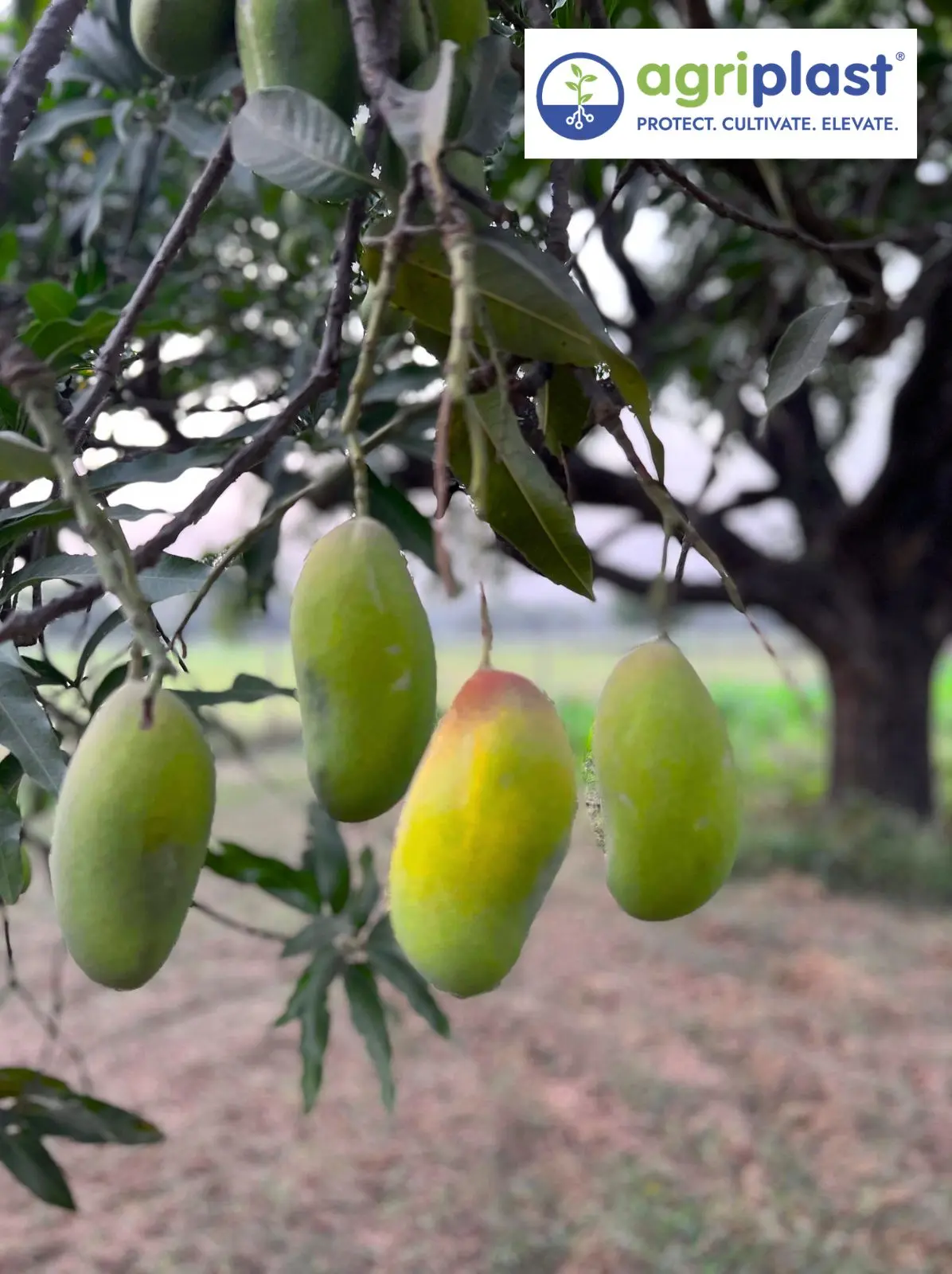
Mango fruits at the mid-development stage. Fruit size at this point is directly influenced by irrigation consistency, nitrogen management, and the number of fruits per cluster retained after fruit set.
Mango Farming Economics — Cost, Yield, and Profit per Acre
Mango farming profit depends on three variables: planting system, variety, and management intensity. Yield per acre climbs steeply from Year 4 to Year 10 — investment front-loads the cost while income back-loads the return. The figures in this section are benchmarked against NHB Area-Production-Productivity data 2022–23, MIDH operational guidelines for horticulture cost estimation, and ICAR-CISH yield performance data.
Capital Investment — Per Acre, Year 1
Reference: MIDH Area Expansion Guidelines, permissible project cost schedules and NHB nursery price data.
| Item | Traditional (~50 trees/acre) | HDP (~160 trees/acre) | UHDP (670–1,100 trees/acre) |
|---|---|---|---|
| Land preparation + laser levelling + pit digging | ₹12,000–16,000 | ₹18,000–22,000 | ₹24,000–30,000 |
| Grafted saplings | ₹5,000–8,000 | ₹16,000–24,000 | ₹67,000–1,50,000 |
| Drip irrigation system | ₹18,000–25,000 | ₹25,000–35,000 | ₹35,000–45,000 |
| Weed mat (inter-row coverage) | ₹10,000–15,000 | ₹15,000–20,000 | ₹20,000–28,000 |
| Mulching film (tree basins) | ₹4,000–6,000 | ₹8,000–12,000 | ₹15,000–20,000 |
| Fertilisers + FYM (Year 1) | ₹5,000–7,000 | ₹8,000–10,000 | ₹12,000–15,000 |
| Labour (Year 1) | ₹12,000–16,000 | ₹16,000–20,000 | ₹22,000–28,000 |
| Total Year 1 Capital | ₹66,000–93,000 | ₹1,06,000–1,43,000 | ₹1,95,000–3,16,000 |
Annual Operating Cost — Per Acre, Year 5 Onwards
Reference: MIDH operational cost norms for mango. Actual costs vary by state and input prices.
| Item | Cost (₹/acre/year) |
|---|---|
| Fertilisers + micronutrients | ₹12,000–18,000 |
| Pest and disease management (organic/biological inputs) | ₹5,000–10,000 |
| Labour (pruning, monitoring, harvest) | ₹18,000–28,000 |
| Irrigation power + maintenance | ₹6,000–10,000 |
| Weed mat / orchard floor maintenance | ₹3,000–5,000 |
| Total Operating (Year 5+) | ₹44,000–71,000 |
Mango Yield per Acre — Year-Wise Curve
Reference: NHB Area-Production-Productivity Statistics and ICAR-CISH UHDP trial data for Amrapali. Yields are indicative ranges; actual performance depends on management and agro-climatic conditions.
| Year | Traditional (50 trees/acre) | HDP (160 trees/acre) | UHDP — Amrapali (1,100 trees/acre) |
|---|---|---|---|
| Year 4 | 200–400 kg | 800–1,200 kg | 2,000–4,000 kg |
| Year 6 | 600–1,000 kg | 2,500–4,000 kg | 6,000–10,000 kg |
| Year 8 | 1,500–2,500 kg | 5,000–8,000 kg | 10,000–15,000 kg |
| Year 10+ | 2,500–4,000 kg | 6,000–10,000 kg | 12,000–18,000 kg |
Revenue Projection by Variety — Mature Orchard, Year 10+
Reference: Farm gate price ranges sourced from APEDA market intelligence reports and NHB market price data 2022–24. Prices fluctuate annually with harvest size, quality, and demand.
| Variety | System | Yield/Acre | Farm Gate Price | Gross Revenue | Net Profit* |
|---|---|---|---|---|---|
| Alphonso (Ratnagiri) | Traditional | 2.5–4 T | ₹80–150/kg | ₹2–6 lakh | ₹1.5–5 lakh |
| Kesar (Gir) | Traditional/HDP | 4–8 T | ₹60–120/kg | ₹2.4–9.6 lakh | ₹1.8–8.5 lakh |
| Dasheri (Malihabad) | HDP | 6–10 T | ₹25–45/kg | ₹1.5–4.5 lakh | ₹75,000–3.7 lakh |
| Banganapalli | HDP | 8–12 T | ₹15–30/kg | ₹1.2–3.6 lakh | ₹60,000–2.8 lakh |
| Amrapali | UHDP | 12–18 T | ₹20–35/kg | ₹2.4–6.3 lakh | ₹1.7–5.5 lakh |
*Net profit = Gross revenue minus annual operating costs. Capital recovery not included.
Important: All cost and revenue figures are indicative planning benchmarks. Actual costs vary by state, district, season, and input market conditions. Revenue figures depend on variety, grade, market channel, and year. These are not guaranteed returns. Consult your State Horticulture Department or MIDH district office for current-year project cost schedules applicable to your location.
For farmers evaluating mango against other orchard crops, our complete guide to pomegranate farming in India covers a comparable perennial fruit crop.
Frequently Asked Questions
Blog written and Posted by
Rani Singh
Rani Singh is a Content Executive at Agriplast Tech India, covering high-value farming, protected cultivation, and farmer success stories. She focuses on turning field experiences into practical, actionable content for Indian farmers and agri-entrepreneurs.You can write your view/comments here
Need Expert Assistance?
Get personalized recommendations for your greenhouse, polyhouse, or irrigation needs.
-
Bengaluru (Corporate Office)
- 918141446666
- support@agriplast.co.in
WeWork Roshni Tech Hub - 1st floor, PFS Club House, Marathahalli Main Rd, R.J.Gardens, Lakshminarayana Pura, EPIP Zone, Chinnapanna Halli, Bengaluru, Karnataka 560037