Soilless Turmeric Cultivation in India: Yield, Cost & Profit Guide 2026
India produces nearly 75–80% of the world's turmeric, making it one of the country's most important spice crops. Traditionally grown in open fields, it has been a consistent part of Indian farming systems.
But now, a shift is emerging. Turmeric is being grown inside Polyhouses using soilless media like coco peat, allowing greater control over growing conditions.
In conventional open-field cultivation, yields typically range from 8,000–12,000 kg of fresh rhizomes per acre. Controlled systems are reporting higher outputs, but with increased costs, risks, and management requirements.
This blog examines soilless turmeric cultivation, how it works, where it fits, and what farmers must evaluate before adopting it.
Before we start, understand that success in agriculture depends on execution, not just theoretical knowledge and claims.
Curious how this compares to vegetables? See our polyhouse cucumber farming guide for cost, yield, and profit numbers.
Let's get into it.
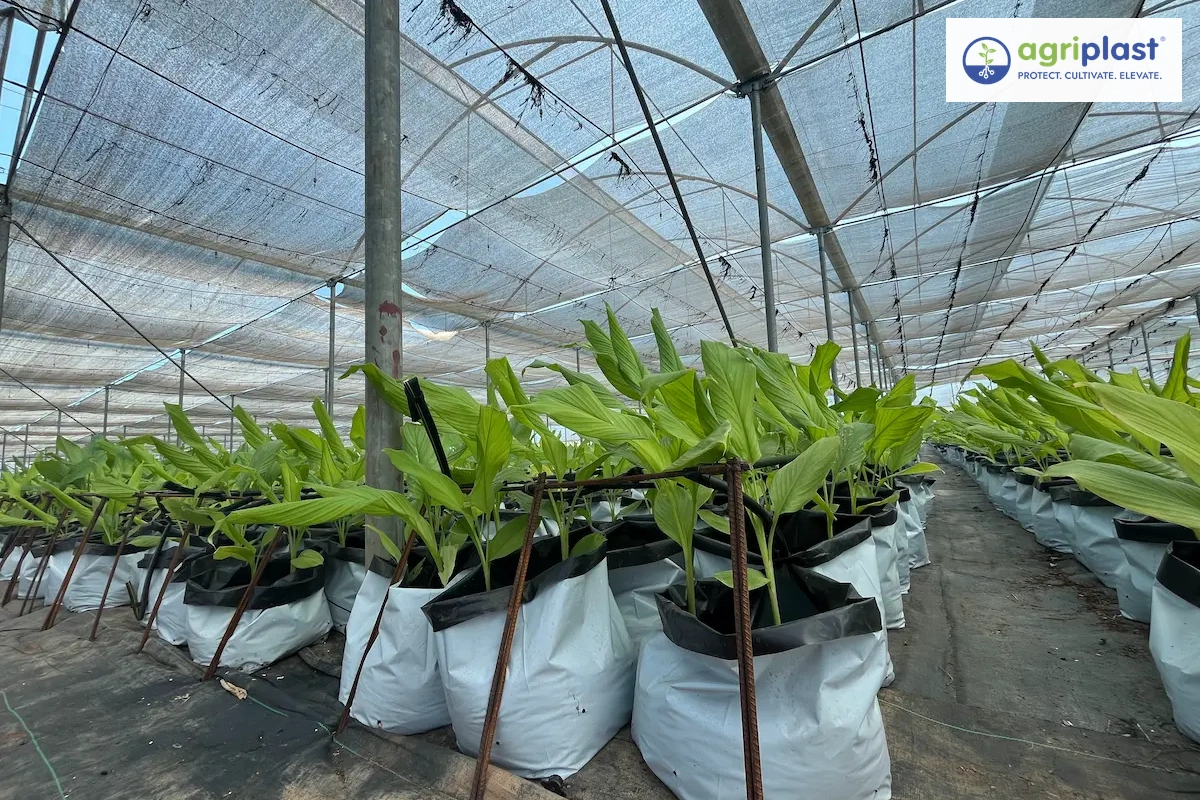
Soilless turmeric in a grow-bag coco peat system inside a naturally ventilated polyhouse — documented yield of 45 tonnes per acre per cycle.
Why Turmeric Cultivation Is a Growing Opportunity
India grows over 75% of the world's turmeric, yet Indian processors imported 1,257 metric tonnes of turmeric from Cambodia in 2023 (World Bank WITS trade data).
Why? Primarily because global buyers — across nutraceuticals, pharmaceuticals, and cosmetics — are not looking for just turmeric. They demand high-curcumin, residue-free, and consistent-quality produce.
Despite its scale, India currently supplies only ~10% of the global demand for high-curcumin turmeric (ICRIER–Amway India, Making India the Global Hub for Turmeric, Jan 2025).
And this gap exists at a time when global demand is rising. The turmeric trade was valued at USD 587 million in 2023 (OEC Turmeric Trade Profile), with India's exports growing steadily.
Growing Conditions for Turmeric
Turmeric is a shade-loving plant by nature. To grow turmeric successfully under protected cultivation, you must understand the ideal growing conditions for turmeric.
| Parameter | Ideal Range | Tolerance | Why It Matters |
|---|---|---|---|
| Temperature (overall) | 28–35°C | 15–42°C | Sustained heat above 40°C or cold below 15°C stalls growth and hurts curcumin |
| Temperature (by stage) | See below | — | Each growth stage has its own sweet spot |
| Humidity | 60–70% RH | Up to 90% | Dry air (below 50%) causes leaf curl and small rhizomes |
| Light / shading | 50–70% shade | — | Shade-loving crop; direct sun reduces curcumin |
| Root zone moisture | 30–50% | Never above 55–60% | Above 55%, root rot risk rises sharply |
| pH (water + nutrients) | 6.5–7.0 | — | Slightly acidic to neutral; alkaline locks up micronutrients |
| EC (nutrient solution) | Below 2.0 | Root zone below 2.8–3.0 | Above 3.0, salt buildup damages roots |
| Water TDS | Below 300 ppm | — | Above 300, use RO to prevent salt stress |
| Elevation | 0–1,500 m | — | Plains to mid-hills all work; above 1,500 m the cycle extends and yield drops |
Temperature by Growth Stage
| Growth Stage | Ideal Temperature |
|---|---|
| Germination | 28–33°C |
| Tillering | 25–30°C |
| Rhizome initiation and development | 18–20°C |
One Rule That Often Gets Missed
Rhizomes must stay in complete darkness throughout the cycle. Any rhizome exposed to light — pushed up by irrigation, uncovered during inspection — needs to be topped up with substrate immediately. Light exposure causes uneven development and visible discolouration that buyers reject.
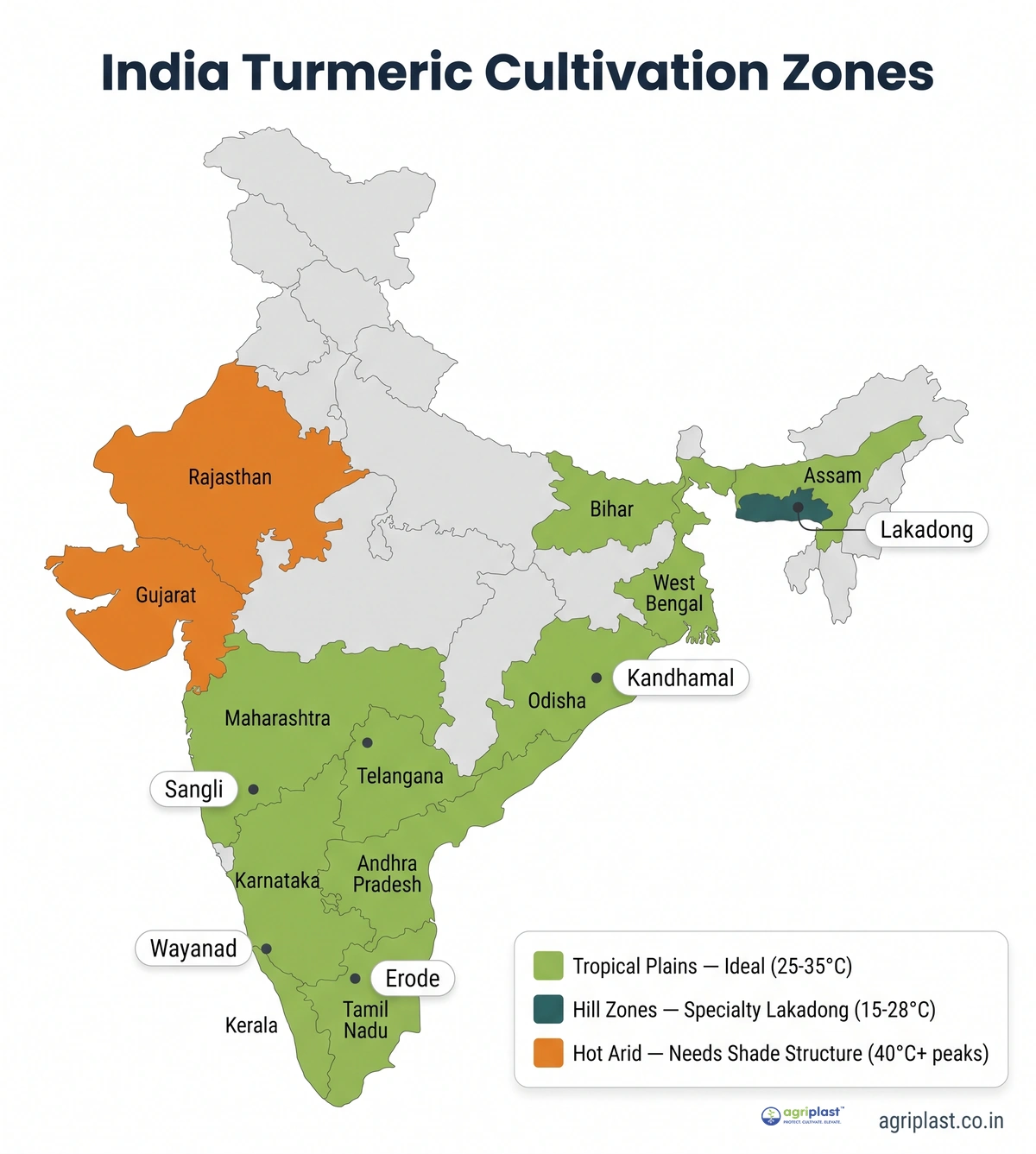
India's turmeric cultivation zones — tropical plains (ideal), Meghalaya hill zones (specialty Lakadong), and hot arid regions that need shade structures.
Turmeric Under Protected Cultivation
Open-field turmeric has a ceiling and that ceiling is set by two things you cannot control in open soil: the weather above the plant, and the microbiology beneath it.
Any cultivation under controlled conditions that creates a modified microclimate for the crop is known as protected cultivation. For turmeric, that comes down to two things — the structure above, and the substrate below.
The Structure — What Surrounds the Plant
Turmeric wants 50–70% shade, 60–70% humidity, and 28–35°C held steady for 8–9 months. Open fields cannot hold those conditions.
A protected structure buys you four things:
- Rainfall protection — no monsoon spikes flooding the root zone
- Temperature buffer — no midday 42°C scorching the canopy
- Light control — shade net or polyhouse film diffuses harsh direct sun into usable, even light
- Pest exclusion — insect mesh blocks thrips, shoot borers, and hairy caterpillars before they reach the crop
The Substrate — What Surrounds the Root
The substrate decides what the rhizome grows into. Native soil brings three problems you inherit whether you want them or not:
- Uneven moisture — swings with every rain event particularly in open field
- Soil-borne pathogens — Pythium, Rhizoctonia, and nematodes carry over year after year
- Residue history — the previous crop's chemicals are still in the soil when you plant
A coco peat trough system replaces all three with a sterile, drained, measurable root zone:
- Moisture held between 30–50%, monitored by a pulse meter
- Zero soil-borne pathogens — the foundation of residue-free certification
- Fertigation delivered through drip lines at controlled EC and pH
When we combine a naturally ventilated polyhouse with soilless cocopeat, then the output volume and quality can increase significantly.
This demands higher capital and sharper operational discipline. For a farmer chasing the quality gap that India currently imports from Cambodia to fill, this is the configuration that fills it.
Open-Field vs Protected Cultivation — Side by Side
| Factor | Open-Field Turmeric | Protected Cultivation (Polyhouse + Coco Peat) |
|---|---|---|
| Yield per acre per cycle | 8,000–12,000 kg | 45,000–60,000 kg |
| Curcumin content | 2–4% (standard varieties) | 7%+ achievable (Lakadong) |
| Root zone moisture | Rain-dependent, uneven | Measured 30–50% via pulse meter |
| Pathogen risk | High — Pythium, Rhizoctonia, nematodes | Near-zero — sterile coco peat |
| Residue-free certification | Difficult — soil history limits control | Achievable — every input is measurable |
| Rainfall risk | Significant — waterlogging, flooding | Eliminated by structure |
| Pest pressure | Full open exposure | Excluded by insect mesh |
| Labour (earthing-up, weeding) | High — manual, recurring | Minimal — substrate top-ups only |
| Capital per acre | Low (seed + basic inputs) | ₹68–72 lakh all-in (structure + substrate + drip + automation) |
| Buyer access | Open mandi, variable rates | Nutraceutical / pharma contracts |
| Realised price | Commodity rates (swings ₹60–120/kg dry) | ₹70–100/kg wet on residue-free contracts |
(Source: Agriplast field data, Bengaluru — December 2025 farm visits; ICAR-IISR Kozhikode for open-field benchmarks)
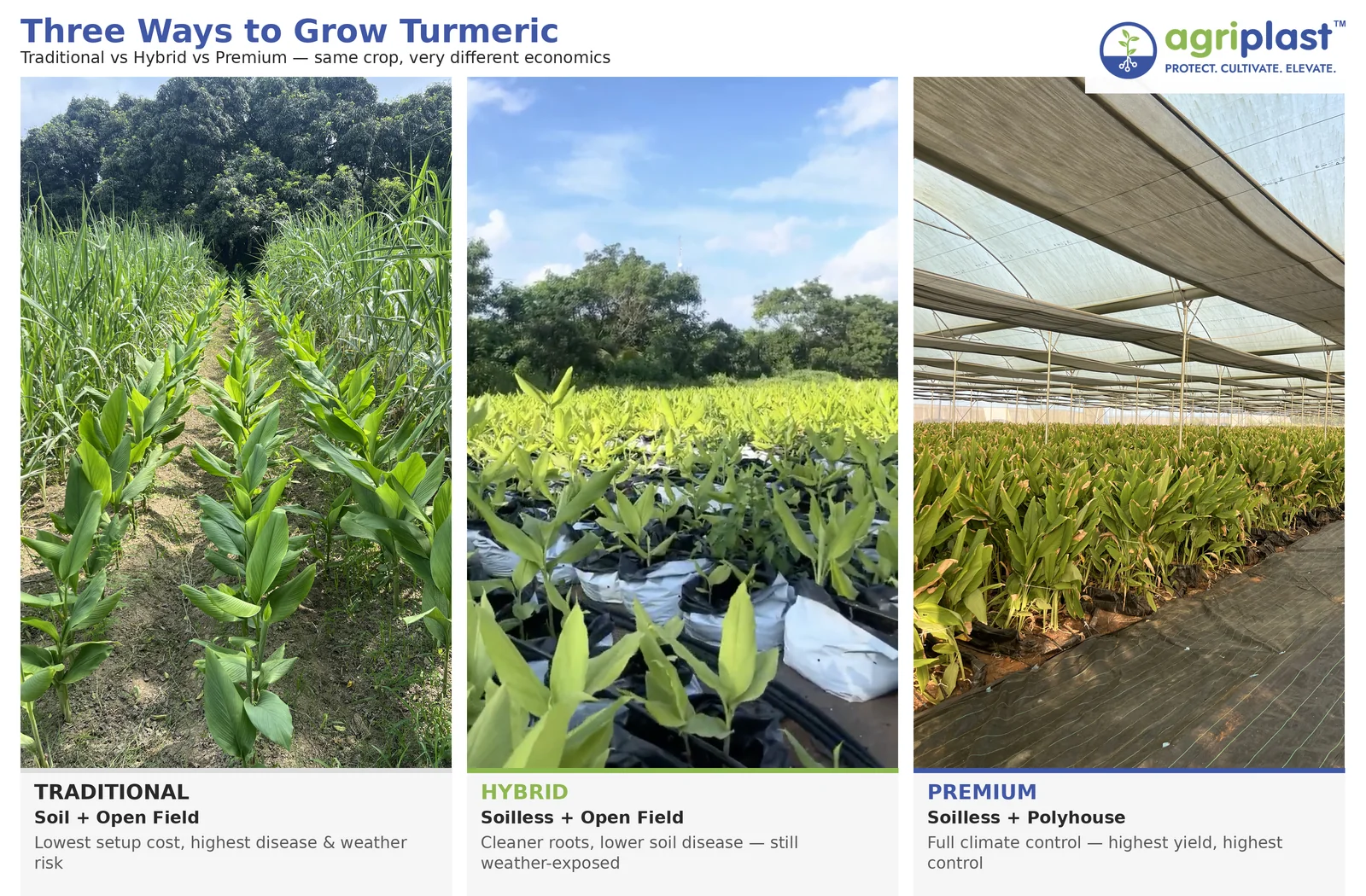
Note: Turmeric can also grow very well inside net houses as they are shade-loving plants.
How to Choose the Right Structure for Turmeric
Choosing the right structure for turmeric cultivation depends on balancing the crop's natural preferences with your local climate conditions, particularly rainfall. Based on comparative studies, here is how to evaluate the main options:
| Structure | Rainfall Protection | Climate Moderation | All-In Capital Cost/Acre | Fit for Turmeric |
|---|---|---|---|---|
| Shade Net House (50% shade + 40 mesh) | Low | Good — shade + airflow reduces heat 3–5°C | ₹25–35 lakh | Ideal in areas with low rainfall |
| Naturally Ventilated Polyhouse (6–6.5m height) | Full | Moderate — ventilation only, no active cooling | ₹55–65 lakh | Recommended for high-rainfall regions |
| Open-Field Soilless (grow bags + weed mat) | None | None | ₹15–20 lakh | Entry-level pilot; not a long-term answer |
| Fan-Pad Polyhouse | Full | Active cooling (fans + wet pads) | ₹70–85 lakh | Not required for turmeric — cost not justified |
Costs shown are for the structure only. Add soilless base setup (~₹15–20 lakh/acre: grow bags, coco peat, drip, weed mat) on top to get full capital. Please verify costs with your suppliers and region.
Minimum internal height for the polyhouse: 6–6.5 metres. Turmeric reaches 5–6 feet at peak canopy — adequate vertical clearance is essential for airflow and ventilation within the structure.
The quality of the greenhouse film matters significantly. Agriplast's greenhouse films, manufactured with Ginegar technology from Israel, provide consistent light diffusion and UV stabilization suited to India's monsoon-to-summer climate cycles — protecting the root zone from humidity fluctuations that trigger moisture imbalance in the substrate.
For shade house setups, a 50% shade net matches turmeric's light preference as a shade-loving crop. Direct high-intensity sun reduces curcumin accumulation in the developing rhizome.
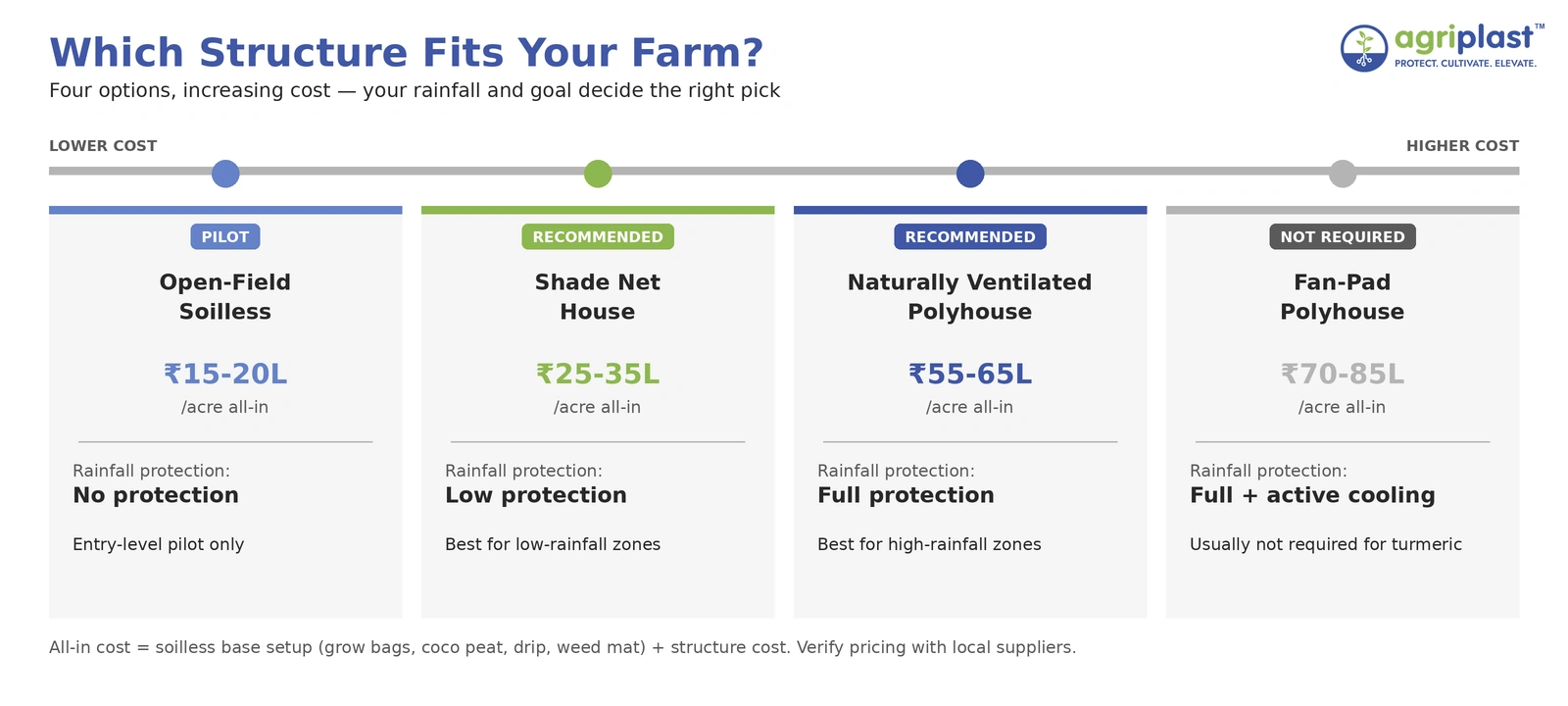
Structure decision cost ladder — from open-field soilless at ₹15–20 lakh to fan-pad polyhouse at ₹70–85 lakh. Naturally ventilated polyhouse is the recommended choice for most Indian growing zones.
Choosing the Right Variety
Variety choice determines yield, curcumin content, and — most importantly — which markets you can access. Choose based on your confirmed buyer, not on what your neighbour grows.
| Variety | Duration (Soilless) | Yield Potential | Curcumin % | Best For |
|---|---|---|---|---|
| Pratibha | 8–9 months | High | 5.5–6.2% | Volume markets |
| Pragati | 8–9 months | High | ~5% | Faster turnover, wide adaptability |
| IISR Surya | ~8 months | Very high | ~4–5% | Yield-first operations |
| Lakadong (Meghalaya GI) | 7–7.5 months | Medium | 7–8% | Confirmed pharma / nutraceutical buyer only |
| Mega (PTS-62) | 4–5 months | Lower | Variable | Hot climates (peak 38–40°C) — start nursery May, transplant June–July |
Pro Tip — Seed Rhizome Quality Drives Half Your Yield
Pick mother rhizomes weighing 60–70 grams with 5–8 sprouting eyes. A 65g rhizome with 8 eyes produces 2–3 kg wet turmeric at harvest. A 20–30g rhizome with 2–3 eyes produces a fraction of that.
Treat before planting: Wash rhizomes in fresh limestone water (slaked lime / calcium hydroxide solution), then air-dry before placing in grow bags. This prevents rhizome rot and improves sprouting consistency.
Seed requirement per acre: ~1,800 kg (30,000 plants × 60g).
Source: ICAR-IISR Kozhikode; 6-acre commercial farm, Bengaluru
Substrate Setup and Trough Design
The substrate is where soilless turmeric farming succeeds or fails. Get this wrong and no amount of good variety selection or fertigation management will recover the season.
Trough vs Grow-Bag: Which to Choose
| Factor | Trough System | Grow-Bag System |
|---|---|---|
| Capital cost | Lower — weed mat liner on floor (this can vary upon the kind and life of trough). Agriplast Mapal soilless Trough has a life of 10+ years. | Higher — individual bags + higher drip cost |
| Substrate per acre | 120 tonnes+ | 100+ tonnes (will vary based on grow bag diameter; typically uses less substrate) |
| Disease containment | Harder — disease moves along trough | Easier — infected bag removed and isolated |
| Harvest labour | Lower | Slightly higher |
Average Substrate Composition per Acre
| Material | Quantity | Purpose |
|---|---|---|
| Aged coco peat (6–12 months old) | 100 tonnes | Primary growing medium — moisture retention + aeration |
| Vermi compost | 10 tonnes | Organic nutrition + microbial activity |
| Fermented organic manure (FOM) | 10 tonnes | Long-release nutrition, substrate structure |
| Coir drainage layer (trough base) | As required | Prevents water stagnation at root base |
Total: approximately 120 tonnes of substrate per acre.
Never use fresh coco peat. Fresh coco peat actively decomposes and generates heat — root zone temperatures can reach 33–35°C, damaging young rhizomes at their most critical early stage. Always specify aged coco peat (6–12 months old). Budget ₹7–9/kg. The substrate is reusable across multiple cycles — top up 20 tonnes (~20%) per subsequent cycle after solarization. You are not replacing 120 tonnes every season.
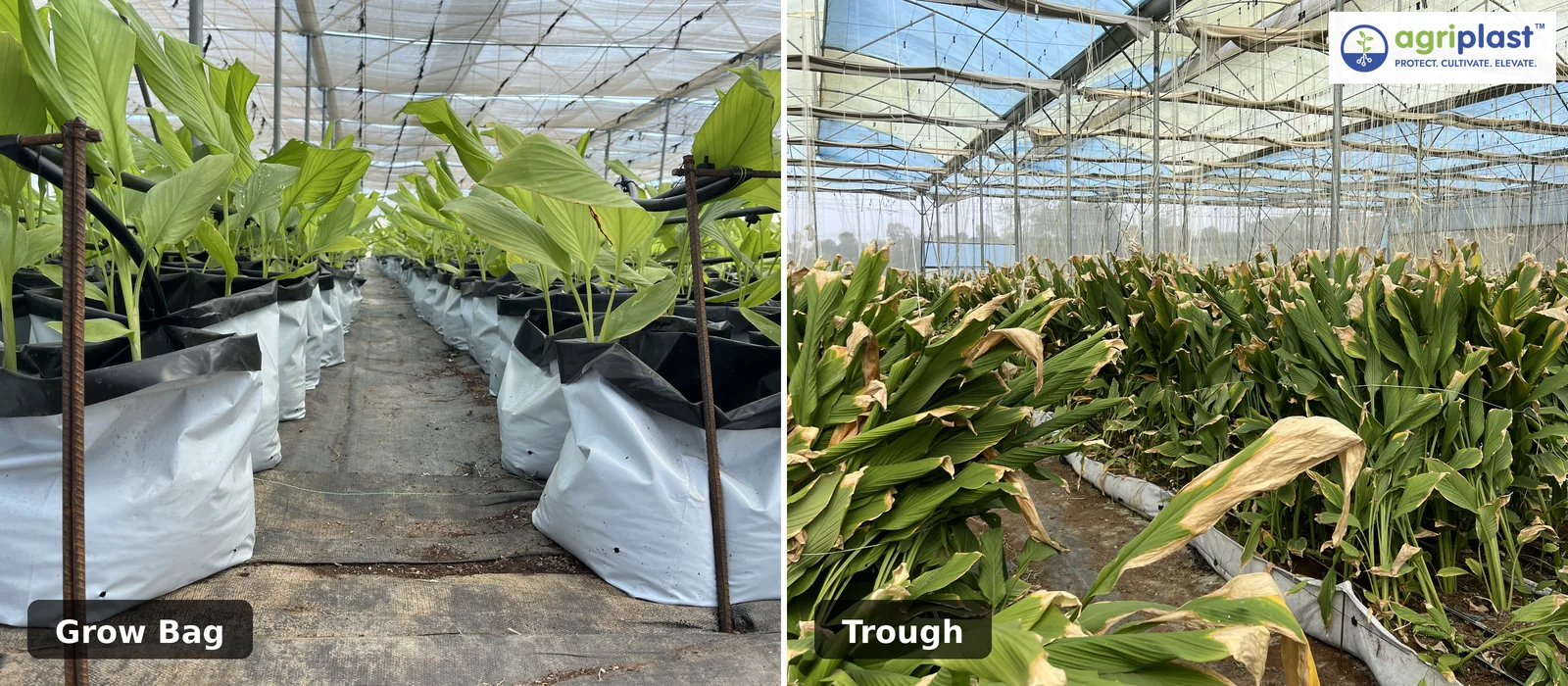
Grow bag vs trough — same crop, two different ways to manage the substrate.
Planting Density and Spacing
| Parameter | Specification |
|---|---|
| Plants per acre | 30,000 |
| Bed width | 1 metre |
| Plants per metre (lateral) | 4 plants (25 cm spacing) |
| Plant-to-plant along bed | 35 cm |
| Trough depth / coco peat depth | Minimum 7–8 inches |
| Drip lines per bed | 3 lines, 1 LPH emitters |
| Planting depth | 1 inch into substrate (shallow) |
| Planting season | February–March |
30,000 plants per acre is 3× the typical open-field density of 10,000 plants. The controlled environment and substrate system support this density without the disease pressure that would make it risky in open soil.
Planting depth is only 1 inch — far shallower than open-field (5–7 cm). Coco peat's loose structure lets roots develop freely. As rhizomes develop and begin emerging at the surface, cover them immediately with additional coco peat. Exposed rhizomes stop developing. This is the soilless equivalent of open-field earthing-up — but requires no manual mounding.
Note: February–March is the recommended planting window for most Indian zones. Plants established in February go through spring, peak through monsoon, and reach harvest in October–November at their full potential. In cooler hill zones, June–August windows can also work where summer temperatures stay moderate.
Irrigation, EC, and pH Management
Moisture management is the single most important agronomic discipline in soilless turmeric. The crop is naturally hardy — curcumin's antimicrobial properties make it resistant to many pests — but it becomes acutely vulnerable to root rot when root zone moisture exceeds 55–60%.
| Parameter | Target | Notes |
|---|---|---|
| Root zone moisture | 30–50% | Measure with pulse moisture meter at multiple random points per bed |
| Maximum safe moisture | 55% | Above this → root rot begins; no chemical fix once established |
| pH of nutrient solution | 6.5–7.0 | Slightly acidic — optimal for turmeric's enzyme activity |
| Source water TDS | Below 300 | No RO treatment needed at this level |
| EC at fertigation — Stage 1 | 1.6–1.8 | Vegetative phase (months 1–3) |
| EC at fertigation — Stage 2 | 2.2–2.4 | Rhizome development (months 3–6) |
| EC at fertigation — Stage 3 | 1.4–1.6 | Pre-harvest dormancy (months 7–9) |
| Root zone EC ceiling | 3.0 | Absolute maximum — never exceed |
| Water per plant per day | 30–35 ml/day | ~9 litres per plant over the 9-month cycle; ~250–270 KL per acre per cycle |
| Drip emitter type | 1 LPH | Slow flow ensures even distribution in coco peat — not a budget decision |
| Irrigation frequency | 3–4× daily (hot); 2× (cloudy) | Reduce on overcast and rainy days — key monsoon discipline |
Drip emitter note: Growers run turmeric on anything from 1 L/h to 4 L/h drippers. There's no single "correct" answer — pick the flow rate that matches your climate, substrate drainage, and crop stage.
Fertigation Schedule by Growth Stage
Turmeric has three distinct nutritional phases. Your fertigation programme must shift with each one — applying Stage 1 nutrition during Stage 2 will reduce yield, and ignoring the Stage 3 reduction interrupts the critical rhizome-filling process.
| Stage | Period | Nitrogen | Phosphorus | Potassium | EC at Fertigation |
|---|---|---|---|---|---|
| Vegetative | Months 1–3 | High | Moderate | Moderate | 1.6–1.8 |
| Generative (Rhizome Development) | Months 3–6 | Moderate | Elevated | High | 2.2–2.4 |
| Dormancy (Pre-Harvest) | Months 7–9 | Reduced | Reduced | Reduced | 1.4–1.6 |
Micronutrients — boron, manganese, zinc, molybdenum — are applied at full dose from month 1 through month 6, then reduced in the dormancy phase. Deficiencies in boron or zinc visibly reduce rhizome size and curcumin accumulation.
Organic inputs throughout all stages:
- Trichoderma + Pseudomonas: spray every 15 days (preventive biological programme)
- Neem-based spray: every 15 days
- Vermi wash + panchagavya: monthly
This all-organic input protocol is what makes the produce certifiable as residue-free — the key qualifier for nutraceutical buyers at ₹70–100/kg.
Stage 3 Dormancy — Do Not Panic: When the canopy yellows at months 7–8, the plant is not dying — it is transferring energy reserves downward into the rhizome. Farmers who see yellowing and increase irrigation or fertilizers to "revive" the plant interrupt this critical transfer. The correct response is to reduce all inputs and let dormancy complete. The final 4–6 weeks are when rhizomes reach their peak weight and curcumin content.
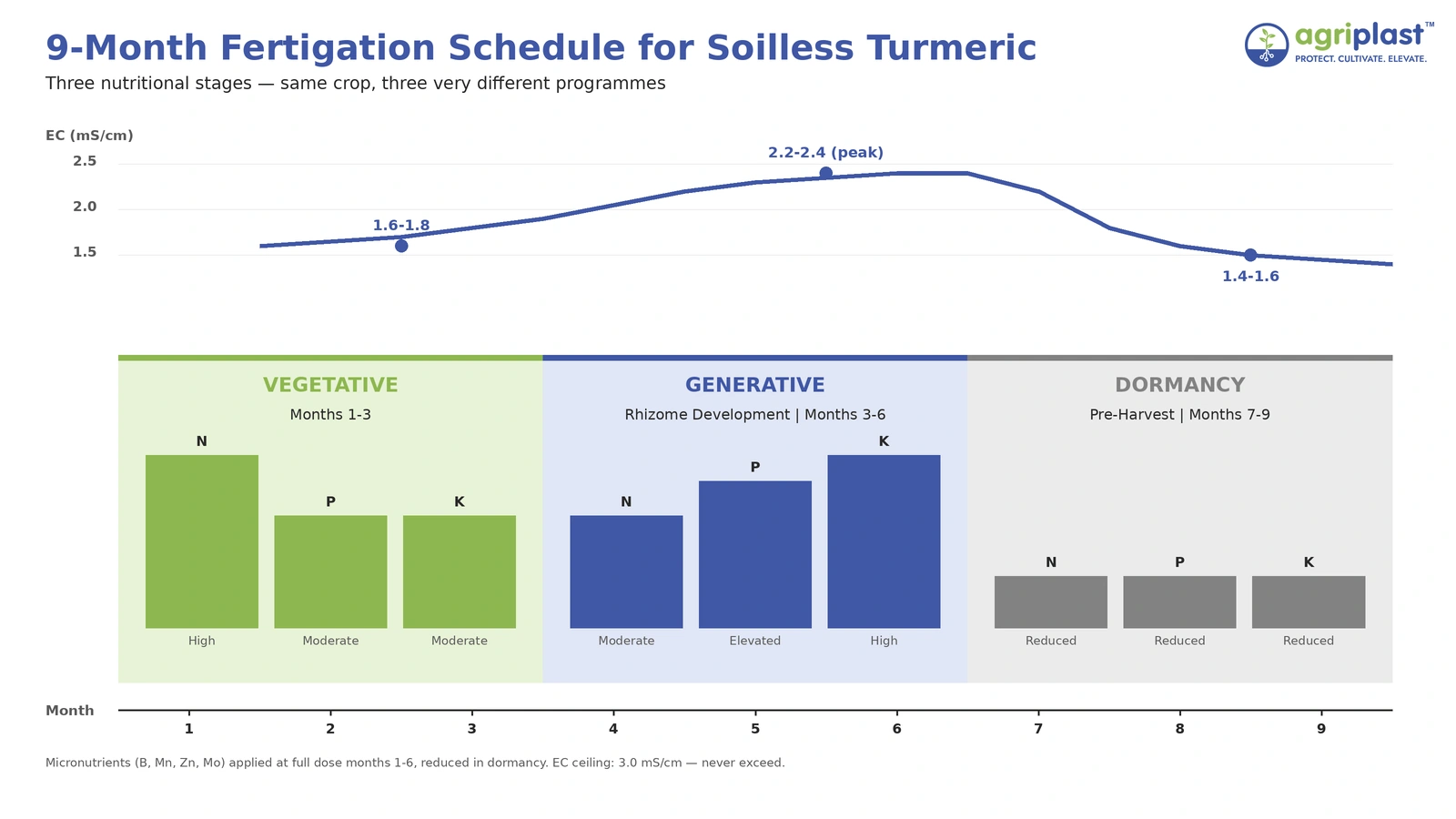
9-month fertigation map for soilless turmeric. EC climbs from 1.6 to a 2.4 peak during rhizome bulking (months 4–6), then drops to 1.4 in dormancy. NPK ratios shift in lockstep with the stage.
Pest and Disease Management
Turmeric is naturally pest-resistant — curcumin's antimicrobial properties make it one of the easier crops to manage organically in a soilless system. It is a hardy crop where neem sprays and organic pest repellents can handle the pest pressure.
| Risk | Trigger | Prevention / Management |
|---|---|---|
| Root rot | Root zone moisture >55–60% | Prevention only — moisture discipline. No fungicide fixes this once established. |
| Leaf spot (fungal) | High polyhouse humidity + poor airflow | Preventive Trichoderma + Pseudomonas spray; organic Spinosad if acute |
| Trough disease spread | Pathogen moving through shared substrate | Strict biological spray schedule; grow-bag system allows individual plant isolation |
Root rot is a management failure, not a disease — and no fungicide can fix it once it starts. The entire preventive protocol exists to prevent this one outcome. The zero-pesticide approach is also commercially strategic: residue-free certification from accredited labs is what gives you access to nutraceutical buyers at ₹70–100/kg. Pharmaceutical processors specifically require third-party residue testing before contracting.
Harvesting Soilless Turmeric
Harvest at 8–9 months from planting. For a February–March planting window, this means October–November. The signal: canopy fully yellowed, leaves dried and lodged. Do not harvest on a calendar date — wait for the full dormancy signal.
Harvest Process
- Cut or break the above-ground stem at the base
- Lift the entire rhizome mass from the coco peat — it comes out as a clean ball with no digging required
- Shake coco peat off roots over the trough — recovered substrate returns to the bed
- Weigh representative sample plants to track per-plant production across the acre
- Sort: large finger rhizomes (60–70g+, 5–6 eyes) are retained as next season's seed; remainder goes to market
Expected per-plant yield:
- Standard conditions: 1.5–2 kg wet turmeric per plant
- Excellent conditions (60–70g seed rhizomes, tight moisture management): 2.5–3 kg per plant
- At 30,000 plants per acre: 45,000–60,000 kg fresh wet turmeric typical, up to 90,000 kg under exceptional conditions
Labour advantage: 2 people per acre for a complete trough harvest — versus 10–12 labourers per quarter-acre per day for open-field soil digging and clearing. The harvest labour saving alone recovers a significant portion of substrate cost over multiple cycles.
Post-Harvest Substrate Management
- Add organic decomposers (neem cake + Trichoderma) to break down remaining root material in the trough
- Optional: grow a 6–8 week high-nitrogen leafy crop (spinach, coriander) in the trough for soil biology benefit
- Solar solarize the substrate for 2–3 weeks
- Top up with 20 tonnes fresh aged coco peat
- Ready for next crop cycle
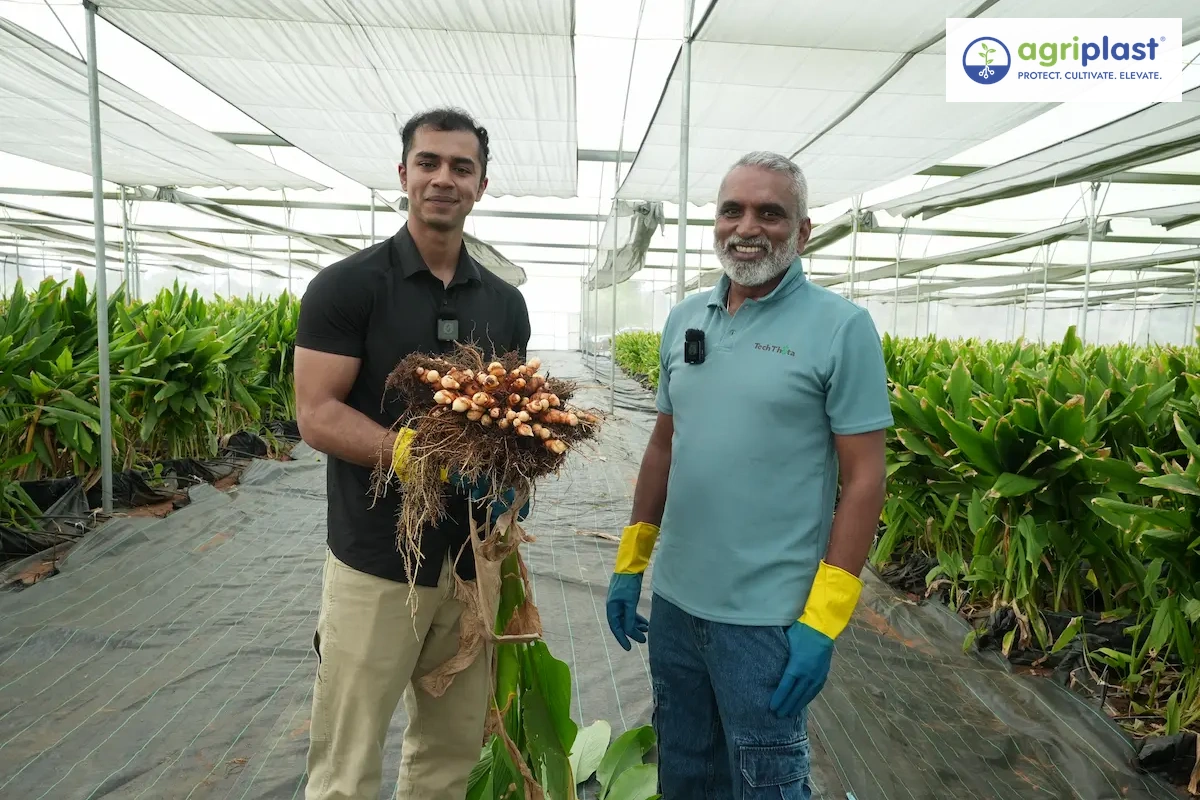
Freshly harvested soilless turmeric from a coco peat trough system. At 1.5–2 kg per plant across 30,000 plants per acre, total fresh yield reaches 45–60 tonnes — versus 8–12 tonnes in open field.
Economics: Capital, Operations, and Revenue
Treat these economics as a directional guide, not a guarantee. Actual returns vary with your farming skill, local climate, input quality, and market timing. The figures here are drawn from farmers we have worked with and interacted on the ground.
Scale Matters: At 1 acre, all fixed costs — supervisor, automation, irrigation system — load onto a single unit. At 3+ acres, the same fixed costs spread across multiple units, reducing per-acre operating cost from ~₹10 lakh to ~₹8 lakh. Plan for 3 acres minimum.
Capital Investment (One-Time, Per Acre)
| Item | Cost (₹/acre) |
|---|---|
| Naturally ventilated polyhouse | 40,00,000 |
| Automation (sensors, timers, controllers) | 7,00,000–10,00,000 |
| Drip irrigation (PC inline, 1 LPH) | 7,00,000 |
| Weed mat-lined troughs | 5,00,000–6,00,000 |
| Aged coco peat — 100 tonnes @ ₹8/kg | 8,00,000 |
| Organic amendments (vermi compost + FOM) | 1,00,000 |
| Total Capital Investment | ₹68–72 lakh/acre |
Operating Cost (Per Acre, Per 8–9 Month Cycle)
| Item | Cost (₹) |
|---|---|
| Seed rhizomes — 1,800 kg @ ₹60/kg | 1,08,000 |
| Coco peat top-up — 20 tonnes @ ₹8/kg | 1,60,000 |
| Hydroponic fertilizers | 3,00,000 |
| Bio-inputs (neem, Trichoderma, Pseudomonas) | 50,000 |
| Labour — 1 person × 8 months × ₹25,000/month | 2,00,000 |
| Electricity + generator backup | 1,20,000 |
| Agronomist (first cycle recommended) | 50,000 |
| Total Operating Cost | ~₹10 lakh/cycle |
Revenue by Selling Form
| Selling Form | Volume | Price | Revenue |
|---|---|---|---|
| Wet turmeric — nutraceutical buyers | 45 tonnes | ₹80–100/kg | ₹36–45 lakh |
| Wet turmeric — open market | 45 tonnes | ₹25–35/kg | ₹11–16 lakh |
| Dry turmeric (20% of wet yield) | ~9 tonnes | ₹100–130/kg | ₹9–12 lakh |
| Seed rhizomes (retained for next cycle) | 400–600 kg | ₹80–100/kg | ₹40,000–60,000 |
The Non-Negotiable Rule: The soilless model only works with a premium nutraceutical buyer at ₹70–100/kg. Open-market wet turmeric pricing makes the business unviable regardless of yield. Confirm your buyer before you build your structure — not after your first harvest.
Actual results vary by region, variety, buyer access, and management quality.
Is Soilless Turmeric Right for You?
Soilless only pays off when three conditions line up:
- Capital access of ₹68–72 lakh per acre all-in (or 50% MIDH subsidy + own capital for the rest)
- A confirmed nutraceutical or pharma buyer willing to pay ₹80–100/kg wet turmeric
- 3+ acres of operation — fixed costs spread better at scale
Missing any one of the three? Start with open-field soilless or soil-based turmeric as a one-acre pilot, build supply chain relationships, then scale into a polyhouse when the buyer and the capital are both confirmed.
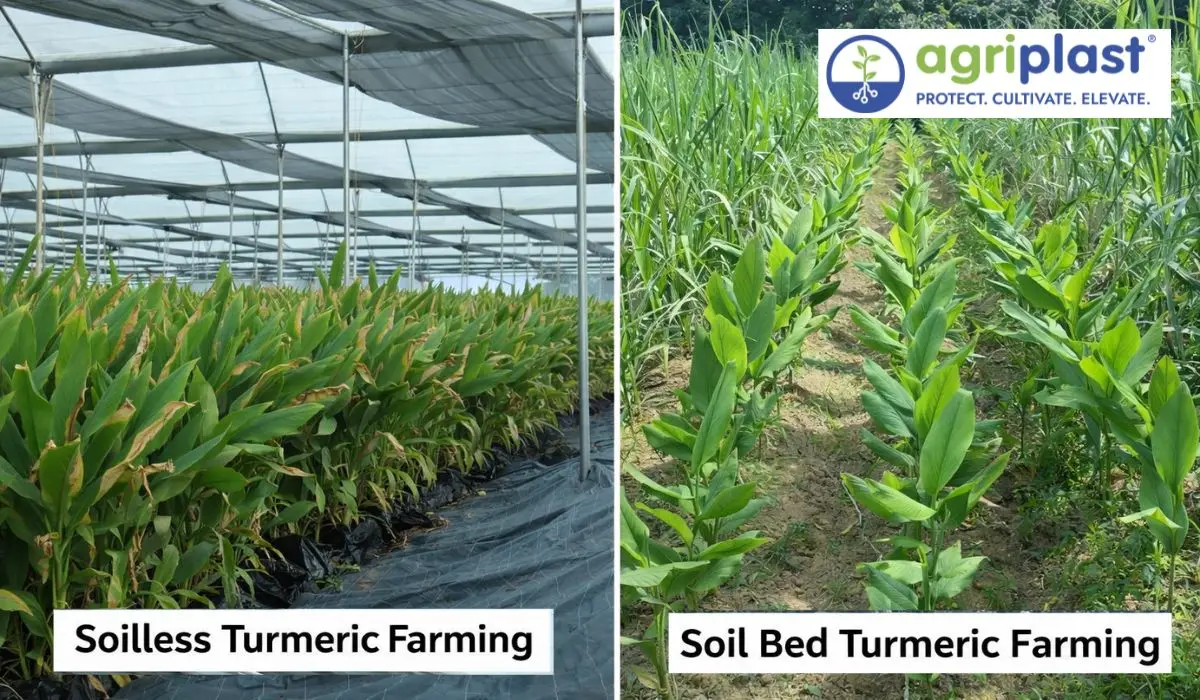
Left: soilless turmeric at near-harvest dormancy stage inside a polyhouse — dense, uniform canopy at 30,000 plants per acre. Right: open soil bed turmeric at a similar growth stage — lower plant density, exposed to weather and weed pressure.
🎥 Watch: 6-Acre Soilless Turmeric Farm Tour — 45 Tonnes Per Acre, Full Farm Visit
A full deep-dive at a 6-acre commercial soilless operation in Bengaluru growing turmeric and ginger in coco peat trough systems inside naturally ventilated polyhouses. Covers substrate setup, EC and pH management, fertigation schedules, harvesting practices, and complete farm economics including ₹2 crore total gross revenue across the 6 acres.
Government Subsidies
MIDH (Mission for Integrated Development of Horticulture): Up to 50% subsidy on polyhouse and net house construction cost. Apply through the National Horticulture Board (NHB) or your state horticulture department portal. Maharashtra, Telangana, Karnataka, AP, and HP have additional state top-up schemes above the central component.
National Turmeric Board (announced 2023, operationalised in early 2025, headquartered in Nizamabad): Mandated to grow India's turmeric exports to USD 1 billion by 2030. Active support areas include high-yield variety access, quality testing labs, and export linkage for residue-free producers. Contact through the Ministry of Commerce and Industry or Spices Board India (Kochi).
Common Mistakes to Avoid
1. Building before confirming your buyer. The economics only work at ₹70–100/kg. Constructing the polyhouse and finding the buyer after your first harvest is the most expensive mistake in this business model. Visit the facility, understand their residue-testing SOPs, and get a written LOI before you break ground.
2. Using fresh coco peat. Heat from decomposing fresh coco peat damages young rhizomes at the most critical growth stage. Always specify aged coco peat (6–12 months). This is non-negotiable regardless of cost difference.
3. Over-irrigating during monsoon. Ambient polyhouse humidity rises in July–September and the substrate holds water longer than in summer. Check the pulse meter more frequently and reduce irrigation cycles on overcast days — most moisture disasters happen during this period.
4. Harvesting early for cash flow. Dormancy phase (months 7–9) is when rhizomes complete their final weight gain and curcumin accumulation. Early harvest reduces both — exactly the two numbers your buyer pays for.
5. Planning for 1 acre only. Fixed costs (supervisor, automation, irrigation infrastructure) require 3+ acres to distribute efficiently. If budget allows only 1 acre now, design the infrastructure for 3-acre expansion from the start.
6. Skipping weed mat on pathway areas. Even inside a polyhouse, pathways between trough rows accumulate organic matter and can harbour pests. Laying Agriplast weed mat on pathway areas keeps the growing environment clean and maintains the hygiene required for residue-free certification.
Frequently Asked Questions
🌿 Planning a Soilless Turmeric Farm? Talk to Agriplast
Agriplast supplies the materials that make soilless protected cultivation work — from greenhouse films and shade nets for your polyhouse structure, to PP woven weed mat for trough liners and pathway hygiene. Our team works with farmers across India on protected cultivation projects at every scale.
- Weed mat for soilless troughs — 90–130 GSM, UV-stabilised, 3–5 year life
- Shade nets for polyhouse interiors — 50% green or aluminet for turmeric's light needs
- Greenhouse films — Ginegar-technology UV-diffusion films for naturally ventilated polyhouses
Blog written and Posted by
Rani Singh
Rani Singh is a Content Executive at Agriplast Tech India, covering high-value farming, protected cultivation, and farmer success stories. She focuses on turning field experiences into practical, actionable content for Indian farmers and agri-entrepreneurs.You can write your view/comments here
Need Expert Assistance?
Get personalized recommendations for your greenhouse, polyhouse, or irrigation needs.
-
Bengaluru (Corporate Office)
- 918141446666
- support@agriplast.co.in
WeWork Roshni Tech Hub - 1st floor, PFS Club House, Marathahalli Main Rd, R.J.Gardens, Lakshminarayana Pura, EPIP Zone, Chinnapanna Halli, Bengaluru, Karnataka 560037