How Girish Earns ₹25 Lakhs Per Acre From Chrysanthemum Cultivation in Tumkur
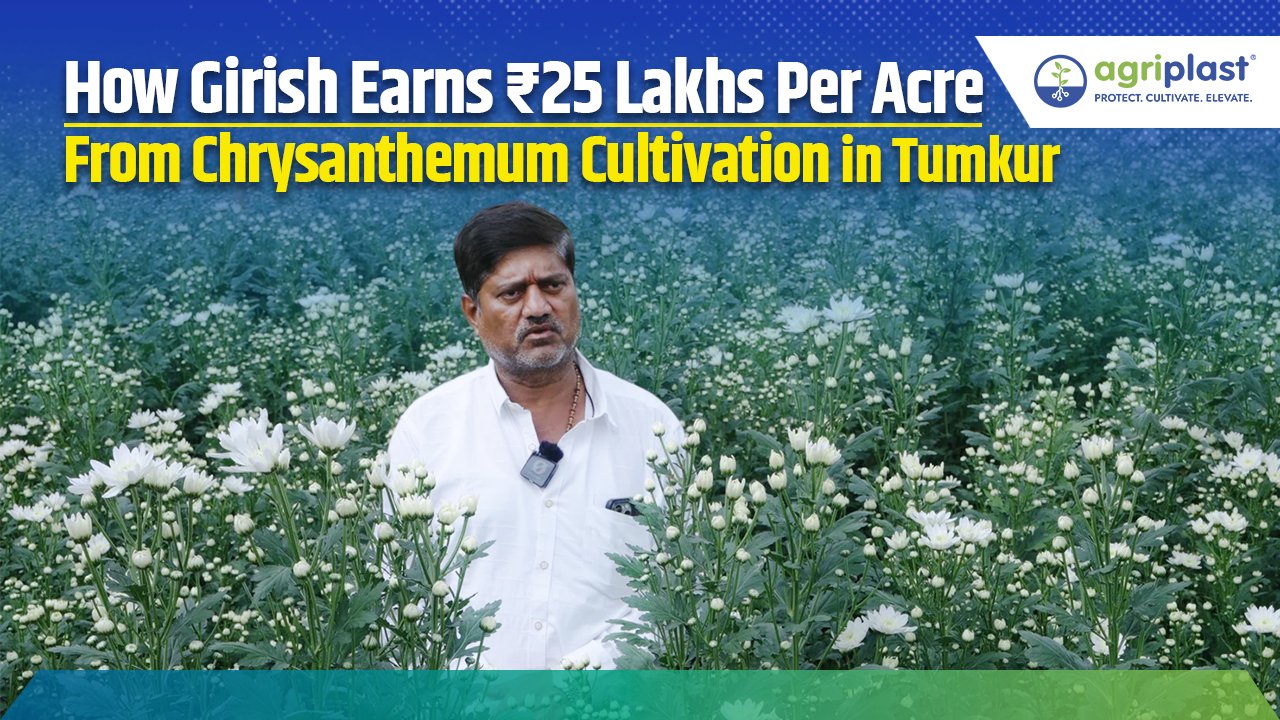
Girish grows chrysanthemum on a 10-acre polyhouse operation in Koratagere, Tumkur — and earns ₹25 lakhs per acre. That number is not a projection. It is what his farm produces today, after 15 years of chrysanthemum cultivation under Agriplast polyhouse film.
His farm sits in rural Karnataka, about 90 km northwest of Bangalore. He started with gerbera and carnation. Today, he grows Prashanti Mum — a chrysanthemum variety that flowers within 100–120 days when managed correctly. His entire 10-acre polyhouse uses Agriplast polyfilm, and he has been with the same supplier for a decade and a half.
This is not a story about a product. It is a story about a farmer who treats agriculture as a business — and how the right polyhouse film played a role in that journey.
Why Chrysanthemum Cultivation Demands More Than Just a Polyhouse
Most farmers assume that once you build a polyhouse, good results follow. Girish disagrees. In his experience, growing the crop is only half the battle. The other half — and the harder half — is managing the science behind it.
"Growing in a polyhouse is not the main thing. Marketing is the main thing. Marketing plus quality — both must be there for you to grow."
Chrysanthemum is one of the most light-sensitive crops in polyhouse farming. Research from ICAR-IIHR Bengaluru confirms that during the vegetative growth phase, the plant needs 15–18 hours of light per day. Once the plant transitions to the reproductive (flowering) stage, you must introduce darkening — again, 18 hours — to trigger bud formation.
Get the light cycle wrong, and your flowering delays. Delays mean missed market windows. Missed windows mean lower prices.
On top of light management, chrysanthemum cultivation requires precise EC and pH monitoring — both in the soil and in irrigation water. The TNAU Agritech Portal provides detailed chrysanthemum cultivation practices for reference. Pest cycles need to be tracked. Fungicide schedules need to follow the crop stage, not a fixed calendar. Every step demands a scientific approach.
"To grow any crop in a polyhouse, you need a scientific approach. You need EC and pH knowledge — what the soil EC should be, what the water pH should be. You need to know which insecticide and pesticide to use at which time."
Five to ten years ago, this kind of chrysanthemum knowledge was limited to a handful of growers. Today, Girish calls it an “open secret” — the information is available, but the discipline to apply it consistently separates profitable farms from struggling ones.
15 Years With Agriplast Polyfilm — What Kept Him Loyal
Girish did not switch to Agriplast yesterday. He has used Agriplast polyhouse film across all 10 acres for 15 years. That is not an endorsement based on a single season — it is a verdict based on 15 years of continuous use.
Three things kept him with Agriplast:
Quality that lasts. Some of the polyfilm on his older structures has been in place for 10–12 years and is still functional. For a material that faces daily UV exposure, monsoon rain, and Karnataka’s summer heat, that kind of durability matters.
On-time supply. Girish’s farm depends on precise crop cycles. A delayed polyfilm delivery can throw off an entire planting season. Agriplast supplies through both Bangalore and Hosur warehouses, so turnaround is fast for farms in South India.
Affordable price increase. Over 15 years, the price per meter has gone from ₹42 to roughly ₹59–60 — an increase of ₹10–15 per meter. In the same period, fertilisers and pesticides have gone up 4x. The polyfilm cost has barely moved by comparison.
"I have been using Agriplast polyfilm for 15 years. Very good. The quality is good. Even 10–12 year old polyfilm is still there and working well on my farm."
The Numbers: ₹25 Lakhs Per Acre From Chrysanthemum
Here is what Girish’s chrysanthemum cultivation operation looks like in numbers.
| Parameter | Girish’s Farm |
|---|---|
| Total polyhouse area | 10 acres |
| Revenue per acre | ₹25 lakhs |
| Crop | Chrysanthemum (Prashanti Mum) |
| Crop cycle | 100–120 days (planting to flower) |
| Polyhouse film used | Agriplast Polyfilm |
| Film tenure | 15 years continuous use |
| Film price change (15 years) | ₹42 → ₹59–60/meter (~₹15 increase) |
| Fertiliser/pesticide price change | ~4x increase over same period |
The key insight from these numbers: while most input costs have multiplied, polyhouse film has remained relatively stable. For a farmer running 10 acres, that cost stability directly protects per-acre profitability.
Chrysanthemum, when grown in a well-managed polyhouse, can produce flowers within 100–120 days. That means two to three crop cycles per year, depending on variety and market timing. According to National Horticulture Board data, floriculture is among the fastest-growing segments in Indian horticulture. At ₹25 lakhs per acre per cycle, the economics favour farms that can maintain quality and hit the right market windows.
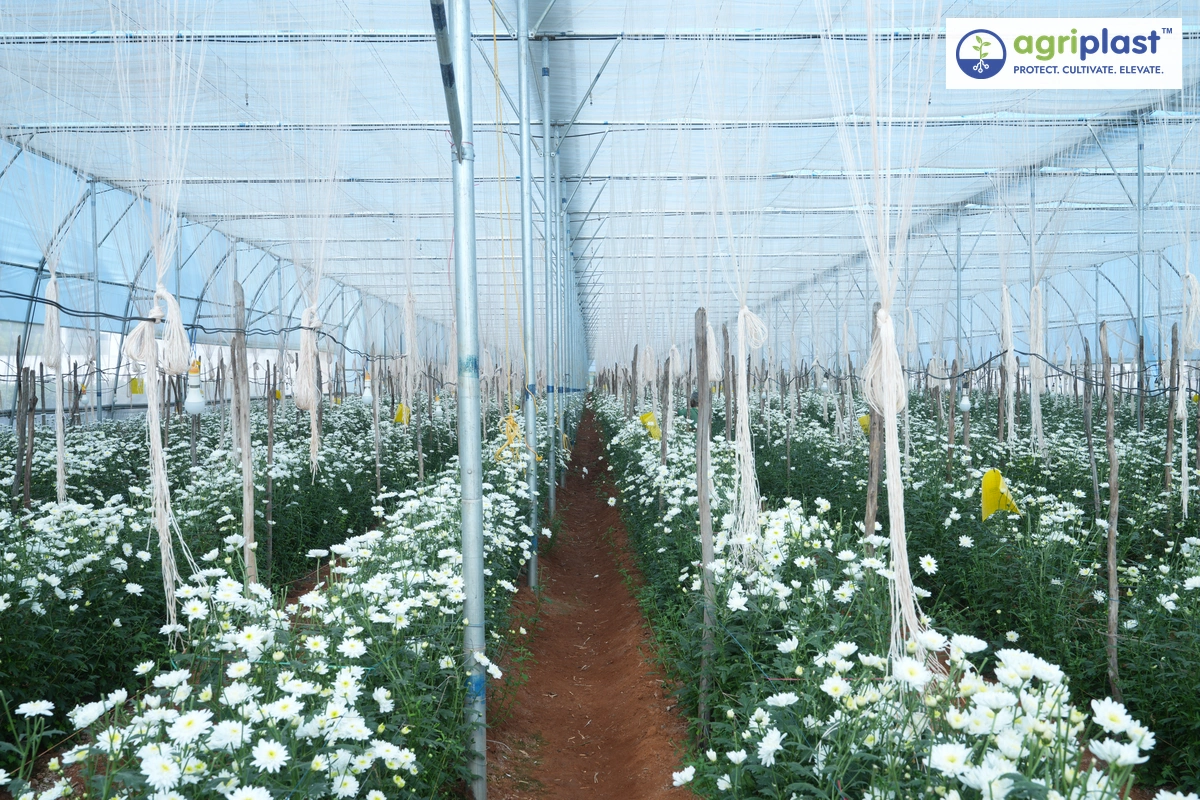
White Prashanti Mum chrysanthemum flowers in full bloom inside Girish’s polyhouse. Proper light management and quality polyfilm produce this level of uniformity.
Watch Girish Tell His Story
🎥 Watch: How Girish Earns ₹25 Lakhs Per Acre From Chrysanthemum in Tumkur
Hear directly from Girish, a polyhouse farmer from Koratagere, Tumkur, Karnataka, as he shares how he built a 10-acre chrysanthemum operation using Agriplast polyfilm — and why treating agriculture as a business, not a hobby, is the key to success.
How Polyhouse Film Supports Chrysanthemum Cultivation
The connection between polyhouse film quality and chrysanthemum yield is not obvious — until something goes wrong.
Chrysanthemum light management depends on the film overhead. If the polyfilm degrades prematurely — losing UV stabilisation or developing micro-tears — the light environment inside the polyhouse changes. That change disrupts the carefully managed light cycles that drive flowering.
A high-quality greenhouse film does three things for chrysanthemum growers:
- Consistent light transmission: The film maintains stable light levels through the crop cycle, so your vegetative and darkening schedules work as planned.
- UV protection: UV-stabilised polyfilm lasts longer and protects the crop from harmful radiation without blocking the photosynthetically active light the plant needs.
- Thermal stability: Good film helps regulate temperature inside the polyhouse, reducing heat stress during Karnataka’s summer months (March–May).
Girish’s 10–12 year old Agriplast polyfilm still performing on his farm is not a sales claim. It is what 15 years of continuous use on a commercial operation looks like.
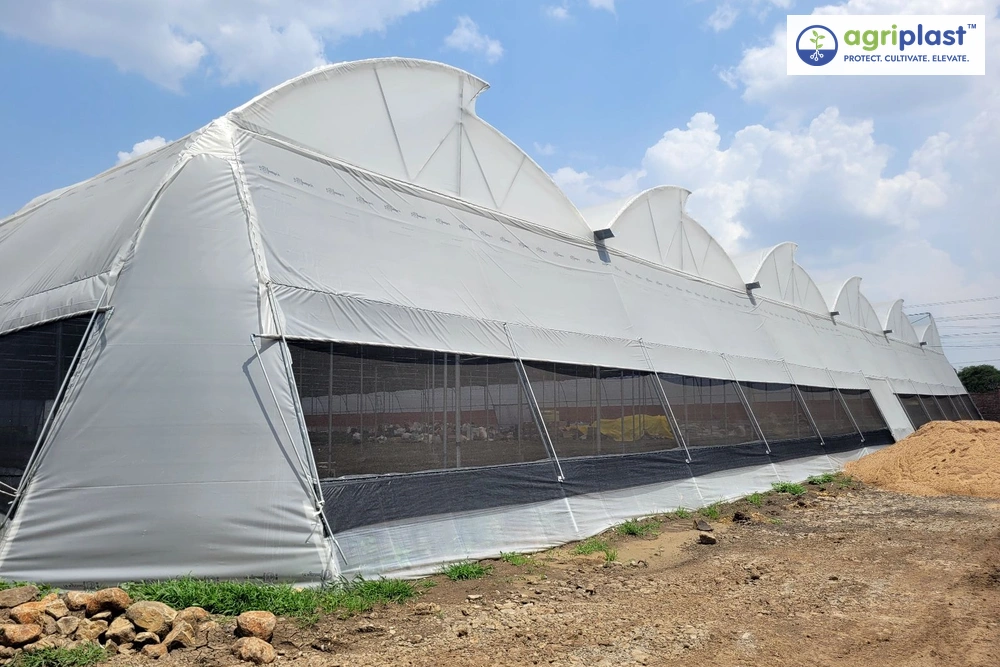
Exterior view of a multi-span polyhouse structure covered with Agriplast polyfilm. Quality film maintains consistent light and temperature conditions critical for chrysanthemum flowering.
Girish’s Advice for Farmers Starting Chrysanthemum Cultivation
Girish has seen many farmers enter polyhouse chrysanthemum farming over the past decade. His advice is direct.
"Leave traditional ways of farming. Use a scientific approach. Apply your knowledge. Adopt new techniques. If you do that, you will see results. The future is in farming."
His specific recommendations:
- Start with good mother plants: The quality of your chrysanthemum flowers starts at planting material. Poor mother plants mean poor output — no amount of film or fertiliser fixes bad genetics.
- Invest in marketing, not just growing: Flower quality, packaging, and presentation matter as much as yield. A well-packed, high-quality flower gets better prices than a bulk dump at the mandi.
- Monitor EC and pH religiously: Soil EC, water pH, and fertigation schedules should be tracked weekly, not guessed at.
- Think long-term on inputs: Choosing a slightly more expensive polyfilm that lasts 10+ years costs less per season than replacing a cheap film every 2–3 years.
Is Polyhouse Film the Right Choice for Your Chrysanthemum Farm?
Polyhouse film makes sense if:
- You are growing chrysanthemum or other light-sensitive flowers that need controlled environments
- Your farm is in a region with extreme heat, heavy rain, or strong winds that damage open-field crops
- You plan to run 2+ crop cycles per year and need consistent conditions across cycles
- You want to reduce pesticide use — a polyhouse with intact film reduces pest entry
It may not be the right fit if:
- Your chrysanthemum operation is small-scale (under 0.5 acres) — the economics may not justify polyhouse investment
- You are growing field varieties that do not require light management
- You do not have access to reliable water and power for irrigation and lighting systems
For polyhouse film specifications, visit the Agriplast greenhouse film collection.
Frequently Asked Questions
Start Your Chrysanthemum Cultivation Journey
Girish’s 15-year track record proves one thing: chrysanthemum cultivation in a well-built polyhouse with quality materials is a profitable, repeatable business — not a gamble.
If you are planning to start or upgrade your polyhouse for chrysanthemum or other flower crops, the polyhouse film you choose will affect every crop cycle for years. Choose a film that lasts.
Contact Agriplast to discuss polyhouse film options for your farm: Get in Touch
Blog written and Posted by
Agriplast Tech India Editorial Team
Author bio will be updated soon.
You can write your view/comments here
Need Expert Assistance?
Get personalized recommendations for your greenhouse, polyhouse, or irrigation needs.
-
Bengaluru (Corporate Office)
- 918141446666
- support@agriplast.co.in
WeWork Roshni Tech Hub - 1st floor, PFS Club House, Marathahalli Main Rd, R.J.Gardens, Lakshminarayana Pura, EPIP Zone, Chinnapanna Halli, Bengaluru, Karnataka 560037