Clear vs Diffused Greenhouse Film: Which One Gives Better Yield?
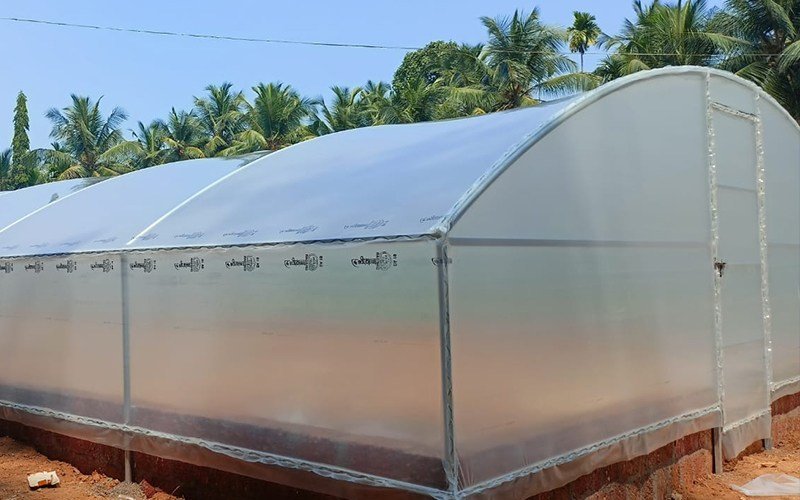
One of the first questions growers face while setting up a greenhouse is which film to use — clear or diffused. While clear greenhouse film allows maximum sunlight to pass through, more light does not always mean better yield. In high-radiation regions like Central and South India, direct sunlight can create hotspots, cause heat stress, and lead to uneven crop growth.
Diffused greenhouse film works differently. It scatters incoming light, allowing it to reach deeper into the crop canopy. This results in better photosynthesis, reduced plant stress, and more uniform yields, especially for vegetables grown under protected cultivation.
Clear film still has its place — mainly in low-light regions or winter conditions, where higher heat and direct radiation help boost early crop growth.
To choose the right film, it’s important to understand how light behaves inside a greenhouse and how modern films — like those developed by Agriplast — are engineered to control it.
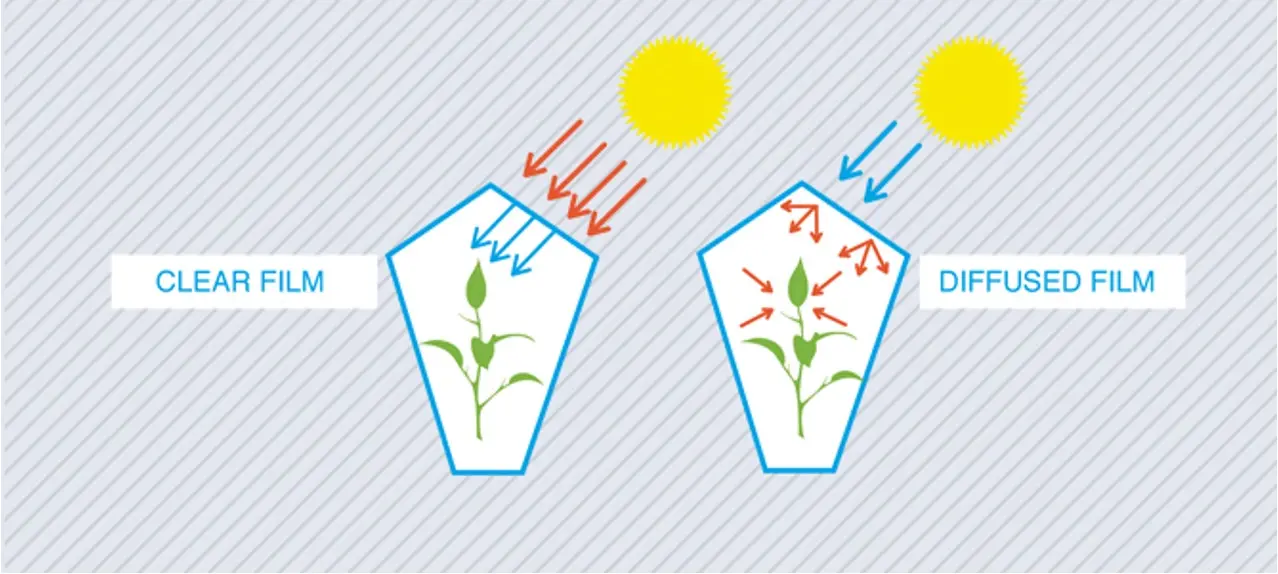
Clear film creates direct light and shadows, while diffused film spreads light evenly through the crop canopy
When choosing greenhouse film, many farmers focus only on light transmission — how much sunlight enters the structure. What matters just as much, however, is light diffusion — how evenly that light spreads inside the greenhouse.
Clear Greenhouse Film: High Transmission, Low Diffusion
Clear greenhouse film allows sunlight to pass through directly. This increases heat build-up and creates concentrated light zones inside the greenhouse.
- Upper leaves receive excess radiation: Increasing the risk of leaf burn and heat stress
- Lower and inner canopy leaves remain shaded: Reducing overall photosynthetic efficiency
- Uneven photosynthesis: Limiting total plant productivity
Clear film works best only where light availability is low, such as winter cultivation or cooler regions.
Diffused Greenhouse Film: Optimised Light for the Entire Canopy
Diffused greenhouse film contains optical additives that scatter incoming light as it enters the structure.
- Deeper canopy penetration: Light reaches middle and lower leaves
- Reduced hotspots: Harsh shadows are eliminated
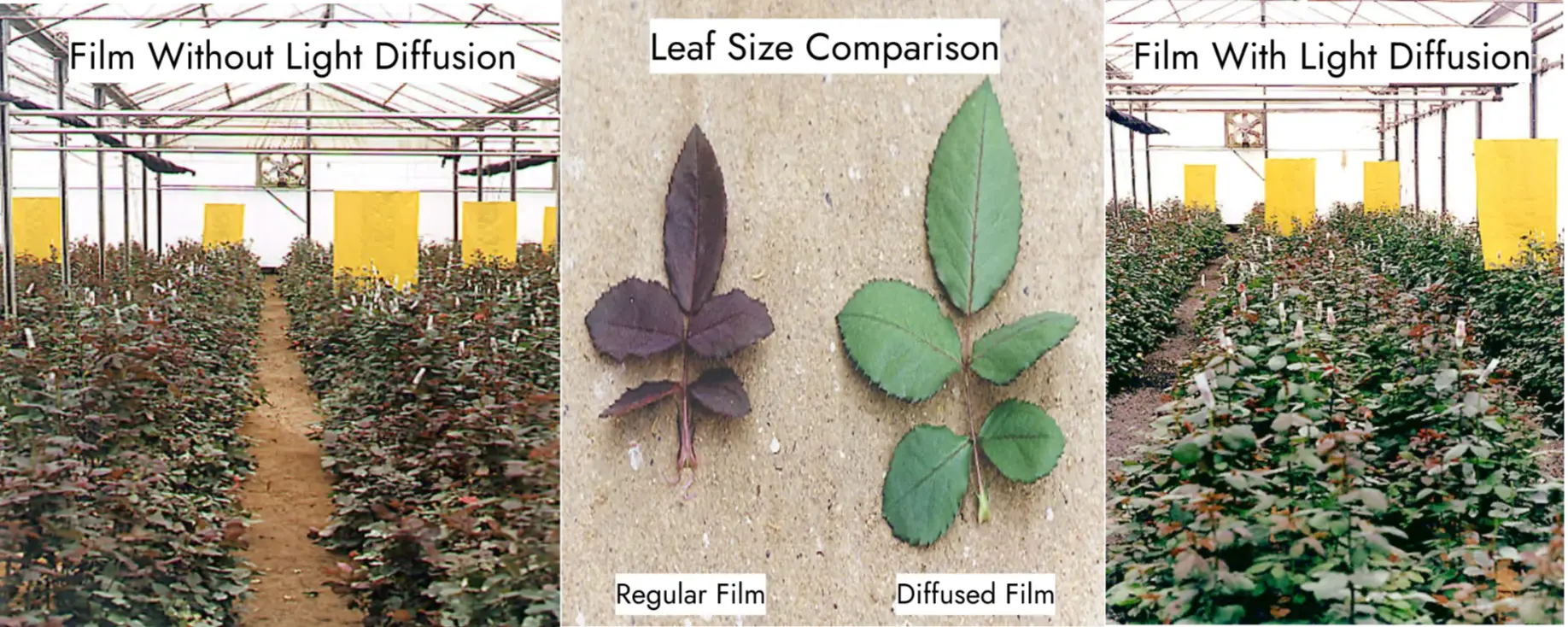
- Uniform growth: Plants experience higher photosynthetic efficiency across the entire canopy
This is why diffused film is widely recommended for high-radiation climates like India, especially for crops with dense canopies.
Modern diffused greenhouse films — such as those engineered by Agriplast — are designed to balance light transmission and diffusion, ensuring crops receive the right quality of light, not just more of it.
Key performance properties of clear and diffused greenhouse films used in protected cultivation
Clear vs Diffused: A Feature Comparison Matrix
| Parameter | Clear Greenhouse Film | Diffused Greenhouse Film |
|---|---|---|
| Light Transmission (PAR) | Very high, direct transmission | High, but evenly scattered across canopy |
| Light Distribution | Uneven; concentrated on top leaves | Uniform; penetrates middle & lower canopy |
| Shadow Formation | Sharp, hard shadows | Soft or no shadows |
| Heat Behaviour | Rapid heat build-up; hotspots common | Balanced temperature; reduced hotspots |
| Crop Stress Risk | High risk of sunburn and leaf scorching in hot climates | Low stress; better plant comfort |
| Photosynthesis Efficiency | Limited by shaded lower leaves | Higher whole-plant photosynthesis |
| Crop Suitability | Winter crops, nurseries, low-light or cold regions | Dense, vertical crops (capsicum, tomato, cucumber, roses) |
| Climate Suitability | Cool climates, low radiation zones | High-radiation regions (India, tropics) |
| Ventilation Dependency | Very high (needs aggressive cooling) | Moderate (better thermal balance) |
| Yield Impact | Baseline / standard yield | 15–20% higher yield in hot climates* |
| Overall Use Case | Heat gain priority | Yield stability & quality priority |
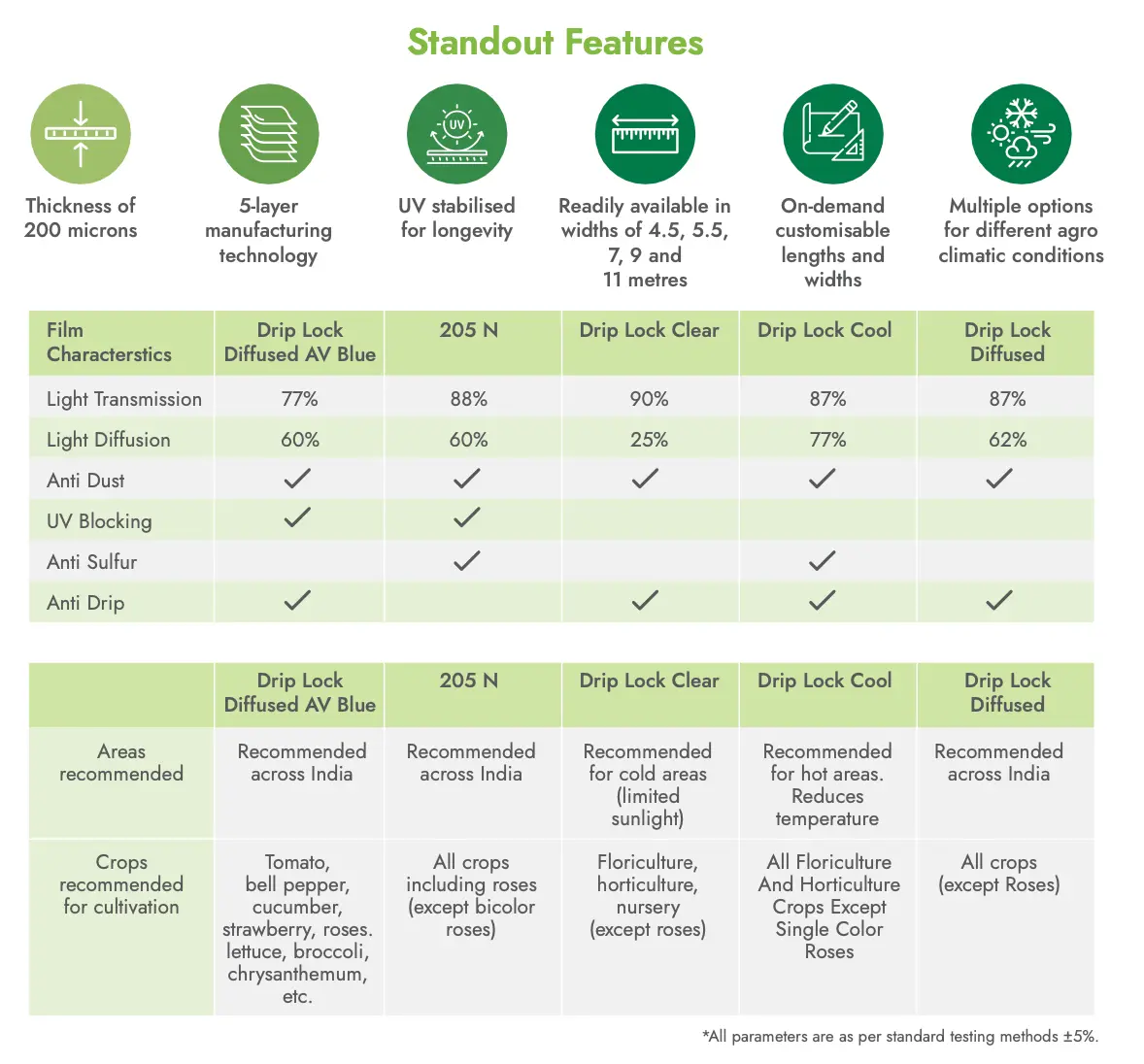
Key performance properties of clear and diffused greenhouse films used in protected cultivation
3 Reasons Why Diffused Film Increases Yield
Based on our agronomy data and field observations, diffused films provide three specific biological advantages that lead to better harvest weight and more uniform crop development.
Better Canopy Penetration
In vertical crops like tomatoes or cucumbers, clear film only lights up the top 20% of the plant. The rest is in shade. Diffused film scatters light so it reaches lower leaves, activating more of the plant for photosynthesis.
Reduction of Heat Stress
In regions with high solar radiation, clear plastic can act like a magnifying glass, scorching plant tips (apical scorching). Diffused film breaks up intense radiation.
Less Phototropism (Vertical Stretching)
Plants under clear film often stretch towards the light source, becoming “leggy”. Under diffused film, light is more evenly available, so plants grow stockier, stronger, and focus energy on fruiting rather than height.
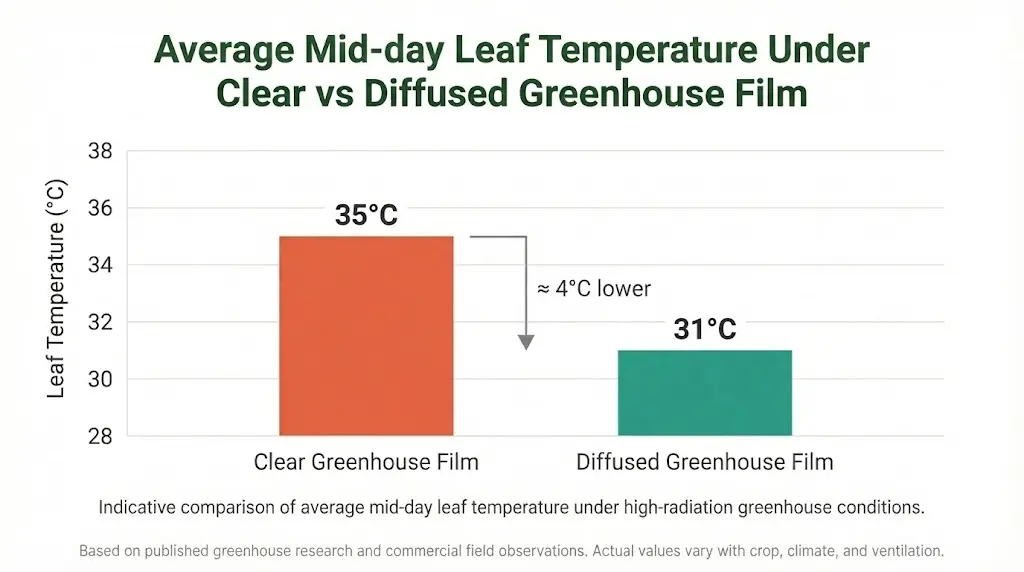
Diffused greenhouse film helps lower average leaf temperature under high solar radiation
When Should You Choose Clear Film?
Clear greenhouse film is the right choice when maximum light and increasing heat are more important than light distribution.
- Nurseries & Seedlings: Young plants need faster heat build-up for germination, and sparse canopies don’t always require diffusion. (This can vary by location, stage, type of structure and purpose. Please consult our experts before choosing your greenhouse film.)
- Cold Climates & Hill Stations: In regions like the Himalayas or Ooty, clear film helps maximise solar heat during winter.
- Low-Light Seasons: Areas with heavy cloud cover or short daylight hours benefit from higher PAR transmission.
- Drying & Solar Applications: Ideal for solar drying of fruits, vegetables, spices, seeds, and other post-harvest uses where heat accumulation is the goal.
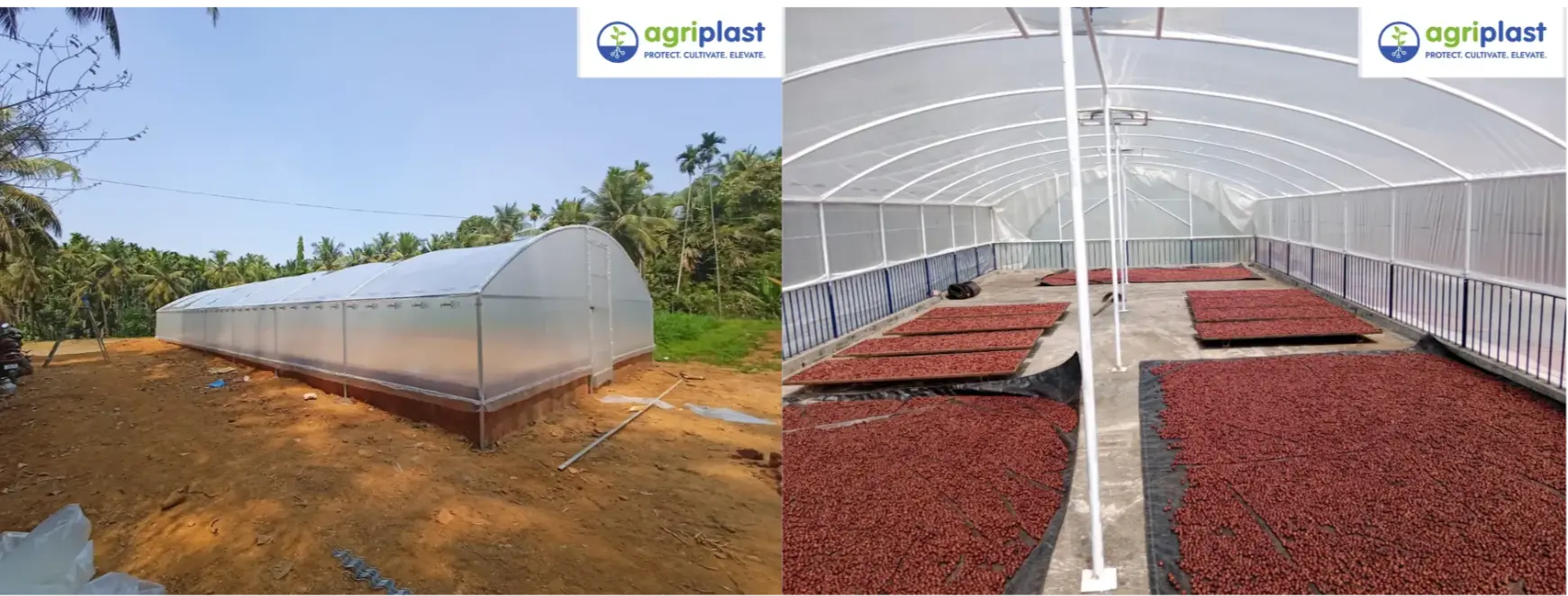
Clear greenhouse film is preferred where heat gain and direct sunlight are required
What Is the Haze Factor?
Haze factor refers to the percentage of light that is scattered by the greenhouse film.
- High Haze (>60%): High diffusion. Ideal for hot, sunny climates (e.g., South India) to prevent burning.
- Low Haze (<25%): Low diffusion (clearer). Ideal for colder, cloudy climates where light intensity is weak.
Conclusion: Making the Right Choice
Choosing between clear and diffused greenhouse film comes down to your geography and crop. If you are growing tall crops in a high-radiation zone, diffusion is an investment in yield. If you are in a cold, low-light region, clear film is a necessity for heat.
Not sure which Greenhouse Film fits your location? Contact Agriplast’s Agronomy Team for a Free Consultation.
*Yield improvement varies by crop, season, greenhouse design, ventilation, and agronomy practices.
Frequently Asked Questions (FAQs)
Blog written and Posted by
Abhinav Roy
Abhinav Roy is an agribusiness professional, agricultural communicator, and host of AgriTalk by Abhinav Roy. He works closely with farmers, agripreneurs, across India to simplify complex agricultural technologies into practical, field-ready insights. With hands-on exposure to protected cultivation, crop protection systems, and farm economics, Abhinav focuses on bridging the gap between science, sustainability, and scalable farming solutions.You can write your view/comments here
Need Expert Assistance?
Get personalized recommendations for your greenhouse, polyhouse, or irrigation needs.
-
Bengaluru (Corporate Office)
- 918141446666
- support@agriplast.co.in
WeWork Roshni Tech Hub - 1st floor, PFS Club House, Marathahalli Main Rd, R.J.Gardens, Lakshminarayana Pura, EPIP Zone, Chinnapanna Halli, Bengaluru, Karnataka 560037