Why Weedmat Is Mandatory for Blueberry Farming: Vishal’s ₹90L Earning Secret

Weed mat for blueberry farming is one of the most underbudgeted line items in Indian blueberry setups. It costs a fraction of what farmers spend on plants, grow bags, or drip systems — and yet, without it, every rupee of daily fertigation investment is at risk.
Vishal Thakur learned this not from a training manual but from building one of India's first open-field commercial blueberry farms in Kullu, Himachal Pradesh — from scratch, with no template to follow.
Seven years later, his farm reaches ₹90 lakhs per acre in peak production years. His government-approved blueberry nursery is one of the only facilities of its kind in India. Farmers from Maharashtra, Karnataka, and Uttarakhand call him when they want to start. This is the story of how he built it — and the infrastructure decisions behind the numbers.
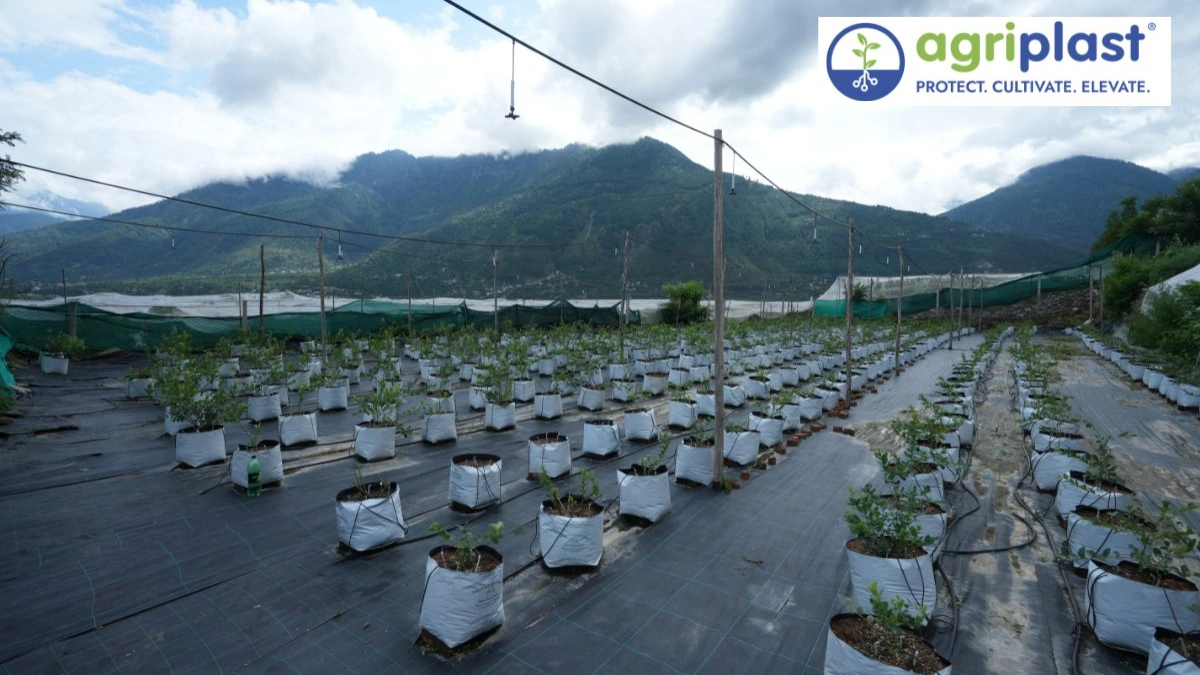
Vishal Thakur (right) at his open-field blueberry farm in Kullu, HP — black Agriplast Weed Mat visible between grow-bag rows, Beas river valley in the background.
From Engineering Desk to Blueberry Farm in Kullu
Vishal Thakur was working as an engineer in Delhi when COVID-19 changed his plans. He returned to his village in the Kullu-Manali region and began researching high-value crops that could work commercially in India's northern hills.
Blueberry farming in India was barely explored at the time. The country imports over 20,000 metric tons of blueberries annually while domestic production remains at just 1,000–2,000 metric tons. But Vishal saw something clear — the Kullu region had the chill hours, the cool temperatures, and the altitude that blueberry plants need. The Kullu-Manali belt sits at 400–800 chilling hours annually, making it naturally suited to medium-chill varieties — the commercial sweet spot for Indian conditions.
"Most people said it couldn't be done commercially in India. I thought — if the climate is right and you manage the rest of the inputs correctly, there's no reason it can't work. The crop doesn't know it's in India."
— Vishal Thakur, Kullu, Himachal Pradesh
He spent years reading, consulting experts, testing soil mixes, and calibrating his drip and fertigation systems. He made mistakes early enough that they didn't cost him the farm. Seven years on, he manages 2–3 productive blueberry plots in open field, runs a government-approved blueberry nursery, and is one of the most referenced names in Indian blueberry cultivation.
The Open-Field Setup: How Vishal's Blueberry Farm Works
Vishal's operation is open field — not a polyhouse or tunnel structure. Blueberry cultivation in grow bags is his chosen system — 50-litre bags filled with an acidic substrate mix, primarily cocopeat and pine sawdust, maintained at a soil pH between 4.5 and 5.5. Rows of grow bags sit directly on the farm floor, with drip lines running to each bag.
The fertigation program runs daily — approximately 1 gram of fertilizer per litre of water, around 2.5 kg of total fertilizer per day for a farm of 2,400–2,500 plants. Every input is measured and timed. In this kind of setup, the farm floor between the grow-bag rows is not bare soil. It is covered entirely with Agriplast Weed Mat.
"Weed mat installation is mandatory in blueberry farming. Blueberry is a highly nutrient-dependent crop, and we supply water and fertilizers almost every day. Without a weed mat, weeds grow aggressively and steal those nutrients directly from the plants."
— Vishal Thakur, Kullu, Himachal Pradesh
This is not a preference — it is a system requirement. In an open-field grow-bag layout with daily drip irrigation, the ground between rows stays consistently moist and nutrient-rich. Without a physical barrier, weed germination is aggressive and constant. Blueberry roots are fine and shallow — they cannot compete with weeds for the nutrients being delivered through fertigation every single day.
Why Vishal Uses Agriplast Weed Mat — And Which GSM
When Vishal chose weed mat for blueberry farming on his Kullu plots, he needed a product that was water-permeable by design. Agriplast Weed Mats, manufactured from UV-stabilized woven polypropylene (PP), do exactly that — drip irrigation and fertigation pass freely through to the grow bag substrate below while the mat maintains complete light blockage above. Weeds cannot germinate without light. The mat removes the variable entirely.
For an open-field blueberry farm like Vishal's — where workers walk between grow-bag rows daily for irrigation checks, pruning, and harvest — ground cover durability matters as much as weed suppression. Agriplast's UV stabilization delivers a rated 3-year outdoor life, making it well-suited to an 8–10 year crop that will see multiple growing seasons.
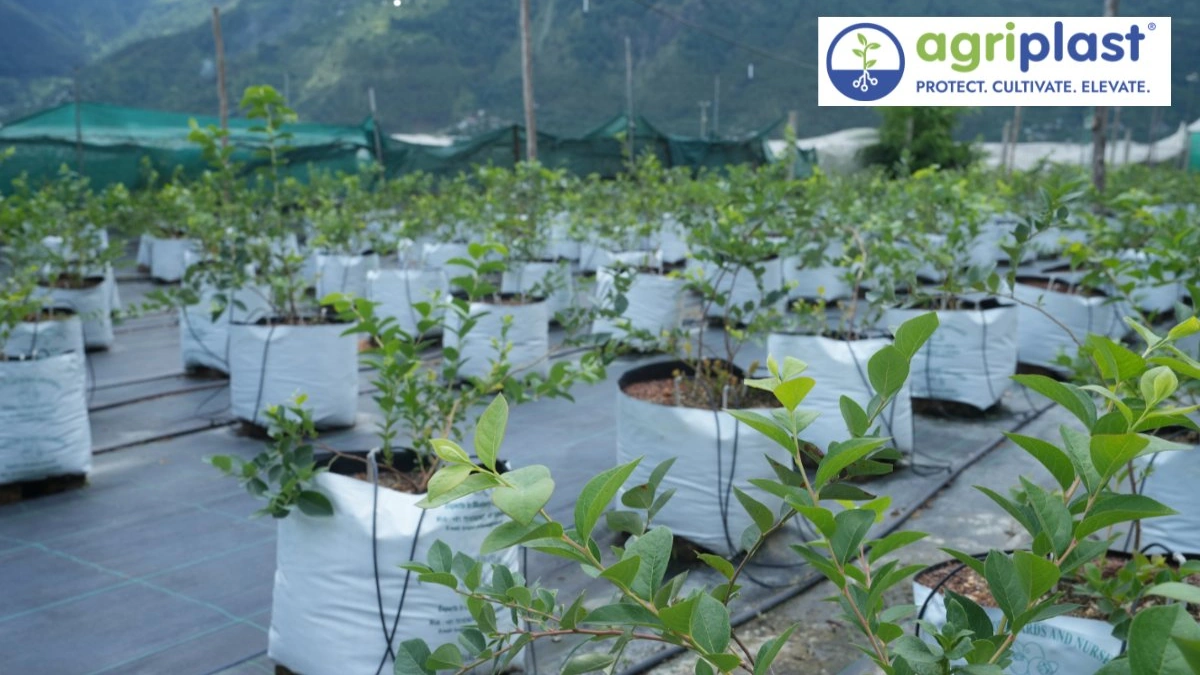
Blueberry plants in 50-litre grow bags on Agriplast Weed Mat — drip lines run to each bag, ensuring precise daily fertigation with zero weed competition at ground level.
Weed Mat for Blueberry Farming: Which GSM Does Vishal Recommend?
| GSM | Construction | UV Life | Best Use in Open-Field Blueberry Farm |
|---|---|---|---|
| 90 GSM | Black PP woven | 3 years | Nursery rows, low-traffic zones |
| 100 GSM | Black PP woven, permeable | 3 years | Standard open-field grow-bag rows |
| 130 GSM | Black-White PP woven | 3 years | High-traffic walkways between rows — walkable surface + light reflection into canopy |
For Vishal's layout, the 130 GSM Black-White mat serves two functions at once: the black underside blocks weed germination completely, and the white upper surface reflects light upward into the plant canopy — supporting photosynthesis and contributing to even berry colour development at harvest. Mats come in widths of 1.2m, 4.2m, and 5.2m and lengths of 50m or 100m, matching standard grow-bag row widths without excessive joins.
See the full Agriplast Weed Mat range with specifications →
The Investment: What Goes Into Vishal's Open-Field Blueberry Farm
Understanding why weed mat for blueberry farming matters starts with understanding what it protects. Blueberry farming in India is capital-intensive — the plants are the largest single cost, and they take years to reach full yield. Vishal recommends investing in 1.5–2-year-old plants. At ₹800–₹1,000 each, they cost more than younger tissue culture stock — but they have already cleared their most vulnerable growth phase and can produce fruit in the very first season after planting.
| Component | Estimated Cost |
|---|---|
| Land preparation / borewell | ₹10 lakhs (hilly terrain) / lower in plains |
| Agriplast Weed Mat installation | ~₹1.5 lakhs |
| Drip irrigation system | ₹2.5 lakhs |
| Plants — 1.5–2 yr old @ ₹800–₹1,000 each | ₹20–25 lakhs |
| Grow bags + cocopeat-sawdust substrate | ₹5–7.5 lakhs |
| Total — open field (plains) | ~₹15–20 lakhs |
| Total — open field (hilly, full infrastructure) | ~₹40 lakhs |
At 2,500 plants at ₹800–₹1,000 each, that is ₹20–25 lakhs in planting material alone. Agriplast Weed Mat at ~₹1.5 lakhs is the smallest line item in the project — and the one that protects every other line item above it, every single day of the season.
For a complete breakdown of blueberry farming costs, variety selection, and cultivation steps, read the Complete Blueberry Farming guide for Indian Growers →
Blueberry Farming Profit Per Acre — What Vishal's Numbers Show
Blueberry farming profit per acre in India does not arrive in Year 1. The crop establishes in Year 1, begins producing meaningfully in Year 2, and reaches commercial peak between Years 3 and 8. According to the International Blueberry Organization's 2025–2030 outlook, global blueberry production crossed 2 million tons in 2024 — and India's window as an early domestic producer is still wide open for farmers who move now.
| Year | Yield per Plant | Total Production | Revenue (@ ₹1,000/kg) |
|---|---|---|---|
| Year 1 | 0.5–1 kg | ~1 tonne | ~₹10 lakhs |
| Year 2 | 1.5–2 kg | ~4 tonnes | ~₹40 lakhs |
| Year 3 | 3–4 kg | ~8 tonnes | ~₹90 lakhs |
| Year 4–8 (Peak) | 3–5 kg | 8–12 tonnes | ₹90–120 lakhs |
| Year 8–10 (Decline) | Gradual reduction | — | Varies by variety |
Based on 2,000–2,500 plants per acre. Variety and management dependent. Field-level estimates — not guaranteed projections.
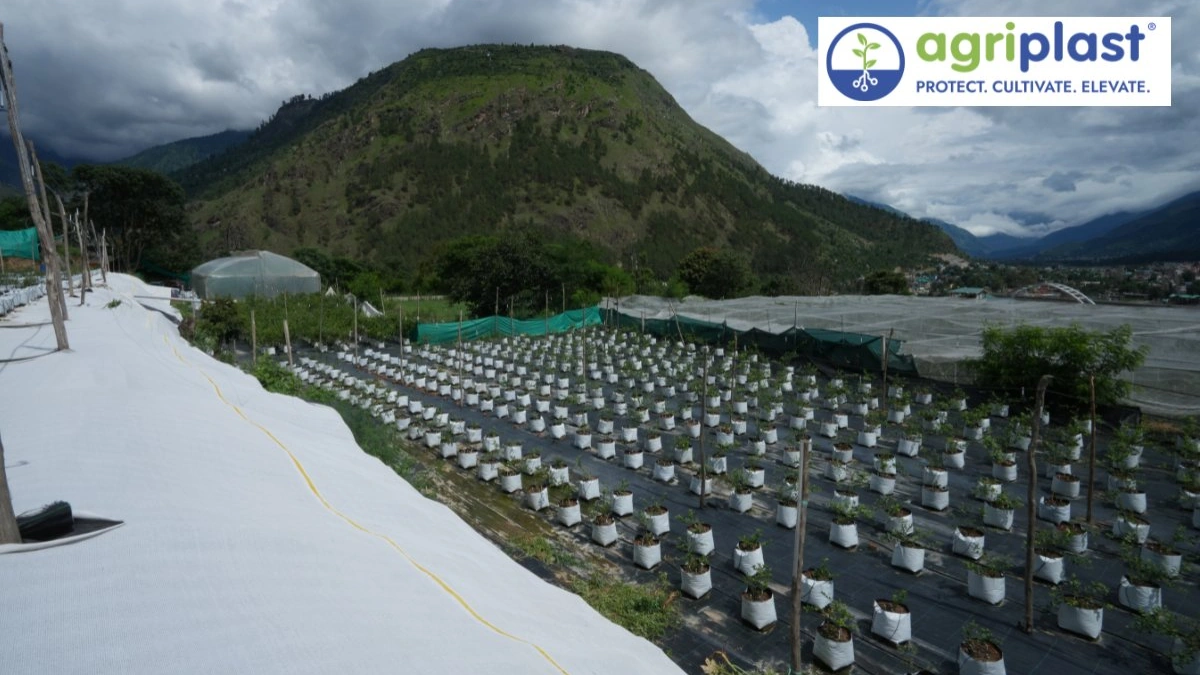
Vishal's commercial blueberry farm in Kullu — rows of grow bags on black Agriplast Weed Mat covering the entire farm floor, with the Kullu valley and Beas river visible in the background.
At ₹1,000/kg — conservative relative to the ₹800–₹1,600/kg wholesale range at Azadpur Fruit Market, Delhi — investment recovery typically falls between Year 2 and Year 3. Fresh blueberries reach direct retail at approximately ₹200 per 125g punnet, and export-grade berries of 16–18mm command premium pricing in select international markets.
Vishal's farm reaches this trajectory because the fundamentals are right from Day 1 — and correct use of weed mat for blueberry farming is one of those non-negotiable fundamentals — substrate calibrated, fertigation precise, and Agriplast Weed Mat ensuring every rupee of daily nutritional input reaches the plant. Read more about weed mat uses, selection, and ROI across Indian farming systems →
Blueberry Farming in Himachal Pradesh: Why Kullu Works for Vishal
Blueberry farming in Himachal Pradesh has a natural advantage that most other Indian states have to engineer around. Medium-chill varieties like Legacy and Duke — which require 400–800 chilling hours annually — perform well here without the climate management overhead needed in warmer states. The HP Horticulture Development Society has identified the Kullu belt as one of the most suitable zones in India for high-value berry cultivation, supported by cool summers and well-defined winters.
Harvest in Himachal Pradesh runs from April to June — before the monsoon arrives. This gives Kullu-region farms a clean harvest window where rain damage risk is low, fruit quality is high, and the Delhi wholesale market is accessible within a day's transport.
"In zero-chill regions, the shorter 7-month crop cycle makes it possible to harvest twice in 14 months through managed pruning. This is still experimental in India, but early results are promising."
— Vishal Thakur, Kullu, Himachal Pradesh
The combination of natural chill hours, a pre-monsoon harvest window, and seven years of cultivation knowledge in this terrain makes Vishal's Kullu operation the most referenced open-field blueberry farm in India's northern hill zone.
The Nursery: How Vishal's Work Reaches Farmers Across India
Alongside his production plots, Vishal runs a government-approved blueberry nursery — one of the only facilities of its kind in India producing quality planting stock at scale. Farmers from Maharashtra, Karnataka, Uttarakhand, and beyond contact him for plants, variety guidance, and farm setup advice.
The same infrastructure discipline he applies on his own farm — correct grow bag substrate, tight daily fertigation, Agriplast Weed Mat as mandatory ground cover — is what he passes to every farmer he guides.
"When I started, I had to figure everything out myself. The infrastructure questions are always the same wherever I go — what grow bag mix, what drip setup, what ground cover. The basics that nobody teaches properly."
— Vishal Thakur, Kullu, Himachal Pradesh
If you are planning a blueberry farm and need the right weed mat specification for your layout — open field, grow bags, or nursery — connect with the Agriplast team for a customised recommendation →
🎥 Watch: Vishal Thakur on Blueberry Farming in India
Vishal Thakur shares his seven-year journey building one of India's first commercial open-field blueberry farms in Kullu, HP — covering variety selection, grow bag setup, daily fertigation, and why Agriplast Weed Mat is non-negotiable in his open-field system.
Frequently Asked Questions
Blog written and Posted by
Rani Singh
Rani Singh is a Content Executive at Agriplast Tech India, covering high-value farming, protected cultivation, and farmer success stories. She focuses on turning field experiences into practical, actionable content for Indian farmers and agri-entrepreneurs.You can write your view/comments here
Need Expert Assistance?
Get personalized recommendations for your greenhouse, polyhouse, or irrigation needs.
-
Bengaluru (Corporate Office)
- 918141446666
- support@agriplast.co.in
WeWork Roshni Tech Hub - 1st floor, PFS Club House, Marathahalli Main Rd, R.J.Gardens, Lakshminarayana Pura, EPIP Zone, Chinnapanna Halli, Bengaluru, Karnataka 560037