How Mulching Helped Anand Barbudde Save ₹2.5 Lakh/Acre in Chilli Farming
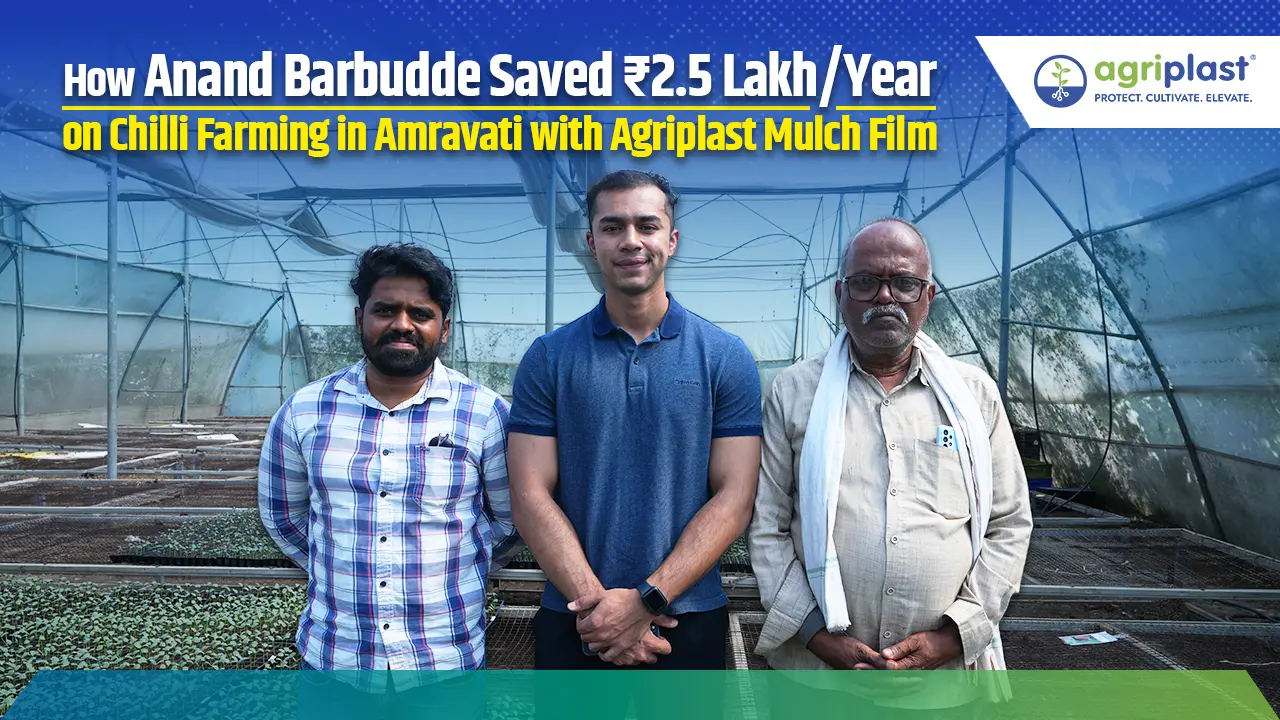
Most vegetable farmers in Amravati know that chilli farming can be profitable — but very few make it consistently so. Input costs keep rising. Thrips attack early. Weed labour eats into margins. And the crops that should run 10 months often collapse at six.
Anand Gajendrao Barbudde has been running chilli on his land in Morshi, Amravati for 20 years, and his numbers look different. On a 3-acre chilli and karela rotation, he saves ₹2 to ₹2.5 lakh per acre per year. His current crop's first two pickings already delivered 300 to 350 pouches of 10 kg each — at market rates of ₹40 to ₹50 per kg.
The difference between his farm and most others in Amravati comes down to one decision made before a single seedling goes into the ground: Agriplast mulching film, used continuously for 20 years.
_1775560951_69d4e8f780f48.webp)
Anand Gajendrao Barbudde — progressive farmer and nursery owner from Amravati, Maharashtra. He has farmed with Agriplast mulching film for 20 continuous years.
The Farmer Behind the Numbers
Anand is not a traditional farmer who inherited a method and stuck with it. He holds a BBA in Agriculture and chose farming deliberately — as a business, not a livelihood of last resort. He started with 12 acres in Amravati. Today he farms 60 acres and runs three operations from the same location: Kamal Narayan Hitech Nursery, Kamal Narayan Farm, and Kamal Narayan Krushi Seva Kendra.
The nursery supplies quality seedlings to farmers across the Amravati area. The farm produces chilli, karela, cucumber, tomato, watermelon, brinjal, and lauki across 40 acres. The krushi seva kendra connects the knowledge he has built over 20 years to other farmers in the district.
In the Amravati belt, chilli is the dominant commercial crop. Planting happens in June, with field preparation — including mulching and basal dose application — done through May. A well-managed crop runs 8 to 10 months. A very good one reaches 12. Most farmers manage 6 before pest pressure, disease, or moisture stress forces them to pull the crop early.
Why Mulching Is No Longer Optional in Vegetable Farming
Anand grows seven vegetable crops on his farm — chilli, tomato, karela, cucumber, capsicum, brinjal, and watermelon. Every single one goes into mulched beds. That was not always the standard in Amravati, but his view on it has not changed in 20 years.
"We have been using mulching for 20 years — across chilli, tomato, karela, cucumber, capsicum, brinjal. The benefits from mulching are enormous. In the early stage, sucking insects do not attack your crop because light reflection from the mulch prevents them. Water stored in the bed lasts 1 to 2 days from just 1 to 2 hours of irrigation.
Root zone growth happens very easily because the bed stays dark underneath. And if you calculate the total crop cost — weeding, manual labour — the money spent on mulching upfront is always the better decision."
— Anand Gajendrao Barbudde, Amravati, Maharashtra
This is not a general endorsement. It comes from a farmer who has calculated both sides of the equation — with and without mulching — across 20 years of commercial vegetable production in Amravati district.
Mulching in Vegetable Farming: Input Cost vs Output Gains
Anand's farm in Amravati provides a working model for what mulching delivers in practice across vegetable crops. The figures below are drawn directly from his 20 years of field experience.
| Parameter | Without Mulching | With Agriplast Mulching Film |
|---|---|---|
| Irrigation frequency | Daily or every alternate day | 1–2 hours/day sufficient for 1–2 days |
| Weed management cost | Repeated manual weeding — high labour cost per acre | Near-zero weed pressure — mulch blocks sunlight to soil surface |
| Early-stage pest pressure (thrips) | High — sucking insects attack in weeks 2–3 post-transplant | Significantly reduced — silver-black surface reflects light, disrupting thrips navigation |
| Root zone health | Temperature fluctuation, moisture stress between irrigation cycles | Stable dark environment promotes deep root growth and consistent nutrition uptake |
| Crop cycle duration | 6–8 months typical | 10–12 months achievable with healthy root system |
| Chilli yield (first two pickings) | Variable — depends on pest and moisture management | 300–350 pouches × 10 kg = 3,000–3,500 kg (Anand's current season, Amravati) |
| Income per acre — chilli alone | Lower — shorter crop cycle, higher input cost | ₹2.5 lakh/acre at 40/kg conservative average (market rate at filming: ₹40–₹50/kg) |
| Annual savings — chilli + karela rotation (3 acres) | — | ₹1.5–₹2.5 lakh/acre/year |
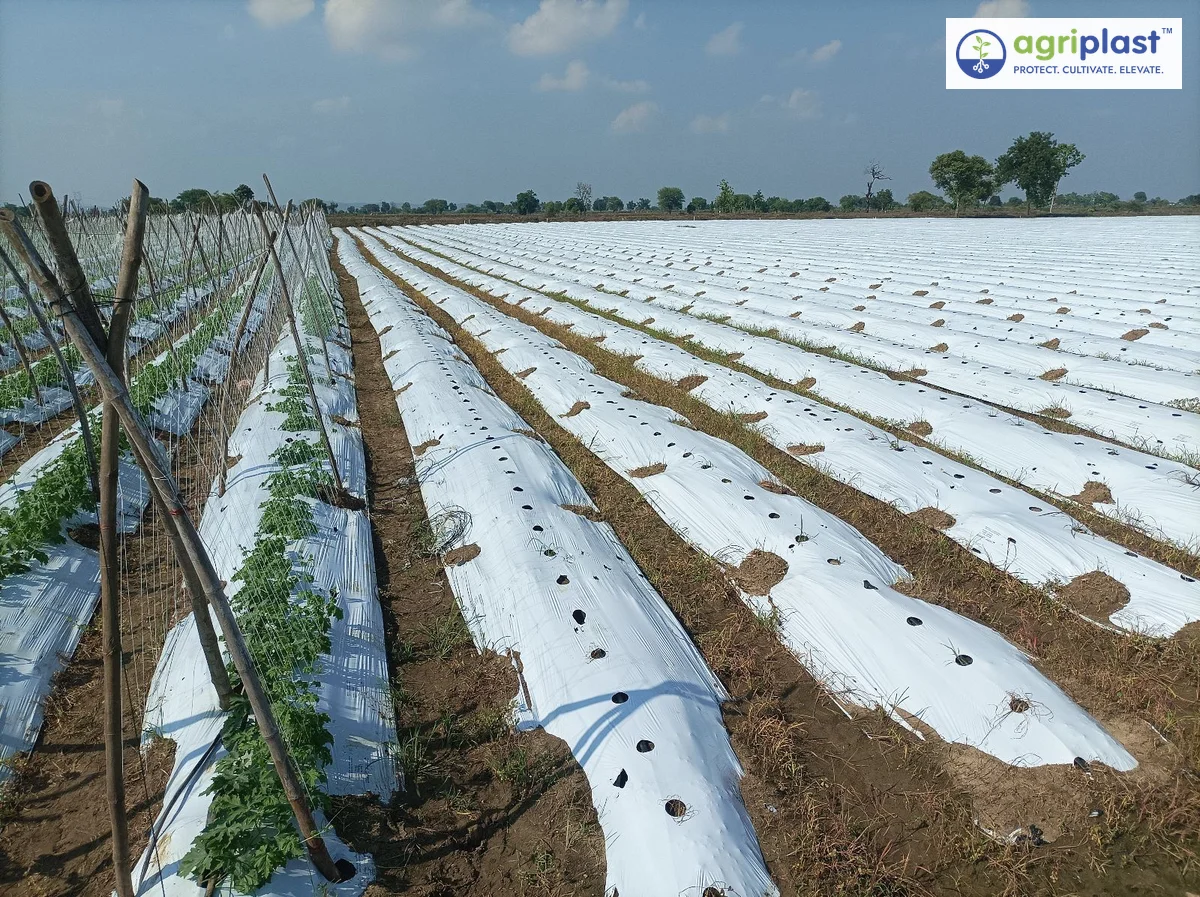
Raised vegetable beds covered with Agriplast mulching film at Anand's farm in Amravati. Silver-black film reflects light upward to repel thrips while the black underside retains soil moisture and blocks weed germination.
How Mulching Controls the Biggest Threat to Chilli: Sucking Insects
Of the three major challenges in Amravati's chilli farming — wilting disease, black thrips, and winter borer attack — thrips cause the most consistent damage. They arrive in the early vegetative stage, feed on the underside of young leaves, and transmit viruses that cause leaf curl complex and chilli mosaic. By the time symptoms are visible, yield loss is already locked in.
Anand's use of silver-black mulch film on his chilli beds addresses this problem not through chemistry, but through how the film interacts with light. Thrips and other sucking insects navigate toward crops using light cues. The reflective silver surface bounces light upward from the bed, disrupting these cues at the most critical point: the first two to three weeks after transplanting, when the plant has no canopy and is entirely exposed. Fewer early arrivals mean fewer emergency sprays and a crop that establishes cleanly before the first real pest pressure wave hits.
For a detailed look at how plastic mulching in agriculture works across vegetable crops, the full guide covers every mechanism in depth.
20 Years With Agriplast: Why the Brand Has Not Changed
Anand has used Agriplast mulching film for 20 consecutive years in Amravati. In a market where input dealers constantly push alternatives, that continuity has two specific reasons — both from direct field observation.
The first is the gap between what is printed on a label and what is actually in the roll. The second is what happens at the end of every season when the film comes off the bed. Both matter on a farm that has worked the same soil for 20 years.
"These days in the market, farmers cannot even get 21 micron under the name of 25 micron. But with a trusted brand like Agriplast, you can rely on them — their 18 micron roll performs on a par with a competitor's 25 micron roll. And when you remove Agriplast mulching at season end, it does not break into pieces — it comes off as one continuous piece.
The after-sales service is also always good. No problem of ours is ignored. Whatever difficulty we have, it gets solved. That is why we have stayed with this company for 20 years."
— Anand Gajendrao Barbudde, Amravati, Maharashtra
Clean removal is not a minor detail. Cheap mulch film that crumbles at season end leaves plastic fragments in the soil — damage that compounds across multiple seasons and affects the bed quality that Anand depends on year after year for his vegetable rotation.
To understand how to identify quality mulch film and choose the right specification, read How to Choose the Right Agriculture Mulching Paper. For a foundational understanding of mulching methods and crop applications, see What Is Mulching and How It Works.
Agriplast Across the Full Farm System
Mulching film is not the only Agriplast product in Anand's operation. His nursery — Kamal Narayan Hitech Nursery, based in Amravati and supplying quality seedlings to chilli and vegetable farmers across Amravati district — runs on Agriplast polyhouse film and weed mat. When he built the nursery, there was no deliberation about which brand to use. The trust earned on mulching film extended naturally to every other product in the system. Strong seedlings go into well-prepared mulched beds — every link in that chain depends on the same quality standard, and a weak link anywhere shows up in the harvest.
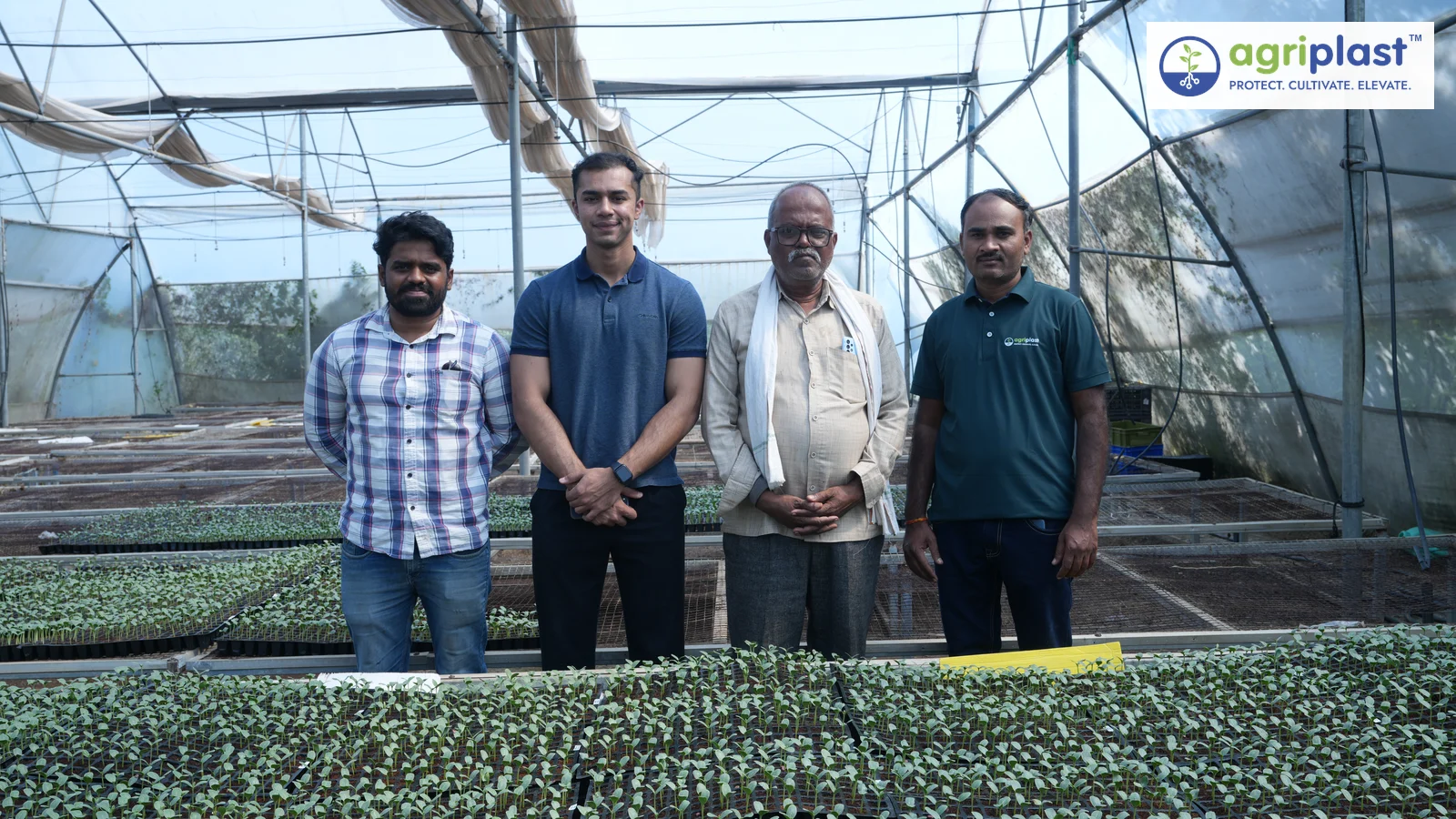
Kamal Narayan Hitech Nursery in Amravati — built and operated with Agriplast polyhouse film and weed mat. The nursery supplies quality vegetable seedlings to progressive farmers across the Amravati region.
This is what a 20-year relationship with an input brand looks like in practice: it expands from one product to the full system, because the trust earned on one product makes every subsequent decision easier. For a complete look at how mulching in agriculture performs across crops and soil types, the Agriplast mulching guide covers the full range of applications.
Anand's Message for the Next Generation of Farmers
In Amravati, the resistance to mulching is not ignorance — it is the upfront cost calculation. Farmers see the per-roll price and compare it to the familiar cost of manual weeding. Anand's response goes beyond product economics. It is about what farming can be when you approach it with the right intention.
"Today many people think farming has become very difficult. But if young people like us take an interest in farming, trust the land, and take care of the soil's health — farming will never give you bad days. We started with 12 acres. Today we have 60. That happened because we trusted the land. If you protect the land and choose the right inputs, the land will always take care of you."
— Anand Gajendrao Barbudde, Amravati, Maharashtra
That growth from 12 to 60 acres did not come from external investment. It came from farming the land well, protecting the soil every season, and choosing inputs that supported long-term productivity rather than just one season's margin. If you farm chilli, tomato, capsicum, or any vegetable crop in Maharashtra and want to see how another Amravati farmer applied the same approach to fruit crops, read how Shashwat Mundra saved ₹2 lakh per acre in Amravati using Agriplast mulch on papaya and guava.
🎥 Watch: How Anand Barbudde Saves ₹2.5 Lakh/Acre From Chilli Farming in Amravati
Anand speaks directly from his chilli field in Amravati — explaining how Agriplast mulching film controls sucking pests, reduces irrigation requirements, and contributes to ₹2 to ₹2.5 lakh per acre savings across his vegetable rotation. Video in Marathi.
Frequently Asked Questions
Planning to use Agriplast mulching film for your vegetable crop this season? The right mulch colour, micron thickness, and installation timing differ by crop, season, and soil type. Explore the full Agriplast mulching range or speak with the technical team to find the right solution for your chilli, tomato, or vegetable operation.
Blog written and Posted by
Rani Singh
Rani Singh is a Content Executive at Agriplast Tech India, covering high-value farming, protected cultivation, and farmer success stories. She focuses on turning field experiences into practical, actionable content for Indian farmers and agri-entrepreneurs.You can write your view/comments here
Need Expert Assistance?
Get personalized recommendations for your greenhouse, polyhouse, or irrigation needs.
-
Bengaluru (Corporate Office)
- 918141446666
- support@agriplast.co.in
WeWork Roshni Tech Hub - 1st floor, PFS Club House, Marathahalli Main Rd, R.J.Gardens, Lakshminarayana Pura, EPIP Zone, Chinnapanna Halli, Bengaluru, Karnataka 560037