How to Start Strawberry Farming in India: Varieties, Cost, and Profit Guide
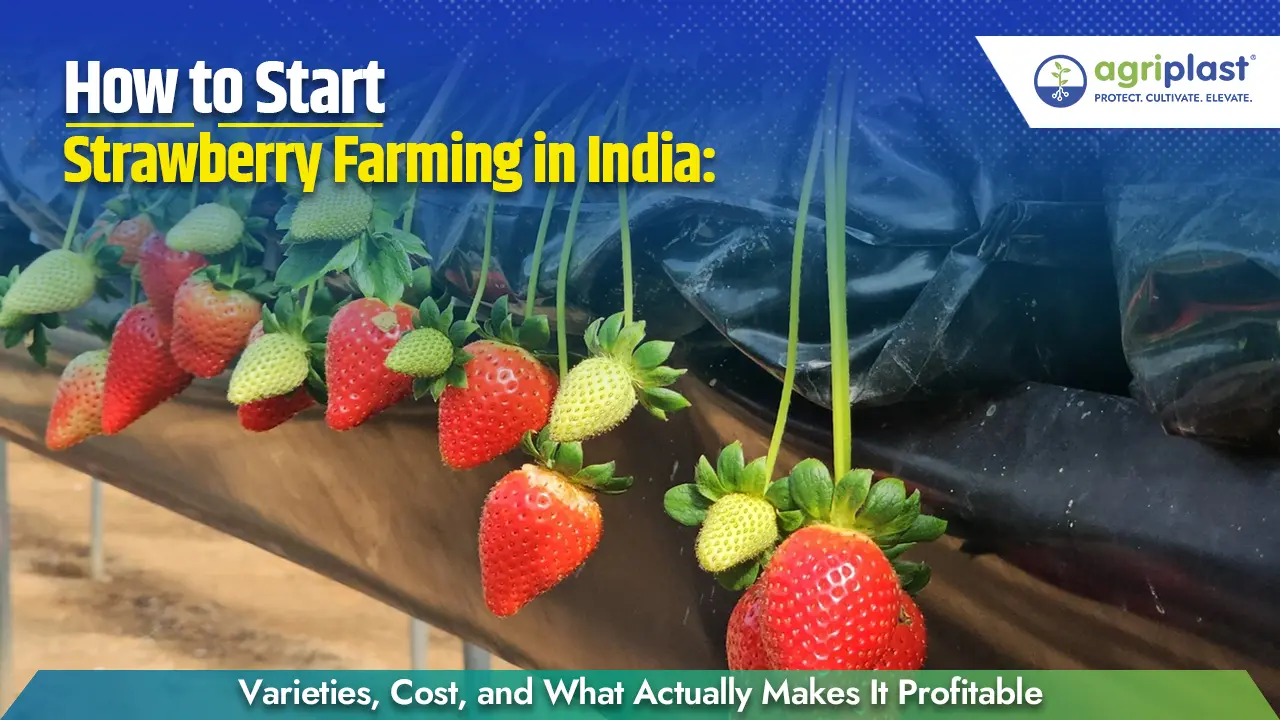
Strawberry farming in India has crossed a turning point. What was once limited to the cool hills of Mahabaleshwar and Himachal Pradesh is now spreading into new zones — the UP plains, Karnataka's Nilgiris, and Gujarat — as better growing inputs and protected cultivation bring this high-value crop within reach of more farmers.
The numbers are worth taking seriously. India produced over 19,840 metric tonnes of strawberries in 2020-21, with Mahabaleshwar alone accounting for approximately 85% of national output (National Horticulture Board / APEDA). Domestic demand keeps rising, and farm-gate prices average ₹300 per kg for premium protected-cultivation fruit.
Farmers running a well-managed half acre under polyhouse in Ooty have reported ₹48 lakh gross revenue with ₹10–15 lakh net profit — and those are documented field numbers, not projections.
This guide covers everything you need to get strawberry farming right — climate requirements, variety selection, soil preparation, mulching, pest management, protected cultivation, soilless systems, and honest profit figures drawn from real Indian farms.
_1775448233_69d330a98cd8d.webp)
Ripe strawberries grown in Agriplast Strawberry Containers (Closed Type) inside a protected polyhouse — designed for soilless cultivation, terrace gardening, and commercial strawberry farming.
Which Zones in India Are Best for Strawberry Farming?
Strawberry is a short-day plant. It needs cool temperatures, adequate light, and the right humidity during flowering to produce well. The ideal day temperature is 14–28°C, with a minimum of 20,000 lux of light and humidity around 60–80%. That combination is naturally available in Ooty, Mahabaleshwar, Himachal Pradesh, and India's hilly northeast — but with protected cultivation, the window is widening.
Maharashtra's Mahabaleshwar gets a 4–5 month production window — plantation in October, harvest December through April. Ooty, by contrast, runs a 9–10 month production cycle continuously because the climate does not force a seasonal break. Both regions are proven. The key difference is duration and system investment.
| Zone | States / Regions | Planting Window | Production Window |
|---|---|---|---|
| North India | Haryana, Punjab, HP, Uttarakhand | October–November | January–March. Mulch critical for root cold protection. |
| UP Plains | Lucknow, Kanpur belt | October–November | Emerging region. Polytunnel extends season significantly. |
| Maharashtra | Mahabaleshwar–Panchgani, Pune, Nashik | June–September | November–April. 4–5 month production window per season. |
| Northeast & Hills | Darjeeling, Ranchi, Meghalaya, Mizoram | September–October | January–April. Jharkhand = 3rd nationally. |
| South India (Nilgiris) | Ooty, Kodaikanal, Bangalore rural | Year-round (polyhouse) | 9–10 months continuous production possible under protection. |
Strawberry Varieties for India: Which One to Plant?
Variety selection is where many first-time strawberry farmers go wrong — they pick what is available at the nursery, not what suits their zone and market. Always trial a new variety for at least one full season before scaling up. Commercial growers in Ooty, for example, ran trial runs across multiple varieties before committing to Sweet Sensation (Enza Zaden) as their primary commercial choice — then filled both polyhouses with it.
| Variety | Type | Best Zone | Key Traits | Market Fit |
|---|---|---|---|---|
| Sweet Sensation | Short-day | South India hills (Ooty) | Large fruit, excellent flavour, suited to soilless systems | Premium B2C, supermarkets, direct delivery |
| Winter Dawn | Short-day | All zones | Early fruiting, consistent yield, reliable | Fresh market + local |
| Chandler | Short-day | Maharashtra, HP | High yield, excellent flavour, softer fruit | Fresh market + local export |
| Camarosa | Short-day | Maharashtra, Karnataka | Large firm fruit, 7–10 days shelf life | Premium fresh, long-distance transport |
| Festival | Short-day | HP, Punjab | Cold tolerant, high yield | Local fresh market |
| Sweet Charlie | Short-day | UP, WB, Haryana | Sweet, early-bearing, disease tolerant | Local fresh + processing |
For plains regions (UP, Haryana, Gujarat), Winter Dawn and Sweet Charlie are the entry-point varieties — they tolerate slightly warmer nights better than Chandler and establish well under polytunnel conditions.
Soil and Land Preparation
Strawberry has shallow roots — most feeding activity happens in the top 20–30 cm of soil. That makes soil structure and drainage critical. Poor drainage causes root rot, which is one of the top reasons strawberry farms fail in the first season. For soilless systems, the same principle applies to your substrate mix.
| Parameter | Soil System | Soilless (Coco Peat) System |
|---|---|---|
| Growing media | Sandy loam to loamy, pH 5.7–6.5 | Coco peat 70% + coco chips 30% |
| EC at planting | Below 1.5 mS/cm | 1.6 mS/cm (field-verified, Ooty) |
| pH target | 5.7–6.5 | 5.5 (field-verified, Ooty) |
| Drainage | Well-drained raised beds, 30–45 cm high | Coco chips provide natural aeration and drainage |
| Between seasons | Soil fumigation or solarisation | Full coco peat change each crop cycle |
The soilless advantage is repeatability. With soil, repeating the same planting area across seasons builds up disease pressure year after year. With coco peat, you change only the media — the same area is used cleanly every cycle.
This is why commercial growers in Ooty, running a half-acre soilless polyhouse for 10 years, have maintained consistent yields without soil fumigation.
Planting, Spacing, and Irrigation
Plant ready-to-transplant runner plants — not seeds. Nursery preparation takes 100–105 days before the plant is field-ready. The crown must sit exactly at soil level on transplanting. Too deep causes crown rot. Too shallow causes root desiccation.
In open soil, standard spacing is 30 cm between plants giving around 20,000 plants per acre. In a soilless polyhouse at 22 cm spacing, approximately 30,000 plants per acre is achievable — tighter spacing works because disease pressure is managed through environment control rather than chemicals, but it requires more precise monitoring.
- First 45 days (vegetative): High nitrogen and calcium fertigation. Remove first flowers — debudding builds plant health and improves subsequent flush quality.
- After 45 days (fruiting): Switch to high-potassium mix — MKP or SOP at 2–3 kg per 1,000 litres through drip.
- First harvest: 90 days from transplanting. Then 3+ flushes, 10–15 fruits per flush, targeting 1 kg per plant over the season.
- Harvest frequency: Every alternate day during peak. Harvest timing matters — early morning (before sunrise) keeps fruit cold from the first moment, protecting shelf life.
Drip irrigation is the standard. Sprinkler systems wet the canopy and fruit, directly triggering Botrytis during fruiting — avoid it once flowering begins. Commercial soilless operations use drip emitters at 15 cm spacing, 600 ml/hour flow rate, with all nutrition delivered via fertigation through the same line.
Why Mulching Film Is Non-Negotiable for Strawberry Beds
Mulching film is the single most impactful input decision in strawberry farming. Strawberry plants have three vulnerabilities that mulch directly addresses: fruit-soil contact causes grey mould (Botrytis); shallow roots compete poorly against weeds; and root zone temperature swings slow growth in winter. Mulch resolves all three.
_1774800715_69c94f4b6ee81.webp)
Agriplast Ginegar mulching film (25 micron, Batch H/24, Aug 2024) on strawberry beds — even soilless trough systems benefit from mulch for weed control and moisture retention.
One detail that surprises many growers: at Purple Patch Farms in Ooty, mulch film is laid even over the soilless troughs — not just soil beds. The reason is practical, not decorative.
"The advantage of using this mulch — even on the soilless trough — is to control the weeds and also to retain the moisture. Evaporation is also reduced."
For soil-grown strawberry, black LDPE (25 micron) is the field standard for a single season. Silver-black is widely used in hilly regions where reflective properties help distribute light inside the canopy. Agriplast's mulching film range covers 20 25, 30, 50, and 100 micron options in black, silver-black, and white-black variants, UV-stabilised from 9 to 24 months depending on the SKU.
See how Sachin Dake earns ₹10–12 lakh/acre using silver-black mulch.
For a full breakdown of mulch types, microns, and cost per acre, see Agriplast's complete guide to mulching in agriculture.
Pest and Disease Management
Strawberry is not a low-maintenance crop. It is susceptible to grey mould (Botrytis), verticillium wilt, powdery mildew, spider mite, and thrips — most of which intensify when canopy temperature rises or drainage is poor. In a well-managed protected structure, the first line of defence is environmental control, not a spray schedule.
| Disease / Pest | Symptom | Management |
|---|---|---|
| Botrytis (Grey Mould) | Grey fuzzy growth on fruit and leaves | Black mulch eliminates soil-fruit contact — primary trigger. Reduce humidity, improve airflow. Harvest at the correct colour stage — overripe fruit is most vulnerable. |
| Verticillium Wilt | Sudden wilting, dark crown discolouration | Soil solarisation pre-planting, or switch to soilless system which eliminates soil-borne disease entirely. |
| Powdery Mildew | White powder on leaves, leaf curl | Maintain adequate spacing for air movement. Avoid overhead irrigation — use drip only. |
| Spider Mite | Yellowing leaves, fine webbing — peaks in summer | Control temperature by closing shade nets when heat rises. Foggers to maintain humidity. Monitor weekly during April–June. |
| Thrips | Scarring on fruit surface, bronzing of leaves | 40–50 mesh insect net as side enclosure provides a complete physical barrier. Yellow sticky traps for early detection. |
In farms transitioning to low-chemical production, a 40–50 mesh insect net as a side enclosure provides a physical barrier against thrips, whitefly, and aphids. See Agriplast's insect net guide for mesh selection and installation details.
Protected Cultivation: Polytunnel, Polyhouse, and Soilless Systems
The shift from open field to protected cultivation is the most important strategic decision a strawberry farmer can make. It directly affects production window, fruit quality, price realised, and disease pressure — all at once.
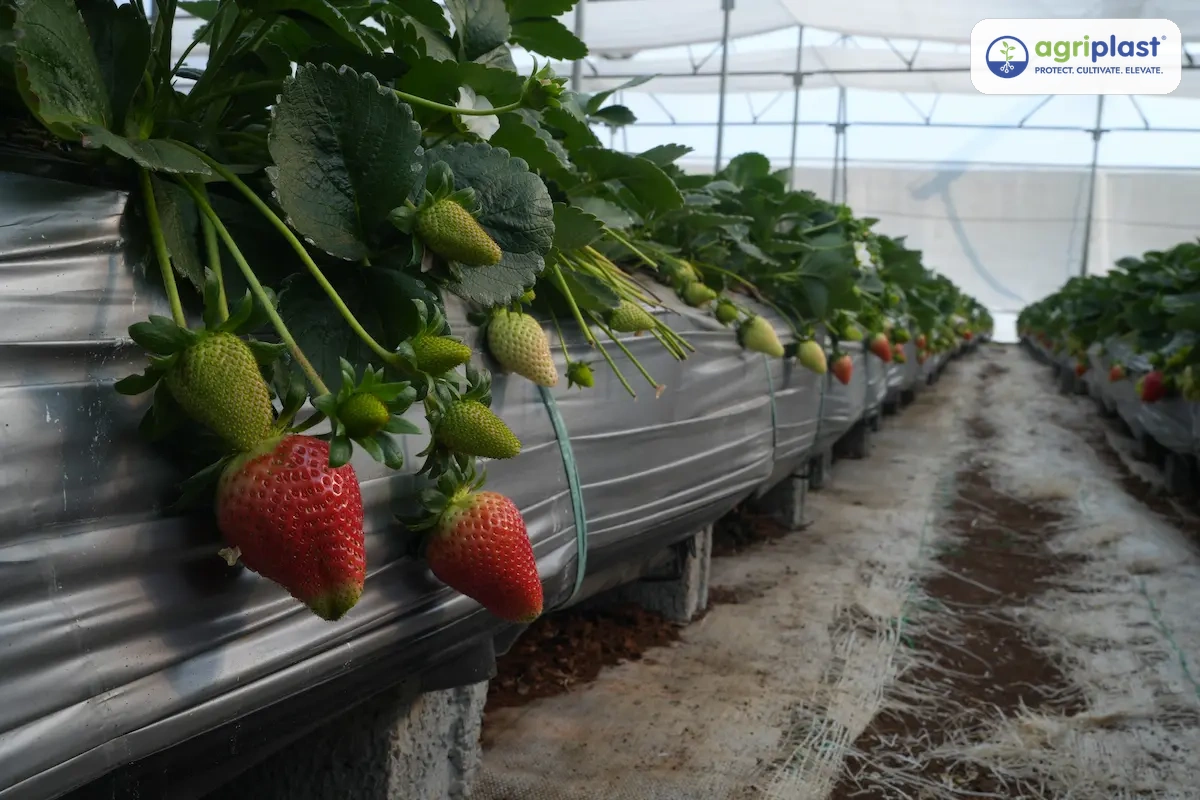
Ripe strawberries hanging clean off mulch-covered soilless troughs inside a protected polyhouse — no soil contact, no Botrytis risk, consistent quality year-round.
For most farmers starting out, a low-cost polytunnel is the practical entry point — a curved metal or bamboo frame with 200-micron UV-stabilised greenhouse film. Cost: ₹20-30 lakh per acre (MIDH project cost norms, 2025–26). It protects fruit from rain (the primary Botrytis trigger during ripening), extends the harvest window by 2–4 weeks, and delivers a 15–25% price premium over open-field fruit.
A full naturally ventilated polyhouse structure costs ₹45-50 lakh per acre minimum (MIDH benchmark, naturally ventilated type) — the system used at Purple Patch Farms in Ooty, where soilless growing and year-round production justify the higher structure cost. For film selection, strawberry needs maximum light in winter — so a clear or light-diffusion film with anti-drip properties is the right choice.
Condensation dripping onto ripening fruit is a direct Botrytis trigger, and Agriplast's Ginegar Drip Lock greenhouse films include anti-drip and anti-mist properties — part of their 5-layer film structure. See Agriplast's polyhouse crops guide for a full overview of which crops suit which protection levels.
Open Field vs Polytunnel vs Soilless Polyhouse — Side by Side
An Agriplast farmer in Ooty runs open-field strawberry farming with Agriplast silver-black mulch and earns ₹10 lakh profit per acre per year. Purple Patch Farms (same zone) runs a soilless polyhouse and earns ₹10–15 lakh from half an acre. Both are real. The right system depends on your land, capital, and market access.
_1775217774_69cfac6eb13f3.webp)
Soilless trough (left) vs soil bed (right) — soilless uses coco peat substrate with drip fertigation and eliminates soil-borne disease entirely; soil beds require raised bed preparation, FYM, and solarisation between seasons.
| Factor | Open Field | Low-Cost Polytunnel | Soilless Polyhouse |
|---|---|---|---|
| Setup cost per acre | ₹7-8 lakh | ₹20-30 lakh (includes structure) | ₹45–50 lakh (structure + soilless system) |
| Plants per acre | 20,000 at 30 cm spacing | 20,000–22,000 | ~30,000 at 22 cm spacing (soilless) |
| Production window | 4–6 months (zone dependent) | 6–8 months | 9–10 months (Ooty; year-round possible) |
| Average yield | 8,000–10,000 kg/acre | 10,000–13,000 kg/acre | ~16,000 kg per half acre (1 kg/plant) |
| Selling price range | ₹200/kg (farm gate) | ₹200-250/kg | ₹300/kg (direct B2C) |
| Net profit per acre/season | ₹ 10-12 lakh (Sachin Dake, Ooty) | ₹15-20 lakh | ₹15-30 lakh per acre (Purple Patch Farms, Ooty) |
| Mulch film required? | Yes — silver-black, 25 micron | Yes — silver-black or black | Yes — even on soilless troughs |
| Disease risk | Highest — rain, soil pathogens | Medium — rain protected | Lowest — no soil, controlled environment |
| Best for | Ooty / Nilgiris hill farmers, low capital start | Rain-risk zones, yield extension | Commercial scale, direct market access |
Open field profit figures based on verified Agriplast farmer (Sachin Dake) testimonial, Ooty (April 2025); soilless polyhouse figures based on Purple Patch Farms walkthrough (AgriTalk, March 2025). Actual results vary by zone, variety, and management.
🎥 Watch: Inside India's Top Soilless Strawberry Farm — Purple Patch Farms, Ooty
A full farm walkthrough covering the complete soilless polyhouse setup, crop cycle stages, variety selection (Sweet Sensation), mulching on troughs, pesticide-free management, harvest timing, post-harvest grading, and real economics from Purple Patch Farms, Ooty — 10 years in commercial berry farming.
Strawberry Farming Profit Per Acre: Real Numbers
The profit range for strawberry farming in India is wide — ₹10-12 lakh at the lower end for open-field, ₹15-30 lakh or more for a well-run soilless polyhouse. What drives the gap is yield per plant, selling price realised, and how directly you access your market.
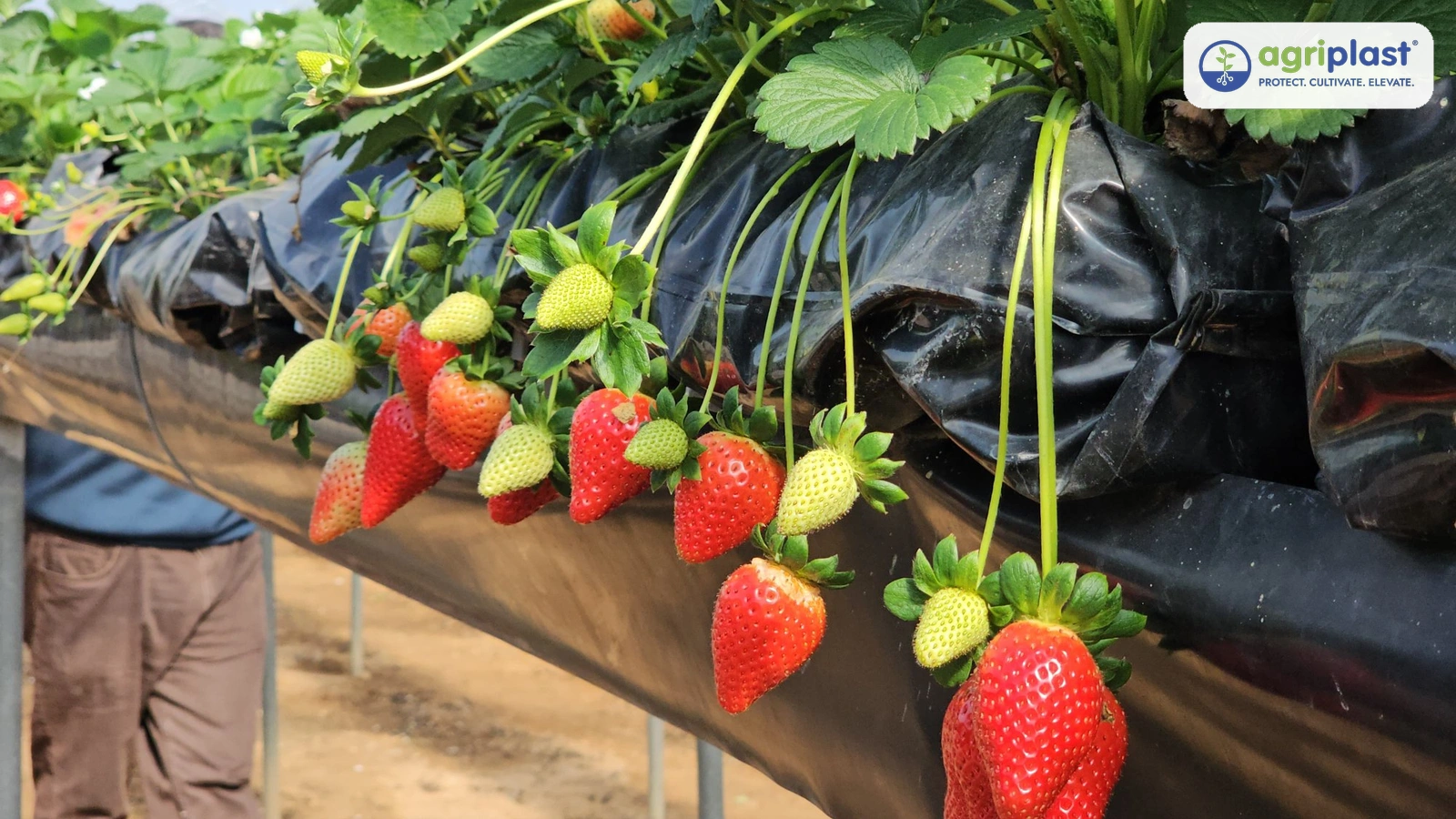
A full flush on black mulch beds — at ₹300/kg average and 16 tonnes from half an acre, gross revenue reaches ₹48 lakh at Purple Patch Farms, Ooty.
| Item | Soilless Polyhouse — Ooty (half acre) | Open Field — Standard (1 acre) |
|---|---|---|
| Plant count | 16,000 plants at 22 cm spacing | 20,000–22,000 plants at 30 cm spacing |
| Yield target | 16,000 kg (1 kg per plant) | 8,000–10,000 kg (0.5kg per plant) |
| Average selling price | ₹300/kg (direct to shops + B2C) | ₹200/kg (farm gate, seasonal) |
| Gross revenue | ₹48 lakh | ₹20lakh |
| Cost of production | ₹150/kg all-in operational cost | ₹7-8 lakh total |
| Net profit | ₹10–15 lakh (half acre) | ₹10-12 lakh (1 acre) |
"We grow at ₹150 per kilo and sell at roughly ₹300 per kilo — that is still 100% margin. But there is a lot involved: coco peat, plant cost, maintenance, fertigation, labour. All put together."
Their market model is as important as the farm numbers. Purple Patch Farms bypasses the mandi entirely — direct supply to shops and supermarkets, plus B2C delivery via cold chain vehicles to Coimbatore, Bangalore, Chennai, and Kerala. This protects the ₹300/kg average throughout the year. Retail packs are 200g nets at ₹100 per pack, with dry pads inside each punnet to absorb moisture and extend shelf life.
Actual results vary by region, variety, product quality, growing skills, and market channel. The soilless polyhouse figures reflect a 10-year commercial operation with established direct market relationships. Consult your local Krishi Vigyan Kendra for site-specific projections before making investment decisions.
Post-Harvest: Grading, Packaging, and Market
Getting to harvest is half the battle. Getting the fruit to the customer in premium condition is the other half — and it is what separates a ₹300/kg direct price from a ₹100/kg mandi price.
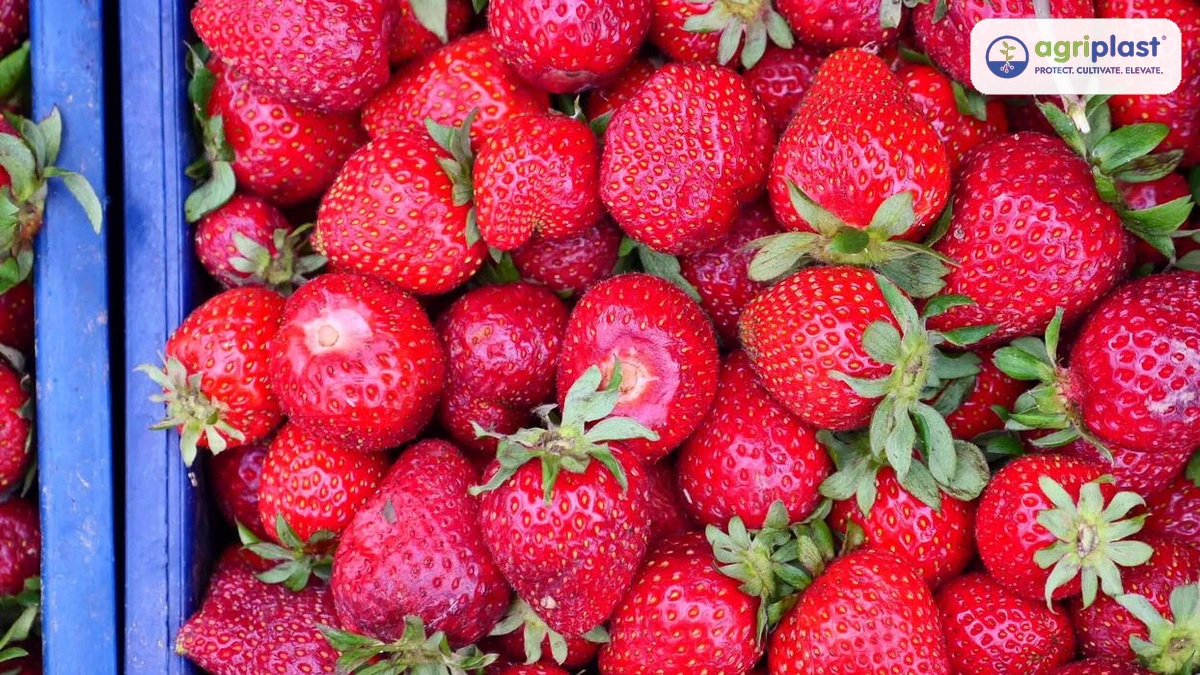
Freshly harvested strawberries ready for market — minimal handling from field to punnet is the post-harvest rule that protects both shelf life and price.
At Purple Patch Farms, harvest begins at 4 AM. Fruit goes directly into punnets in the field — every additional touch reduces shelf life. Sorting and grading happens in the punnet, not at a packing table. The three-grade system: A grade (50–60g+ fruit, premium 200g nets at ₹100 direct), B grade (slightly smaller, shops and supermarkets), and processing grade (jams and food service). Dry pads inside each punnet absorb any moisture from ripe fruit. Cold chain vehicles carry packed punnets directly to destination cities.
Government Subsidies for Strawberry Farming
Strawberry is eligible for support under the Mission for Integrated Development of Horticulture (MIDH), which covers protected cultivation infrastructure, cold chain, and planting material.
💰 MIDH Subsidy Available for Strawberry Farmers
Protected Cultivation (Polytunnel / Polyhouse): 50% of project cost for general farmers; 65–75% for hilly regions and SC/ST farmers. Drip Irrigation (PM Krishi Sinchai Yojana): 45–90% depending on landholding size. Planting Material: 25–50%. Apply through your state horticulture department or local Krishi Vigyan Kendra. For scheme details, visit the APEDA agricultural resources portal or the Vikaspedia strawberry cultivation support page.
Common Mistakes Strawberry Farmers Make
Strawberry farming is not forgiving of guesswork. These are the errors that most commonly cut a season short.
- Wrong variety for the zone. Trial at least one full season before committing to scale. Commercial growers who get this right spend a year testing before filling their structure.
- Skipping mulch or using the wrong grade. The ₹8,000–12,000 per acre cost of proper UV-stabilised black mulch pays for itself through reduced labour alone — before counting fruit quality improvement.
- Incorrect planting depth. Crown too deep causes crown rot within 3–4 weeks. Crown too shallow causes root desiccation. Every plant, every time — crown exactly at soil level.
- Not monitoring EC and pH. Target EC 1.6 mS/cm and pH 5.5 for soilless systems. Deviations compound quickly in a closed nutrient loop. Check daily, not weekly.
- Missing the harvest window. Strawberry moves from 75% colour to fully ripe in 48–72 hours in warm weather. Harvest every alternate day. Late harvesting means splits, mould, and lost price.
- No post-harvest plan. Harvest early morning. Minimise touch. Pack into punnets with dry pads. Cold chain from farm to customer. Every shortcut here directly reduces the price you receive.
"Please do strawberries as your crop — but be very, very cautious. It is like a child. You have to take care. You need a lot of technical knowledge, you must maintain EC and pH, and selection of a good variety is very, very important."
The Bottom Line
Strawberry farming in India rewards preparation more than almost any other crop. Get the variety right, prepare raised beds with proper drainage, lay black mulch film before planting, manage irrigation through drip, monitor EC and pH constantly, and consider a polytunnel if you are in a rain-risk zone or want to extend your production window.
The farmers earning ₹10–15 lakh from half an acre are not doing anything extraordinary. They are following a precise system, protecting the crop at the right moments, and taking the fruit directly to the customer without the price loss of a mandi channel.
For berry crop comparison, see Agriplast’s Blueberry Farming in India: Varieties, Cost & Profit.
Actual results vary by region, variety, product quality, growing skills, and market channel. Consult your local Krishi Vigyan Kendra or state horticulture department before making significant investment decisions.
Free Expert Guidance
Not Sure Which Inputs Are Right for Your Strawberry Farm?
Tell us your zone, crop scale, and current setup — our agronomist will recommend the right mulching film, polytunnel film, or soilless container for your farm. No obligation, no sales pitch.
Call / WhatsApp
+91 81414 46666Head Office
Agriplast Tech India Pvt. Ltd.
Marathahalli, Bengaluru — 560037
Pan-India support · Strawberry growers across all zones · Response within 24 hours
📚 Go Deeper — Key Guides for Strawberry Farmers
Every input in this guide has a dedicated resource. Use these before you buy anything.
- Mulching Film — micron guide, colour selection, laying technique:
Mulching in Agriculture: Complete Guide → - Mulching Film Range — 25, 30, 50 and 100 micron options and SKUs:
Agriplast Mulching Film Range → - Polyhouse Crops — which crops suit which protection level:
28 Polyhouse Crops You Can Grow In India → - Soilless Berry Farming — soil vs soilless decision guide:
Blueberry Farming in India: Varieties, Cost & Profit → - Hydroponic Troughs & Containers — Mapal Israel strawberry containers:
Agriplast Hydroponic Troughs & Containers → - Insect Net — mesh selection for thrips and whitefly without chemicals:
Insect Nets: Reduce Pesticides & Improve Food Safety →
Frequently Asked Questions
Blog written and Posted by
Rani Singh
Rani Singh is a Content Executive at Agriplast Tech India, covering high-value farming, protected cultivation, and farmer success stories. She focuses on turning field experiences into practical, actionable content for Indian farmers and agri-entrepreneurs.You can write your view/comments here
Need Expert Assistance?
Get personalized recommendations for your greenhouse, polyhouse, or irrigation needs.
-
Bengaluru (Corporate Office)
- 918141446666
- support@agriplast.co.in
WeWork Roshni Tech Hub - 1st floor, PFS Club House, Marathahalli Main Rd, R.J.Gardens, Lakshminarayana Pura, EPIP Zone, Chinnapanna Halli, Bengaluru, Karnataka 560037