Low Tunnel Farming in India: Off-Season Crop Guide
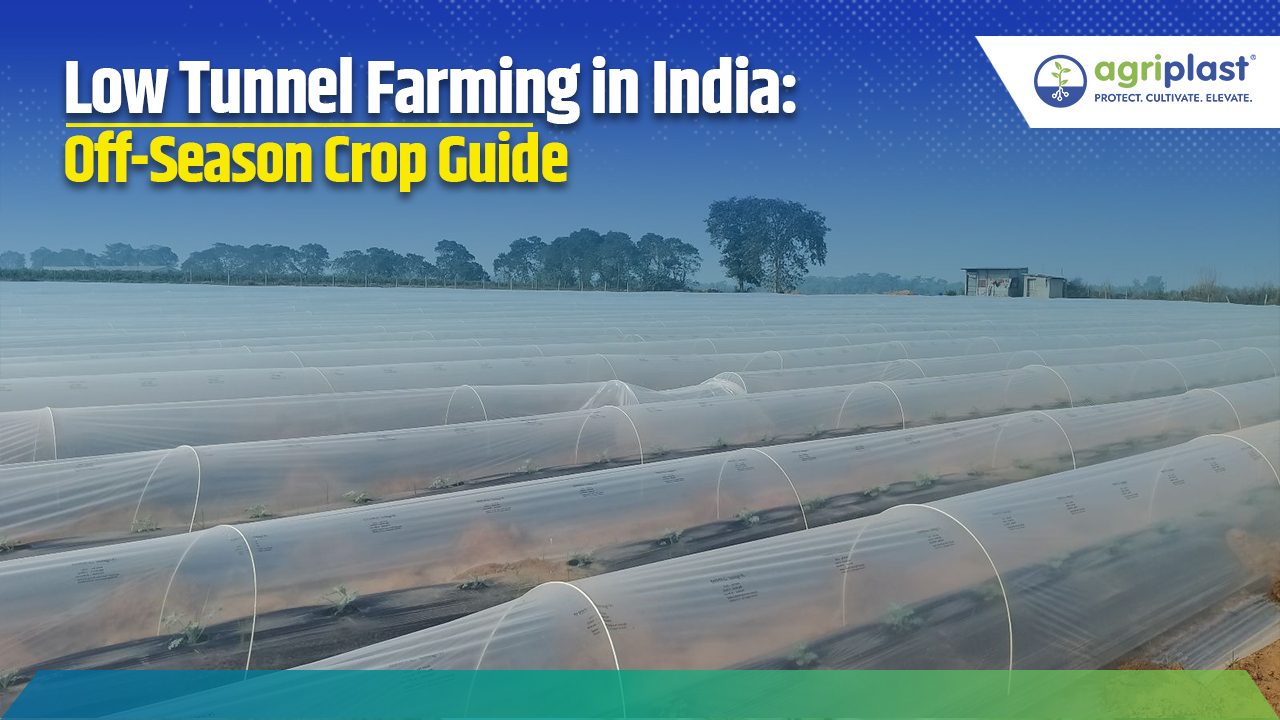
A summer squash that reaches the mandi in the first week of February instead of April sells for two to three times the price. That single timing gap explains why low tunnel farming is spreading fast across India's vegetable belts. It is one of the cheapest ways to grow off-season vegetables and raise hardier nursery seedlings when the open field is still too cold to plant.
In this guide, you'll learn why low tunnel farming works, its key benefits, setup costs, suitable crops, profitability, and the step-by-step process of building and managing a low tunnel successfully.
Why Low Tunnel Farming Is Growing in India
The pull is strongest in the northern plains and the hills, where winter night temperatures sit below 8°C for 30 to 40 days at a stretch. In those weeks, a thin film cover is the difference between a crop that survives and one that does not.
Farmers around peri-urban Punjab, Haryana, Delhi and Uttar Pradesh have adopted it to hit early market windows, and institutes like the ICAR-Central Institute for Arid Horticulture in Bikaner have pushed it into the arid west through training and demonstrations.
What sets it apart from a polyhouse is the commitment: a polyhouse is a permanent structure costing tens of lakhs per acre, while a low tunnel is a seasonal cover you set up in days, dismantle when the weather warms, and reuse next year — protected cultivation without the capital risk.
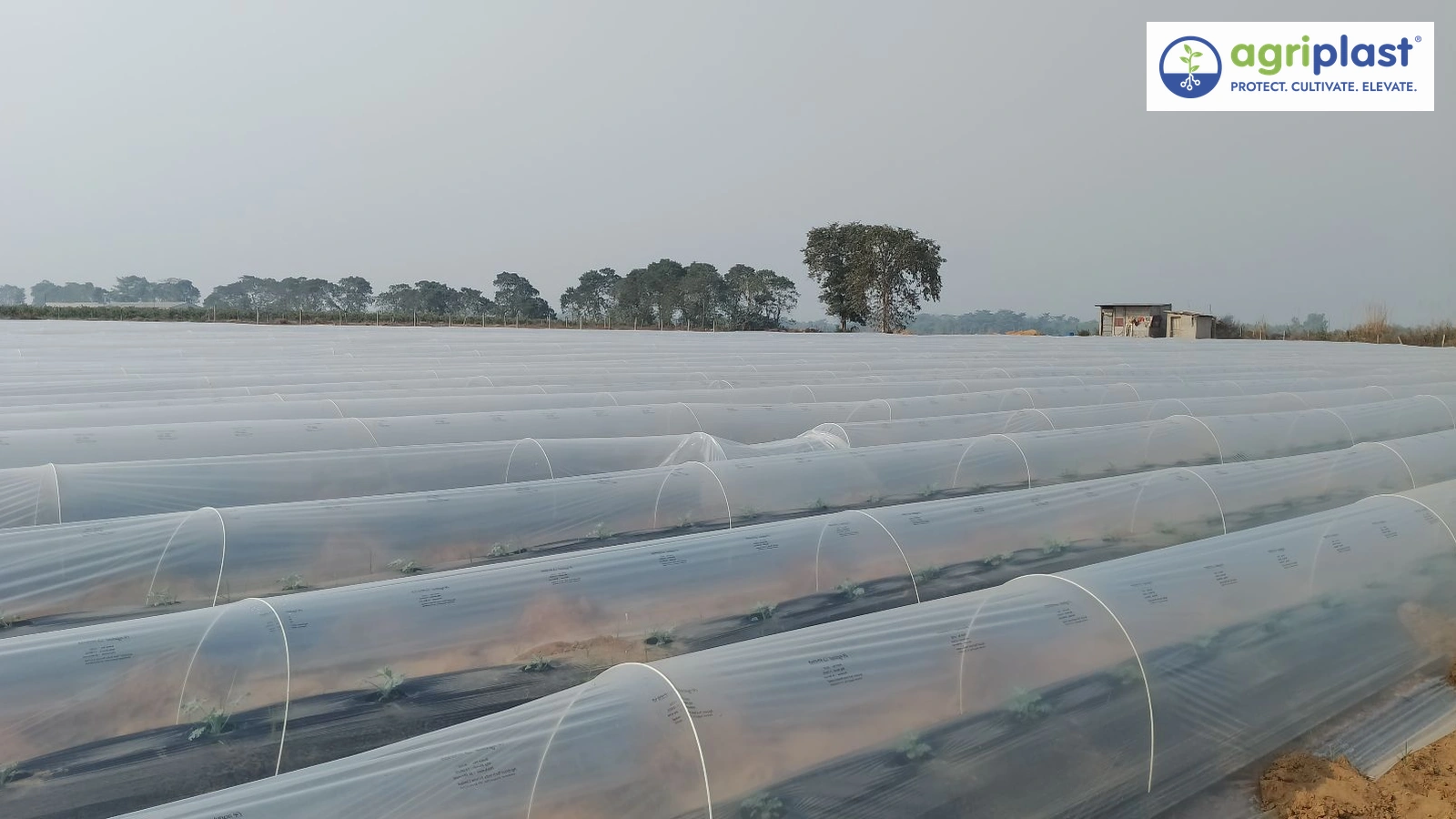
Rows of low tunnels trap daytime heat to grow off-season vegetables in the open field.
What This Guide Will Cover
- What a low tunnel is and how it works
- Key benefits for Indian farmers
- Low tunnel vs high tunnel vs polyhouse
- Best vegetables and off-season timing
- How to set up a low tunnel, step by step
- Cost and profit per acre
- Common challenges and solutions
- Frequently asked questions
What Is a Low Tunnel and How Does It Work?
A low tunnel is a miniature greenhouse built directly over a single row or bed of plants. You bend hoops of GI pipe, PVC or bamboo into arches, push them into the soil at regular spacing, and stretch a thin transparent film over the top — usually under a metre tall. The result is a covered channel that traps daytime heat and holds it through the cold night.
That trapped warmth is the entire point. The film lifts the air and soil temperature around the plant by a few critical degrees, shields the crop from frost, cold wind, hail and heavy rain, and lets carbon dioxide build up around the leaves to support faster photosynthesis. Plants grow when the open field would stall them.
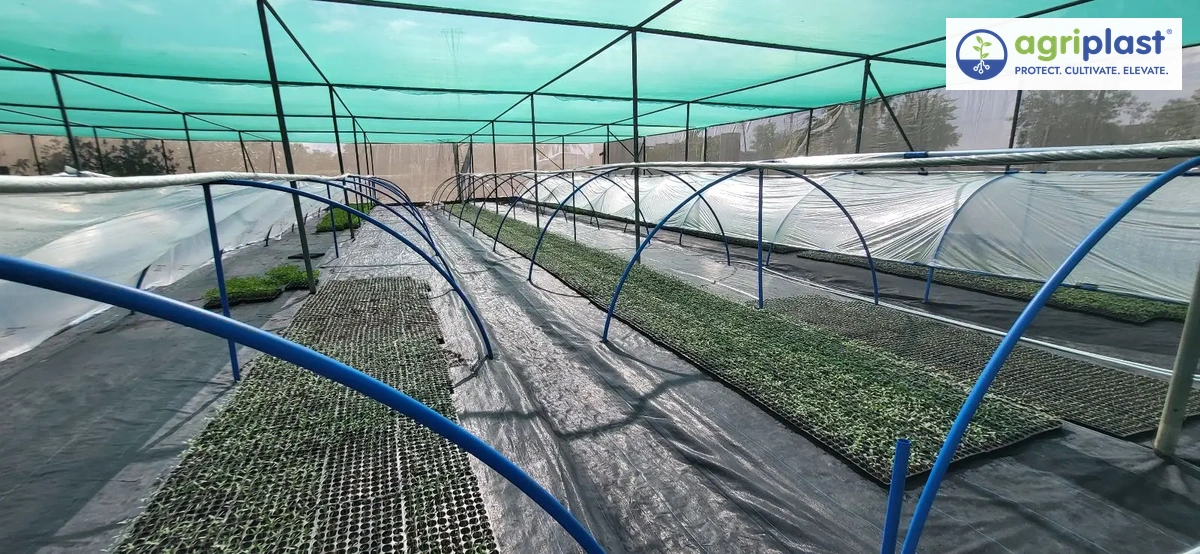
Blue GI-pipe hoops form the low tunnel frame over nursery beds — the same structure scales to field rows.
Because the structure is small and passive, it needs no electricity and no permanent foundation. You manage temperature by hand — opening the sides on warm afternoons, closing them before nightfall. That simplicity keeps low tunnels within reach of small and marginal farmers.
Key Benefits of Low Tunnel Farming for Indian Farmers
Low tunnels do two high-value jobs: they bring vegetables to market out of season, and they protect fragile nursery seedlings. Both come from the same advantage — controlling the small pocket of climate around the plant.
The off-season price premium is the headline benefit. When every grower harvests the same crop at once, the market floods and prices crash. A crop that lands a month or more ahead of that glut sells while supply is thin. Off-season cucurbits raised under low tunnels can be advanced by 30 to 60 days over their normal field season, and that early produce reliably fetches a higher price.
Stronger nurseries are the second benefit. Seedlings are most fragile in their first month, when a single cold snap or pest wave can wipe out a bed. A low tunnel over the nursery gives even germination, faster early growth and far less wilting, so more of your seed and labour survives to transplanting.
Other gains stack up. The cover keeps rain off the canopy and excludes many flying pests, lowering disease pressure and cutting sprays. The warm microclimate also grows the same crop on less water and fertiliser than the open field needs — a real advantage in arid regions like western Rajasthan.
🎥 Watch: How a Jaipur Farmer Uses Low Tunnels to Grow Cucumber and Tomato in Winter
Hear from Girdhari Lal, a vegetable grower near Jaipur, Rajasthan, who explains how low tunnels protect his winter cucumber and tomato from cold — saving nearly a month of irrigation and spraying while improving early growth.
Low Tunnel vs High Tunnel vs Polyhouse — Choosing What Fits Your Farm
These three protected structures solve different problems at very different price points. Picking the wrong one is the most expensive mistake a first-timer makes.
| Feature | Low tunnel | High / walk-in tunnel | Polyhouse |
|---|---|---|---|
| Height | Under 1 metre | 2–3 metres | 6–7 metres |
| Stand inside | No | Yes | Yes |
| Typical use | Off-season rows, nurseries | Nurseries, leafy crops, short cycles | Year-round high-value crops |
| Relative cost | Lowest | Moderate | Highest (₹45–50 lakh/acre) |
| Setup time | 2–5 days | About a week | Weeks |
| Reusable / movable | Fully | Partly | No — permanent |
| Climate control | Passive (manual venting) | Passive to semi-active | Active and precise |
The rule: use a low tunnel to advance an off-season crop or harden a nursery at minimum cost; step up to a high tunnel when you need walking room for a longer cycle; build a polyhouse only when a high-value crop justifies year-round precision climate control. Many growers start with low tunnels and reinvest the profits into bigger structures.
Best Vegetables and Off-Season Timing for Low Tunnels
Low tunnels earn their keep on crops that command a high off-season price and respond to a warm microclimate. Cucurbits are the classic fit — they germinate and set fruit poorly in the cold, so starting them early under cover is exactly where the money is.
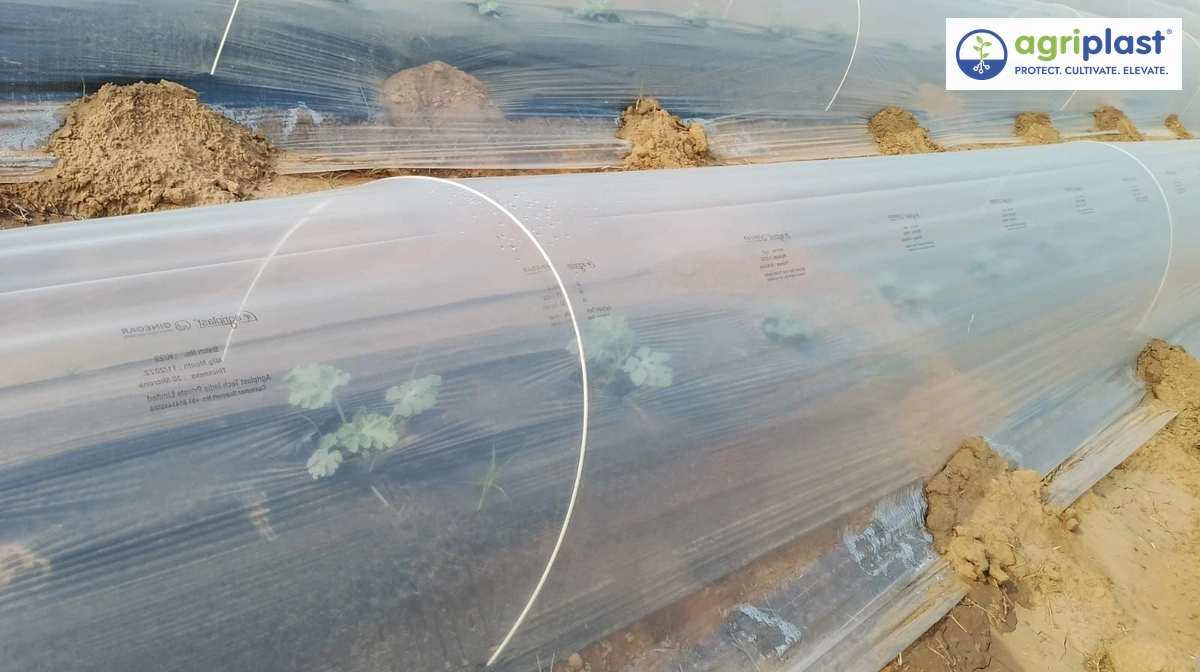
A UV-stabilised 30-micron film cover shelters young cucurbit plants while letting light through.
| Crop | Transplant window (N. plains) | Advancement over field crop | Notes |
|---|---|---|---|
| Summer squash | Early December | Harvest by first week of February | Highest off-season premium; very responsive |
| Muskmelon | Mid-January to early February | 40–60 days early | Mid-Jan crop harvests early April |
| Bottle gourd | First week Dec to first week Feb | 30–60 days early | Strong, consistent performer |
| Bitter gourd | December to February | 30–45 days early | High-value, steady demand |
| Long / round melon | December to February | 40–60 days early | Good peri-urban market |
| Watermelon | January | 40–50 days early | Harden carefully at removal |
| Cucumber | December to January | 30–45 days early | Popular and reliable |
Beyond cucurbits, low tunnels and crop covers also suit tomato, capsicum, beans and radish, and hardening nursery plants. The principle holds throughout: the wider the gap between your harvest and the open-field glut, the better the return.
Explore Tomato Farming in India: Complete Cost, Yield & Profit Analysis.
How to Set Up a Low Tunnel — Structure, Materials and Step-by-Step
Setting up a low tunnel is simple, but the material choices and a few build details decide whether the crop thrives. Start with the two decisions that matter most — the hoops and the film — then work through the build.
Selecting the Hoop Material (PVC vs GI Pipe)
The hoop is the skeleton, and the choice is a trade-off between cost and lifespan.
- PVC pipe: Cheapest and easiest to bend over a length of rebar driven into the soil. The catch is durability — PVC turns brittle under sustained sun and needs replacing sooner.
- GI (galvanised iron) pipe: Costs more but has far higher tensile strength, standing up to wind and repeated reuse over many seasons. Usually the better long-run value for a yearly grower.
- Bamboo: The lowest-cost traditional option where locally available, though less uniform and shorter-lived.
Whichever you choose, space the hoops about 1 to 1.5 metres apart along the row and anchor the ends firmly — wind load is the single most common cause of tunnel collapse.
Choosing the Right Film (30-Micron LDPE Standard)
The cover film does the actual work, so do not cut corners. The standard for low tunnels is 30-micron LDPE (low-density polyethylene) — thick enough to hold heat and resist tearing, thin enough to stay light and cheap.
Two treatments separate a film that lasts from one that fails mid-season. UV stabilisation stops the film going brittle and yellow under the sun, letting you reuse it across seasons. Anti-drip treatment stops condensation forming droplets that fall on the canopy and spread disease, while keeping light transmission high.
The Agriplast low tunnel film is a 30-micron LDPE film built to exactly this specification — UV-stabilised, anti-drip and transparent — in 2 m and 4 m widths for different bed sizes.
Step 1 — Site Preparation and Bed Layout
Form raised beds running north to south for maximum sunlight; the wrong orientation costs you heating. Lay a mulching film over the beds and run a drip line underneath before planting — once the tunnel is on, hand-watering and weeding are awkward. The mulch warms the root zone, holds moisture and blocks weeds.
See our complete guide Mulching in Agriculture: Types, Benefits & Techniques.
Step 2 — Installing the Hoops
Push the hoops into the soil at 1 to 1.5 metre spacing to form a continuous arched frame under a metre tall. Keep the height and width consistent so the film sits evenly and sheds rain without pooling.
Step 3 — Laying the Film
Stretch the 30-micron film over the hoops on a calm day, pulling it taut so it does not flap. Leave enough film on both sides and at the ends to bury or weight down. Flapping film tears at the hoop contact points and lets cold air in.
Step 4 — Securing the Edges
Anchor the film edges along the full length with soil, pegs or weights, and tie down the ends. A well-secured tunnel survives wind; a loose one becomes a kite. Low tunnel clips help fix the film to the hoops and hold a lifted side open during venting.
Step 5 — Ventilation Management (Daily Open/Close)
This is the daily habit that decides the crop. Open the tunnel on warm, sunny afternoons and close it before the cold night. Inside temperatures climb fast in sunshine, and a sealed tunnel can cook young plants within hours. Remove the tunnels progressively as night temperatures rise in late February and March, hardening the crop before full exposure.
Cost and Profit of Low Tunnel Farming per Acre
Low tunnels are among the cheapest protected structures available, and the economics turn on the off-season price premium rather than yield alone. The figures below are converted to a per-acre basis from published Indian field studies; treat them as indicative, since costs vary by region, crop and season.
Capital Cost Breakdown
The tunnel-specific items are reusable, which is what makes the system pay. In the ICAR-linked Bikaner bottle gourd study, the polythene film and structure frame were the two costs absent from open-field cultivation.
| Reusable item | Indicative cost (per acre) | Life |
|---|---|---|
| Cover film (30-micron LDPE) | ~₹37,878 | 2–3 seasons if UV-stabilised |
| Hoops / structure frame (GI, PVC) | ~₹23,600 | Several seasons (GI longest) |
| Drip line + mulch film | Shared farm infrastructure | Multi-season |
Spread across two or three seasons of reuse, the effective per-crop cost of the structure drops sharply — the opposite of a one-time polyhouse outlay.
Operating Cost per Season
Operating cost covers seed, nursery raising, labour, fertigation and crop care. Agriplast field studies place the full per-season operational cost of low tunnel cucurbits at roughly ₹50,000 to ₹60,000 per acre. The higher figure reflects more labour and the cover material — protected cultivation engages noticeably more labour than open-field methods.
Revenue Comparison — Open Field vs Low Tunnel (ICAR Data)
The case is clearest in a paired summer-squash study comparing low tunnel against open field, converted here to per acre.
| Measure | Low tunnel | Open field |
|---|---|---|
| Cost of cultivation | ~₹60,000/acre | ~₹30,700/acre |
| Net return | ~₹85,000/acre | ~₹12,300/acre |
| Benefit–cost ratio | 2.53 | 1.39 |
The net return roughly seven-folds versus the open field, and the benefit–cost ratio climbs from 1.39 to 2.53. ICAR-CIAH Bikaner field data similarly reports about a 25% lift in growers' farm income after adopting the technology, with benefit–cost ratios of 2.05 to 3.35 across off-season cucurbits, as detailed in the published Bikaner field study.
💰 Government Subsidy Available
Under the National Horticulture Mission (MIDH), plastic tunnels draw 50% of cost as assistance, up to ₹300 per square metre (15% more in hilly and North-Eastern areas), and plastic mulch is supported at 50% up to ₹16,000 per hectare. Confirm current rates with your District Horticulture Office or the MIDH portal.
See our complete Polyhouse Subsidy Guide 2026.
Payback Period
Because the cover film and hoops are reusable and cost only about ₹11,000 per acre together, they are recovered inside the first off-season crop. With low tunnel net returns running tens of thousands of rupees per acre above the open field in a single cycle, the structure pays for itself in one season, after which the same materials work across the next two or three.
Common Challenges and Solutions
Low tunnels are forgiving, but the same handful of problems come up repeatedly. Knowing the fix in advance is most of the battle.
| Challenge | Solution |
|---|---|
| Plants overheating on sunny days | Open the sides every warm afternoon; never leave a sealed tunnel in sunshine. Switch to perforated film as cold eases. |
| Tunnel collapsing in wind | Anchor hoop ends firmly and weight the film edges along the full length; GI hoops resist wind better than PVC. |
| Condensation dripping and spreading disease | Use an anti-drip film so moisture runs down the sides instead of falling on the canopy. |
| Film tearing or yellowing mid-season | Choose UV-stabilised 30-micron LDPE; cheap untreated film fails exactly when protection is needed. |
| Uneven watering once the cover is on | Lay a drip line under the mulch before covering, not after. |
| Pests on young plants under cover | The cover excludes most flying pests; for early-stage insects, apply a systemic through the drip, or use an insect-net cover for part of the season. |
| Transplant shock at tunnel removal | Harden the crop by opening tunnels progressively over a few days before full removal. |
Get these right and the system runs smoothly. For the wider picture on protected-cultivation films, our complete greenhouse film guide explains how these materials work, and Agriplast's technical team can recommend the right film and cover for your crop, climate and budget.
Frequently Asked Questions
Blog written and Posted by
Rani Singh
Rani Singh is a Content Executive at Agriplast Tech India, covering high-value farming, protected cultivation, and farmer success stories. She focuses on turning field experiences into practical, actionable content for Indian farmers and agri-entrepreneurs.You can write your view/comments here
Need Expert Assistance?
Get personalized recommendations for your greenhouse, polyhouse, or irrigation needs.
-
Bengaluru (Corporate Office)
- 918141446666
- support@agriplast.co.in
WeWork Roshni Tech Hub - 1st floor, PFS Club House, Marathahalli Main Rd, R.J.Gardens, Lakshminarayana Pura, EPIP Zone, Chinnapanna Halli, Bengaluru, Karnataka 560037