Dragon Fruit Farming in India: 2026 Complete Guide to Cost, Varieties & Profit
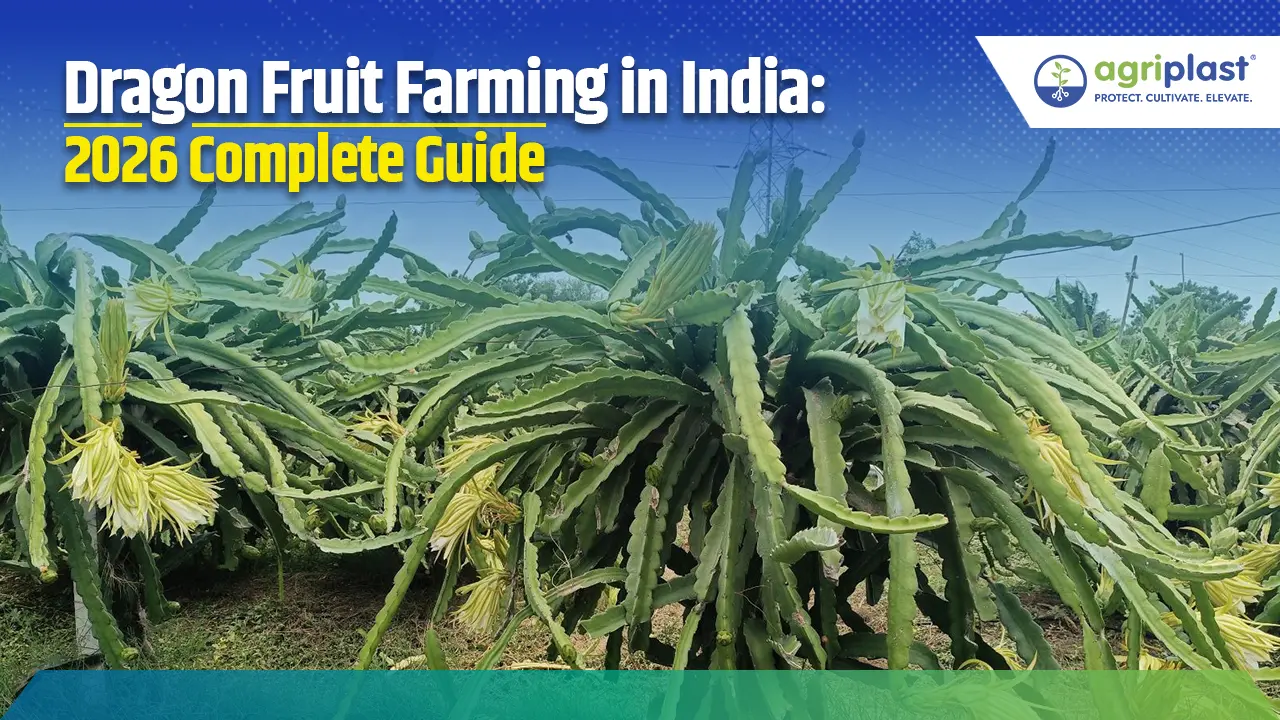
India still imports dragon fruit even though it grows well on barren and water-scarce land where many traditional crops fail. That gap is creating a major opportunity for farmers. Dragon fruit cultivation in India has already expanded to 13.77 thousand hectares with production reaching 52.47 thousand tonnes in 2023-24, according to the (Ministry of Agriculture & Farmers Welfare data).
The government is now pushing to scale cultivation to 50,000 hectares by 2028 under the MIDH scheme, backed by the Centre of Excellence for Kamalam at ICAR-IIHR Bengaluru (PIB, March 2023).
The biggest attraction is profitability. A 1-acre dragon fruit orchard requires an initial investment of around ₹3–5 lakh, but once established, it can produce for 20–25 years. From the third year onward, farmers can earn an estimated net profit of ₹5–7 lakh per acre, even at conservative wholesale prices.
Why Dragon Fruit Farming Is Growing Fast in India
Dragon fruit — also called pitaya or kamalam — entered India in the late 1990s and stayed niche for two decades. Post-2018, six states adopted it commercially: Gujarat, Karnataka, Maharashtra, Telangana, Andhra Pradesh and West Bengal.
Four forces are driving the shift today:
- Domestic supply gap. India still imports dragon fruit to meet demand, keeping farmgate prices firm (PIB / APEDA, August 2021).
- Government push. MIDH targets 50,000 ha by 2028, with the new Centre of Excellence at IIHR Bengaluru supplying planting material and training.
- Low water need (50-60 cm/year). Survives in dryland and rainfed regions where mango, citrus and grapes fail.
- 20-25 year orchard life with 4-5 harvest flushes annually, spread across September-January.
Nutrition & Consumer Demand for Dragon Fruit
The reason farmgate prices stay strong even as supply expands is that demand expands faster. Three layers drive it: nutritional profile, processed-product growth, and export potential.
Nutritional profile (per 100g of dragon fruit):
| Nutrient | Amount | Why it matters |
|---|---|---|
| Calories | 50-60 kcal | Low-calorie, fits weight-loss diets |
| Dietary fibre | 3 g | Prebiotic — feeds gut bacteria |
| Vitamin C | 9-21 mg (15-34% DV) | Immunity, skin health |
| Iron | 0.65 mg | Anaemia management (rare in fruits) |
| Magnesium | 10% DV | Nerve and muscle function |
| Betalains (red varieties) | High | Anti-inflammatory antioxidants |
| Water content | 88-90% | Natural hydration |
Source: Healthline (citing USDA FoodData Central); nutrient values vary by variety.
The fruit's low glycemic index and high fibre make it a recommended food for diabetics and cardiovascular patients — a growing concern in urban India. This positioning has moved dragon fruit out of exotic-fruit aisles and into mainstream urban demand.
Consumer demand signals in India:
- Dragon fruit imports into India grew 35% in 2024, the fastest among all fruit imports (TradeImeX, 2025).
- India began commercial exports in August 2021, when farmers from Kutch (Gujarat) and West Bengal shipped the first consignments to the UK and Bahrain through APEDA.
- The global market is expected to grow from $678 million (2024) to $995 million by 2030 at ~8% CAGR (MarkNtel Advisors, 2024).
- Uttar Pradesh, Maharashtra and Karnataka have launched state-level subsidy programs to expand acreage.
For Indian farmers, this means strong wholesale prices through the next decade, even as area expands. Urban demand, export readiness via APEDA, and processed-product growth (powders, smoothies, juices, pigments) are absorbing supply faster than it's being added.
Want to explore another profitable crop? See our Blueberry Farming in India: Varieties, Cost & Profit.
Climate, Soil and Water Requirements
Dragon fruit is a climbing cactus from Central and South America. It tolerates heat, drought and marginal soil — but two conditions are non-negotiable: warm temperatures and fast-draining soil.
| Parameter | Optimal range | Hard limits |
|---|---|---|
| Temperature | 25-35°C | Below 10°C or above 40°C causes stress/sunburn |
| Soil type | Sandy loam, well-drained | No heavy clay, no waterlogging |
| Soil pH | 5.5-7.0 | Slightly acidic to neutral |
| Annual rainfall | 50-60 cm | Above 80 cm needs raised beds + drainage |
| Sunlight | 6-8 hours/day | Partial shade in extreme summer zones |
The single biggest failure cause in Indian orchards is root rot from poor drainage. Roots are shallow and cannot survive standing water. The second issue is summer sunburn on stems above 42°C — common in Gujarat's Kutch, Andhra's Anantapur, and parts of Karnataka. A 10-30% shade net during peak summer prevents this.
For a deeper understanding of shade selection, explore our complete shade net guide.
Best Dragon Fruit Varieties for Indian Farmers
Varieties differ on flesh colour, fruit weight, and market price. Four colour groups are common in Indian cultivation, with Punjab Agricultural University adding two improved selections in 2023.
| Variety | Skin / flesh | Fruit weight | Wholesale ₹/kg | Best for |
|---|---|---|---|---|
| Red skin, white flesh | Most common | 250-500g | 80-120 | New farmers, easy market |
| Red skin, red flesh | Premium | 300-600g | 150-250 | Maharashtra, Gujarat, export |
| Red skin, pink flesh | Niche | 300-500g | 120-180 | Mid-tier markets |
| Yellow skin, white flesh | Rare in India | 200-350g | 250-400 | Specialty export |
| PAU Red Dragon 1 | Red/red flesh | 200-250g | 180-220 | Punjab, Haryana |
| PAU White Dragon 1 | Red/white flesh | 200-250g | 100-130 | Punjab, Haryana |
PAU's 2023 release of Red Dragon 1 and White Dragon 1 came after five years of trials with germplasm from ICAR institutes. Both varieties fruit July-November in Punjab conditions.
For first-time growers, red-skin white-flesh is the safe entry — easy to grow, predictable yields, forgiving wholesale market. For experienced growers chasing metro markets, red-flesh varieties earn premium margins.
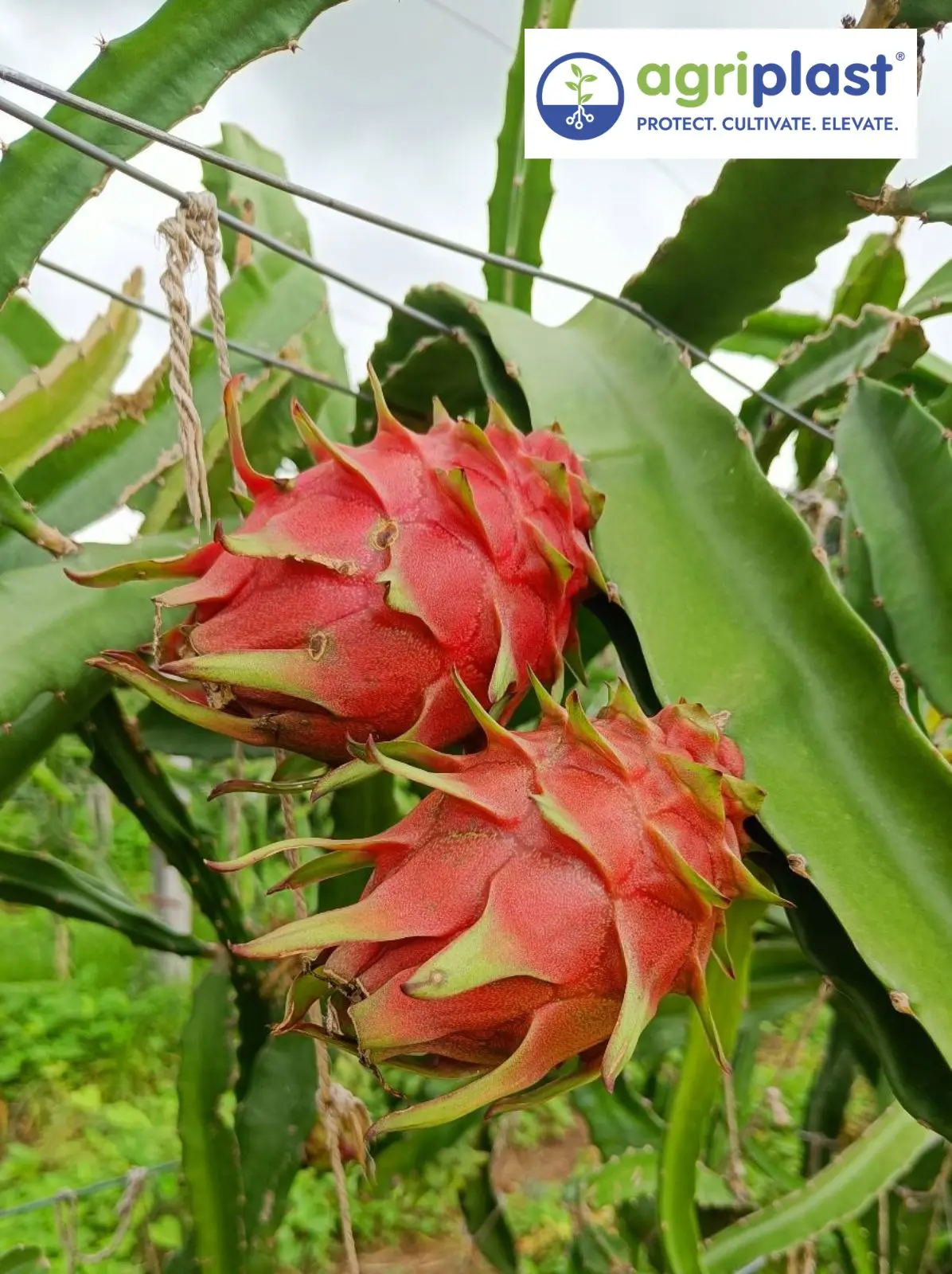
Red-flesh and white-flesh dragon fruit side by side — red-flesh commands ₹150-250/kg in metro markets.
Setting Up Your Orchard — Trellis, Spacing and Planting Material
The trellis is the single largest infrastructure decision in Year 1. Get it right once, and the same setup serves the orchard for 20 years.
Trellis System Options (Cement Pole vs Steel vs Wood)
- Cement (RCC) poles: Standard for commercial orchards. ₹250-400 per pole installed, 20-25 year lifespan, resistant to termites and rot.
- Steel angles/pipes: ₹400-600 per pole, 15-20 years if galvanised. Heats up in summer and can scorch touching stems — a known issue in Maharashtra.
- Wood/teak: ₹150-250 per pole, only 4-7 years. Unsuitable for a 20-year crop — you'll replace twice.
"Cement structures are the best option for dragon fruit farming because wooden supports do not last long"
Orchard Layout and Spacing (12 ft × 8 ft, ~450 poles per acre)
The Indian commercial standard is 12 ft between rows, 8 ft between poles within the row — 96 sq ft per pole, working out to ~450 poles per acre. Each pole holds 4 cuttings (one on each face), for 1,800 plants per acre.
All four stems climb to a circular frame fixed at the pole top — this becomes the fruiting platform where flowers and fruits develop on hanging stems.
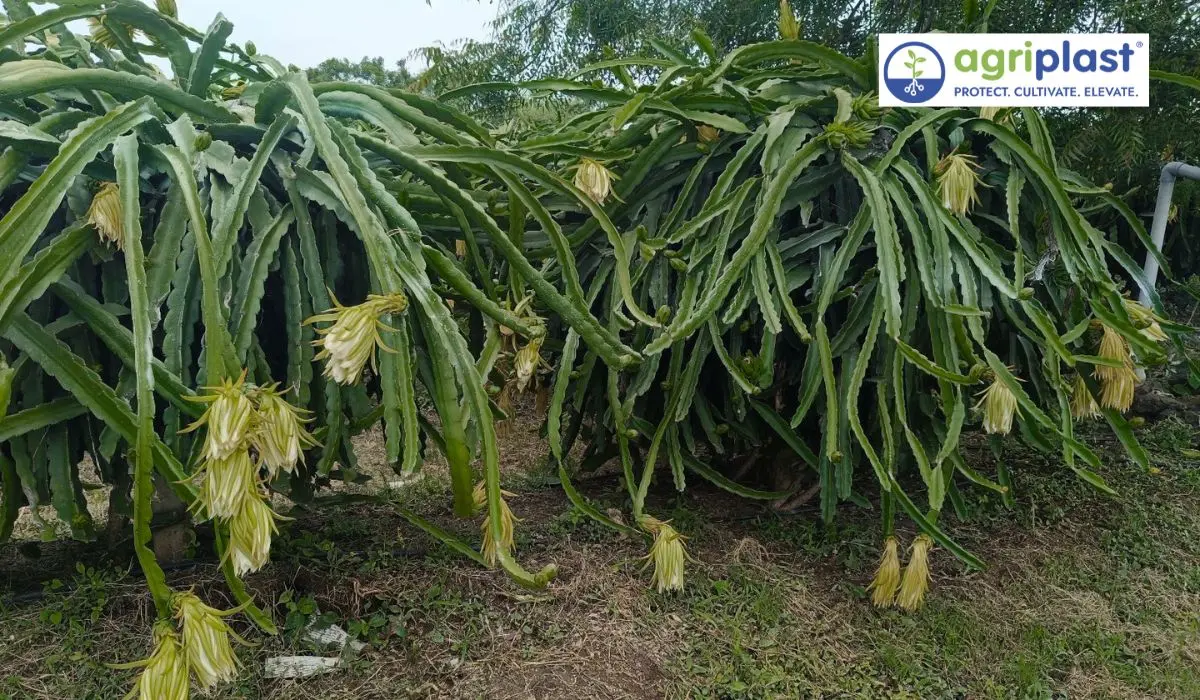
Standard 12 ft × 8 ft pole grid — 450 poles supporting 1,800 plants per acre.
Planting Material — Cuttings vs Grafted Plants
Dragon fruit propagates from 12-18 inch stem cuttings, calloused for 5-7 days before planting. Grafted plants are not used — the species roots easily from cuttings.
Some nurseries sell rooted cuttings in poly bags at ₹40-60 per plant (versus ₹25-50 for fresh cuttings). The premium cuts Year 1 establishment failure significantly, making it worth the cost for first-time growers.
Nursery Sourcing and Quality Check
The biggest avoidable mistake is buying cheap, unverified material. A 20-year orchard runs on the genetics you start with — saving ₹15 per cutting on a roadside vendor can cost ₹6 lakh in lifetime yield.
Source from registered nurseries, agricultural universities (PAU Ludhiana, IIHR Bengaluru), or established farmer-run nurseries with 3+ years of operation. Quality checks: cuttings should be from 2-year-old mother plants, free of black spots or stem rot, clean cut at the base.
Initial Setup Cost Breakdown
| Item | Cost per acre (₹) |
|---|---|
| Cement poles + top frames (450 nos) | 1,35,000 – 2,25,000 |
| Planting material (1,800 cuttings) | 45,000 – 90,000 |
| Drip irrigation | 35,000 – 50,000 |
| Land prep + pit digging (450 pits) | 25,000 – 40,000 |
| FYM + fertiliser (Year 1) | 20,000 – 30,000 |
| Plantation labour | 15,000 – 25,000 |
| Mulching / weed mat | 25,000 – 60,000 |
| Year 1 total | ₹3,00,000 – ₹5,20,000 |
For full ground-cover specifications, see our complete weed mat guide.
Dragon Fruit Crop Cycle — Year-by-Year Stages
Dragon fruit's yield curve is one of the steepest in Indian horticulture — nothing for 16-20 months, then a sharp ramp. Understanding this is critical for cash-flow planning.
Year 1 — Establishment
The cutting roots, climbs and establishes its primary stem. No fruit. First 60 days are critical — root failure happens fast and is hard to reverse. Healthy plants reach the top of the 5-ft pole by month 12 and start branching across the top frame.
Priorities: weed control, drip tuning, sunburn protection, monsoon drainage.
Year 2 — Trellis Growth and First Flowering
Plants spread over the top frame and produce the hanging stems where flowers and fruits develop. First flowering: months 16-20, typically September-October for an April-planted orchard. First harvest follows in October-November.
Yield: 3-4 tons per acre. Fruit weight 200-400g. Treat this as the "trial" year.
Year 3 — Full Fruit Production Begins
First proper commercial harvest. 4-5 flushes between September and January, fruit weight 250-550g. ICAR-NIASM data shows 8-13.5 MT per hectare in established orchards over 3 years old.
Yield: 6-8 tons per acre for well-managed plots.
Years 4+ — Peak Yield and Orchard Maturity
From Year 4, the orchard stabilises at peak yield for the next 20-22 years. Annual pruning replaces setup labour. Operating cost drops to roughly ₹1 lakh per acre per year.
Yield: 8-10 tons per acre sustained. Fruit weight 300-850g.
Flowering Cycle (September to January)
Dragon fruit is night-blooming. Flowers open after sunset, get pollinated overnight, and wilt by the next afternoon. The Indian window runs September-January, with 4-5 flushes spaced 30-35 days apart. Each flush takes 30-35 days from flower opening to harvest-ready fruit — a predictable picking schedule.
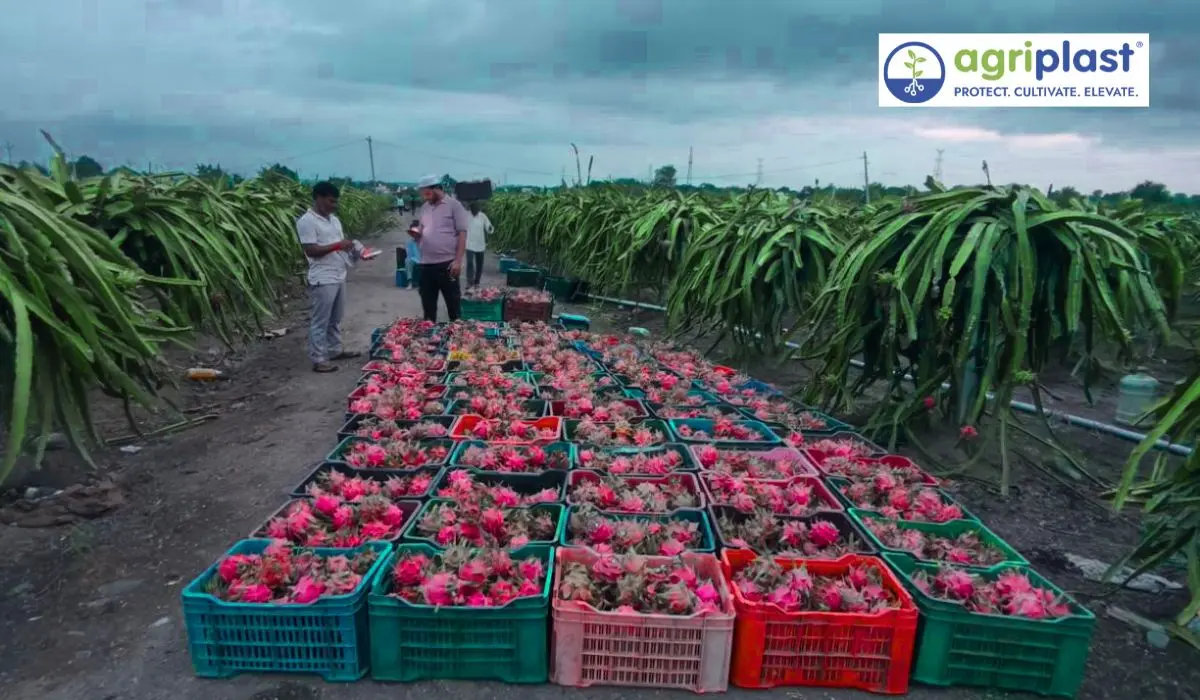
A Year 3-4 plant during peak fruiting — the September-January window when 4-5 harvests happen 30-35 days apart.
How to Grow Dragon Fruit — Complete Step-by-Step Guide
The practical workflow for a first-time grower setting up a 1-acre plot in the April planting window.
Step 1: Site Preparation and Water Testing
Pick a site with full sun (6-8 hours minimum) and natural 1-2% slope. Avoid low-lying plots and heavy clay. Test water for salinity and pH — dragon fruit tolerates EC up to 1.5 dS/m and pH 5.5-7.0. Mark the 12 ft × 8 ft grid using tape and lime powder.
Step 2: Soil Preparation and Pit Digging
Plough twice cross-direction in March. Apply 4-5 tons of well-rotted farmyard manure per acre as base dressing. Dig 2 ft × 2 ft × 2 ft pits at each grid point. Leave open for 2-3 days to sun-sterilise. Refill with topsoil + FYM in 1:1 ratio, adding 700g vermicompost per pit.
Step 3: Planting the Cuttings
Plant April to mid-May, before monsoon. Install the concrete pole with 5 ft above ground. Plant 4 cuttings per pole — one on each face, leaning against the base, inserted 4-6 inches deep. Tie loosely to the pole with biodegradable jute string.
Water lightly for the first two weeks. Once roots establish (visible new growth at 2-3 weeks), shift to drip irrigation.
Step 4: Mulching and Irrigation
Apply mulch around the pit base immediately after planting. Year 1: organic mulch (paddy straw, rice husk, dry leaves). Year 2 onwards: woven polypropylene weed mat for long-term ground cover.
Drip irrigation only — one dripper per pole, 4-6 litres/plant/day in summer, 2-3 litres in cooler months. Never flood-irrigate. Saturated soil kills shallow roots.
Step 5: Pruning and Canopy Training
For the first 12 months, train the four cuttings vertically up the pole. Remove all side branches below the top frame. Once stems reach the frame, let them spread horizontally and drape down — the hanging stems are the productive ones.
From Year 2, prune annually after harvest (February-March). Remove old, non-productive stems, dead wood and diseased sections to maintain airflow.
Step 6: Pollination (Night-Blooming and Hand Pollination)
Dragon fruit relies on bats and night-flying moths for natural pollination. In areas with declining pollinators, fruit set drops below 60%. Hand pollination is the fix — walk the orchard at dusk during flushes, use a soft brush to transfer pollen between adjacent flowers. Cross-pollination between varieties improves fruit set and weight.
Step 7: Pest and Disease Management
Dragon fruit is highly pest-resistant. Specific issues:
-
Ants: Major fruit pest that climbs poles and damages developing fruits. Control using sticky bands at the pole base, neem oil spray, and clean orchard sanitation.
-
Stem rot (Bipolaris cactivora): Causes soft black patches during monsoon due to excess moisture. Manage through good drainage, canopy pruning, removal of infected stems, and Trichoderma bio-fungicide drench.
-
Anthracnose: Appears as orange spots on stems in humid conditions. Control with proper airflow, removal of infected sections, and Pseudomonas or Trichoderma bio-sprays.
Total spray need: Usually limited to 3–4 biological spray applications per year in well-managed orchards.
Step 8: Harvest and Post-Harvest Handling
Harvest when fruit changes from green to red and scales curl outwards — typically 30-35 days after flower opening. Cut with a sharp knife, leaving a 1-inch stem attached. Avoid bruising.
Shelf life: 7-10 days at room temperature, up to 3 weeks refrigerated. Pack in single-layer crates with foam padding. Grade by weight (A: 400g+, B: 250-400g, C: under 250g) before marketing.
Investment, Yield and Profit Per Acre
The figures below combine the latest Government of India horticulture data, the official Ministry of Agriculture economic model for Kamalam, and real cost figures shared by dragon fruit farmer Atul Chawda from his Year 3 orchard in Raipur.
Capital Investment Breakdown
Total Year 1 capital: ₹3-5 lakh per acre (see the full itemised breakdown in the setup section above). Cement poles and planting material together account for over 65% of this — consistent with the official cost structure where poles and plates make up nearly half of total establishment cost (Economic Analysis, Solapur district, 2024).
Atul Chawda's own figures from his Raipur farm: roughly ₹100 per pole in planting material (4 cuttings at about ₹22 each) and around ₹300 per self-cast cement pole — bringing his setup cost toward the lower end of the range through self-labour.
His cutting and pole costs are from 2020 and will be higher today; treat them as a directional reference, not current rates.
Annual Operating Cost
From Year 2 onwards, recurring costs drop sharply — and with organic pest and disease management, input costs stay low.
| Item | Annual cost (₹) |
|---|---|
| Fertiliser + nutrition (FYM, vermicompost) | 25,000 – 35,000 |
| Pruning labour | 15,000 – 20,000 |
| Bio-inputs (neem oil, Trichoderma, sticky bands) | 5,000 – 9,000 |
| Harvest labour | 20,000 – 30,000 |
| Irrigation | 8,000 – 12,000 |
| Annual total (Yr 2+) | ₹73,000 – ₹1,06,000 |
Year-Wise Production Estimate
The Ministry of Agriculture's official model puts average economic yield at 10 tonnes per acre after Year 2, with full production by Year 3-4 (PIB / Ministry of Agriculture, 2023). Field conditions vary, so the table below uses a conservative ramp:
| Year | Yield (tons/acre) | Fruit weight |
|---|---|---|
| Year 1 | 0 | — |
| Year 2 | 3-4 | 200-400g |
| Year 3 | 6-8 | 250-550g |
| Year 4+ (sustained 20-25 yrs) | 8-10 | 300-850g |
Revenue Projection (₹90/kg Base Case)
Atul Chawda reports an average selling price of ₹90/kg in Year 3, with peak-season rates reaching ₹200-250/kg. The Ministry of Agriculture's model uses ₹100/kg. The projection below uses the conservative ₹90/kg figure:
| Year | Yield | Gross revenue | Operating cost | Net profit |
|---|---|---|---|---|
| Year 2 | 3-4 t | ₹2.0-3.0 L | ₹80,000 | ₹1.2-2.0 L |
| Year 3 | 6-8 t | ₹4-5 L | ₹1 L | ₹3.0-4.0 L |
| Year 4+ | 8-10 t | ₹5-7 L | ₹1 L | ₹4-5 L |
Atul Chawda's own Year 3 estimate aligns with this: a minimum of ₹1.5-2 lakh per acre for an average orchard, rising to ₹4-5 lakh per acre with good management — and higher again as the orchard matures past Year 4.
Premium scenario: red-flesh varieties in metro markets at ₹150-200/kg push Year 4+ net profit to ₹11-15 lakh per acre. For planning, use the conservative ₹90-100/kg base case — not the premium upper end.
Actual results vary by region, variety, product quality and growing skills. Atul Chawda's cost figures are from 2020 and are directional; current input costs will be higher.
Government Subsidy (MIDH and NHM)
💰 Government Subsidy Available
MIDH covers up to 40% nationally on area expansion, drip and mulching. NHM covers up to 50% on planting material in identified states. Maharashtra, Gujarat and Haryana state schemes stack on MIDH for combined 50-75% coverage. Apply via your District Horticulture Officer. Verify current rates — schemes update annually. Details on the official MIDH portal.
The Centre of Excellence for Kamalam at ICAR-IIHR Bengaluru also provides technical assistance, training and planting material directly to growers.
Maximizing Early Income Through Intercropping (Atul Chawda's Model)
The biggest objection to dragon fruit is the 16-20 month wait for first revenue. Atul Chawda's Raipur farm solves this with intercropping plus a parallel nursery business.
The intercrop layer: Papaya is planted between dragon fruit poles in Years 1-2. The canopy reduces soil evaporation around the dragon fruit base, keeping moisture and temperature stable through summer. Papaya is harvest-ready in 9-10 months, generating Year 1 income during dragon fruit establishment.
The nursery layer: Atul runs a multi-crop nursery on the same farm — Papaya 786, chilli, tomato, kundru, and grafted brinjal, capsicum, watermelon and muskmelon plants. He supplies planting material across Chhattisgarh and Maharashtra. Both income streams share the same infrastructure, water source and labour.
By the time dragon fruit hits Year 3 production, the nursery is already a stable cash generator. For farmers without nursery experience, the simpler version is papaya intercropping alone — transitioning to chilli or short-duration vegetables once dragon fruit canopy closes in Year 3.
Watch Atul explain the full intercropping system (jumps to 2:39 timestamp):
🎥 Watch: Atul Chawda's Dragon Fruit + Papaya + Nursery Intercropping Model
Atul Chawda walks through how he uses papaya as a living mulch around dragon fruit poles to keep soil cool and reduce evaporation, while running a parallel multi-crop nursery (Papaya 786, chilli, tomato, kundru, grafted brinjal & capsicum) that supplies farmers across Chhattisgarh and Maharashtra.
State-Wise Dragon Fruit Cultivation in India
India's total dragon fruit area reached 13.77 thousand hectares with 52.47 thousand tonnes of production in 2023-24 (Ministry of Agriculture & Farmers Welfare).
Gujarat leads national production, followed by Karnataka, Maharashtra, West Bengal and Tamil Nadu. Emerging belts include Andhra Pradesh, Telangana, Punjab, Haryana, Chhattisgarh and the Northeast.
| State | Status | Key districts | Productivity (t/ha) |
|---|---|---|---|
| Gujarat | Leader (34%) | Sabarkantha, Kutch, Banaskantha | 8-13.5 |
| Karnataka | Rapidly growing | Vijayapura, Tumakuru, Gubbi | 6-10 |
| Maharashtra | Established | Nashik, Pune, Konkan, Solapur | 8-10 |
| AP / Telangana | Emerging | Anantapur, Warangal | 6-9 |
| Punjab | New (PAU, 2023) | Hoshiarpur, Nawanshahr | 8.5 kg/pole |
| Chhattisgarh | Emerging | Raipur, Durg, Bastar | 5-8 |
Agriplast field visits across 2024-2025 confirm consistent adoption patterns from Maharashtra to Punjab. In every region, commercial growers shift to permanent ground-cover solutions within Year 1-2 — manual weeding for a 20-year orchard isn't economically viable.
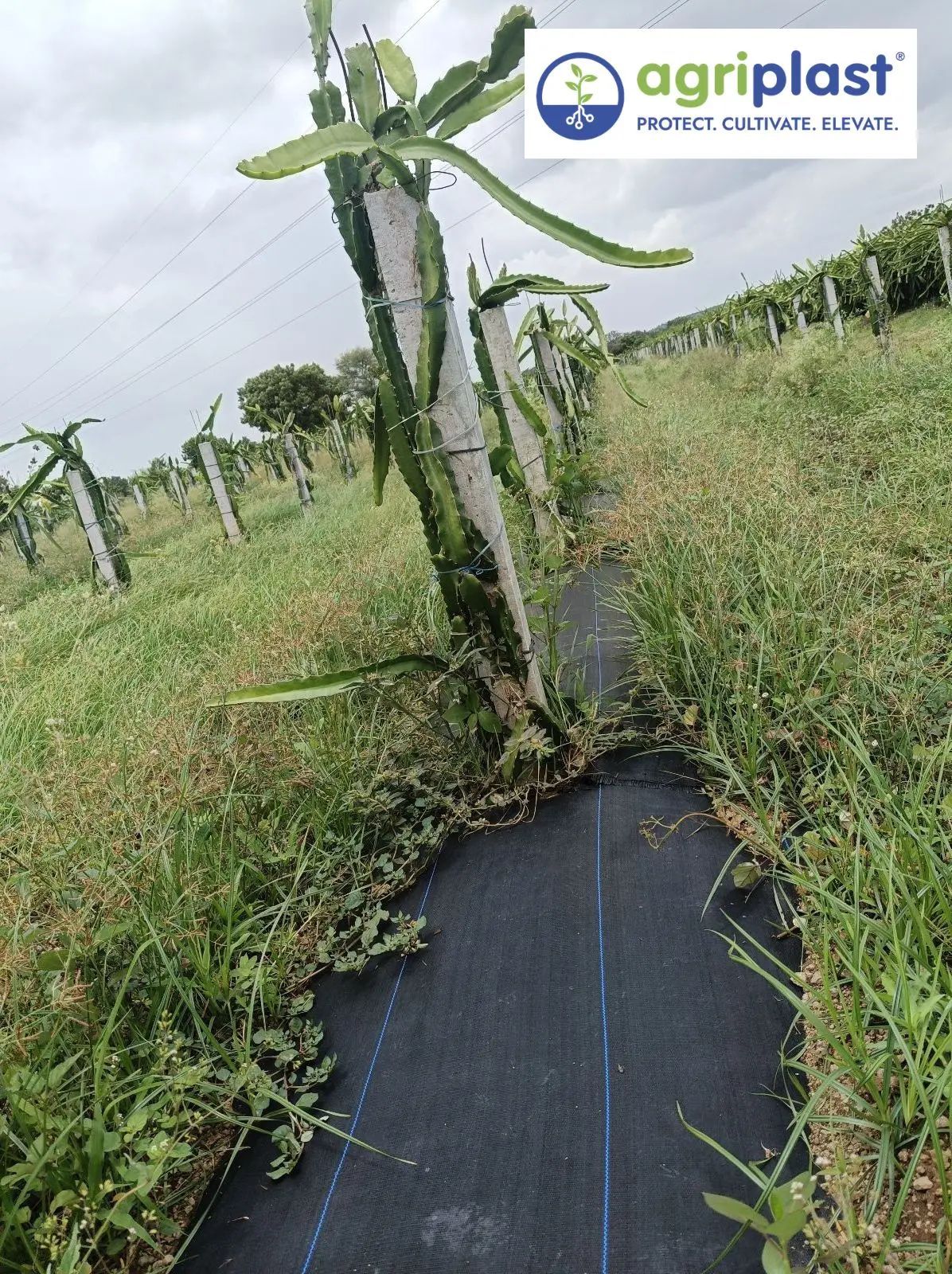
Woven polypropylene weed mat at the pole base — the standard ground-cover solution for 20-year orchards.
Common Mistakes and Honest Cautions Before You Start
- Planting outside the April window. Cuttings root reliably only at 25-35°C with dry soil. Monsoon planting risks 30-50% root rot loss. Winter planting stalls growth. April-mid May is the only safe window.
- Skipping drainage on low-lying plots. Root rot is the #1 cause of orchard failure. Build raised mounds and drainage channels before planting if your plot is below grade or has heavy clay.
- Buying cheap, unverified cuttings. A 20-year orchard runs on its starting genetics. Source from registered nurseries or universities — never roadside vendors.
- Underestimating capital lock-in. Year 1 needs ₹3-5 lakh out with no dragon fruit revenue until Year 2. Either start with a quarter-acre trial or layer in intercropping income from Day 1.
- Ignoring summer sun protection. Above 42°C, stems sunburn — especially mid-row plants. A 10-30% shade net during peak summer prevents 15-25% yield loss.
- Pricing assumptions too high. Wholesale ranges ₹80-250/kg. Plan math on ₹90-120/kg, not the upper end.
Actual results vary by region, variety, product quality and growing skills.
Frequently Asked Questions
Blog written and Posted by
Rani Singh
Rani Singh is a Content Executive at Agriplast Tech India, covering high-value farming, protected cultivation, and farmer success stories. She focuses on turning field experiences into practical, actionable content for Indian farmers and agri-entrepreneurs.You can write your view/comments here
Need Expert Assistance?
Get personalized recommendations for your greenhouse, polyhouse, or irrigation needs.
-
Bengaluru (Corporate Office)
- 918141446666
- support@agriplast.co.in
WeWork Roshni Tech Hub - 1st floor, PFS Club House, Marathahalli Main Rd, R.J.Gardens, Lakshminarayana Pura, EPIP Zone, Chinnapanna Halli, Bengaluru, Karnataka 560037