Tomato Farming in India: Complete Cost, Yield & Profit Analysis for 2026
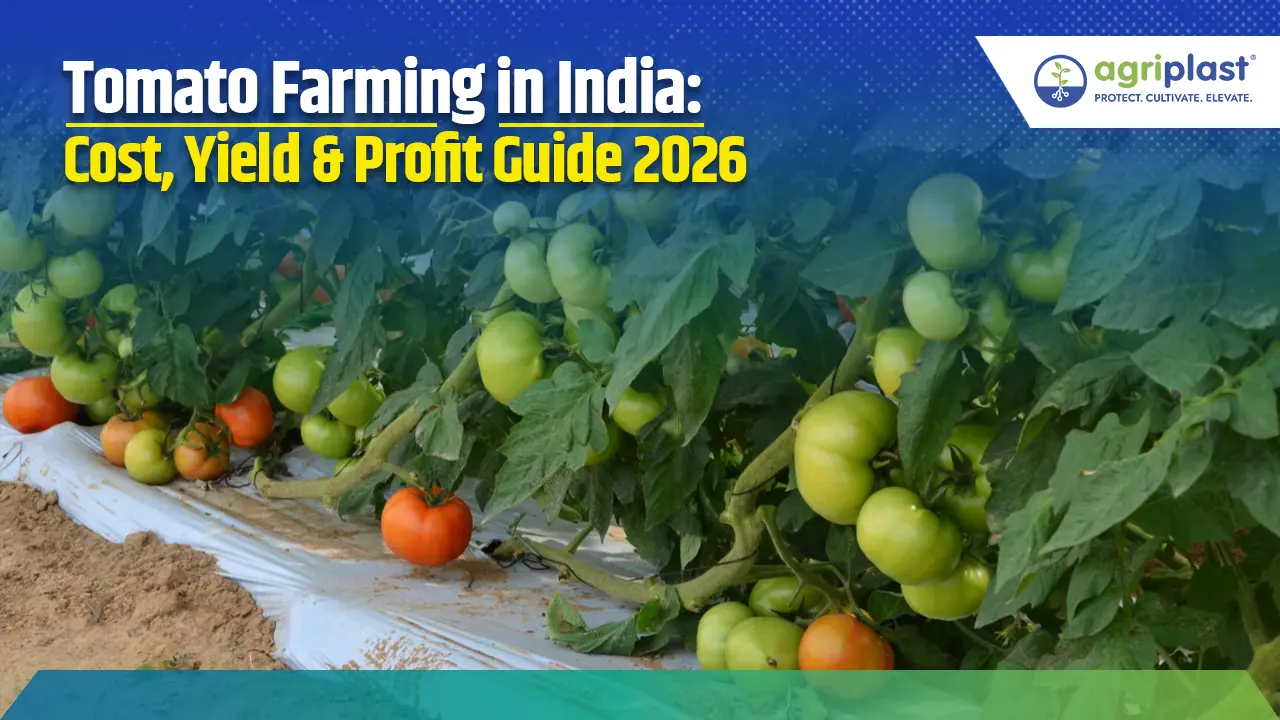
Tomato is one of the most preferred vegetable crops among Indian farmers due to its strong market demand, short crop duration, and profit potential. In just 4–5 months, a well-managed tomato crop can start generating returns, making it a popular choice for both small and commercial growers.
India is among the world's leading tomato-producing countries, and the crop is cultivated across major farming states throughout the year.
However, successful tomato farming is not just about achieving higher yields. Choosing the right variety, managing diseases, and selling at the right time often have a greater impact on profit.
In this guide, you'll learn about the best tomato varieties, cultivation practices, disease management, cost of cultivation, yield, and profit potential in 2026.
Why Tomato Is India's Most Profitable Short-Cycle Vegetable Crop
The reason farmers come back to tomato every season is simple: it pays back faster than almost anything else you can grow. A well-managed Rabi crop takes 4–5 months from nursery to final harvest. Your investment returns in the same season you made it.
And unlike wheat or paddy where the price is fixed before you plant, tomato prices move with the market. That creates real upside — especially in April and May, when all the major Rabi crops have cleared and India runs into its annual tomato supply gap.
Prices spike in that window, and farmers who planned their timing around it capture margins that most mandi sellers never see.
The risk is real too. The same price swings that create opportunity can destroy margins when glut season arrives. Farmers who sell entirely at the mandi gate take the full impact of both sides.
What This Guide Will Cover
- Best tomato varieties for Indian farmers
- Open field vs polyhouse — which makes sense for you
- Cultivation cycles — Kharif, Rabi, Summer, Polyhouse
- Step-by-step cultivation guide
- The protection-first playbook
- Pest and disease management
- Cost, yield and profit per acre
- State-by-state cultivation guide
- Common mistakes and price-risk management
- Frequently asked questions
Best Tomato Varieties for Indian Farmers
Choosing a variety is the first real decision in tomato farming. The wrong variety in the wrong region means fighting disease you could have bred out, or selling fruit a market doesn't want.
Open Field Varieties — Determinate
Determinate varieties grow to a fixed height and set all their fruit roughly together. Good for open-field cultivation — easier to manage at scale, no vertical support needed, harvest is predictable.
| Variety | Plant Type | Fruit Weight | Yield Potential* | Season and Region | Best For | Source |
|---|---|---|---|---|---|---|
| Arka Rakshak (IIHR) | Semi-determinate F1 hybrid | 90–100 g | 75–80 t/ha (140 days) | Kharif + Rabi + Summer — pan-India | Commercial standard for disease-prone zones — triple resistance (ToLCV, bacterial wilt, early blight) | IIHR |
| Arka Samrat (IIHR) | Semi-determinate F1 hybrid | 90–110 g | 80–85 t/ha (140 days) | Kharif + Rabi — Karnataka, TN, AP, Maharashtra | Triple disease resistance; fresh market and processing; recommended for Zone VIII at national level | IIHR |
| Arka Shrestha (IIHR) | Semi-determinate F1 hybrid | 70–75 g | 76 t/ha (140 days) | Rabi preferred — all major states | Long-distance transport and hotel supply — deep red, firm fruit, 17-day shelf life; bacterial wilt resistant | IIHR |
| Arka Abha / BWR-1 (IIHR) | Semi-determinate OP variety | 75 g | 43 t/ha (140 days) | Kharif + Rabi — pan-India | Open-pollinated for seed-saving farmers — bacterial wilt resistant, fresh market focus | IIHR |
| Pusa Ruby (IARI) | Determinate OP variety | 75–80 g | 20–30 t/ha | Rabi + Summer — UP, Haryana, Punjab | Early maturing; suitable for table and processing; widely grown in North India mandis | ICAR |
| Pusa Early Dwarf (IARI) | Determinate F1 hybrid | Medium (flat-round) | 30–35 t/ha (75–80 days DTP) | Rabi + Summer — UP, Bihar | Early harvest, compact plant; good for small farmers wanting fast income cycles | ICAR |
Polyhouse Varieties — Indeterminate
Indeterminate varieties don't stop growing. Trained on vertical strings, they produce continuously for 9–12 months from a single planting. That's the foundation of polyhouse economics — you're not growing one crop per season, you're running a continuous harvest.
| Variety | Plant Type | Fruit Weight | Yield Potential* | Season and Region | Best For | Source |
|---|---|---|---|---|---|---|
| Arka Vishal (IIHR) | Indeterminate F1 hybrid | 140 g | 75 t/ha (165 days) | Kharif + Rabi — all polyhouse regions | Premium fresh market and long-distance supply — large firm fruit, crack tolerant, thick flesh, deep red colour | IIHR |
| Arka Vardan (IIHR) | Indeterminate F1 hybrid | 140 g | 75 t/ha (160 days) | Kharif + Rabi — South India polyhouse | Nematode resistant, large fruit — ideal for nematode-prone soils in AP and Karnataka | IIHR |
These varieties are designed for vertical string training and continuous fruiting. They will not perform well in open field without a support structure. In a well-run polyhouse with good drip fertigation, correct training and pruning, and effective pest management, farmers report production above these figures — sometimes reaching 100–150+ tonnes per acre per year across multiple cycles.
Hybrid F1 vs Open-Pollinated Varieties
The seed cost difference is real — F1 hybrids cost ₹8,000–20,000/acre versus ₹500–1,500 for open-pollinated (OP) seed. But above half an acre of commercial farming, that difference disappears in the first picking. F1 hybrids yield more with engineered resistance to the diseases that most frequently cause crop failure.
- OP varieties: Suitable for subsistence farming or where seed saving matters
- F1 hybrids: The clear choice for any commercial operation above 0.5 acre selling to mandi or buyers
Open Field vs Polyhouse Tomato Farming — The Critical Decision
_1780328191_6a1da6ffcab72.webp)
Open field vs polyhouse — both are viable. The right choice depends on land, capital, and market access.
When Open Field Makes Sense
- Planting 2+ acres where per-acre structure cost becomes hard to justify
- You have a reliable Rabi season with predictable October–March weather
- Your primary market is the local mandi
- Capital is limited — open field recovers investment within the first season
When Polyhouse Makes Sense (Nashik Belt)
- Land is limited but premium buyers exist — hotel chains, supermarkets, export
- You want 3–4 cycles per year rather than 2–3
- Your region has weather extremes (monsoon disease pressure, summer heat) that regularly damage open-field crops
- You're growing cherry tomato or long-duration indeterminate varieties
Maharashtra's Nashik belt — 16,990 hectares under tomato producing 5.6 lakh tonnes at 32.9 t/hectare average efficiency (IJCRT, 2023) — is India's reference for polyhouse-scale commercial tomato. Its combination of moderate climate, established NHM subsidy access, and Mumbai supply chain proximity makes polyhouse economics work here better than almost anywhere else.
Capital Investment Comparison
- Open field (1 acre): Net investment ₹50,000–80,000 (drip + mulch + first crop inputs)
- Net house (1 acre): ₹10–15 lakh structure + drip → after 50% NHM subsidy: ₹4.5–7 lakh net
- Polyhouse NV (1 acre): ₹40–55 lakh structure + drip → after 50% subsidy: ₹20–25 lakh net
Yield and Quality Comparison
- Open field: 30–40 t/acre per cycle; 55–70% Grade A fruit
- Net house: 40–50 t/acre per cycle; 70–80% Grade A fruit
- Polyhouse: 70–80 t/acre per cycle; 80–90% Grade A fruit
Actual farm yield will vary based on soil health, climate, irrigation consistency, pest pressure, variety purity of seed purchased, and agronomic practices.
Risk and Return Profile
Open field carries lower capital risk but full exposure to weather and mandi price swings. Polyhouse inverts this — higher capital deployed, but crop loss risk from pests, weather, and quality inconsistency falls sharply. Payback for a net house post-subsidy: 2–4 years. Full polyhouse: 3–6 years with premium market access.
Tomato Cultivation Cycles — Kharif, Rabi, Summer
Kharif (June–October) — Main Crop
Nursery sowing: May–June. Transplanting: June–July. Harvest: September–November.
Kharif is the highest-volume season nationally — and the riskiest. Monsoon humidity drives early blight, late blight, and bacterial wilt. Whitefly populations peak, and with them, TYLCV transmission risk. All major producing states — Karnataka, AP, Maharashtra, and MP — arrive at mandis simultaneously in October–November, pushing prices to their lowest point of the year.
Kharif tomato makes sense for South India farmers with IPM-disciplined systems and TYLCV-resistant varieties. Without both, crop failure risk is high and price rewards are limited.
Rabi (October–March) — Winter Crop
Nursery sowing: September–October. Transplanting: October–November. Harvest: January–March.
This is the commercial season across North and Central India. Winter conditions keep fungal disease pressure low. Cooler nights improve fruit colour, firmness, and shelf life. Mandi prices in January–March are consistently better than the October–November Kharif flush. A well-managed Rabi hybrid crop on one acre in UP, Haryana, or Punjab returns ₹80,000–1,40,000 net profit in a normal year.
Summer (February–June) — Premium Pricing Window
Nursery sowing: January–February. Transplanting: February–March. Harvest: May–June.
April–May is India's annual tomato supply gap. All major Rabi crops have cleared the market, and production from every producing state drops together. Mandi prices spike to ₹25–60/kg.
The challenge: above 35°C, tomato pollen becomes sterile and flowers drop. Managing summer crops needs drip irrigation on a strict schedule, shade net cover in extreme-heat zones, and TYLCV-resistant varieties. The farmers who capture the April–May price spike are the ones who planned for heat stress before transplanting, not after.
Polyhouse Year-Round Production
In a naturally ventilated polyhouse, the seasonal calendar stops mattering. Indeterminate varieties on vertical string training produce continuously for 9–12 months from a single planting. Internal climate is maintained through the right greenhouse film — UV-stabilised, thermic variants for colder regions, diffused-light options for bright zones — paired with exhaust fans in peak summer to keep temperatures below the flower-drop threshold.
See the full greenhouse film guide for selection by region.
Step-by-Step Tomato Cultivation Guide (Nursery to Harvest)
Step 1 — Nursery Raising
Sow seeds in 98-cell or 128-cell pro-trays filled with 70:30 cocopeat-perlite. Maintain 22–28°C. Seedlings are ready in 25–30 days — 15–18 cm tall with 4–5 true leaves.
Seed rate: 150–200 g/acre for OP varieties; 40–60 g/acre for F1 hybrids. The lower hybrid seed rate is why pro-tray nursery beats direct sowing — at ₹15,000–20,000 per 10 g of hybrid seed, every plant matters. Keep the nursery under insect net from day one — whitefly-infested seedlings carry TYLCV into your field before you've even transplanted.
Step 2 — Land Preparation
Plough to 20 cm depth, 2–3 passes. At the last ploughing, work in 20–25 tonnes of well-decomposed FYM per hectare. This improves water retention, soil structure, and root zone health more than any bought input at basal stage.
Correct pH to 6.0–7.0 before planting — agricultural lime for acidic soils, sulphur for alkaline. Form raised beds 15–20 cm high wherever drainage is at risk. Waterlogged roots invite bacterial wilt within 24 hours.
Step 3 — Transplanting and Spacing
Install drip laterals and lay mulching film before transplanting. Punch planting holes with a dibber — never tear the film. Transplant in the evening or on overcast days; midday transplanting raises seedling mortality sharply from heat shock.
_1780328228_6a1da7243e24d.webp)
Young tomato seedlings through silver-white mulching film on open field beds, Maharashtra.
Spacing guide:
- Rabi open field: 75 cm × 45 cm (~11,000 plants/acre)
- Kharif open field (wider airflow needed): 75 cm × 60 cm (~8,900 plants/acre)
- Drip paired-row system: 50 cm × 50 cm + 1.5-foot gap (~10,500 plants/acre)
- Polyhouse vertical training: 45–50 cm single row (~8,000–9,000 plants/acre)
Step 4 — Staking and Trellis
Drive stakes at every alternate plant once height reaches 25–30 cm. Run horizontal twine at 25–30 cm intervals as plants grow. Fruit on the soil rots. A dense, unventilated canopy breeds fungal disease. Both are preventable with early staking.
In a polyhouse, replace stakes with overhead wire at 2–2.5 m height. Attach vertical string per plant and spiral the vine upward as it grows. tomato clips are the practical choice for fastening the stem at each node — they reposition cleanly as the plant climbs, no tying needed.
Step 5 — Training and Pruning
For indeterminate polyhouse varieties: single-stem or double-stem training. Remove all side shoots (suckers) from leaf axils every week — this is the most labour-intensive routine task, and the most commonly skipped. Unpruned suckers split photosynthate away from fruit-bearing branches and reduce cluster weight over time.
For determinate open-field varieties: remove only the first 2–3 suckers near the soil to improve air circulation at the base. Over-pruning determinates removes productive fruiting branches.
Step 6 — Irrigation and Fertigation
Water requirement: 400–600 mm per season, delivered through drip. Apply 18–20 litres per plant per day in the vegetative phase; increase to 20–25 litres during active fruiting.
Two quality problems that appear to be disease are actually irrigation failures:
- Blossom end rot — calcium deficiency triggered by inconsistent soil moisture
- Fruit cracking — sudden heavy watering after a dry spell
Both destroy Grade A percentage. Both are preventable through consistent drip scheduling. Fertigation phasing:
- Days 7–15 (establishment): Light nitrogen; root development focus
- Days 20–40 (vegetative): Increase N and K₂O; balanced growth
- Days 45–55 (pre-flowering): Calcium nitrate (2 g/L) + Borax (1 g/L) foliar — fruit set
- Days 60–90 (fruit filling): Reduce N; increase K₂O for colour and firmness
Step 7 — Flowering and Fruit Set Care
In open field, wind and insects handle pollination. In enclosed polyhouses, they don't. Install bumble bee hives (one per 1,000 sqm) or vibrate flower clusters manually twice a week. Poor polyhouse pollination is regularly misread as a nutrition problem.
Above 35°C, pollen becomes sterile and flowers drop. In summer polyhouses, exhaust fans maintain the internal temperature below this threshold during peak midday heat.
Step 8 — Harvest Timing and Grading
First harvest at 55–80 days after transplanting. Commercial picking every 10–15 days; 4–5 total picks per season.
- Long-distance mandi (200+ km): Harvest at mature-green to breaker stage (first pink blush). Fruit firms during transport and arrives at market in good condition.
- Local mandi or hotel supply (within 100 km): Harvest at 70–80% colour for better quality and modest premium.
- Direct/farm gate: Fully ripe at 90–100% colour.
Grade A fruit — uniform size, no cracks, no blemishes — commands ₹5–15/kg more than Grade B at most mandis. Quality is mostly determined by mulch coverage and consistent irrigation, not variety or fertiliser.
The Protection-First Tomato Playbook
Mulching for Weed Control and Moisture (25-Micron Black Standard)
Silver-black mulching film at 25 micron is the commercial standard for open-field tomato. Mulched plots need 40% less irrigation water at equivalent or higher yield compared to bare soil. Mulched plots also produce 25–45% more Grade A fruit by weight — and Grade A commands ₹5–15/kg more at the mandi across five pickings.
The 25-micron specification matters practically. Cheaper films fragment at 60–70 days. Weeds break through mid-season. Manual weeding on one unprotected acre costs ₹8,000–12,000 in labour. The saving on cheap mulch is erased in two weeks. Agriplast Ginegar mulch is BIS-certified, zero-light-transmission, and UV-stabilised to last the full crop.
Read the complete guide to mulching in agriculture for selection by crop and season.
"Ginegar mulch leaves zero plastic in my soil — that alone is worth the extra cost."
🎥 Madhukar Pansar on 5 Years of Ginegar Mulch — Nashik, Maharashtra
Madhukar Pansar from Nashik shares his field experience across tomato, onion, and maize crops — covering yield improvement, soil health, and how the premium pays back.
Insect Net for Whitefly and TYLCV Prevention
Whitefly (Bemisia tabaci) transmits Tomato Yellow Leaf Curl Virus. One infected plant in a closed polyhouse can spread TYLCV across the whole structure within weeks — with no recovery once infection is established.
In AP, Telangana, Karnataka, and Maharashtra, TYLCV is endemic. Insect netting at all vents, doors, and sidewalls is the primary physical barrier.
50-mesh nets are the minimum for TYLCV-endemic zones. The Ginegar OptiNet variant adds UV-sensitive optical yarn that disorients whiteflies and thrips on contact — reducing pest entry by up to 5× versus standard 50-mesh nets.
See the insect nets for polyhouse and open-field farming guide.
Crop Shield Cover for Winter Frost Protection
One frost night during January in North India can kill an entire flower truss — wiping 15–20% of gross revenue from one picking. Polypropylene crop shield covers laid over beds at nightfall trap radiated soil heat and maintain 3–6°C above ambient inside the tunnel. At ₹1,500–3,000/acre, the cover costs less than the value of one picking.
In UP, Haryana, and Punjab, Rabi tomato growers treating frost risk as optional have learned the lesson the hard way.
See how crop shield covers work. And in extreme-heat zones, a 35–50% shade net during the summer crop protects flowering when field temperatures push above 35°C.
Tomato Pest and Disease Management
Most tomato crop losses are preventable through the right variety, physical barriers, and bio-based management. No chemical pesticides are recommended here. For intervention beyond these measures, contact your local KVK or state agricultural extension officer.
Whitefly (TYLCV Virus Transmission) — The #1 Killer
Whitefly (Bemisia tabaci) transmits Tomato Yellow Leaf Curl Virus (TYLCV). Symptoms: upward leaf curl, yellowing margins, stunted growth, zero fruit set. No cure — remove infected plants immediately.
| Method | Action |
|---|---|
| Variety | Plant TYLCV-tolerant variety — Arka Rakshak is the field standard across South India and Maharashtra |
| Physical barrier | 50-mesh insect net at all polyhouse/net house vents, doors, and sidewalls |
| Reflective mulch | Silver-black mulching film disorients whiteflies navigating toward soil radiation, reducing settlement on lower leaves from transplanting |
| Sticky traps | 10–15 yellow sticky traps per acre from 25 DAT; replace every 2 weeks |
| Beauveria bassiana | Entomopathogenic fungus; oil formulation achieved 45.86% whitefly reduction on tomato in Indian microplot trials (Journal of Entomology and Zoology Studies, 2017). |
| NSKE @ 5% | Neem Seed Kernel Extract — organic repellent and feeding inhibitor; spray every 10 days from 30 DAT as preventive programme |
Fruit Borer (Helicoverpa armigera)
Entry hole near the calyx = fruit ruined inside. Unmanaged infestations destroy 30–40% of commercial fruit. Every infested fruit left on the plant is an active breeding site.
| Method | Action |
|---|---|
| Pheromone traps | 4–5 per acre from 25 DAT; when catch exceeds 8–10 moths/trap/night, time your biocontrol release |
| Trichogramma chilonis (Tricho-cards) |
Egg parasitoid reared at ICAR-NBAII, Bengaluru; available commercially across India. Release 50,000/hectare at first moth activity, repeat at 4-day intervals. Field studies confirm effectiveness against H. armigera on tomato as part of an IPM module (International Journal of Tropical Insect Science, 2022) |
| Bacillus thuringiensis kurstaki (BTk) | Apply at 1 kg/ha at first flower when moths are active; targets early-instar larvae before they enter the fruit. Certified organic; widely available in India as a registered bio-pesticide |
| Marigold intercropping | 2:1 tomato-to-marigold ratio with a border row of marigold; acts as trap crop and habitat for natural enemies of fruit borer (ICAR-NBAII, 2022) |
Leaf Miner (Liriomyza trifolii)
Serpentine tunnels in leaf tissue reduce photosynthesis. Year-round pest in South India; manageable with early scouting.
| Method | Action |
|---|---|
| Yellow sticky traps | 10–15 per acre; monitor adult fly population levels and catch trends |
| Insect netting | In polyhouses, netting blocks adult entry entirely and prevents population establishment |
| Entomopathogenic nematodes | Steinernema spp. as soil drench targets leaf miner pupae in the soil phase; available from ICAR-NBAII and select private suppliers |
Early Blight, Late Blight, Bacterial Wilt
| Disease | Cause and Symptoms | Biological and Organic Prevention |
|---|---|---|
| Early Blight | Alternaria solani — concentric ring spots on lower leaves; spreads upward in warm, humid conditions |
|
| Late Blight | Phytophthora infestans — water-soaked leaf and stem lesions; white sporulation under high humidity. Most destructive in Kharif. |
|
| Bacterial Wilt | Ralstonia solanacearum — sudden plant wilting; bacterial ooze in stem cross-section. No cure once established. |
|
Tomato Farming Economics — Cost, Yield, Profit per Acre
Capital Cost — Open Field vs Polyhouse
- Open field: ₹50,000–80,000 total (drip amortised over 5 years + mulch + first crop inputs). No structure cost. Full return possible within one season.
- Net house: ₹15–20 lakh structure + drip. After 50% NHM subsidy: ₹6–7 lakh net investment.
- Polyhouse NV: ₹45–50 lakh structure + drip. After 50% subsidy: ₹21–25 lakh net investment.
See our Polyhouse Subsidy Complete Guide 2026.
Operating Cost per Cycle (1 Acre, Open Field, Rabi 2025-26)
| Input | Cost (₹) |
|---|---|
| Seedlings or seed | 3,000–5,000 |
| FYM (10 tonnes) | 4,000–6,000 |
| Land preparation | 3,000–4,000 |
| Mulching film (25-micron, silver-black) | 2,500–3,500 |
| Drip system (amortised, 5-year life) | 4,000–5,000 |
| Fertilisers (NPK + micronutrients) | 4,000–6,000 |
| Crop protection (IPM, traps, bio-agents) | 2,000–4,000 |
| Labour (transplanting, staking, harvesting) | 6,000–8,000 |
| Irrigation (water and electricity) | 1,500–2,500 |
| Miscellaneous | 1,500–2,500 |
| Total Operating Cost | ₹31,500–46,500 |
Yield Expectations (Hybrid vs Open vs Polyhouse)
- Open field, F1 hybrid: 20–30 t/acre per cycle; 1–2 cycles/year
- Net house, hybrid: 40–50 t/acre per cycle; 2–3 cycles/year
- Polyhouse, indeterminate: 70–80 t/acre per cycle; 2–3 cycles/year
Revenue and Price Volatility Caveat
Yield is not the number that drives your income from tomato. Price is. The same 10-tonne crop generates a loss at ₹5/kg and over ₹3 lakh profit at ₹35/kg. Both outcomes happen in Indian tomato farming. Actual results depend on climate, management quality, season, and market access.
💰 Government Subsidy Available — MIDH/NHM
- General-category farmers: 50% subsidy on polyhouse and net house structure cost
- NHB caps total support at ₹1 crore per project
- Drip and mulching separately subsidised at ₹32,000–36,800/hectare
- State top-ups in Karnataka, Haryana, Telangana, HP: 50–65% for eligible SC/ST farmers
- Apply at your District Horticulture Office with land records, Aadhaar, and bank details
State-by-State Tomato Cultivation Guide
_1780328205_6a1da70da975e.webp)
Major tomato-producing states — MP, AP, and Karnataka account for over 60% of India's national output (Govt Advance Estimates, 2024-25).
Madhya Pradesh (Largest Producer — Indore Belt)
MP produced 34.98 lakh tonnes in 2023-24 — the highest of any state — across 2.96 lakh acres (DesiKheti, 2024). Major districts: Indore, Shivpuri, Ujjain, Dewas, Ratlam. Both Rabi and Kharif crops are viable here. Polyhouse and net house cultivation is expanding in the Indore belt, supported by MIDH subsidy access through the state horticulture department.
Andhra Pradesh + Telangana (Anantapur, Mahbubnagar)
AP produced 32.42 lakh tonnes in 2024-25 from Anantapur, Chittoor, Kurnool, and Prakasam. TYLCV is endemic across AP and Telangana — TYLCV-tolerant varieties and 50-mesh insect netting are the floor, not the ceiling, for any serious tomato operation here. Mahbubnagar and Nalgonda in Telangana are growing as net house tomato belts with direct supply into Hyderabad's urban retail.
Karnataka (Kolar, Mulbagal)
Karnataka produced 22.34 lakh tonnes in 2024-25. Kolar district alone covers approximately 9,000 acres and produces around 4 lakh tonnes annually, with peak daily mandi arrivals of up to 2,619 quintals( Karnataka data). Year-round cultivation is viable; Kolar and Belagavi are the two highest-area districts (Journal of Farm Sciences, 2024).
Gujarat (Saurashtra)
Gujarat produced 12.23 lakh tonnes in 2024-25 from Mehsana, Rajkot, Jamnagar, and Anand. Rabi (October–March) and the summer crop (February–June in irrigated Saurashtra) both work commercially. Shade net use for temperature management in the summer crop is expanding among farmers targeting the April–May price spike.
Tamil Nadu (Krishnagiri Belt)
Tamil Nadu produced 11.69 lakh tonnes in 2023-24 (DesiKheti, 2023-24). Krishnagiri, Salem, Dharmapuri, and Dindigul are the main producing districts. The hill gradient in Krishnagiri enables summer crops that supply Chennai and Bengaluru during plains production gaps. The Krishnagiri District Horticulture Department actively promotes shade net and polyhouse schemes for tomato farmers.
Maharashtra (Nashik — Polyhouse Tomato Belt)
Nashik had 16,990 hectares under tomato producing 5.6 lakh tonnes at 32.9 t/ha average efficiency in 2018-19 (IJCRT, 2023). It remains India's reference for polyhouse-scale commercial tomato. Three factors make Nashik exceptional: moderate climate year-round, established NHM subsidy infrastructure, and direct rail supply chain to Mumbai hotel and retail markets.
_1780328216_6a1da718eb69e.webp)
Vertical string-trained tomato inside a polyhouse — the standard production system in the Nashik belt for year-round continuous harvest.
Common Mistakes and Price-Risk Management
- No buyer before planting. Have at least 30% of expected volume committed to a fixed-price buyer before transplanting. Hotel procurement, FPOs, and processors who agree prices before the season starts give you real downside protection — not just mandi hopes.
- TYLCV-susceptible variety in endemic areas. In AP, Telangana, Karnataka, and Maharashtra, this risk is entirely preventable. Arka Rakshak is widely available. There's no justification for planting a susceptible variety where TYLCV is endemic.
- Cutting costs on mulch film. Substandard mulch fragments mid-season. The ₹800–1,000/acre saving is wiped out by ₹8,000–12,000 in weeding labour, plus plastic residue in the soil that affects the next crop.
- Missing the calcium + borax application at flowering. This ₹300 input at first flower opening prevents 40–50% fruit set failure on that truss. Across five pickings, missing it is expensive.
- Harvesting ripe for long-distance supply. Mature-green to breaker stage for 200+ km transport. Fully ripe fruit doesn't survive the journey — it arrives at the mandi as unmarketable soft fruit.
- Planting into the glut, not out of it. Farmers who plant when mandi prices are high often harvest when every other farmer who saw the same prices made the same decision — into a supply flush. Planting 2–3 weeks ahead of the main flush, or targeting the summer supply gap, consistently produces better prices than planting at the peak.
Frequently Asked Questions
Blog written and Posted by
Rani Singh
Rani Singh is a Content Executive at Agriplast Tech India, covering high-value farming, protected cultivation, and farmer success stories. She focuses on turning field experiences into practical, actionable content for Indian farmers and agri-entrepreneurs.You can write your view/comments here
Need Expert Assistance?
Get personalized recommendations for your greenhouse, polyhouse, or irrigation needs.
-
Bengaluru (Corporate Office)
- 918141446666
- support@agriplast.co.in
WeWork Roshni Tech Hub - 1st floor, PFS Club House, Marathahalli Main Rd, R.J.Gardens, Lakshminarayana Pura, EPIP Zone, Chinnapanna Halli, Bengaluru, Karnataka 560037