Polyhouse Subsidy in India 2026: Complete State-Wise Guide
Polyhouse subsidy in India ranges from 50% to 95% in 2026 — depending on your state, category, and project size. For a typical 1-acre polyhouse costing ₹45–50 lakh, that means the farmer's effective contribution can drop to as little as ₹20–25 lakh. The schemes exist. The funds are allocated each financial year. What separates approved applications from rejected ones is the application sequence.
This guide covers every active polyhouse subsidy scheme in India — MIDH, NHM, NHB, and 14 state-wise schemes — with rates verified from official horticulture department sources, the documents required and the application process.
Key Takeaway: Central schemes provide a base 50% polyhouse subsidy under MIDH. States like Haryana and Rajasthan layer additional support — taking total assistance up to 65-95% for farmers. Subsidy is credit-linked (bank loan required) and back-ended (released after construction and inspection).
Why Polyhouse Subsidies Matter for Indian Farmers
Open-field farming carries real risk. One hailstorm, one heatwave, one pest outbreak can wipe out an entire season's investment. Protected cultivation changes that equation:
- Yields rise 5–10× higher than open-field
- Water use drops 50–70% with drip and fertigation
- Year-round production becomes possible regardless of climate
- Premium crops like coloured capsicum, gerbera, and exotic cucumber become viable
The challenge is the upfront cost. A 1-acre polyhouse costs ₹40–50 lakh depending on configuration. That figure prices most smallholder farmers out before the conversation begins.
The Government of India's response is the Mission for Integrated Development of Horticulture (MIDH) — a centrally sponsored scheme that funds 50% of admissible project cost. State governments layer their own top-ups, often taking total assistance well above the central 50%.
What This Guide Will Cover
A complete reference for polyhouse subsidy in India in 2026:
- How polyhouse subsidies work — credit-linked and back-ended structure
- Central schemes — MIDH, NHM, and NHB with current rates
- State-by-state guide — 14 states with verified rates and portals
- Eligibility, documents, and step-by-step application process
- Three worked cost examples — Rajasthan, Maharashtra, multi-acre commercial
- Common mistakes that disqualify files
- Detailed FAQ for first-time applicants
How Polyhouse Subsidies Work in India
Two features define every polyhouse subsidy scheme in India.
Credit-linked: A term loan from a scheduled commercial bank, cooperative bank, or NABARD-refinanced institution is mandatory. Self-financed projects are not eligible. The bank typically funds 75% of project cost; the farmer puts 25% as margin money.
Back-ended: The subsidy is released only after construction is complete and inspected. You build first using the bank loan; the government inspection team verifies the build matches your DPR; only then is the subsidy credited to your loan account.
One more reality check: MIDH cost norms (₹1,000/sqm for naturally ventilated; ₹1,600/sqm for fan-and-pad) are 15–20% below current market rates. Subsidy is calculated on the norm, not the actual bill. Effective subsidy on real project cost works out to 35–40% — not the headline 50%. Plan margin money accordingly.
Curious about high-profit farming? Explore our How to Grow Capsicum in Polyhouse: Profitable Farming Guide 2026
Central Government Schemes — MIDH, NHM and NHB
Three central schemes fund polyhouse subsidy in India. They share the MIDH umbrella but serve different project sizes.
MIDH (Mission for Integrated Development of Horticulture)
MIDH is the centrally sponsored umbrella scheme administered by the Ministry of Agriculture and Farmers Welfare. Per the official MIDH operational guidelines:
- 50% credit-linked back-ended subsidy for private sector
- 100% for public sector
- 100% GOI contribution in North Eastern and Himalayan states
- GOI-state cost share: 60:40 for other states, 90:10 for hilly states
MIDH consolidates NHM, HMNEH, the NHB sub-scheme, and the Coconut Development Board into a single mission.
NHM (National Horticulture Mission)
NHM operates under MIDH and is the route most small and medium farmers take. Minimum polyhouse area is 500 sqm, maximum 4,000 sqm per beneficiary, base subsidy 50%.
MIDH unit cost norms applied across most states:
- ₹1,600 per sqm — Fan & Pad greenhouses
- ₹1,000 per sqm — Naturally ventilated polyhouses
- ₹710 per sqm — Shade net houses
Apply through your District Horticulture Officer (DHO). Most states now accept online submissions.
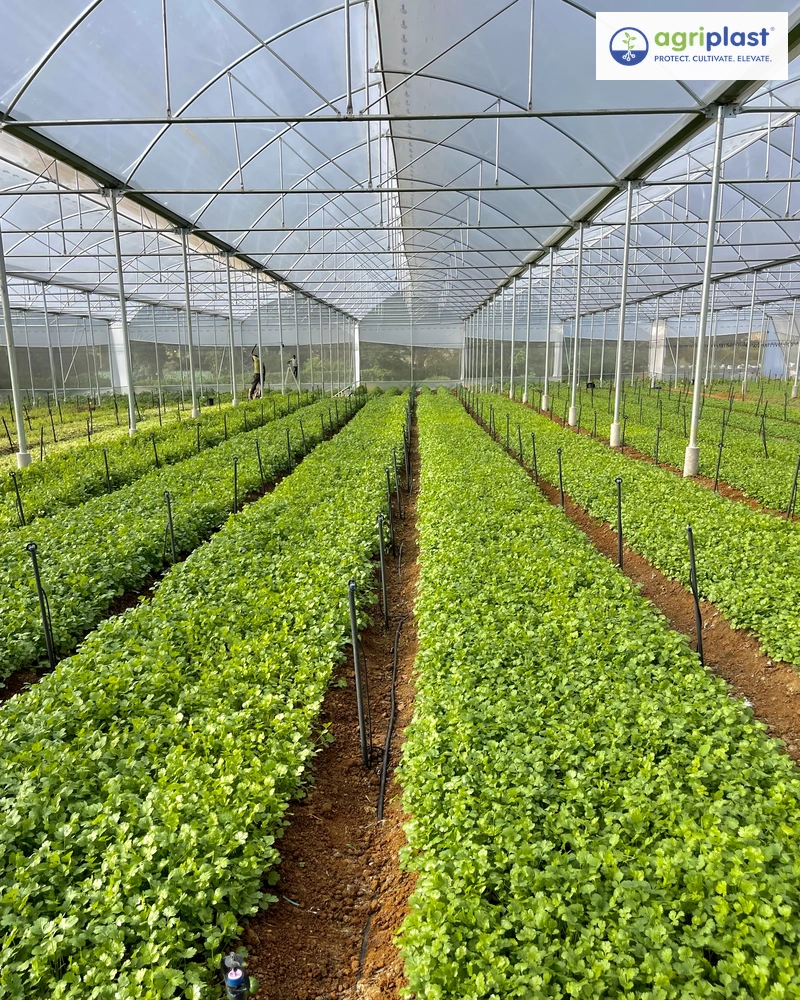
Interior of a naturally ventilated polyhouse — the structure type funded at ₹1,000 per sqm under MIDH unit cost norms through NHM.
NHB (National Horticulture Board)
The National Horticulture Board handles commercial polyhouse projects. Per current NHB scheme guidelines as documented by Krishi Jagran:
- 50% subsidy capped at ₹1 crore per project
- Minimum area: 2,500 sqm general regions; 1,000 sqm in NE states
- Best for FPOs, agri-entrepreneurs, and 1-acre+ commercial units
NHB issued revised MIDH protected cultivation guidelines in August 2025, which should be reviewed before applying.
💰 Central MIDH Subsidy Quick Reference
MIDH base: 50% private, 100% public, 100% GOI for NE/Himalayan states. NHM: 500–4,000 sqm, via DHO. NHB: 50% capped at ₹1 crore, min 2,500 sqm (MIDH Operational Guidelines).
How Central Schemes Stack with State Top-Ups
The 50% central base is the floor. Every state runs its own State Horticulture Mission (SHM) that can add a top-up of 15–45% on top of the central rate.
For farmers in Haryana, and Rajasthan, the combined central + state + special-category support can reach 65-95%. For general farmers in Punjab and Uttar Pradesh, total assistance typically caps at 50%.
State-by-State Polyhouse Subsidy Guide
Central schemes set the base. State governments add top-ups. The figures below come from official state horticulture portals and verified industry sources for 2025–26. Rates change every financial year — confirm with your DHO before applying.
Polyhouse Subsidy in Rajasthan (Up to 95% for Small and Marginal Farmers)
Rajasthan operates one of India's most generous state polyhouse schemes. Per the Rajasthan Green House Scheme:
- 50% — General farmers
- 70% — Small and marginal farmers
- 95% — Scheduled Tribe farmers in scheduled tribe areas (70% + 25% additional benefit)
Maximum area covered: 4,000 sqm. Minimum landholding: 1 acre. Apply via the Rajasthan SSO portal under the Agriculture Department.
Polyhouse Subsidy in UP (Uttar Pradesh)
Polyhouse subsidy in UP runs through the State Horticulture Mission at the 50% NHM base. The state has not historically added a major top-up, keeping total assistance at 50% for most categories.
Active polyhouse clusters: Lucknow, Varanasi, Gorakhpur, Allahabad. Polyhouse subsidy in Uttar Pradesh applications are routed through the District Horticulture Officer via the UP Agriculture Department portal.
Polyhouse Subsidy in Maharashtra
Maharashtra layers a state top-up on the 50% NHM base, taking total assistance to 65–70%. Maximum project area: 4,000 sqm under state scheme.
Maharashtra is India's most mature state for online polyhouse applications — the entire process initiates through the MAHA-DBT portal under Horticulture Department. Documents upload as scanned PDFs and files are trackable online.
Polyhouse Subsidy in MP (Madhya Pradesh)
MP provides polyhouse subsidy through the State Horticulture Mission (MP Horticulture and Food Processing Department):
- Cost norm for naturally ventilated polyhouse: ₹935 per sqm
- 50% subsidy = approximately ₹4.67 lakh for a 1,000 sqm structure
- SC/ST and women farmers: additional 10–15% state top-up
- Tribal districts (Mandla, Dindori, Jhabua) receive higher allocation
Polyhouse Subsidy in Haryana
Haryana provides one of the better-supported polyhouse schemes among North Indian states.
- 65% — General farmers (50% NHM + 15% state top-up)
- Apply through the Haryana Horticulture portal.
Polyhouse Subsidy in Karnataka
Karnataka runs NHM at the 50% base with category-specific top-ups for small, marginal, SC/ST, and women farmers. The state operates a separate floriculture mission funding polyhouse projects for gerbera, chrysanthemum, and rose — relevant for floriculture growers.
Apply through the Karnataka Department of Horticulture portal or the District Horticulture Office.
Polyhouse Subsidy in Tamil Nadu
Tamil Nadu provides polyhouse subsidy under MIDH-NHM through district horticulture offices. Per verified guidelines from Coimbatore District Horticulture and Krishnagiri District MIDH-NHM portal:
- 50% subsidy on polyhouse construction
- Maximum area: 4,000 sqm per beneficiary
- Shade net house: 50% at ₹355 per sqm, same area cap
- Mulching: 50% back-ended subsidy at ₹16,000 per hectare
Apply through HORTNET registration at the District Horticulture Office. Required documents include Chitta and Adangal (original), FMB sketch, Aadhaar, and registered lease agreement for lease farmers.
Polyhouse Subsidy in Bihar
Bihar provides polyhouse subsidy through the State Horticulture Mission. Per the Bihar Horticulture Department:
- 50% subsidy at ₹140 per sqm admissible cost
- Coverage: 23 districts including Patna, Gaya, Muzaffarpur, Bhagalpur, Darbhanga
Apply online through the Bihar Horticulture portal under the High-Tech Horticulture Scheme section.
Polyhouse Subsidy in Gujarat
Gujarat layers a state top-up on the NHM base, taking total assistance to around 65% in standard categories. Polyhouse adoption is strongest in Saurashtra and South Gujarat for coloured capsicum, exotic cucumber, and cherry tomato.
Apply through the iKhedut portal under the Directorate of Horticulture.
Polyhouse Subsidy in Punjab
Punjab provides polyhouse subsidy at the 50% NHM base with limited state top-up. Per Tribune India reporting, the state Horticulture Department operates under MIDH and RKVY schemes.
Polyhouse adoption is concentrated in the Doaba region. Apply through the Punjab Department of Horticulture.
Polyhouse Subsidy in Andhra Pradesh and Telangana
Both states fund polyhouse projects through their State Horticulture Missions under MIDH.
The AP Horticulture Department protected cultivation guidelines set admissible subsidy at ₹422 per sqm, limited to 4,000 sqm per beneficiary. Only GI pipes are permitted in the polyhouse structure — MS pipes disqualify the unit from subsidy release.
Telangana adds a substantial state top-up. For SC/ST farmers, combined central + state + special-category provisions reach up to 50% — among the highest in India.
Apply through the Telangana State Horticulture Mission portal.
Polyhouse Subsidy in Chhattisgarh and Jharkhand
Polyhouse subsidy in Chhattisgarh and polyhouse subsidy in Jharkhand both run under NHM through MIDH at the 50% central base, with state-level top-ups for tribal and SC/ST categories under the Tribal Sub-Plan.
Apply through:
Polyhouse Subsidy in Kerala, Himachal Pradesh, and West Bengal
Himachal Pradesh is the outlier. The HP government has consistently provided 50% subsidy for polyhouse construction under its flagship state scheme, with the farmer contributing just 15%. Replacement subsidy of 50% has historically been available for poly sheets after 3–5 years or in case of natural calamity damage.
West Bengal provides polyhouse subsidy at the 50% NHM base. The West Bengal Food Processing and Horticulture Department implements a "Do It Yourself" polyhouse kit scheme at ₹225 per sqm admissible cost — ₹22,500 subsidy per 100 sqm naturally ventilated polyhouse.
Kerala implements NHM under MIDH at the base 50% with category top-ups through the State Horticulture Mission. Apply through the Kerala Agriculture Department.
| State | Total Subsidy (Central + State) | Apply Through |
|---|---|---|
| Rajasthan | 75% (general) → 95% (SC/ST) | SSO Rajasthan portal |
| Himachal Pradesh | 50% (flagship state scheme) | HP Horticulture Department |
| Telangana | 75% (general) → 95% (SC/ST) | Telangana SHM portal |
| Haryana | 50% (general) → 65% (SC/ST) | Haryana Horticulture portal |
| Maharashtra | 50% (general) → 70% (SC/ST) | MAHA-DBT portal |
| Gujarat | 50% (general) → 60% (SC/ST) | iKhedut portal |
| Bihar | 50% (combined) | Bihar Horticulture portal |
| Tamil Nadu | 50% (combined) | HORTNET via DHO |
| Karnataka, MP | 50% (combined) | State SHM / DHO |
| UP, Punjab | 50% (combined) | State portals / DHO |
| AP, CG, Jharkhand, Kerala, WB | 50% (combined) | State SHM / DHO |
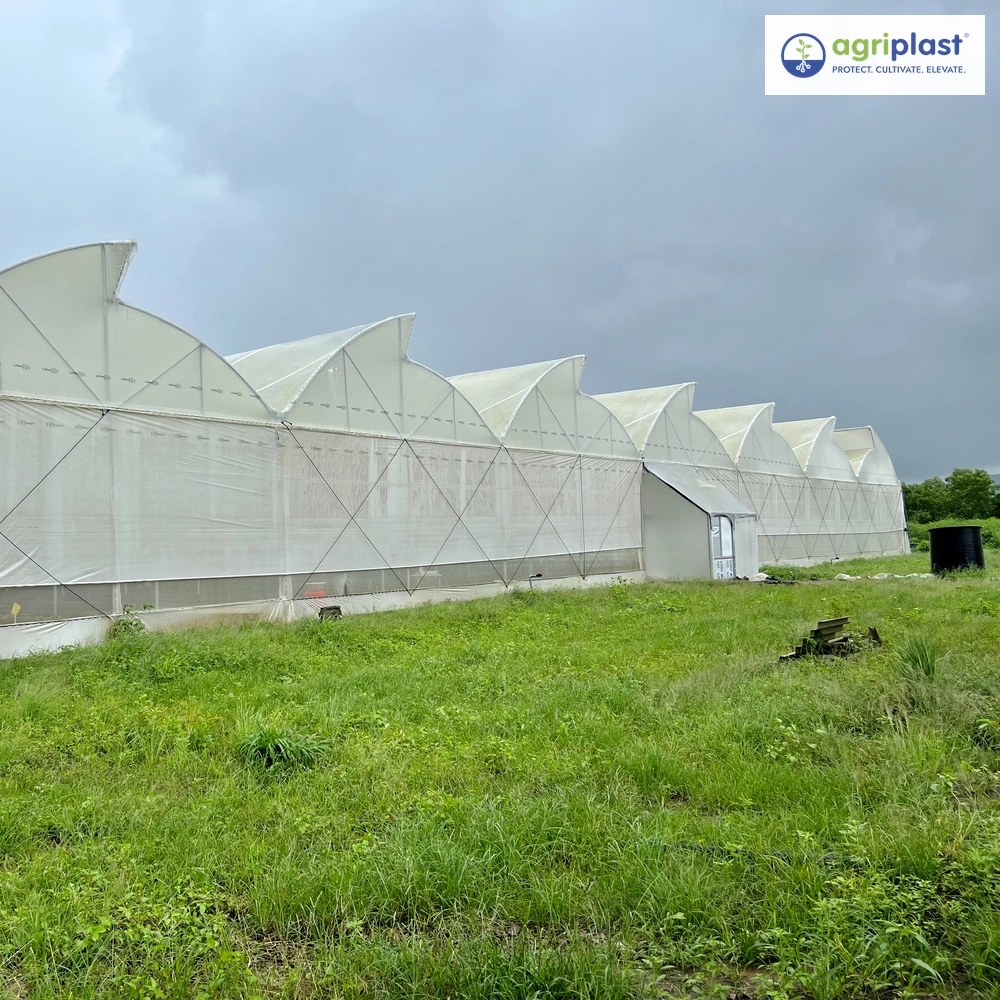
A commercial multi-span polyhouse — the type funded under NHB's ₹1 crore subsidy ceiling for projects of 2,500 sqm and above.
Who Can Apply — Eligibility Criteria
Eligibility for polyhouse subsidy is broad across central and state schemes:
- Individual farmers with land records in their name (minimum landholding typically 1 acre)
- Farmer Producer Organisations (FPOs) registered under the Companies Act or Cooperative Societies Act
- Partnership firms and proprietorship businesses engaged in horticulture
- Self-help groups, cooperative societies, and agri-entrepreneurs
- Lease-holders in many states, provided the lease covers the loan tenure
Additional conditions across most schemes:
- Valid farmer registration number (KCC or state farmer ID)
- No previous polyhouse subsidy availed for the same parcel
- Margin money of 10–25% (varies by scheme)
- Assured irrigation at the project site
- Bank loan eligibility (CIBIL score, debt-equity profile)
Documents Required — Complete Checklist
The document set is consistent across central and state schemes. Keep all of these ready before applying.
| Document | Purpose |
|---|---|
| Land records (Khasra/Khatauni or 7/12 extract), patta, phani, EC) | Establishes ownership and clear title |
| Aadhaar and PAN card | Identity verification and tax linkage |
| Bank account passbook (first page) | For subsidy credit linkage |
| Recent soil and water testing report | Confirms crop suitability |
| Detailed Project Report (DPR) | Crop plan, cost, yield, marketing plan |
| Vendor quotations (minimum 3, empanelled preferred) | Cost validation |
| Market linkage proof | Mandi tie-ups, FPC contracts, exporter MoUs |
| Caste certificate (if applicable) | Triggers SC/ST subsidy slab |
|
Bank loan in-principle letter:
|
Proves credit-linkage is in motion |
| Farmer registration / KCC card | Mandatory on most state portals |
| Passport-size photographs | For application attachments |
| Lease agreement (registered, if applicable) | For lease farmers |
How to Apply for Polyhouse Subsidy — Step-by-Step Process
The application sequence is consistent across MIDH, NHM, and NHB. Reorder any step and the subsidy lapses.
- Pre-application research — soil and water testing, visit operational polyhouses, shortlist 3 empanelled vendors, select crops for local mandi demand
- DPR preparation — Detailed Project Report following the MIDH DPR format with crop plan, cost, yield, marketing plan
- Online registration — register on your state portal (SSO Rajasthan, iKhedut, MAHA-DBT, HodaHaryana, HORTNET, Bihar Horticulture)
- Application submission — submit DPR and documents to DHO (NHM) or NHB regional office (commercial)
- Pre-sanction site verification — joint inspection by horticulture officer and bank officer
- GOC and loan sanction: The horticulture department issues a GOC. The bank sanctions the term loan based on the GOC and DPR
- Construction — build with empanelled vendor matching DPR specifications
- Joint inspection — NHB team verifies build matches DPR
- Subsidy release — credited to bank loan account via DBT
After Approval — Construction, Inspection, and Disbursement
Approval is the midpoint, not the finish line. Three stages remain between GOC and the subsidy hitting your loan account.
Construction phase (2–4 months). Build must match DPR exactly — same vendor, structure type, area. Document with photographs, dated invoices, and material delivery receipts. The AP Horticulture Department guidelines specify that only GI pipes are permitted — MS pipes disqualify the unit. This rule applies in most states.
Cover film, insect net at vents, internal shade net, and accessories matter — both for polyhouse performance and because schemes specify component standards. Farmers building under MIDH-admissible specifications often source through specialised suppliers.
Agriplast's Ginegar greenhouse film range (5-layer co-extruded, 200-micron, UV-stabilised) is one option used in protected cultivation projects across India.
Joint inspection (2–4 weeks). Joint inspection by Assistant Director of Horticulture, bank officer, and DMC committee member verifies the structure. Photos and bills upload to the state MIDH portal (HortNet in AP, equivalent platforms elsewhere). Discrepancies between DPR and actual build can delay or block subsidy release.
Subsidy release (1–3 months from Joint inspection). Credited directly to bank loan account via DBT.
Total realistic timeline from application to disbursement: 8–14 months.
See our Comprehensive Guide to Starting Your Polyhouse Farming Journey
Cost of Polyhouse Before and After Subsidy
Three examples showing how the subsidy plays out in practice. Figures based on MIDH unit cost norms and state top-up patterns.
Example 1 — Rajasthan Small Farmer
Profile: Scheduled Tribe farmer in a scheduled tribe area of Rajasthan, building a 1,000 sqm naturally ventilated polyhouse for capsicum.
- Project cost at ₹1,000/sqm MIDH norm: ₹10 lakh
- Subsidy at 95% (70% + 25% ST top-up): ₹9.5 lakh
- Farmer's effective contribution on norm: ₹50,000
In practice, market rates exceed MIDH norms by 15–20%, so the farmer's true contribution is closer to ₹1.5–2 lakh including the gap above the cost norm. Cover film, insect net at vents, and shade net inside the structure are part of the admissible cost calculation.
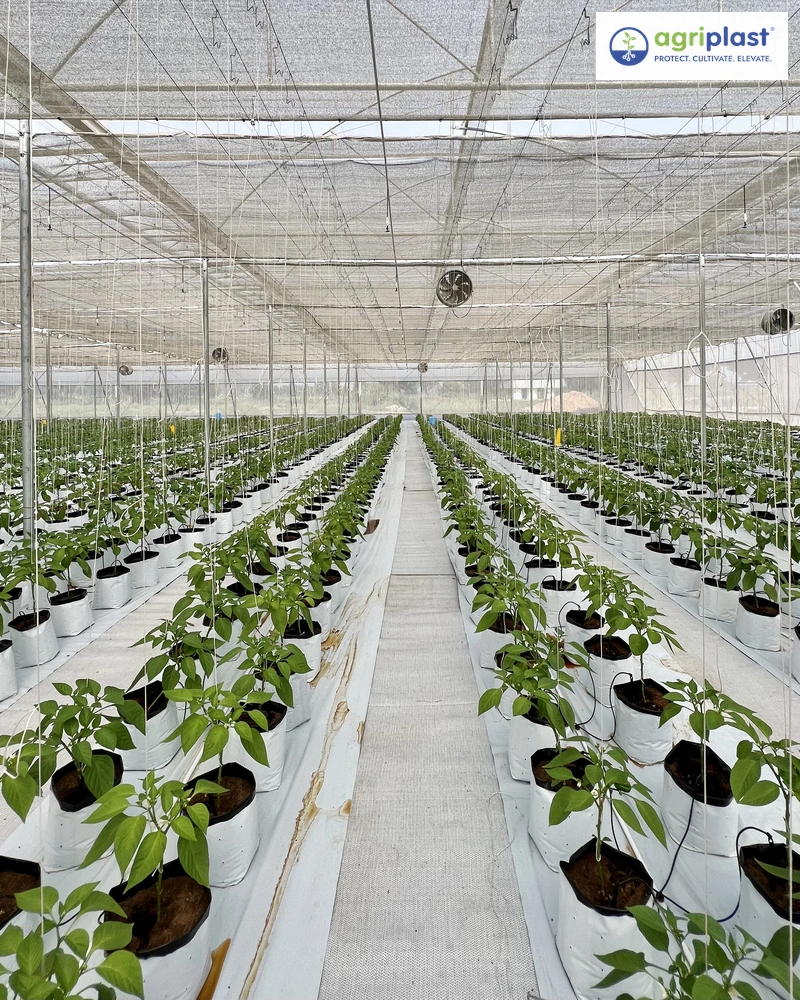
Capsicum grown in a polyhouse equipped with overhead shade net and ground cover — a typical setup funded under state polyhouse subsidy schemes in Maharashtra, Rajasthan, and Karnataka.
Example 2 — Maharashtra General Farmer
Profile: General-category farmer in Pune district building a 4,000 sqm naturally ventilated polyhouse for coloured capsicum.
- Project cost at ₹1,000/sqm MIDH norm: ₹40 lakh
- Subsidy at 65% (50% NHM + 15% Maharashtra state top-up via MAHA-DBT): ₹26 lakh
- Farmer's effective contribution (loan + margin): ₹14 lakh
At 65% effective subsidy, this project typically pays back in 3–5 years for high-value crops. Coloured capsicum yields ₹15–25 lakh per acre per year under proper protected cultivation. Quality components matter — UV-stabilised insect net at side-wall vents to keep thrips and whiteflies out, and the right shade net configuration for summer months — protect the multi-year yield curve.
Explore our 28 Profitable Polyhouse Crops You Can Grow in India and discover high-income farming opportunities for modern Indian farmers.
Example 3 — Multi-Acre Commercial Project
Profile: Agri-entrepreneur or FPO building a 16,000 sqm (4-acre) fan-and-pad polyhouse complex for gerbera and anthurium under NHB.
- Project cost at ₹1,600/sqm MIDH norm for fan-and-pad: ₹2.56 crore
- NHB subsidy at 50% capped at ₹1 crore per project: ₹1 Crore
- Effective subsidy rate on actual cost: ~22% (capped, not headline 50%)
- Farmer's effective contribution (loan + margin): ~₹2 crore
For projects above ₹1.12 crore, the NHB ₹1 crore ceiling reduces effective subsidy below 50%. Larger projects often pursue state-level top-ups separately. Commercial fan-and-pad units require substantial investment in cooling pads, exhaust fans, aluminium profiles, and gutter systems — covered under the greenhouse accessories line item in the DPR.
Common Mistakes and How to Avoid Them
Most rejected polyhouse subsidy files fail on procedure, not project quality. Five mistakes repeat across rejected applications.
Mistake 1 — Starting construction before sanction. Vendor pressure does not change the rule. Sign no contract, pour no concrete until the GOC is in hand. Document the construction start date in writing.
Mistake 2 — Choosing vendors outside the empanelled list. Many states maintain empanelled vendor lists at the DHO. Unlisted vendors can void eligibility under specific schemes. Cross-check empanelment before signing any quote.
Mistake 3 — Lowest-quote vendor selection. Quotes vary by 25–40% across vendors. Lower quotes often mean thinner GI pipes, lower-GSM coating, lower-grade film, and faster structural failure. Get specifications in writing — pipe wall thickness in mm, GI coating in GSM, film micron and UV rating, drip pressure compensation. A vendor unwilling to put numbers on paper is planning to compromise.
Mistake 4 — Weak or generic DPR. Copy-paste DPRs with generic yield numbers, no market linkage, and zone-mismatched crop plans get pushed back three or four times before sanction. Some files never recover.
Mistake 5 — Wrong crop for the climate zone. Proposing heat-sensitive crops in summer-extreme districts without fan-and-pad cooling triggers immediate red flags at sanction review. Match polyhouse type to your maximum summer temperatures.
Frequently Asked Questions
Planning Your Polyhouse Project
Polyhouse subsidy in India in 2026 is among the most generous capital subsidy programmes available — provided the application sequence is followed, the DPR is defensible, and the structure is built to scheme-admissible component standards.
For farmers planning their polyhouse build, the cover film, insect netting at vents, internal shade net, and accessories like aluminium profiles and cooling pads each contribute to whether the polyhouse delivers reliable yields for 4 years or 10.
Agriplast Tech India supplies the protected cultivation components covered under MIDH-admissible specifications. For a project-specific recommendation matching your crop, zone, and scheme requirements, talk to the Agriplast technical team.
Blog written and Posted by
Rani Singh
Rani Singh is a Content Executive at Agriplast Tech India, covering high-value farming, protected cultivation, and farmer success stories. She focuses on turning field experiences into practical, actionable content for Indian farmers and agri-entrepreneurs.You can write your view/comments here
Need Expert Assistance?
Get personalized recommendations for your greenhouse, polyhouse, or irrigation needs.
-
Bengaluru (Corporate Office)
- 918141446666
- support@agriplast.co.in
WeWork Roshni Tech Hub - 1st floor, PFS Club House, Marathahalli Main Rd, R.J.Gardens, Lakshminarayana Pura, EPIP Zone, Chinnapanna Halli, Bengaluru, Karnataka 560037