How a Karnataka Farmer Built a ₹3–4 Crore Summer Capsicum Business Under Shade Net

Every farmer in Karnataka can grow capsicum during the monsoon. Almost none can grow it in peak summer—and that gap is exactly where Ramachandra makes his money. In Karnataka's Mandya district, he cultivates 15 acres of capsicum, bajji chilli, and jalapeño under shade nets. In a bumper year, that operation generates a turnover of ₹3–4 crore.
He has farmed this land for 40 years, spending the last three decades focused on vegetables. Strip away the crops and the revenue, and his entire strategy comes down to a simple idea that any farmer can learn from: grow what others cannot, in the season when others cannot.
Capsicum and bajji chilli do not perform well in the open during peak summer—which is precisely why he invested in shade-net cultivation.
Why He Walked Away From Paddy and Sugarcane
Ramachandra did not start with capsicum. For the first decade, his family cultivated the region's traditional crops—paddy and sugarcane. The shift to vegetables was driven by economics: the same land and water generated far higher returns from capsicum, tomato, and chilli than from cereals. Three decades later, he has no intention of going back.
Those years of experience gave him something no manual can teach—the ability to read his crop. He can walk through a field and spot a problem before it spreads. Black thrips has been a persistent challenge for the past two to three years, and he openly admits it is not fully under control. Instead, he manages it season by season, keeping the crop productive despite the pressure.
Why Open Field Capsicum Farming Fails in Summer
The core problem is seasonal. Capsicum, chilli and jalapeño have little tolerance for heat, and through a Mandya summer, open-field temperatures climb past what the plant can carry. The crop simply will not set the way it should.
"In summer you can't grow these crops in open field — the temperature is too high, and the plants have no tolerance for it. So for summer, shade net becomes necessary. That's why we put it up."
The science behind his observation is well established. A shade net can reduce canopy temperature by several degrees and soften direct sunlight reaching the crop. During Indian summers, intense heat and radiation increase moisture loss, leaf scorching and plant stress. By diffusing light and lowering temperature, shade nets create a more favourable microclimate.
Ramachandra uses a 50% shade net from Agriplast, which blocks about half of the incoming sunlight. Research shows that shade-net colour and density influence temperature, humidity and light distribution around the crop.
He pairs the shade net with Agriplast mulching on the beds. The mulch suppresses weeds, conserves soil moisture, supports root growth and improves water-use efficiency. Together, the two systems create a stable environment for summer vegetable production.
Here is how the two systems compare for a summer crop:
| Factor (summer crop) | Open Field | Under Shade Net |
|---|---|---|
| Crop survival in peak summer | Poor — heat past plant tolerance | Stays healthy and productive |
| Canopy temperature | Full summer heat | ~3–5°C cooler |
| Light on the crop | 80,000–120,000 lux (excess) | Cut toward the usable range (50% net ≈ half) |
| Water use | Baseline | ~25.5% less |
General shade-net vs open-field factors, drawn from horticulture research and Ramachandra's own observations. His farm-specific yields and economics are in the next section.
The research points the same way. In a two-year IIT Kharagpur trial, capsicum under a shade net house used about 25.5% less water than open field while delivering higher yield, quality and returns — the closest published match to Ramachandra's setup.
A fully controlled polyhouse pushes the ceiling higher still: a Punjab Agricultural University study recorded polyhouse capsicum yielding roughly 111% more than open field, with a benefit-cost ratio of 1.3 and a 24% internal rate of return. Shade net sits between the two — cheaper than a polyhouse, far more productive than open field in summer.
What It Yields, and What It Actually Earns
On his own farm, the proof is in the harvest. A healthy crop under shade, he says, does in about 65 days what open field cannot manage all year.
"In 65 days the crop gives a minimum of two to three kilos a plant. That simply cannot grow in open field. To grow through summer, you have to go under shade — there's no other way."
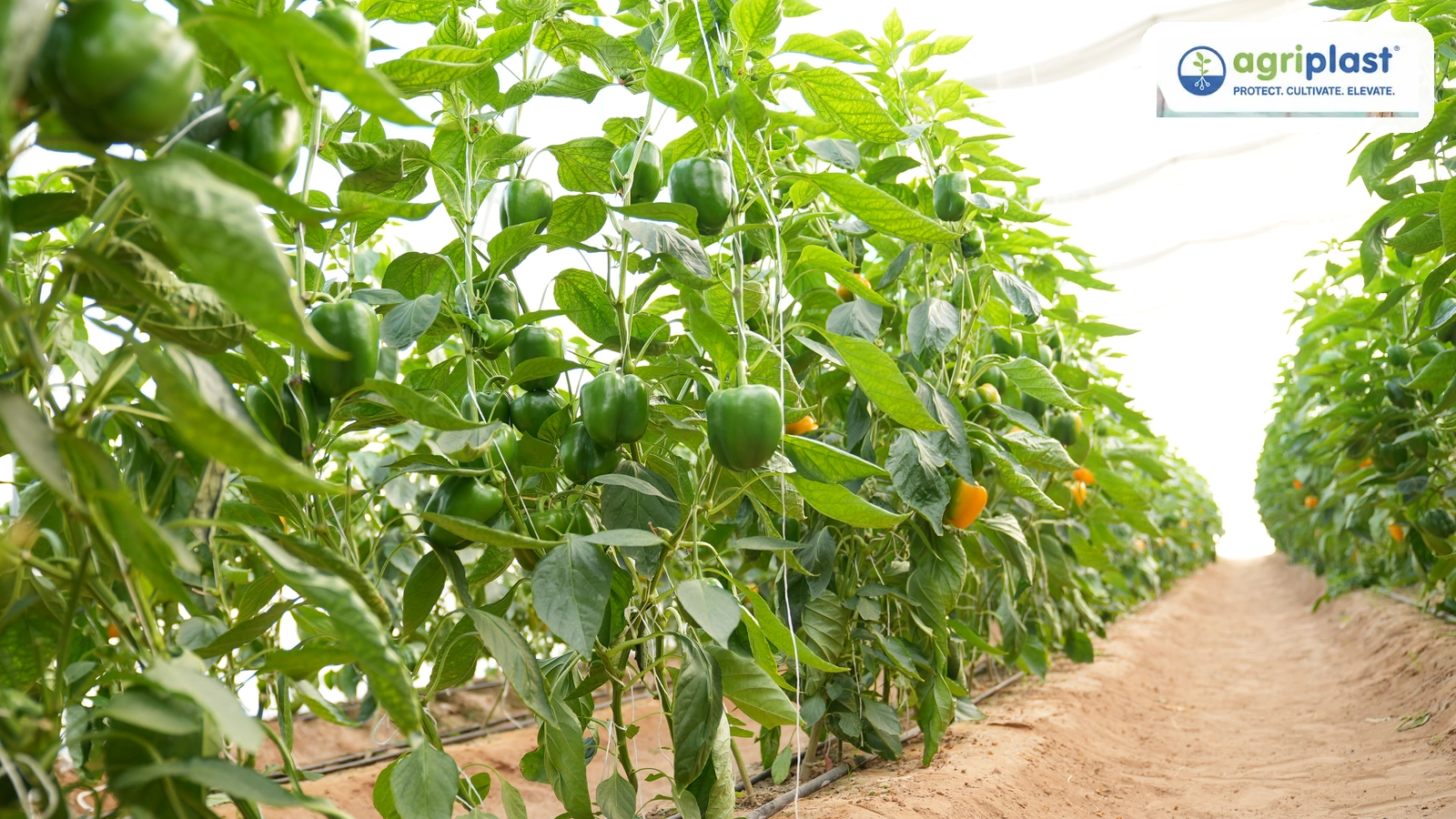
Healthy capsicum under shade net — diffused light and a cooler canopy let the crop set fruit right through summer.
Across the 15 acres, capsicum runs to roughly 50 tonnes and jalapeño 20–25 tonnes. By his own estimate the cost of cultivation works out to around ₹20 a kilo — and in summer the market rate sits well above that line, because so few farmers can produce a quality crop then.
| Crop (under shade net) | Approx. yield | Ramachandra's note |
|---|---|---|
| Capsicum | ~50 tonnes | Cost of cultivation ≈ ₹20/kg (his estimate); profit above that line |
| Jalapeño | 20–25 tonnes | His stated shade-net yield |
| Bajji chilli | 5 acres | Part of his 15-acre summer block |
The structure itself is the most affordable protected option. Under MIDH cost norms a shade net house is pegged near ₹710 per square metre, against ₹1,000 for a naturally ventilated polyhouse — which is why many farmers begin their protected-cultivation journey here.
💰 Government Subsidy Available
Shade net houses qualify for a 50% credit-linked back-ended subsidy under MIDH/NHB, capped at ₹56 lakh per project, with several states adding a top-up. In practice the effective subsidy is often closer to 35–40%, because the government cost norm trails real market rates — so plan margin money accordingly. See our polyhouse and shade net subsidy guide for the full process.
Then comes the part that makes the whole model work — the bumper year.
"Once in three or four years we get a bumper rate — ten, even fifteen times over. Even if it comes only once in four years, that single year makes up for the losses of the other three. You just have to keep going."
That is where the ₹3–4 crore comes from: not every year, but the bumper year across the full 15-acre block. It is the upside the structure makes possible — and the reason he treats the shade net as an investment, not a cost.
🎥 Watch: How a Karnataka Farmer Grows Capsicum Under Shade Nets for Year-Round Profit
Hear directly from Ramachandra, a farmer from Mandya district in Karnataka with over 40 years of experience, as he explains how shade net cultivation transformed his capsicum, chilli, and jalapeno farming on 15 acres — enabling production even during peak summer when open-field cultivation is not possible.
The Logic That Makes Ramachandra Win
Strip away the crops and the numbers, and his success runs on four simple ideas any farmer can borrow.
1. Sell when no one else can. In the monsoon, everyone grows, the market floods, and the rate collapses. In summer, very few can produce a quality crop — so the rate climbs. Shade net is his ticket into that scarce, high-value window.
2. Treat the structure as a multi-year bet, not a one-season gamble. He openly admits farming does not pay every single year. The discipline is to stay in long enough for the bumper year to arrive and cover the lean ones.
3. Manage problems, don't wait for perfect. Black thrips is still in his field. He did not quit; he found a way to keep the crop productive around it. Shade net improves conditions — it is not a magic shield.
4. Match the tool to the season. The net is not there to make farming generally easier. It is there to solve one specific, expensive problem: summer heat on a heat-sensitive crop.
"Grow what no one else grows, in the season no one else can. That means farming in a challenging environment — but if you invest in the structure for summer, you will definitely make a profit."
And then there is the part no yield table captures. Ask him why he keeps at it through the lean years, and the answer has nothing to do with rates. The farm holds his family — his brother works beside him every day — and, more than anything, it holds his contentment. That, in the end, is why he farms.
See how Manoj Bhatia built a 170-acre nursery operation on the same principles
Is Shade Net Right for Your Capsicum?
Ramachandra's farm answers a specific question: can you grow capsicum profitably through a hot Indian summer? In the open, in his climate, the answer is no. Under shade net — with mulch on the beds and an honest read of the market cycle — the answer becomes yes. The one condition is mindset: treat it as a multi-year investment, not a single-season bet.
If you are losing summer capsicum to heat and light stress, start with the fundamentals in our shade net guide, then match the right shade level and colour to your crop.
If you are weighing protected systems against each other, compare the shade-net route with the polyhouse approach see our complete guide to growing capsicum in polyhouse.
Frequently Asked Questions
Blog written and Posted by
Agriplast Tech India Editorial Team
Author bio will be updated soon.
You can write your view/comments here
Need Expert Assistance?
Get personalized recommendations for your greenhouse, polyhouse, or irrigation needs.
-
Bengaluru (Corporate Office)
- 918141446666
- support@agriplast.co.in
WeWork Roshni Tech Hub - 1st floor, PFS Club House, Marathahalli Main Rd, R.J.Gardens, Lakshminarayana Pura, EPIP Zone, Chinnapanna Halli, Bengaluru, Karnataka 560037