How Manoj Scaled Vegetable Nursery Farming from 2.5 to 170 Acres in Haryana

In 2010, Manoj Bhatia had 2.5 acres in Karnal, a young farming business, and one important decision to make: choose cheap inputs that needed replacing every few seasons, or invest in premium materials built for the long term. He chose the longer game.
Fifteen years later, that single decision has grown into a 170-acre vegetable nursery farming operation — including a 60-acre cauliflower nursery supplying seedlings to farms across Haryana every July.
This isn't a story about farming harder. It's a story about farming smarter — and what fifteen years of compounding small, careful decisions can build with the right shade net solutions and protected cultivation framework.
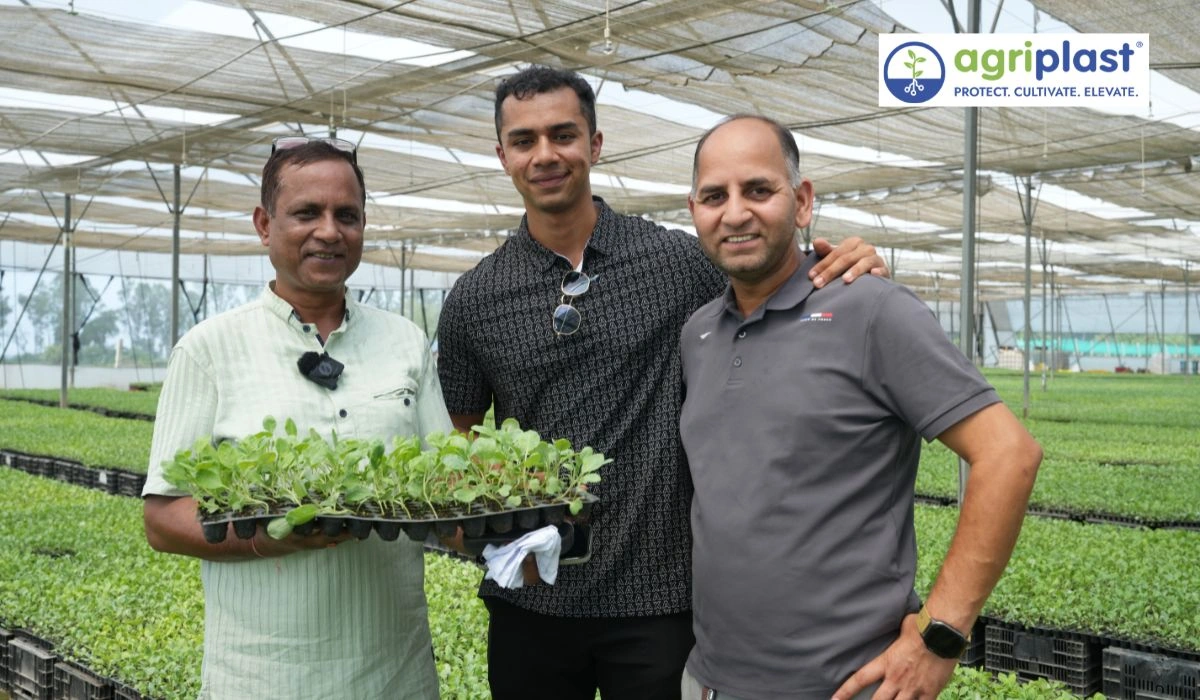
Manoj Bhatia (right) with the Agriplast team at the 60-acre cauliflower nursery in Karnal — the operation has scaled 68 times since he began with 2.5 acres in 2010.
The Question Most Indian Farmers Don't Ask
Every season across India, the same pattern repeats. A farmer plants what worked last year, hopes for a better outcome, and quietly absorbs the loss when something goes wrong. Capital leaks out one bad season at a time. Most farmers can't say, with any precision, which crop made them money and which one cost them.
Manoj's framework was different from day one. He treated his 2.5-acre plot as a business with measurable inputs and measurable returns. Every product had to earn its place. Every loss had to be traced to a specific cause — and corrected before the next planting.
That discipline — not the size of his starting plot — is what allowed scale to compound.
The 2010 Decision That Defined the Next Fifteen Years
When Manoj started, North India's protected-cultivation market was full of cheap shade nets and mulch films promising big results at low prices. The economics looked tempting on a per-roll basis. But the math broke down fast on a per-decade basis: material that fails in two years has to be replaced four times before a quality alternative even reaches its rated lifespan.
For the underlying logic of how shade nets actually work and why GSM, UV stabilisation, and percentage matter, see our complete shade net guide.
Manoj chose Agriplast. Not because it was the cheapest option. Because it was the one with the longest math.
"This Agriplast Aluminet shade net was installed in 2010. Today — fifteen years later — it's still standing exactly as we put it up. That's the kind of lifespan we observed firsthand."
For comparison: most shade nets in the Indian market are sold with 3–5 year life claims. Cheaper variants can fail inside two seasons. Manoj's 2010 installation has now run through fifteen North Indian summers, monsoons, hailstorms, and dust loading — and is still working as installed.
That single product decision, multiplied across 170 acres, is the difference between a farm that pays dividends and a farm that pays for replacements.
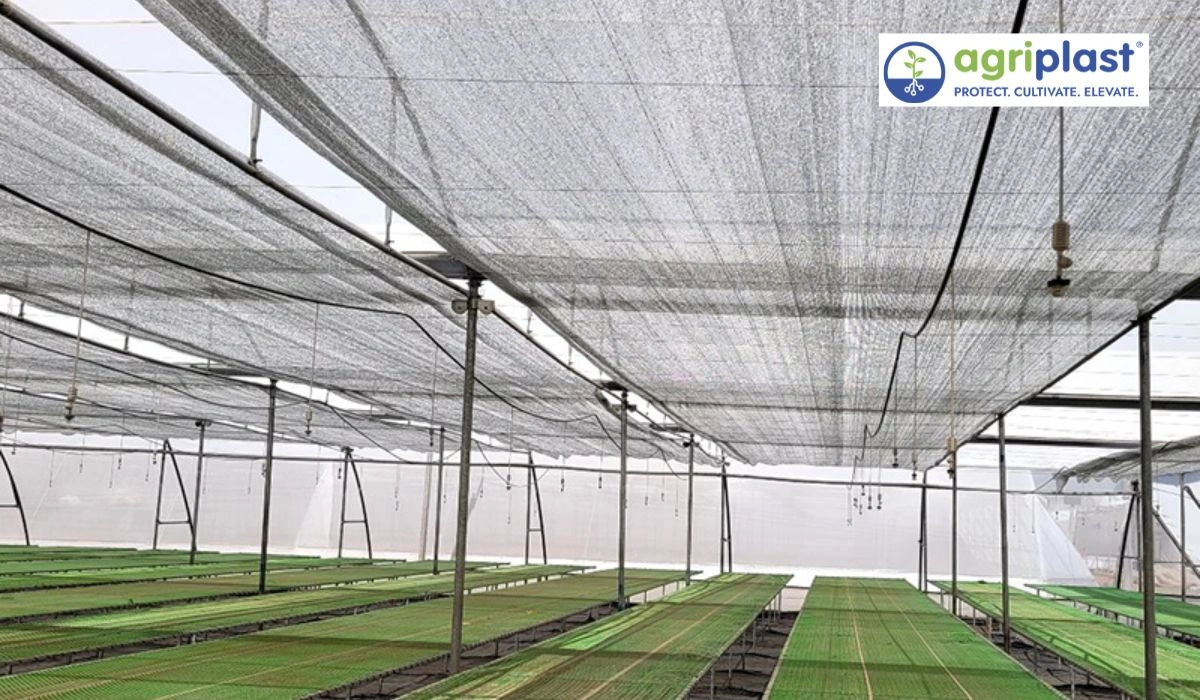
The 2010 Aluminet shade net structure — fifteen years of North Indian summers, monsoons, and dust loading, still working as installed.
Inside the 60-Acre Cauliflower Nursery
Today, Manoj's operation runs on a two-season calendar that uses every working week of the year:
| Season | Transplant Window | Major Crops |
|---|---|---|
| Season 1 | June – July | Cauliflower, bitter gourd, bottle gourd, cucumber |
| Season 2 | After Season 1 | Muskmelon, watermelon, bitter gourd, bottle gourd |
Cauliflower is the operation's headline crop. As of the recording, Manoj's 60-acre cauliflower nursery was at ready stage — seedlings prepared, hardened, and waiting for July 10 transplantation across his network of buyer farms.
To put 60 acres in scale: most commercial vegetable nurseries in India operate on 1–5 acres. Manoj's nursery alone is bigger than most farms in his district.
The business logic of running a nursery — versus growing only field crops — is sharp. Predictable cash flow. Lower individual risk. Customers who come back every season because seedlings are time-sensitive. Field farmers absorb full weather risk on a one-shot crop.
Nursery operators spread a smaller, more diversified risk across dozens of buyer farms — and turn capital faster.
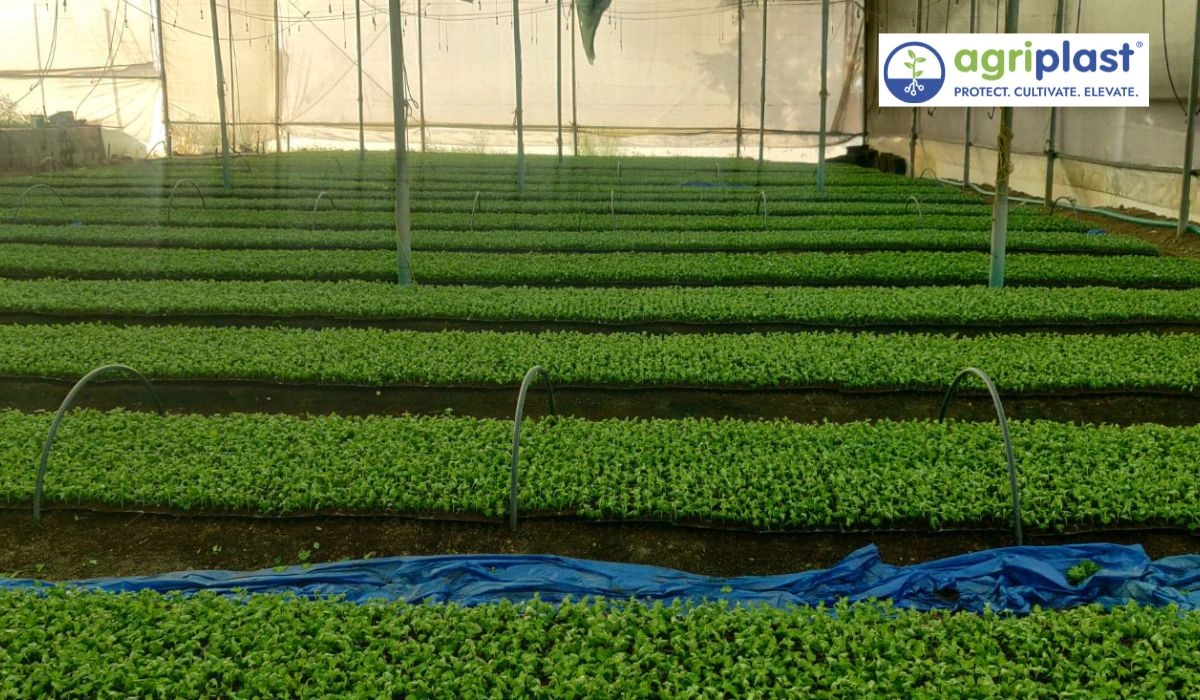
The 60-acre cauliflower nursery at ready stage — one of the largest commercial vegetable nursery operations in North India.
Why Aluminet, Not a Standard Shade Net
Most shade nets work by blocking sunlight — woven HDPE strips that cut light intensity by a fixed percentage. Aluminet works differently. The strips are aluminium-coated, which means the net reflects heat radiation back upward instead of absorbing it. The result on the ground is a noticeably cooler microclimate beneath the structure — without losing the diffuse light seedlings need.
Manoj installed both kinds on his farm so he could see the difference himself:
"Open the Aluminet right now and the temperature inside will jump six to seven degrees. The crop growth difference between Aluminet and a simple shade net — it's sky and earth."
This 6–7°C drop tracks with what independent reflective-shade research has consistently observed: aluminised reflective screens reduce greenhouse and canopy temperatures by roughly 5–8°C compared to standard black shade cloth at the same shade percentage, because the reflective layer redirects infrared radiation back skyward instead of absorbing it.
🎥 Watch: Manoj Bhatia Walks Through His 170-Acre Karnal Operation
Hear directly from Manoj Bhatia as he walks through his 170-acre vegetable nursery operation in Karnal, Haryana — the 60-acre cauliflower nursery, the 2010 Aluminet structure still working today, and his framework for treating farming as a business.
The Money Lesson Every Farmer Should Hear
Across a long conversation about farming at scale, one theme came back repeatedly: most farmers don't actually know whether they're making money. They know the harvest came in. They know money moved. But they cannot trace specific profit to specific decisions — and that gap is where capital quietly disappears, season after season.
Manoj's prescription is the discipline he ran for fifteen years:
- Track every crop's true cost — including hidden ones like material replacement and labour overtime.
- Trial new material on 2–5 acres before committing across 50. A bad input at scale takes years to recover from.
- Stay away from counterfeit material. It looks similar on day one and fails predictably by year two.
- Earn the right to scale. 170 acres is where Manoj's system led, after fifteen years of compounding small wins.
Capital support exists too. Under the National Horticulture Board (NHB) and the Mission for Integrated Development of Horticulture (MIDH), farmers can access up to 50% subsidy on protected cultivation projects, with Haryana adding a state top-up that takes total support to roughly 65%.
This is the difference between farming as a habit and farming as a business.
Fifteen Years of Trust, Built One Season at a Time
The reason Manoj is still using the same brand fifteen years after his first install isn't loyalty — it's verification. Every season, the material delivered. Every expansion phase, the agronomy team showed up when problems came. Every product comparison he ran on his own farm confirmed the original 2010 decision.
For an operation that scaled from 2.5 to 170 acres, having a partner that doesn't break under stress is what made compounding possible. You don't grow 68 times your starting size on shaky inputs.
His final word, when asked what he'd tell other farmers starting out, sums up everything:
"Every crop has money in it. But only if you understand the crop, its protection, its nutrition, and its market. Without that, you'll keep losing every season."
For another farmer-led case study on protected cultivation discipline, see polyhouse farming success story of Arul Shankar — a former Infosys engineer who built a profitable farm using the same trial-then-scale framework.
What Nursery Farmers Can Take from This Operation
If you're running or planning a vegetable nursery, Manoj's 15-year experience offers clear lessons:
- Treat shade net as a long-term investment. A quality Aluminet lasts far longer and costs less over time than replacing cheap nets every few years.
- Choose the right shade net for the crop. Black shade nets work for many crops, but Aluminet's reflective cooling is better for vegetable seedlings in peak summer. Manoj recorded a 6–7°C lower temperature, improving germination and seedling survival.
- Use mulch film and weed mat together. Mulch film supports transplant fields, while weed mat controls weeds in pathways and work areas. Together, they reduce labour and stabilise growing conditions.
Manoj's last piece of advice — "do a trial first, then commit at scale" — is the principle behind every successful 170-acre operation we've seen. Run new material on 2 acres before laying it across 50.
Talk to the Agriplast team to design a nursery structure and product mix calibrated for your zone, crop, and operating scale.
Frequently Asked Questions
Blog written and Posted by
Rani Singh
Rani Singh is a Content Executive at Agriplast Tech India, covering high-value farming, protected cultivation, and farmer success stories. She focuses on turning field experiences into practical, actionable content for Indian farmers and agri-entrepreneurs.You can write your view/comments here
Need Expert Assistance?
Get personalized recommendations for your greenhouse, polyhouse, or irrigation needs.
-
Bengaluru (Corporate Office)
- 918141446666
- support@agriplast.co.in
WeWork Roshni Tech Hub - 1st floor, PFS Club House, Marathahalli Main Rd, R.J.Gardens, Lakshminarayana Pura, EPIP Zone, Chinnapanna Halli, Bengaluru, Karnataka 560037