Shade Net Percentage Guide: 35%, 50%, 75%, 90% — Which Is Best for Your Crop?
Choosing the right shade net percentage is one of the most critical decisions a farmer makes when setting up a polyhouse, nursery, or open-field shade structure. If the shade level is too low, crops may suffer from heat stress, sunburn, and excessive transpiration. If it is too high, plants may become weak and less productive due to insufficient light for proper photosynthesis.
Despite its importance, many farmers in India still select shade nets based on lowest cost rather than on the actual light requirements of their crop. This often leads to suboptimal growth and reduced yields.
In this guide, we break down what shade net percentages really mean, how different levels (35%, 50%, 75%, and 90%) perform in real farming conditions, and — most importantly — how to choose the right shade net for your crop using a scientific framework called Daily Light Integral (DLI). Whether you are growing tomatoes in Maharashtra, capsicum in Karnataka, or roses in Tamil Nadu, this complete shade net guide will help you make a more informed and confident decision.
What Does Shade Net Percentage Actually Mean?
In simple terms, shade net percentage tells you how much sunlight the net blocks. A 50% shade net blocks half of the incoming sunlight and allows the remaining half to pass through. Similarly, a 75% shade net blocks three-quarters of the light.
If your field receives 100 units of sunlight, a 50% shade net allows 50 units to reach your crop. A 35% net allows 65 units through.
But why does this matter?
Plants rely on sunlight to produce food through photosynthesis. The amount of useful sunlight they receive during the day directly affects how well they grow, flower, and produce fruit.
However, plants don't simply need more sunlight — they need the right amount of sunlight every day.
Scientists measure this daily light exposure using a concept called Daily Light Integral (DLI). Understanding this concept helps farmers choose the correct shade net percentage for their crops.
Understanding DLI: The Science Behind Shade Net Selection
To select the right shade net percentage, you must understand DLI.
What Is Daily Light Integral?
DLI measures the total amount of photosynthetically active light a plant receives over an entire day. It is measured in mol/m²/day. Think of it as your crop's "daily food budget" for light.
Just like you need a certain number of calories each day, your crop needs a certain DLI to grow, flower, and produce fruit properly.
Every crop has a DLI sweet spot. Too little light: the plant stretches, weakens, produces fewer fruits. Too much: sunburn, heat stress, wilting.
How Shade Net Percentage Controls DLI
In most Indian growing regions, outdoor DLI during the peak season (March–June) ranges from 40–50 mol/m²/day. That is far too much light for many crops. A shade net reduces this to the ideal range for your specific crop.
Here is how different shade net percentages affect DLI when outdoor conditions deliver approximately 40 mol/m²/day:
| Shade Net % | Light Blocked | Light Transmitted | Resulting DLI (mol/m²/day) | Best For |
|---|---|---|---|---|
| 35% | 35% | 65% | ~26 | Tomato, capsicum, high-light vegetables |
| 50% | 50% | 50% | ~20 | Cucumber, leafy greens, nurseries |
| 75% | 75% | 25% | ~10 | Orchids, ferns, gerbera, anthurium |
| 90% | 90% | 10% | ~4 | Orchid hardening, mushroom beds, car parking |
(Based on outdoor DLI of 40 mol/m²/day)
Outdoor DLI Across Indian Regions
Sunlight intensity varies significantly by region:
| Region | Typical Summer DLI (mol/m²/day) |
|---|---|
| Punjab / Haryana | 45–55 |
| Tamil Nadu | 45–50 |
| Maharashtra | 42–50 |
| Karnataka | 40–48 |
| Himachal / Uttarakhand | 30–40 |
North Indian plains often need higher shade. Hill regions may need lower shade or none during cooler months.
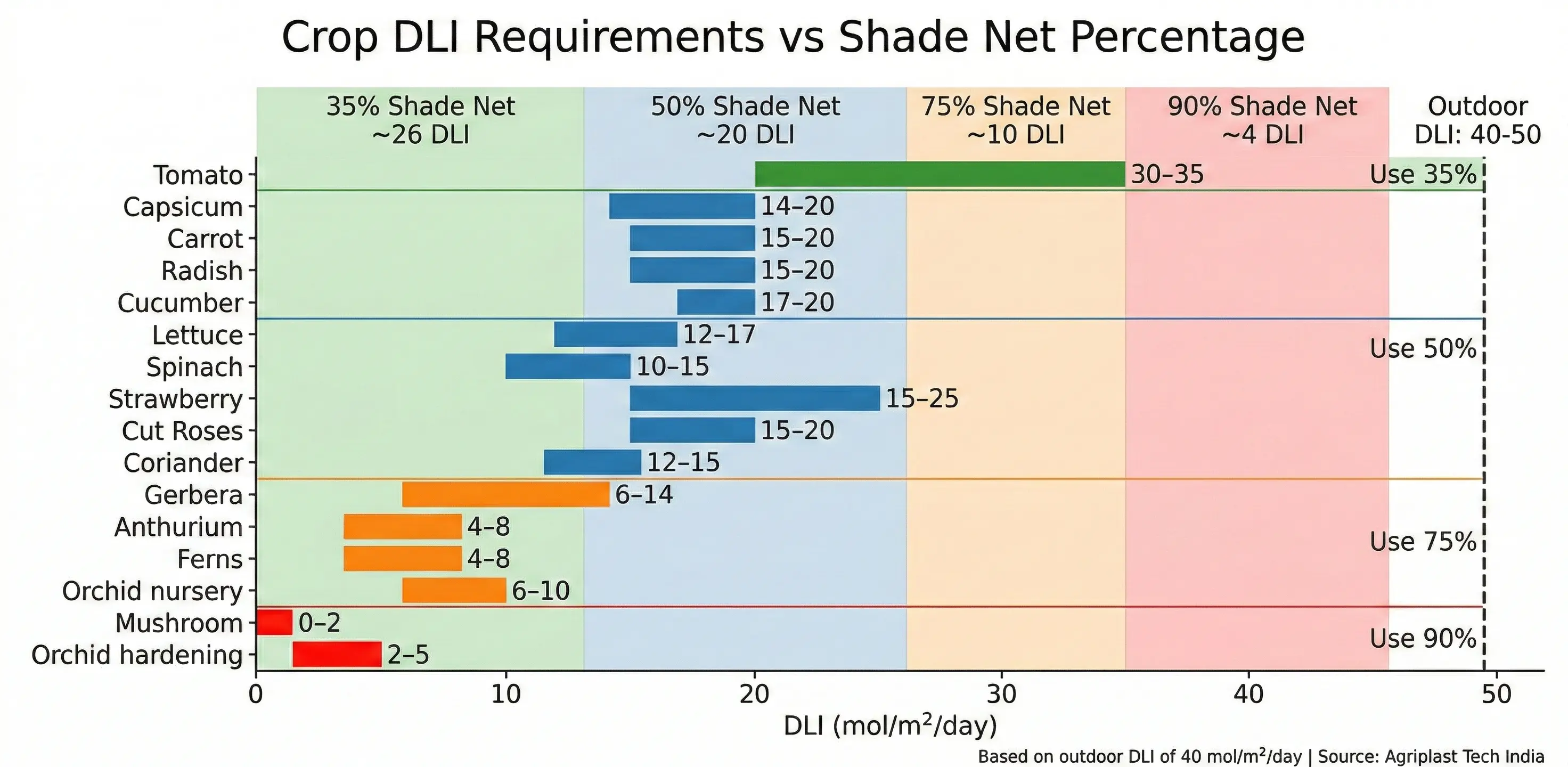
How different crops' daily light requirements (DLI) map against shade net percentages — use this chart to match your crop to the right shade level.
Shade Net Percentage Chart: 35%, 50%, 75%, and 90%
| Shade % | Tag | DLI Delivered | What It Does | Best For |
|---|---|---|---|---|
| 35% | Maximum Light, Minimum Protection | ~26 mol/m²/day | Blocks one-third of sunlight. Ideal for sun-loving crops needing protection only from peak midday radiation | Tomato (DLI: 30–35), capsicum (DLI: 14–20), open-field fruit vegetables, nursery-to-field transition |
| 50% | The Most Versatile Choice | ~20 mol/m²/day | India's most popular shade. Hits the sweet spot for a wide range of vegetables, flowers, and nursery operations | Cucumber (DLI: 17–20), lettuce & leafy greens (DLI: 12–17), nursery stage of most vegetables, strawberry (DLI: 15–25), cut roses (DLI: 15+) |
| 75% | For Shade-Loving Crops | ~10 mol/m²/day | Creates low-light conditions. Primarily for floriculture crops that evolved under forest canopies | Gerbera (DLI: 6–14), anthurium, foliage plants, fern cultivation, orchid nurseries, medicinal herb propagation |
| 90% | Near-Complete Shade | ~4 mol/m²/day | Blocks almost all sunlight. Used for infrastructure shading, not crop production | Orchid hardening houses, mushroom cultivation, livestock shade, composting areas, car parking |
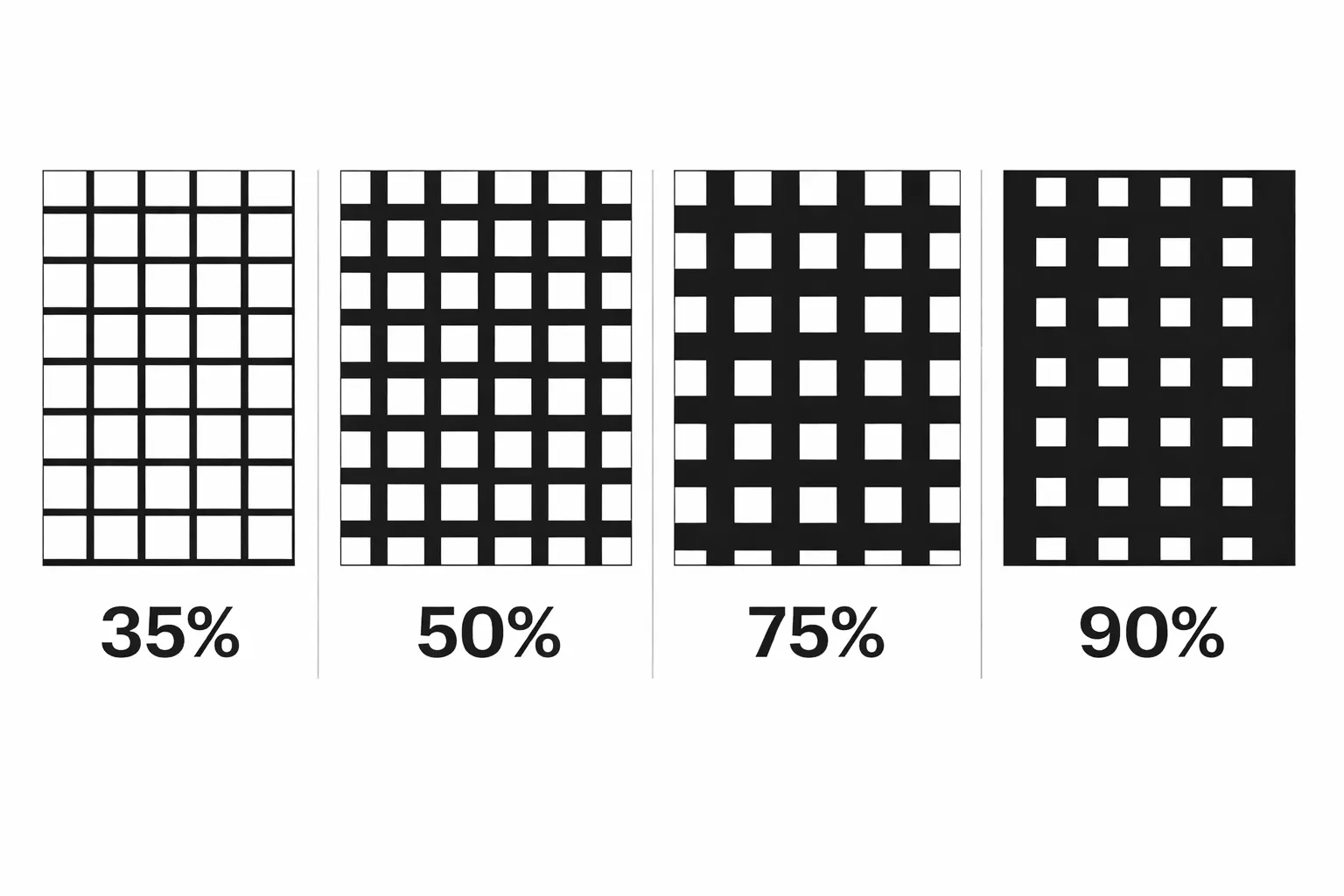
Visual comparison of shade net weave density from 35% (mostly open) to 90% (nearly solid) — the tighter the weave, the less sunlight reaches your crop canopy.
Which Shade Net Percentage Is Best for Vegetables in India?
| Vegetable | DLI Need (mol/m²/day) | Shade % | Summer Adjustment | Notes |
|---|---|---|---|---|
| Tomato | 30–35 | 35% | Stay at 35% | High light demand |
| Capsicum | 14–20 | 35–50% | 50% in peak summer | Heat-sensitive above 35°C |
| Cucumber | 17–20 | 50% | 50% year-round | Thrives in partial shade |
| Lettuce | 12–17 | 50% | 50–60% in extreme heat | Bolts in high light |
| Spinach | 10–15 | 50% | 50% | High light causes bitterness |
| Coriander | 12–15 | 50% | 50% | Bolts fast in full sun |
| Broccoli | 15–20 | 35–50% | 50% | Cool-season crop |
| Carrot | 15–20 | 35% | 35% | Good light aids root development |
| Radish | 15–20 | 35% | 35% | Needs light for bulb formation |
For most Indian vegetable farmers, 50% is the safest all-round choice. For tomatoes and capsicum, consider 35%. Refer to our shade net colour guide to understand how colour affects light quality beyond percentage.
Shade Net Percentage for Nurseries, Polyhouses, and Open Fields
Seedling Nurseries — Why 50–75% Works Best
Seedlings are highly sensitive to intense sunlight because their leaves have not yet developed the protective waxy cuticle found in mature plants. Most vegetable nurseries therefore use around 50% shade to prevent heat stress while allowing sufficient light for growth.
For floriculture seedlings such as gerbera plugs and orchid flasks, 75% shade nets are commonly used to maintain cooler, low-light conditions during early growth stages.
Polyhouse and Net House Shade Requirements
Polyhouse films typically transmit 80–90% of incoming sunlight, meaning crops inside already receive slightly less light than outdoors. When additional shading is required, growers install internal shade screens.
For example, if outdoor DLI is around 40 mol/m²/day, a polyhouse transmitting 85% of light delivers about 34 mol/m²/day inside. Adding a 35% shade screen reduces this to roughly 22 mol/m²/day, which is ideal for crops such as capsicum and cucumber.
In regions such as Chikkaballapur, Karnataka, many polyhouse growers use Aluminet reflective shade screens to reduce heat load. These screens can lower temperatures by 4–8°C by reflecting radiant heat, unlike conventional black shade nets that primarily absorb heat.
Browse Agriplast's shade net solutions, including Mono x Mono shade nets, which provide precise and consistent shade factor ratings.
Open Field — When to Use 35%
For open-field shade structures, 35% shade nets are the most common choice. The goal is not to create greenhouse conditions but to reduce extreme solar radiation during peak summer.
Many tomato and chilli farmers in Andhra Pradesh and Karnataka install temporary 35% shade structures during March–May to protect crops from heat stress. These structures are often removed during the monsoon when cloud cover naturally reduces sunlight.
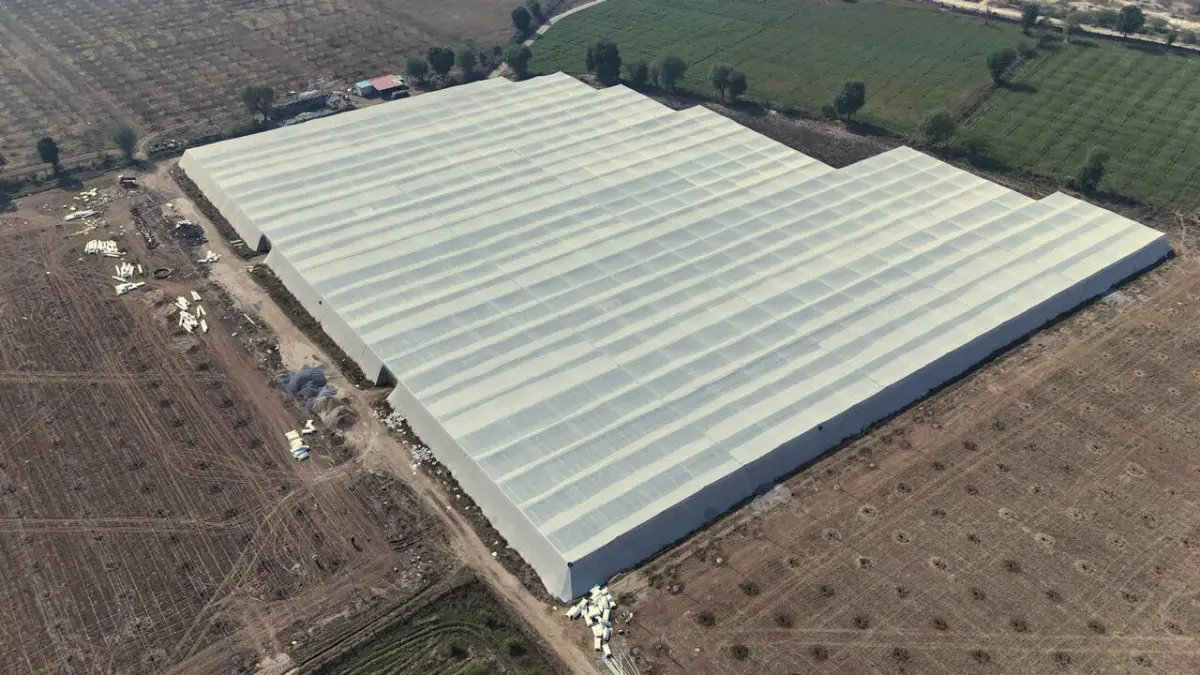
50% white shade net installed inside a net house — this setup is commonly used across Karnataka and Tamil Nadu for nurseries and leafy vegetable production during summer months.
🎥 Watch: How a Karnataka Farmer Grows Capsicum Under Shade Nets for Year-Round Profit
Hear directly from Ramachandra, a farmer from Mandya district in Karnataka with over 40 years of experience, as he explains how shade net cultivation transformed his capsicum, chilli, and jalapeno farming on 15 acres — enabling year-round production even during peak summer when open-field cultivation is not possible.
7 Signs Your Shade Net Percentage Is Wrong
Even with a shade net installed, incorrect light levels produce clear symptoms:
| Plant Symptom | Likely Problem | Solution | |
|---|---|---|---|
| ❗ | Tall, weak, leggy stems | Too much shade (low DLI) | Reduce shade % |
| ⚠ | Leaf burn or scorching | Too much light (high DLI) | Increase shade % |
| ❗ | Flower or fruit drop | Heat stress | Add or increase shading |
| ❗ | Unusually small leaves | Low photosynthesis | Reduce shade % |
| ❗ | Slow or stunted growth | Insufficient DLI | Switch to lower shade % |
| ⚠ | Wilting at midday despite watering | Excess solar radiation | Add shade |
| ❗ | Delayed flowering | Light imbalance | Adjust to crop's DLI range |
Common root causes: choosing shade based on dealer stock instead of crop need, using nursery-grade nets (50–75%) for mature field crops, ignoring that polyhouse film already blocks 20–30%, and confusing GSM with shade percentage. With Agriplast shade nets, shade percentage is clearly labelled on every variant.
Shade Net Calculator: Find Your Ideal Percentage in 3 Steps
Here's a simple 3-step method to calculate exactly which shade net percentage your crop needs:
Step 1 — Know Your Crop's DLI Requirement
Use the vegetable table above. Example: Capsicum needs 14–20 mol/m²/day.
Step 2 — Estimate Your Outdoor DLI
| Season | Approx. Outdoor DLI |
|---|---|
| Summer (March–June) | 40–50 mol/m²/day |
| Monsoon (July–Sept) | 20–30 mol/m²/day |
| Winter (Oct–Feb) | 25–35 mol/m²/day |
Step 3 — Calculate
Formula: Shade % needed = 1 − (Crop DLI ÷ Outdoor DLI)
Example 1: Capsicum needs 20 DLI. Summer outdoor = 40.
1 − (20 ÷ 40) = 0.50 → Use 50% shade net
Example 2: Tomato needs 30 DLI. Outdoor = 45.
1 − (30 ÷ 45) = 0.33 → Use 35% shade net
Try It Yourself — Interactive Shade Net Calculator
Select your crop, region, season, and polyhouse film — and we will recommend the right Agriplast shade net for you:
DLI data sourced from Michigan State University floriculture research, Purdue University extension, and NITI Aayog / Global Solar Atlas regional irradiance data for India.
Frequently Asked Questions
Agriplast Tech India Private Limited manufactures shade nets, greenhouse films, mulching films, and insect nets at India's largest protected cultivation factory. With 500+ projects across 15+ countries, Agriplast's technical team helps farmers match the right shade net specifications to their crop and climate conditions. Explore the full range at agriplast.co.in.
Blog written and Posted by
Abhinav Roy
Abhinav Roy is an agribusiness professional, agricultural communicator, and host of AgriTalk by Abhinav Roy. He works closely with farmers, agripreneurs, across India to simplify complex agricultural technologies into practical, field-ready insights. With hands-on exposure to protected cultivation, crop protection systems, and farm economics, Abhinav focuses on bridging the gap between science, sustainability, and scalable farming solutions.You can write your view/comments here
Need Expert Assistance?
Get personalized recommendations for your greenhouse, polyhouse, or irrigation needs.
-
Bengaluru (Corporate Office)
- 918141446666
- support@agriplast.co.in
WeWork Roshni Tech Hub - 1st floor, PFS Club House, Marathahalli Main Rd, R.J.Gardens, Lakshminarayana Pura, EPIP Zone, Chinnapanna Halli, Bengaluru, Karnataka 560037